Posted in nature

Lots of Fun Guys

The weather this year continues to be strange. Early October was relatively mild. Buddleias were still flowering and on the 7th, a very sunny day, I saw a Painted lady (Vanessa cardui), a few Red admirals (Vanessa atalanta) and many Comma (Polygonia c-album) butterflies visiting one, together with some Verbena bonariensis. There were lots of bees on these plants as well, along with lots of mining bee activity in lawns too.

Now, a month on, still milder than usual, the clocks have gone back and Samhain/ Halloween has passed. While the autumnal colour has been developing for a short while, leaves have only been falling in great numbers for the passed few weeks. Grass is still being mown although growth is slowing down.

It has been lovely watching the various birds visiting the Rowan tree (Sorbus) outside my flat. Alongside Redwings (Turdus iliacus) there have been a few Blackbirds (Turdus merula), Magpies (Pica pica) and many Starlings (Sturnus vulgaris) eating the berries.

I have also noticed a Winter flowering cherry (Prunus subhirtella Autumnalis) in bloom too. 

This small ornamental tree can continue flowering until February if the weather remains mild and gives a wonderful winter interest.

Fungi have been putting on a wonderful show over the past month; some providing a splash of colour to rival the leaves during this transitional period. I noticed Shaggy inkcaps (Coprinus comatus) in late October, followed by many others, including puffballs, Common bonnets (Mycena galericulata) as well as Scarlet waxcap (Hygrocybe coccinea) and Amethyst deceivers (Laccaria amethystina).

This aging Amethyst deceiver has lightened in colour.

The latter, as the common name suggests is a lovely purple colour that fades to lilac as it ages. The caps are typically 1.5 to 5 cm in diameter and height of stem 4-6 cm. This fungi has gills and is commonly found in broadleaf woodlands containing Beech (Fagus) and Oak (Quercus) between June and November. I noticed these under some Copper beech (Fagus sylvatica f. purpurea).

I also found a carpet of Scarlet waxcap on a lawn, unfortunately I didn’t manage to get a good photo of them. However, it was an amazing view, bright red caps with orange gills. Photographs and information on this fungi can be found on the Wild Food UK website here.

Posted in nature

Nature’s fireworks 🍁🍂

The temperature has fluctuated during the previous two weeks, with a few light frosts and hotter than average November days. Leaf fall is well under way now too keeping us busy at work. I never cease to be in awe of the beautiful leaf colours as the sun shines; They make fireworks look monochrome in comparison.

Fungi observations were still numerous. Here are some that I have seen over the past few weeks;

The Prince (Agaricus augustus)
Golden waxcap (Hygrocybe chlorophana)
Russula queletii
False saffron milkcap/ Orange milkcap (Lactarius deterrimus)

Amazingly I have still seen the occasional Buff-tailed bumblebee (Bombus terrestris) queen; plus the previous Friday I also noticed a Common carder bee (Bombus pascuorum) near a compost bin in one garden.

Common carder bee

The Rowan (Sorbus) berries on the tree outside my flat are almost gone, mostly due to a local flock of starlings (Sturnus vulgaris); however other visitors enjoying the bounty have been two Song thrushes (Turdus philomelos) and two blackbird (Turdus merula) couples.

I enjoy watching Starlings, seeing their shiny purple and green plumage and listening to their social interactions and mimicry. Starlings have a wide repertoire of calls because they imitate sounds, especially other bird calls (usually 15-20 distinctive sounds); even their murmurations are beautiful to watch.

Other birds visiting the tree, not interested in the berries, were a male and female Chaffinch (Fringilla coelebs), my family of Blue tits (Cyanistes caeruleus) along with a newcomer, a rather vocal Coal tit (Periparus ater). It was lovely to be able to hear a new call coming from the Rowan, it can be heard here (RSPB).

Posted in nature

A Snowy Adventure

The previous Sunday brought a little light relief as snow covered most of the UK. My childhood excitement of seeing the snow returned, so the days exercise was a walk through the local woodland park.

As I wondered past trees I began to notice odd glimpses of colour amongst the white and greys. Upon closer inspection I could see catkins already dangling along with female flowers ready to bloom on the Hazel (Corylus avellana) trees.

The male catkins are more showy than the tiny female flowers (which appear at the end of buds and harder to spot).
A very enlarged photo showing the red styles of the female flowers.

I also saw female flowers and cones on several Scots pine (Pinus sylvestris).

A closer view of the female flowers at the end of new shoots.

Surprisingly, given it was still snowing at the time, lots of birds were about too. I saw Redwing (Turdus iliacus), Blue tits (Cyanistes caeruleus), a small group of noisy Long tailed tits (Aegithalos caudatus) as well as a male Chaffinch (Fringilla coelebs) amongst the trees.

Redwings are migratory birds, from Iceland, Scandinavia and even Russia. Named after the red area under the wings, they can be seen in the UK between October and spring.

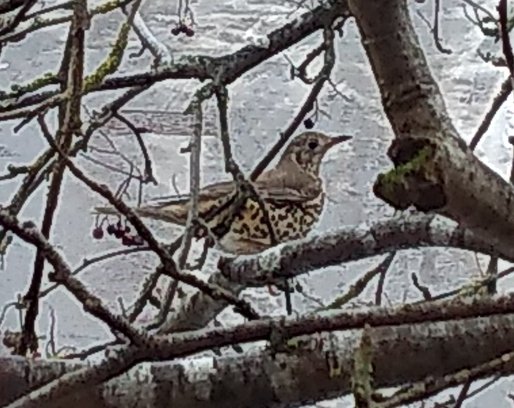
Throughout the week, as the snow slowly disappeared, I saw different birds visiting my Rowan (Sorbus) tree. I had never seen a Mistle thrush (Turdus viscivorus)

or male Chaffinch (Fringilla coelebs) visit the tree before.

Perhaps the reduced availability of food, during the snowy weather, made them search further afield than usual. Thankfully they found the remaining, mostly dried, berries on the Rowan tree outside my window.

Mistle thrush, so named because of their love of eating mistletoe (and guarding trees where it grows) also visit Rowan and Holly (Ilex) trees for their berries as well as eat worms, slugs and insects. They are larger and duller in colour than Song thrush (Turdus philomelos). Their spots are darker and rounder plus they have white tips to their tails. In fact they are larger than Blackbirds (unlike Song thrushes).

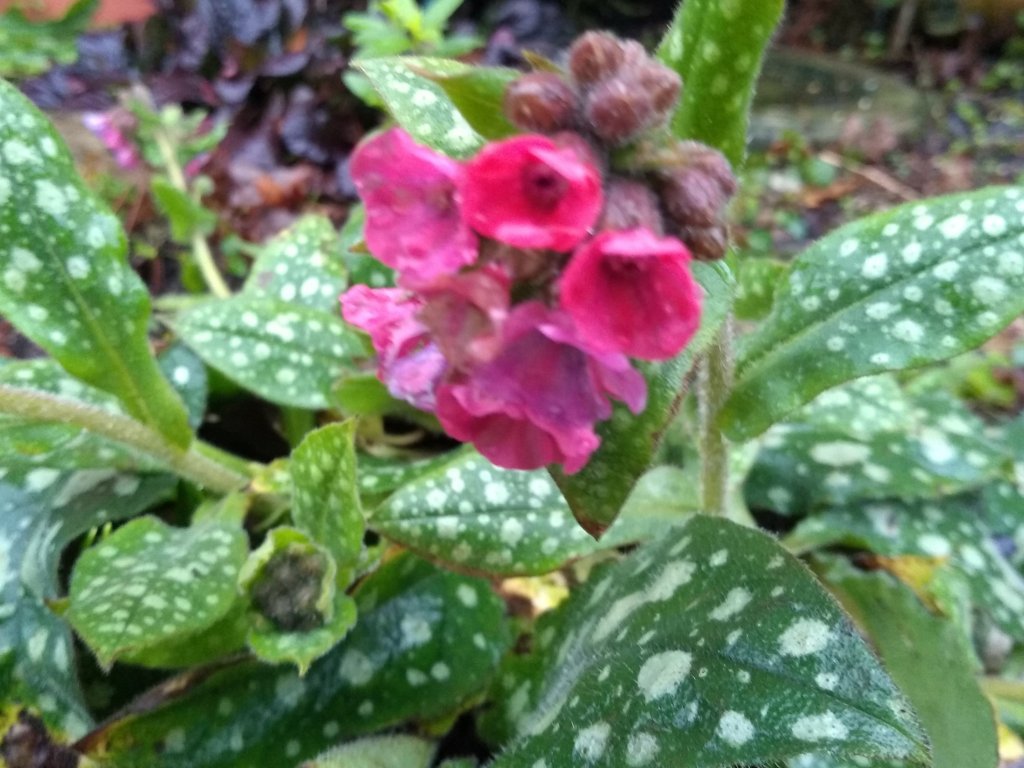
Wonderfully, there were even more flowers blooming in the garden too. I saw

Lungwort (Pulmonaria officinalis),

Crocus and

lots of Cyclamen.

Posted in Bookworm review

Solace in Nature

During a particularly difficult week, once again, nature has given me solace. I went on local walks for exercise as well as watch birds from my sofa, while they visited the Rowan tree (Sorbus) next to my flat. Several bird species visited even though it’s mostly stripped of berries now. I noticed bud development on the branches already too.

I have recently spent time catching up on some reading.
The first book I read was ‘Witch’s Garden’ by Sandra Lawrence.

This book contains botanical illustrations along with other pictures, including those of specimens from KEW. Folklore as well as natural medicinal properties of fifty well known plants are explored.

One of the plants written about is the Rowan tree. In the past it has been associated with fairies, the Norse God Thor, Goddesses Hebe and Brid as well as St Brigid.

Also known as the Witches tree, traditionally Rowans were believed to offer protection against evil. Other common names for them are Lady of the Mountain, Quicken tree, Wildwood, Whispering tree and probably the most well known Mountain ash. The latter name is due to its ability to thrive in high regions and a similarly in the leaves, however it isn’t actually an Ash (Fraxinus). In fact Rowans are part of the Rosaceae family alongside Apple trees (Malus) Roses (Rosa) and Hawthorn (Crataegus). Just as the haws of the Hawthorn and Rose hips contain vitamin C, Rowan berries are high in this vitamin too. Although all require cooking before they can be eaten they were traditionally used to treat scurvy, sore throats and other ailments, especially during the World War Two. 

The second book I read was ‘Back to Nature’ by Chris Packham and Megan McCubbin.

Containing personal stories and factual explanations, this book looks at the importance of nature for humans along with what actions can be undertaken to protect it.

I grew up avidly watching the Really Wild Show and love Springwatch and Autumnwatch. Part of my enjoyment of this book was ‘hearing’ Chris’ voice as I read the parts he’d written. His descriptions contain both urgency and hopefulness. He speaks about various topics from the importance of nature as therapy to wildlife issues that exist at this time.

He also mentions how during lockdown verges sprung into life as wildflowers were allowed to bloom, something that was great for pollinators. Chris talks about the worrying loss by 97% of wildflower meadows since the 1930s, attributing to a decrease in insect numbers. Therefore reversing this by councils allowing verges to grow is great. Yet, having a small wildflower patch in gardens is another achievable action that we can all undertake that will have a big impact on helping wildlife thrive.

Both books are great reads, they are informative and enjoyable; I highly recommend them both.

Posted in nature

A Rare Visit

Last Sunday five Greenfinch (Chloris chloris) came to visit the Rowan tree outside my flat. Seeing these lovely finches is a rare occurrence for me, I tend to hear their wheezy call rather than see them; although even this isn’t often. The Greenfinch call can be heard on the RSPB website.

Along with Chaffinch (Fringilla coelebs) the greatest decline in bird numbers over the years has been in Greenfinches; due to the parasite Trichomonas gallinae. This parasite was first recorded in the UK in 2005 and believed to be transmitted via bird saliva around food and water sources especially in gardens. Greenfinch are social birds that often rely on garden feeding stations and bird baths. It is incredibly important to keep on top of good hygiene around these areas, if you feed birds, in order to prevent the spread of this parasite. Clean bird feeders, tables and bird baths thoroughly each week and fill little and often is the best strategy to combat it’s spread. For further information see the BBC news report on the Trichomonas gallinae parasite.

On a more positive note from last week, it was lovely to hear the occasional gentle buzzing of a Buff-tailed bumblebee (Bombus terrestris) around Mahonia japonicas which are currently blooming; it is such a relaxing sound.

Unfortunately the bee was camera shy.

This plant is great for bumblebees and will flower well into spring. If like me, you prefer not to have spiky plants in your garden then there is a Mahonia for you. Mahonia eurybracteata subsp. ganpinensis ‘Soft Caress’ (see the RHS website) is smaller than Mahonia japonica and as the name suggests can be handled without risk of skin being punctured. Along with Heathers (see my post from 18th November this year What Present Would you Buy for Bees?) this plant is on my list of must buys.

Posted in nature

Birdwatching and Blooming Flowers

The annual Big Garden Birdwatch returned last weekend. As usual I took part on a Sunday morning. As with the previous year, there were lots of birds to see in my little patch, namely;

– 2 Blackbirds (Turdus merula)
– 3 Magpies (Pica pica)
– 7 Starlings (Sturnus vulgaris)
– 1 Robin (Erithacus rubecula)
– 1 Dunnock (Prunella modularis)
– 5 Blue Tits (Cyanistes caeruleus)
– 2 Great Tits (Parus major)
– 2 Wood Pigeons (Columba palumbus)
– 1 Carrion Crow (Corvus corone)
– 1 Ring necked parakeet (Psittacula krameri) and
– 3 Common Gulls (Larus canus)

There were a few changes to my 2019 list, the Dunnock, Ring necked parakeet and Common gulls were not visible during surveys before. Although I have noticed these birds in the area many times.

I enjoy purposely sitting for an hour on a Sunday morning observing birds, especially at this time of year. It is a lovely reminder that if you atune yourself to nature you will notice it even in the depths of winter.

One bird I have been hoping to see all winter were Redwings (Turdus iliacus). In previous years there have always been a few visitors to the Rowan (Sorbus) tree. However the berries were quickly eaten this Winter, which may explain why I haven’t seen any. Although perhaps they arrived when I wasn’t around to see them.

It was fantastic to witness more flowers popping up last week too, they were;

– Crocus vernus

-Anemone blanda

-Iris reticulata

– and Primroses (Primula vulgaris)

Spring really does feel as though it is around the corner now we have entered February.

Posted in nature

Sparkling Fireworks on a Damp and Windy Saturday

The autumnal weather remains mostly damp with brief glimpses of sunshine. Even Saturday was wet and blustery, so it was lovely to see fireworks from the comfort of my sofa. Although I worry about fireworks disturbing wildlife and pets, it is lovely to have light festivals to brighten the spirits once the clocks go back. At this time of year I try to find enjoyment in small things each day to counteract the gloom; the beauty of autumn helps this. My main obsession at the moment continues to be fungi. They are as difficult to identify as moths which adds to the fascination. As with the previous two weeks, I have discovered more fungi as I work.

*Once again, please do not use this post as a guide to edible mushrooms. I have managed to identify some but have placed question marks next to those I am unsure of.*

Last weeks finds were;

– The deceiver (Laccaria laccata)?

– Fried chicken mushrooms (Lyophyllum decastes)

– Suede bolete (Xerocomus subtomentosus)

– Common rustgill (Xerocomus subtomentosus)?

– Porcelain fungus (Oudemansiella mucida)

– Wood blewit (Lepista nuda)

– Shaggy scalycap (Pholiota squarrosa)

– Tawney funnel cup (Lepista flaccida)?

Fungi haven’t been the only things I noticed last week. On Monday I saw two Long-tailed tits (Aegithalos caudatus) in my neighbouring Rowan (Sorbus) tree. These social birds were eating insects and spiders alongside the regular Blue tit (Cyanistes caeruleus) and Coal tit (Periparus ater) visitors.

I was surprised to see a Tree bumblebee (Bombus hypnorum) last week. It was resting in the sunshine on Tuesday morning.

I usually see them between March and July so I relied on the Norfolk Wildlife Trust website to explain this sighting. New queens can be seen feeding through to October before hibernating until February; therefore it was a female bee I saw.

Another insect I saw last week was a Feathered thorn (Colotois pennaria) moth.

Due to the presence of the feathered antenna I was able to identify it as male. The caterpillars of this moth feed on various deciduous trees and shrubs with the moths appearing between September and November.

Posted in nature

More Fabulous Fungi

The autumn colours were glorious last week; particularly the Acers like the Acer dissectum below.

Another tree that I loved seeing was a Tulip tree (Liriodendron tulipfera).

This tree is so called because the flowers look similar to tulips. I have never noticed it flower but I will try to remember to keep an eye out for them next summer.

The recent wet weather has had opposite affects on wildlife. I haven’t seen many pollinators lately but have continued to see lots of fungi. Infact the timing of this wet weather has meant it’s been a bumper year for fungi.

The few pollinators that I have noticed include Common wasps (Vespula vulgaris) on some Ivy (Hedera helix) flowers

and one White tailed bumblebee (Bombus lucorum) on Monday.

I also saw a couple of moths at the end of the week too. The first one was a Winter moth (Operophtera brumata)

and the second one was a Scarce bordered straw (Helicoverpa armigera). The latter moth is a migrant visiting the UK.

I was a little surprised to see some Feverfew (Tanacetum parthenium) still flowering in one garden. I enjoy seeing this daisy like wild flower and like it’s common name Bachelor buttons.

The mushrooms I noticed last week were varied in size and colour.

*Once again, please do not use this post as a guide to edible mushrooms.*

I have managed to identify some but have placed question marks next to those I am unsure of.

The mushrooms I saw last week were;

– the Common puffball (Lycoperdon perlatum).

[The second photo was from a few days later. I noticed that they had matured, ready to release their spores].

-Orange Bonnet (Mycena acicula)

-Purple brittlegill (Russula atropurpurea)

-Turkey tail (Trametes versicolor)

-Lilac bonnet (Mycena pura)?

-Rosy bonnet (Mycena rosea)

-Milking bonnet (Mycena galopus)?

-Horse mushroom (Agaricus arvensis)?

-and Cortinarius umbrinolens?

The week ended with a brief visit from a Jay (Garrulus glandarius) to the Rowan tree outside my home. I can’t wait to see if I get Redwings (Turdus iliacus) visit soon as well. I usually have a few snacking on the berries each year; hopefully they come before all the berries disappear. The UK conservation status of this thrush is red so it’s always special to see them. Redwings look similar to thrushes but have a splash of red under their wings.

Posted in nature

What a Difference a Month Makes

A month ago I had a weeks holiday. Signs of autumn were beginning to mingle with late summer. Now October is here autumn has definitely arrived.

As I had another week off I decided to revisit my local park, observing changes from a month ago.

In September Roesel’s bush crickets (Metrioptera roeselii) were chirping everywhere, butterflies were flitting about and some flowers still bloomed amongst the meadow (see Relaxing into Autumn).

Upon my return last Tuesday the only sounds I heard were birds singing and the meadow area had been cut and baled. Cobwebs were visible in the long dew dampened grass around the edges of the woodland too.

Hawkweed, Ragwort (Jacobaea vulgaris), Red clover (Trifolium pratense) and Yarrow (Achillea millefolium) were only just flowering still while the Ivy (Hedera) was in full bloom.

Ivy is fantastic for pollinators at this of year. I saw a few hoverflies flying to and from several flowers but the Honey bees (Apis mellifera), that were still active from the nearby hives would probably visit them too.

It was lovely to see dried seedheads of Wild carrot (Daucus carota)

and Cow parsley (Anthriscus sylvestris)

as I wondered around the park. They look beautiful but they are useful for insects to shelter in as well. In fact I noticed a ladybird snuggling amongst one of the Cow parsley seedheads. I also discovered field mushrooms (Agaricus campestris) growing amongst the grass.

Trees and shrubs were starting to show autumnal colours along with their ripe fruits. I found elderberries, sloe as well as haws on the Hawthorn (Crataegus monogyna) alongside Rosehips. However there were no longer any blackberries left on the brambles.

I noticed the leaves of one Horse chestnut tree (Aesculus hippocastanum) affected by the Horse chestnut leaf miner (Cameraria ohridella) moth.

Similarly there was evidence of caterpillars (most likely another moth) having been on a Silver maple (Acer saccharinum) tree.

The eggs and excrement are still visible on the nibbled leaves.

I ended my weeks holiday with a visit the Horniman museum in London.

On route to the train station I saw a Brown rat (Rattus norvegicus) running across a path. It attempted to cross the road until either the traffic or pedestrians scared it into fleeing towards a nearby hedge. Once I arrived in London I realised that I never see rats in the underground any more. I used to enjoy seeing them scurrying between the tracks. I have owned pet rats for many years so I find wild rats intriguing. I also like to watch Squirrels as rodents tend to act in similar ways to one another. After lunch I observed two Grey Squirrels (Sciurus carolinensis) scamper about.

The nearest squirrel had an acorn in its mouth and appeared to bury it in different places. I once saw a television programme on squirrels in which one was observed ‘pretending’ to bury a nut in several places while in the presence of other squirrels to avoid their stash being taken. Presumably this was occurring with the squirrels I was watching on Friday.

There is a butterfly house and aquarium at the Horniman museum. The butterflies were looking a little aged with their wings rather worn, however they were still beautiful. As soon as I entered the butterfly house a Malachite butterfly (Siproeta stelenes) landed on me which felt wonderfully welcoming.

The photo below shows a selection of the many butterflies I saw.

Feeding on the fruit are one Blue morpho (Morpho peleides), one Brown clipper (Parthenos Sylvia philippinensis), two Blue clipper (Parthenos Sylvia) and three Owl butterflies (Caligo memnon).

There were lots to see in the aquarium as well but my favourites were the White spotted jellyfish (Phyllorhiza punctata); watching them was so relaxing.

Even at the weekend nature was visible. As I ate breakfast on Saturday morning I heard and watched a group of Coal tits (Periparus ater) on the Rowan tree (Sorbus aucuparia) outside. I have never seen Coal tits on this tree before, I hope to see them again.

Another animal I became aware of last week was a Red fox (Vulpes vulpes). I first noticed it on my way home on Wednesday night and again on Sunday morning. It was making itself known on Saturday night too as it was being very vocal.

Posted in nature

Cozy Evening Reflections

I am feeling cozy, sitting on the sofa, as I reflect on last weeks observations on a dark evening.

Along with the earlier sunsets, fresh mornings have begun to take hold too. I have been noticing a lot of changes occurring with trees throughout the week. Their leaves are turning autumnal and I have been able to pick fresh apples as I work. Lots of conkers are falling around the bus stop too.

One of the apple trees with lovely sweet apples is pictured below. There were other trees with Russet and Cox apples.

The Rowan tree outside my home continues to have Blue tits (Cyanistes caeruleus) feeding on insects. Plus I have also seen a Robin (Erithacus rubecula) and two Long tailed tits (Aegithalos caudatus) eating insects on it’s branches, along with a Blackbird (Turdus merula) feasting in the berries.

Mr Blackbird wasn’t camera shy.

I still saw Small white (Pieris rapae), Red admiral (Vanessa atalanta) and Painted lady (Vanessa cardui) butterflies as they took advantage of the late flowering perennials.

On Wednesday I noticed a Painted lady butterfly as well as a Common carder bee (Bombus pascuorum) visiting some Ceratostigma willmottianum which is still blooming while the leaves are turning red.

Some plants have been flowering all summer, such as Geraniums and Verbena bonariensis, and now bloom alongside Sedums, Asters and Autumn crocus (Colchicum autumnale) painting gardens in muted colours.

Sedums and Verbena bonariensis looking lovely amongst ornamental grasses.

Geranium still flowering.

A Painted lady butterfly collecting nectar from an Aster flower.

Autumn crocuses blooming in the lawn.

Cutting back faded perennials was one of last weeks jobs which meant I disturbed a lot of Seven-spot ladybirds (Coccinella septempunctata). So I spent quite a bit of time rescuing them from garden waste bins too.

Lastly, as I walked home late on Wednesday, I ended up seeing a beetle walking across the path in the moonlight and enjoyed the view of the Waxing gibbous moon amongst the clouds.