Posted in nature

Lots of Fun Guys

The weather this year continues to be strange. Early October was relatively mild. Buddleias were still flowering and on the 7th, a very sunny day, I saw a Painted lady (Vanessa cardui), a few Red admirals (Vanessa atalanta) and many Comma (Polygonia c-album) butterflies visiting one, together with some Verbena bonariensis. There were lots of bees on these plants as well, along with lots of mining bee activity in lawns too.

Now, a month on, still milder than usual, the clocks have gone back and Samhain/ Halloween has passed. While the autumnal colour has been developing for a short while, leaves have only been falling in great numbers for the passed few weeks. Grass is still being mown although growth is slowing down.

It has been lovely watching the various birds visiting the Rowan tree (Sorbus) outside my flat. Alongside Redwings (Turdus iliacus) there have been a few Blackbirds (Turdus merula), Magpies (Pica pica) and many Starlings (Sturnus vulgaris) eating the berries.

I have also noticed a Winter flowering cherry (Prunus subhirtella Autumnalis) in bloom too. 

This small ornamental tree can continue flowering until February if the weather remains mild and gives a wonderful winter interest.

Fungi have been putting on a wonderful show over the past month; some providing a splash of colour to rival the leaves during this transitional period. I noticed Shaggy inkcaps (Coprinus comatus) in late October, followed by many others, including puffballs, Common bonnets (Mycena galericulata) as well as Scarlet waxcap (Hygrocybe coccinea) and Amethyst deceivers (Laccaria amethystina).

This aging Amethyst deceiver has lightened in colour.

The latter, as the common name suggests is a lovely purple colour that fades to lilac as it ages. The caps are typically 1.5 to 5 cm in diameter and height of stem 4-6 cm. This fungi has gills and is commonly found in broadleaf woodlands containing Beech (Fagus) and Oak (Quercus) between June and November. I noticed these under some Copper beech (Fagus sylvatica f. purpurea).

I also found a carpet of Scarlet waxcap on a lawn, unfortunately I didn’t manage to get a good photo of them. However, it was an amazing view, bright red caps with orange gills. Photographs and information on this fungi can be found on the Wild Food UK website here.

Posted in Allotment, nature

March Arrives like a Lion

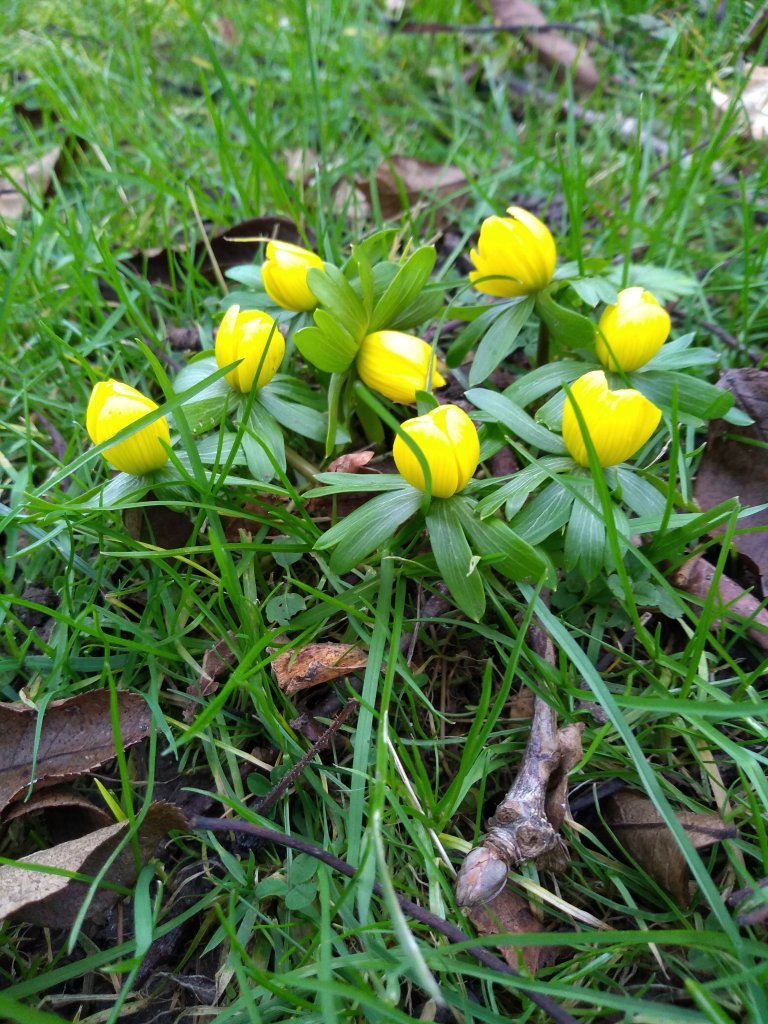
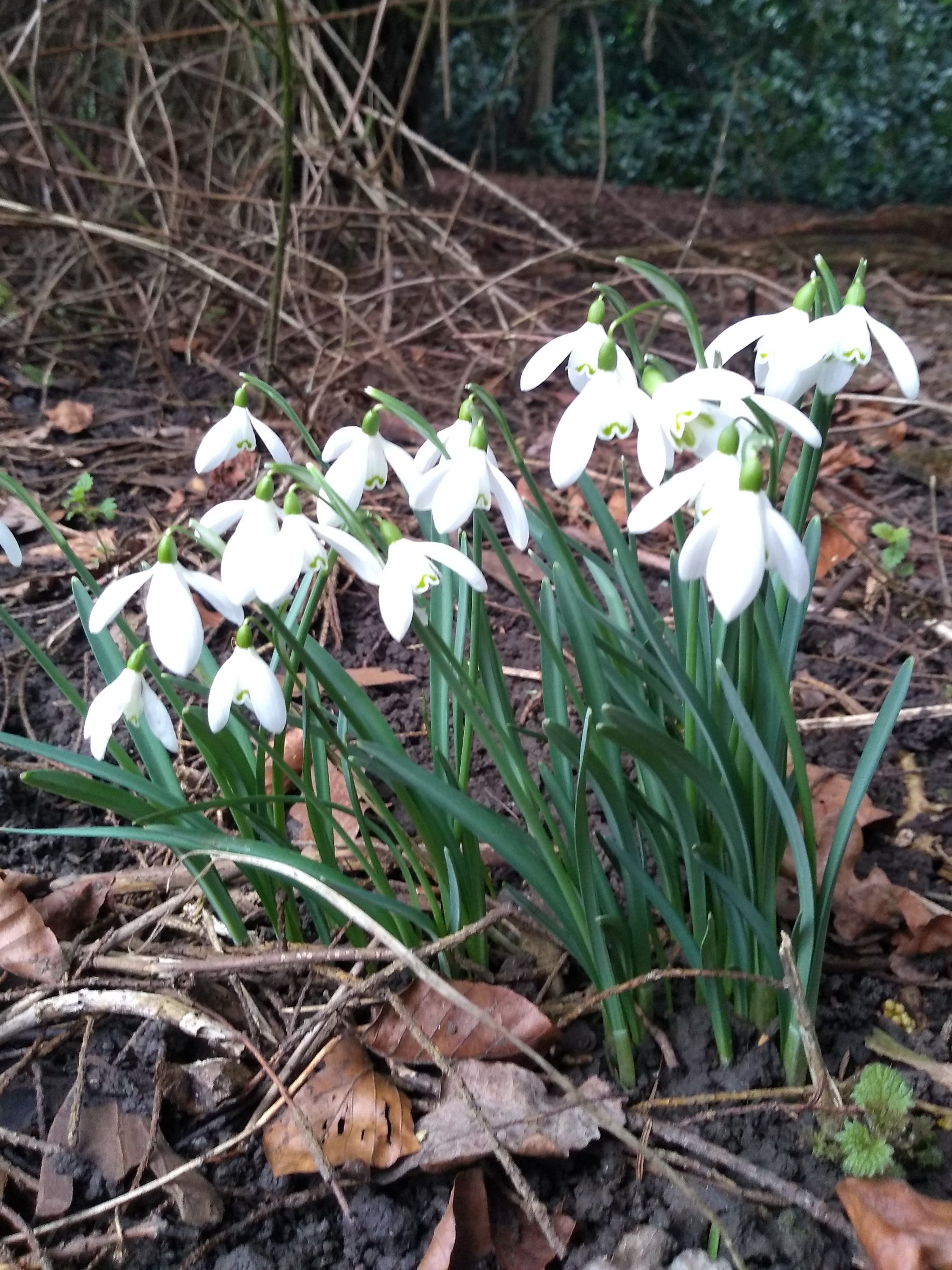
I’ve slowly started to emerge from hibernation now that Imbolc, the half way point between the Winter solstice and Spring equinox, (meaning ‘In the belly of the mother’- referring to the first stirrings of the years new growth) has passed; mirroring the snowdrops, winter aconites and hazel flowers (the first signs of the transition into the next season).

The scents of Daphne, Mahonia and Sarcococca fill the air alongside the arrival of other spring flowers; daffodils, cyclamen, crocus and hellebores. Willow (Salix) catkins are also opening while Blackthorn (Prunus spinosa) blossoms fill the roadsides with glorious white clouds.

Although it has still been too early for most allotment activities, the rhubarb has been emerging on the plot for the last month. I still haven’t cut back perennials as I want to allow cover for beneficial insects such as sheltering ladybirds (Coccinellidae) until the weather makes their survival easier. Instead February is mainly a month for planning the forthcoming years growing (thinking about chitting potatoes and planning seed sowing). One job I have begun however is the indoor Sweet pea and Chilli seed sowing. This small step gives me hope that I will soon be able to sow other seeds soon.

Although I am beginning to think ahead, I am still fondly holding on to snuggly sofa moments such as reading and partaking in arts and crafts, especially on wet days.

Through the winter I still immersed myself in nature. In January I pruned my apple tree on the allotment, blessing and giving thanks through Wassailing. Although symbolic, it was a nice way to feel deeply connected to the plot. I am grateful to be a guardian over it and receive the abundance of fruit, veg and flowers in return.

I saw quite a few foxes (Vulpes vulpes) over the winter too, including one on the allotment. It was such a beautiful moment to watch it foraging under trees.

Once again, I took part in the RSPB Big Garden Bird Watch in January. The list of birds I saw this time were;
4 Long-tailed tits (Aegithalos caudatus)
5 Starlings (Sturnus vulgaris)
1 Blackbird (Turdus merula)
3 Wood pigeons (Columba palumbus)
5 Sparrows (Passer domesticus)
2 Blue tits (Cyanistes caeruleus)
1 Greenfinch (Chloris chloris)
1 Great tit (Parus major)
6 Magpies (Pica pica)
1 Gull (Larinae) and
1 Red kite (Milvus milvus)

There is a small group of Ring-necked Parakeet (Psittacula krameri) that visit a nearby tree of late but frustratingly they didn’t show up during the observation hour.

During February, bird song continued to fill the skies, growing in frequency and volume. Also occasionally insects have boldly buzzed and fluttered about on the odd sunny days. Butterflies I noticed were a Brimstone (Gonepteryx rhamni) and Peacock (Aglais io); the latter I saved from an abandoned spider web.
I have also seen bees visiting mahonia, crocuses and hellebores, especially queen bumblebees.

Last week, I was excited to find some Jelly ear fungus (Auricularia auricula-judae) for the first time. They were growing on a Buddleia bush. Although this fungus is usually associated with elder (Sambucus) it can also be found on other hard woods like sycamore (Acer pseudoplatanus), ash (Fraxinus) and beech (Fagus) in damp shady conditions. Perhaps the fungus was thriving on the Buddleia, in the garden I visited, because of the recent weather as well as it being planted near a beech hedge.  Interestingly this fungus can continue to grow on dying wood that has been thawed, once frozen; hence it can survive really cold winters. The common name was given to this fungi because of how it looks and also its jelly-like texture.


Worryingly, it has been a very mild winter overall with lots of flooding occurring in Britain; certainly very different from last winter. So far the wet weather is continuing into March; hopefully the month will exit like a lamb and the roaring weather won’t continue too much in spring, as it will have an affect pollinators. We will have to see what the rest of 2024 has in store.

Posted in Bookworm review, nature

February Arrives

As another month rolls on, an initial glance may suggest that nothing is changing. Bare trees and quiet gardens with cold weather still nipping at fingertips and noses still persist, while sunny days bring glorious colourful skies.

A stripey sunset.

However, upon closer inspection small changes can be seen. The striking yellow of Winter aconites (Eranthis hyemalis) as well as delicate Early crocuses (Crocus tommasinianus) are beginning to bloom alongside the snowdrops (Galanthus).

The tiny red female flowers of Hazels (Corylus) have opened joining the male catkins. Plus, Blackthorn (Prunus spinosa) buds are ready to burst open (in fact on one walk, I saw a single flower already blooming).

I even witnessed a Red admiral (Vanessa atalanta) visit a flowering Mahonia on one sunny day; clearly making use of the milder weather before sheltering once again.

However the main focus of my attention, over the past few weeks, have been birds.

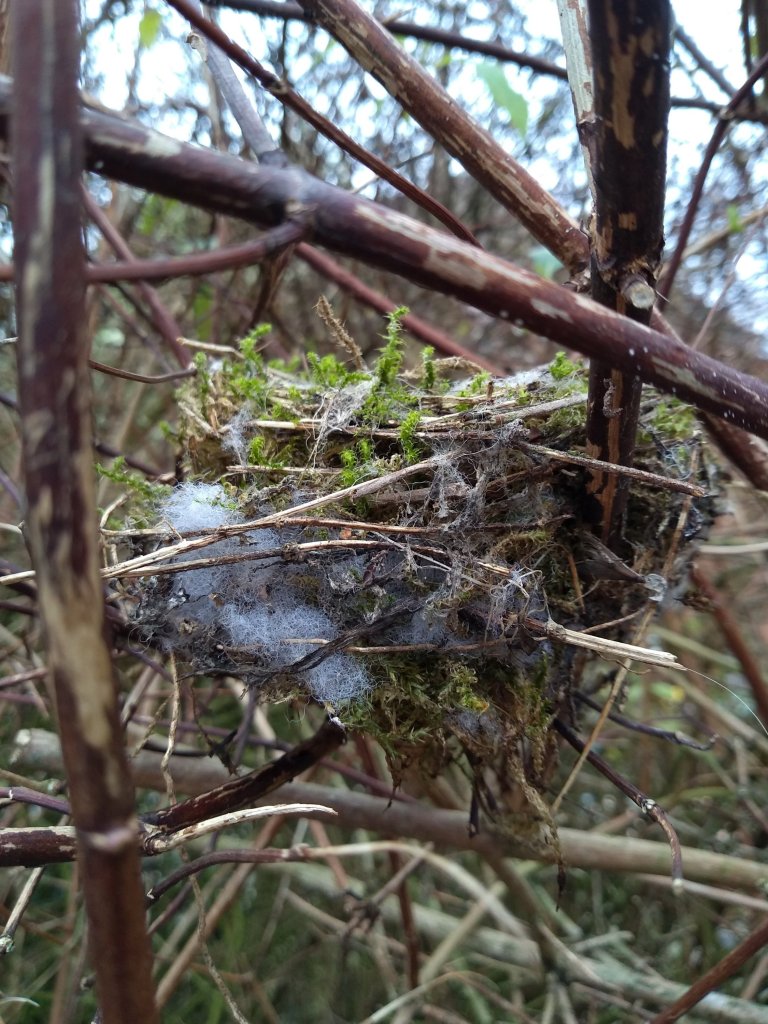
In one garden, I discovered a lovely little nest, from the previous year, in a shrub. Upon investigation I discovered it was either a Goldfinch (Carduelis carduelis) or Greenfinch (Chloris chloris) nest (most likely the former); it can be seen below.

I also saw a Lesser spotted woodpecker (Dendrocopos minor) perched on a tall tree in the distance. I was able to follow the sound of the drumming to watch it move around the trunk before flying off. Given the length of drumming and location of the red on it’s crown I was able to identify it as a male Lesser spotted woodpecker.

Then later in the week, while pruning roses, I watched a Wren (Troglodytes troglodytes) forage around the base of a hedge; I managed to film it briefly before it disappeared fully into the undergrowth.

I am currently reading ‘The Wren: A biography’ by Stephen Moss.

This charity shop find is a fascinating read. Chapters are set out month by month, each concentating on an aspect of a Wrens life. Included alongside facts about the Wren, are their involvement in human history, culture, literature, art and folklore together with beautiful illustrations. The chapter entitled February, for example, focuses on courtship and population. As with other books written by this author, such as ‘The Robin’, this book is definitely worth emmersing yourself in.

Lastly, once again I partook in the Big Garden Birdwatch. My results this year were-
7 Starlings (Sturnus vulgaris),
4 Magpies (Pica pica),
2 Bluetits (Cyanistes caeruleus),
2 Blackbirds (Turdus merula)- a male and female,
2 Wood pigeons (Columba palumbus),
1 Dunnock (Prunella modularis) as well as a Carrion crow (Corvus corone).

Although there weren’t any major surprises in what I saw, it was lovely that the Dunnock made an appearance (usually I only get to hear them). However the Red Kite (Milvus milvus), Ring-necked parakeets (Psittacula krameri), Great tit (Parus major) and Robin (Erithacus rubecula), that I regularly observe, all decided to have a lie in the previous weekend, most only making an appearance once my chosen hour had ended.

Posted in nature

Too hot to handle

Last Friday was a scorcher. Anything above 22 degrees celsius and I start to wilt, so the 37 degrees endured that day was certainly too much for me. According to the Met Office the warmest temperature on Friday was 37.8°C, the third hottest day on record in the UK. I am fairly sure the top two hottest days on record were also recorded in recent years, which make me wonder about their impact on wildlife.

On Friday I tried to work in the shade as much as possible, while remaining hydrated (cooling techniques also used by mammals and birds). Like humans a few animals perspire to cool their bodies, namely primates and horses. These mammals also pant to keep cool (enabling cooler air to replace the expelled hotter air). Other mammals and birds use this method as well. In fact on extremely hot days I have often observed Magpies (Pica Pica) and Corvids walk around with their beaks open.

One of the Jackdaws (Corvus monedula) panting to cool down during the hottest part of the day last Friday.

In the past, I have even witnessed Magpies lie forwards on the ground wings spread out, allowing colder temperatures to reach a greater surface area. Having access to water, especially on hot days, is also important. Along with drinking the water, it allows them to have a dip; fluffing up wet feathers to enable a breeze to cool them down.

It is important to leave fresh drinking water out for hedgehogs (Erinaceinae) too. Of course hedgehogs also wonder about in the evenings and night time when it’s generally cooler.

Unfortunately last week some negative news about hedgehogs was reported; they have been added to the Vulnerable to Extinction Red List of British mammals produced by the Mammal society (please read the report on their website).

These snuffling garden helpers need our help, whatever the weather. For information on how to help them check out the websites below

Hedgehog street

The British Hedgehog Preservation Society.

Lastly, I went to check on the European gypsy moth (Lymantria dispar) on the allotment at the weekend but there was no sign of it. Therefore I will assume it was a male moth and had flown away safely into the night.

Posted in nature

All Four Seasons in One Week

The weather during the second week of lockdown was mixed. It began with snow flurries and sleet but ended with the warmest day of the year so far.

I continued my daily exercise walks around my area and saw more wild flowers, trees, bees and birds enjoy Spring.

Plants that began to bloom last week were;

– Shepherd’s Purse (Capsella bursa-pastoris),

– Snake’s head fritillary (Fritillaria meleagris),

– Herb Robert (Geranium robertianum),

– Annual honesty (Lunaria annua),

– Common Groundsel (Senecio vulgaris)

– and Laurel (Prunus laurocerasus).

I also noticed my first Dandelion (Taraxacum officinale) clock of the year 

Water droplets can be seen as frost began to melt on this Dandelion clock. A flower head will produce an average of 180 seeds.

along with Horse chestnut (Aesculus hippocastanum) trees budding at this time too.

One particularly special moment occurred last Wednesday when I visited my local woodland park. I went for my exercise as early as possible so that I would avoid too many people. As I entered the park I heard a sound of my childhood, that of Skylarks (Alauda arvensis). I grew up surrounded by farmland, similar to where I live now, and Skylarks singing was familiar to me (see RSPB). 

I knew there were nesting Skylarks in this area because of a notice I saw last year (see my blog post Relaxing into Autumn). There were three Skylarks, two were clearly a pair. Occasionally the third bird would get too close to the other two; causing a noisy aerial display before they all returned to the open ground apart once again. I watched this happen four times as I carefully moved around them; maintaining a distance so that I wouldn’t disturb them unnecessarily. Seeing and hearing these lovely birds was a beautiful experience to witness.

On Friday, while at home, I heard a group of Magpies (Pica pica). They were making such a raucous noise that I looked outside to see what was occurring. I was fascinated to see one Magpie (which was trying to escape) pinned down and being pecked at by another one. As this occurred, four more Magpies kept flying in, occasionally taking part in the attack. Eventually the bird which was under attack escaped and forced by the group to fly away. I have witnessed birds defend territories before but not like that.

Another sound I became aware of later in the week, were Greenfinch (Carduelis chloris), (See RSPB). Although I heard their call, I was unable to see them. However I have observed a Great tit (Parus major) and Coal tit (Periparus ater) and several Blue tits (Cyanistes caeruleus) visit the Rowan (Sorbus) tree outside my flat.

Posted in nature

Birdwatching and Blooming Flowers

The annual Big Garden Birdwatch returned last weekend. As usual I took part on a Sunday morning. As with the previous year, there were lots of birds to see in my little patch, namely;

– 2 Blackbirds (Turdus merula)
– 3 Magpies (Pica pica)
– 7 Starlings (Sturnus vulgaris)
– 1 Robin (Erithacus rubecula)
– 1 Dunnock (Prunella modularis)
– 5 Blue Tits (Cyanistes caeruleus)
– 2 Great Tits (Parus major)
– 2 Wood Pigeons (Columba palumbus)
– 1 Carrion Crow (Corvus corone)
– 1 Ring necked parakeet (Psittacula krameri) and
– 3 Common Gulls (Larus canus)

There were a few changes to my 2019 list, the Dunnock, Ring necked parakeet and Common gulls were not visible during surveys before. Although I have noticed these birds in the area many times.

I enjoy purposely sitting for an hour on a Sunday morning observing birds, especially at this time of year. It is a lovely reminder that if you atune yourself to nature you will notice it even in the depths of winter.

One bird I have been hoping to see all winter were Redwings (Turdus iliacus). In previous years there have always been a few visitors to the Rowan (Sorbus) tree. However the berries were quickly eaten this Winter, which may explain why I haven’t seen any. Although perhaps they arrived when I wasn’t around to see them.

It was fantastic to witness more flowers popping up last week too, they were;

– Crocus vernus

-Anemone blanda

-Iris reticulata

– and Primroses (Primula vulgaris)

Spring really does feel as though it is around the corner now we have entered February.