Posted in nature

A Snowy Adventure

The previous Sunday brought a little light relief as snow covered most of the UK. My childhood excitement of seeing the snow returned, so the days exercise was a walk through the local woodland park.

As I wondered past trees I began to notice odd glimpses of colour amongst the white and greys. Upon closer inspection I could see catkins already dangling along with female flowers ready to bloom on the Hazel (Corylus avellana) trees.

The male catkins are more showy than the tiny female flowers (which appear at the end of buds and harder to spot).
A very enlarged photo showing the red styles of the female flowers.

I also saw female flowers and cones on several Scots pine (Pinus sylvestris).

A closer view of the female flowers at the end of new shoots.

Surprisingly, given it was still snowing at the time, lots of birds were about too. I saw Redwing (Turdus iliacus), Blue tits (Cyanistes caeruleus), a small group of noisy Long tailed tits (Aegithalos caudatus) as well as a male Chaffinch (Fringilla coelebs) amongst the trees.

Redwings are migratory birds, from Iceland, Scandinavia and even Russia. Named after the red area under the wings, they can be seen in the UK between October and spring.

Throughout the week, as the snow slowly disappeared, I saw different birds visiting my Rowan (Sorbus) tree. I had never seen a Mistle thrush (Turdus viscivorus)
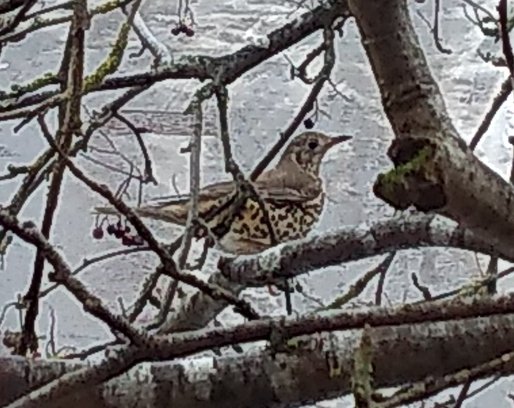
or male Chaffinch (Fringilla coelebs) visit the tree before.

Perhaps the reduced availability of food, during the snowy weather, made them search further afield than usual. Thankfully they found the remaining, mostly dried, berries on the Rowan tree outside my window.

Mistle thrush, so named because of their love of eating mistletoe (and guarding trees where it grows) also visit Rowan and Holly (Ilex) trees for their berries as well as eat worms, slugs and insects. They are larger and duller in colour than Song thrush (Turdus philomelos). Their spots are darker and rounder plus they have white tips to their tails. In fact they are larger than Blackbirds (unlike Song thrushes).

Wonderfully, there were even more flowers blooming in the garden too. I saw

Lungwort (Pulmonaria officinalis),
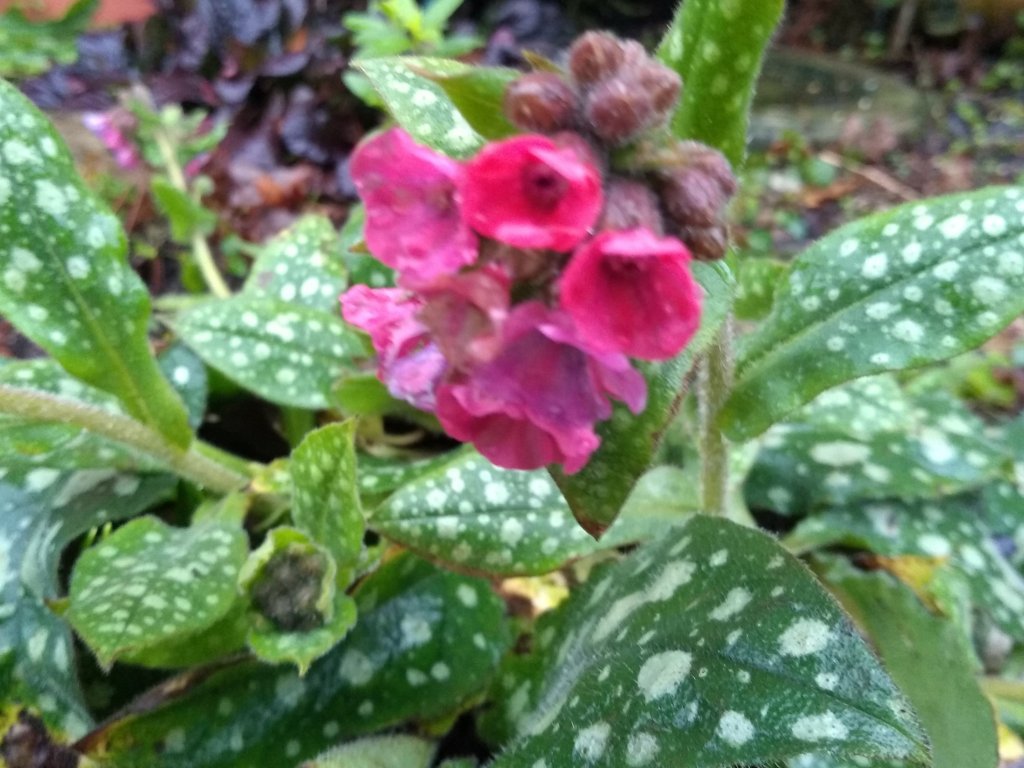
Crocus and

lots of Cyclamen.

Posted in nature

Garden Treasures

It feels like spiderweb season, the time when they become more prevalent, has arrived. I often get a face full of web when I accidentally walk into hidden ones as I work.

The spider’s web I come across most often is created by the European garden spider (Araneus diadematus). Also called the Diadem spider, Garden cross spider or Crowned orb weaver, due to the pattern on their abdomen and large circular webs they weave.

Males are 9mm in length, smaller than females (which grow to 15mm). Colouration can vary from light to dark brown and even burnt orange.

They are often found in gardens but also inhabit woodlands and meadows. The large orb webs (up to 40cms diameter) become more noticeable at this time of year in strong sunlight, due to the position of the sun, especially when glistening with dew in the mornings.

Those spiders which have survived summer will be mature adults now and start mating when autumn arrives. Males pluck the threads of the female’s web before he approaches, so he isn’t mistaken for food. However this tactic isn’t 100% successful as they can still become prey, even after mating. In late autumn a pregnant female will lay her eggs and spend every second protecting them until she eventually dies. Any adult spider still alive by November will succumb to cold weather.

The young spiderlings will survive winter inside a protective egg sac made of silk, to hatch in May the following year. Repeating the process of feeding on insects caught in webs (after being given a paralysing bite and wrapped in silk for later). They may not be the nation’s favourite garden helpers but they reduce pests and therefore should be treasured just like Ladybirds.

I also learnt a new plant last week. Standing out like a jewel amongst the other perennials was the beautiful Bog sage (Salvia uliginosa).

A Buff-tailed bumblebee (Bombus terrestris) visiting some Bog sage.

As it’s common name suggests this plant grows in damp areas. The one I saw was planted in a herbaceous border that used to be a pond which never completely dries out.

Originally from South American waterways (between Brazil to Argentina) this tall hardy perennial also requires a sunny position to survive. The beautiful blue flowers, loved by bees, bloom between August and October so this plant is a wonderful addition to gardens for extending the pollinating season.

Posted in nature

Further Easing into Summer

I am constantly amazed by the natural world. Last week I saw something that, as a gardener, I’m surprised I’ve never noticed before. A few White-tailed bumblebees (Bombus lucorum) flew to and from a nest in a wall, via the damp proofing brickwork, of an old house. What I wasn’t expecting to see were the blue pollen baskets.

I had never thought of pollen as anything other than varying shades of yellow. After researching this I found that different coloured pollen often shows up in nests and hives. Charts have been produced enabling beekeepers to identify which flowers their bees have visited by the colour and shade of the pollen found. The most likely candidates in this instance, given the time of year and dark blue shade, is Purple tansy (Phacelia tanacetifolia), see the North Shropshire Bee Keepers Association website.

Phacelia is loved by bees. These photos are from a neighbouring allotment plot.

As well as Phacelia other flowers currently blooming include;

– Hedge woundwort (Stachys sylvatica),

– Pineappleweed (Matricaria discoidea),

A close up view of Pineappleweed. When crushed, the flowers have a refreshing pineapple scent.

– Stinking iris also called Roast-beef plant (Iris foetidissima),

This plant has two colour variations. It thrives in shady areas.

– Scarlet pimpernel (Anagallis arvensis) and

– Pyramidal orchid (Anacamptis pyramidalis)

This orchid is attractive to butterflies and moths.

Birds are particularly noticeable at this time of year as they feed youngsters and defend territories. Last week I was able to listen to Song thrush (Turdus philomelos), Chiff chaff (Phylloscopus collybita), Robin (Erithacus rubecula) Great spotted woodpecker (Dendrocopos major) and Swifts (Apus apus).  I saw the Swifts’ arial display as they soared and dived in the distance while I ate lunch last Wednesday. They were too high and quick for me to identify visually but their vocalisations gave them away. The Swifts’ call can be heard on the RSPB website.

Ladybirds continued to show up last week, but mostly the Seven-spot ladybird (Coccinella septempunctata).

Eventually, the weather turned and rain finally arrived by Friday. It has been much needed and continued throughout the weekend. It was fantastic to watch thunder and lightening from the comfort of my sofa on Saturday afternoon.

Posted in nature

🎵The Heat Is On. 🎤 🎹🎷🎶


“Tell me can you feel it, tell me can you feel it, tell me can you feel it, the heat is on…”

The 80’s song from the Beverly Hills Cop soundtrack with Glenn Frey’s voice, synthesizer and saxophone was my earworm as the temperature soared last week. The temperature increased to around 27°C mid week, which meant lots more insects ventured out as it felt like summer.

I was happy to see my first Red admiral (Vanessa atalanta) butterfly of the year, however my main observations were bees including the Red-tailed bumblebee (Bombus lapidarius) and Honey bees (Apis mellifera).

A Red-tailed bumblebee pollinating some geranium.
Honey bees visited Nepeta.

Another bee I started seeing last week was the Tree bumblebee (Bombus hypnorum). I noticed a nest inside a compost bin as I emptied grass clippings from the mower bag.

I have seen Tree bumblebees nest in bird houses before but not under compost. I made sure I avoided tipping grass onto their home and used the next bin along. I couldn’t help watching them for a little while as I stopped for a breather on the very hot Wednesday.

Moths were prominent throughout the week too. Unfortunately Box tree moth (Cydalima perspectalis) caterpillars and the signs of heavy infestation (foliage that had been eaten and covered with webbing) was noticeably present in several gardens. Therefore, I spent lots of time picking them off buxus topiary and informing clients to keep an eye out for them as well. For more information on this pest see the RHS website.

I discovered this years first sighting of a Silver Y (Autographa gamma) moth.

A Silver Y moth resting on a Heuchera leaf.

This immigrant is one of the few brown moths I can identify easily, mostly due to the clear y markings on it’s forewings but also because of their size and shape. This is a day and night flying moth which can be observed visiting flowers to obtain nectar.

However my most exciting moth sighting was the Lime hawk-moth (Mimas tiliae).

This spectacular large moth is night flying. It’s wingspan is 4.6-7.8cms and it can be found in broadleaf woodland, parks and gardens between May and July. I accidentally disturbed it as I pruned some shrubs under a Lime (Tilia sp.) tree. Thankfully it didn’t seem bothered by the disruption and it was carefully placed back near the lime tree. While adult moths of this species don’t feed, the caterpillars do. Once they have emerged from overwintering pupa, the caterpillars will eat Lime, elms (Ulmus sp.), Alder (Alnus glutinosa), Downy Birch (Betula pubescens) and Silver Birch (Betula pendula), Plane (Platanus x hispanica) along with some Cherry cultivars. This was the first Hawk-moth I have ever seen. There are a few that exist in the UK. The nearest I came to seeing one before was observing caterpillars of the Elephant hawk-moth (Deilephila elpenor) eating away at some Fuchsia. For more information on these Hawk-moths see the Butterfly Conservation website (Lime hawk-moth and Elephant hawk-moth)

I also saw hoverflies. I am still learning about these insects and learnt another one last week.

The photo above shows a Narcissus bulb fly (Merodon equestris). The maggots eat away at the centre of bulbs from the Amaryllidaceae family. However even though the maggots are a pest, the adult hoverflies are pollinators.

Posted in nature

Ciara and Dennis Visited.

After Ciara’s departure, last weekend was another wild one with Dennis’s arrival. Thankfully, apart from a few blown down fence panels and trees there wasn’t much destruction in the gardens. Once again we got off lightly compared to some parts of the country. Since then, the weather has cooled down slightly and it has remained windy and wet with occasional sunshine. 


Despite the topsy turvy weather Forsythia

Strachey’s elephant’s ears (Bergenia stracheyi)

and Blackthorn (Prunus spinosa)

are flowering. Plus as I have traveled round I have noticed that in some places Dandelions (Taraxacum officinalis) and Common gorse (Ulex europaeus) have begun blooming too.  

Posted in nature

A Little Love on Valentine’s Day

Over the last few weeks I have noticed several bees motionless on the ground. Thankfully they were just resting so each time I carefully moved them to a nectar source. It is so lovely to see them hungrily lap it up, getting covered in pollen as they go. Just shows how important it is to grow late winter flowering plants for bees to visit. Yesterday I found another Buff-tailed Bumblebee in the same predicament. Showing love to that bee made my Valentine’s day. ♥️ 🐝🌸

Posted in nature

Birdwatching and Blooming Flowers

The annual Big Garden Birdwatch returned last weekend. As usual I took part on a Sunday morning. As with the previous year, there were lots of birds to see in my little patch, namely;

– 2 Blackbirds (Turdus merula)
– 3 Magpies (Pica pica)
– 7 Starlings (Sturnus vulgaris)
– 1 Robin (Erithacus rubecula)
– 1 Dunnock (Prunella modularis)
– 5 Blue Tits (Cyanistes caeruleus)
– 2 Great Tits (Parus major)
– 2 Wood Pigeons (Columba palumbus)
– 1 Carrion Crow (Corvus corone)
– 1 Ring necked parakeet (Psittacula krameri) and
– 3 Common Gulls (Larus canus)

There were a few changes to my 2019 list, the Dunnock, Ring necked parakeet and Common gulls were not visible during surveys before. Although I have noticed these birds in the area many times.

I enjoy purposely sitting for an hour on a Sunday morning observing birds, especially at this time of year. It is a lovely reminder that if you atune yourself to nature you will notice it even in the depths of winter.

One bird I have been hoping to see all winter were Redwings (Turdus iliacus). In previous years there have always been a few visitors to the Rowan (Sorbus) tree. However the berries were quickly eaten this Winter, which may explain why I haven’t seen any. Although perhaps they arrived when I wasn’t around to see them.

It was fantastic to witness more flowers popping up last week too, they were;

– Crocus vernus

-Anemone blanda

-Iris reticulata

– and Primroses (Primula vulgaris)

Spring really does feel as though it is around the corner now we have entered February.

Posted in nature

RHS Wisley; January 2020

I celebrated the start of a new year by visiting RHS Wisley. It was a lovely way to end my holiday, as I walked round the winter garden, knot garden, herbaceous borders, Enchanted Botanical Christmas in The Glasshouse and the evening event Glow 2019.

The Winter garden was full of life, colour and perfume. Some plants I noticed were:

Helleborus Walberton’s Rosemary = ‘Walhero’

Helleborus ‘Verboom Beauty’

Edgeworthia chrysantha ‘Red Dragon’

Cornus sanguinea ‘Anny’s Winter Orange’

Hamamelis × intermedia ‘Harry’

Pinus mugo ‘Winter Gold’

Iris lazica

Galanthus ‘Magnet’

Daphne bholua ‘Hazel Edwards’

Viburnum × bodnantense ‘Charles Lamont’

Erica carnea

Along with plants, there were some birds in the garden too. I saw Robins (Erithacus rubecula)

and a couple of Pied Wagtails (Motacilla alba).

Between the winter garden and herbaceous borders is the knot garden containing evergreen and deciduous shrubs as possible replacements for Buxus as topiary and small hedges (see below). The RHS are investigating alternatives to box because of the loss of Buxus through Box blight and Box tree Caterpillar.

I was also interested in seeing the herbaceous borders at RHS Wisley. Obviously the Perennials have died back by winters arrival but I was glad to see that they hadn’t been tidied or ‘put to bed’ . Instead, the perennials had been left for the insects and birds; to be cut back in spring. I think the borders looked beautiful and the seedheads very architectural.

Lastly I have included a couple of highlights from the glasshouse and glow exhibits.

Inside the glasshouse.

It was clear enough to see some stars and Venus.

Posted in nature

Leaves, Leaves and more Leaves

Leaf collection was the main job last week, especially on Wednesday through to Friday. It gets the heart pumping and is physically tiring so I definitely felt like I’d had a workout. There are still more leaves to fall so the process will be repeated for a few more weeks yet. At least it will be great for composts or as leaf mould, as well as my health.

One of my favourite trees is still holding onto its autumn colour.
The Maidenhair tree (Ginkgo biloba) pictured below in its glorious yellow hue.

The common name, Maidenhair tree, comes from the fan shaped leaves resembling the Maidenhair fern foliage. This national tree of China is also referred to as a living fossil. Fossils dating back to the Jurassic period have been found. It is the only remaining tree classified under the Ginkgophyta division (neither broadleaf nor conifer). This unique and beautiful tree is simply amazing.

Other plants giving interest at this time of year include
Clematis cirrhosis car purpurescens ‘Freckles’. The delicate drooping flowers appear between November and February. It is a lovely Clematis to grow over a walkway where the flowers can be appreciated from the side as well as underneath (where the freckle pattern hides).

As it flowers early in the year it is categorised as a pruning group 1 Clematis so doesn’t require regular pruning. However if you need to reduce its size then it can be pruned immediately after flowering finishes but when the risk of frosts have passed.

Viburnum tinus is also blooming now. The fragrant flowers will be around until April and followed by blueish black berries that are great for birds. This large shrub is evergreen too so it brings a welcome flourish of colour during the winter months.

Thankfully I managed to relax at the weekend after an exhausting week. I completed my handmade Christmas presents and cards, so I am ready for the festive season. As I sat crafting on the sofa I had a great view of my neighbouring Rowan (Sorbus) tree. The Starlings (Sturnus vulgaris) are getting through the berries quickly; I am not sure there will be any left for the Redwings (Turdus iliacus) when they finally arrive. I do like the iridescent nature of Starling plumage and their ability to mimic sounds so I quite like seeing them. I was excited to see another bird visit the Rowan; my first ever sighting of a Bullfinch (Pyrrhula pyrrhula). Due to the distance my attempt to photograph it isn’t brilliant but you can just about make out its colourful breast in the photo below.

The pinkish breast colouring means it was female (the males have red breasts). She was snacking on the Rowan berries but they also eat seeds, fruit tree buds and find insects for their young.

Other berries eaten by birds are those on the Pyracantha. This week I noticed that lots of Pyracantha plants were overladen with them. Its common name Firethorn is very appropriate and is given because of the heated, itchy reaction when the thorns pierce the skin. I can testify to this every time I have to cut it back.

I am still seeing fungus appearing in gardens too.

*Once again, please do not use this post as a guide to edible mushrooms.*

My latest find was the Pear-shaped or Stump puffball (Lycoperdon pyriforme).

This fungus grows on decaying wood and I found it in a stump.