Posted in nature

Nature’s fireworks 🍁🍂

The temperature has fluctuated during the previous two weeks, with a few light frosts and hotter than average November days. Leaf fall is well under way now too keeping us busy at work. I never cease to be in awe of the beautiful leaf colours as the sun shines; They make fireworks look monochrome in comparison.

Fungi observations were still numerous. Here are some that I have seen over the past few weeks;

The Prince (Agaricus augustus)
Golden waxcap (Hygrocybe chlorophana)
Russula queletii
False saffron milkcap/ Orange milkcap (Lactarius deterrimus)

Amazingly I have still seen the occasional Buff-tailed bumblebee (Bombus terrestris) queen; plus the previous Friday I also noticed a Common carder bee (Bombus pascuorum) near a compost bin in one garden.

Common carder bee

The Rowan (Sorbus) berries on the tree outside my flat are almost gone, mostly due to a local flock of starlings (Sturnus vulgaris); however other visitors enjoying the bounty have been two Song thrushes (Turdus philomelos) and two blackbird (Turdus merula) couples.

I enjoy watching Starlings, seeing their shiny purple and green plumage and listening to their social interactions and mimicry. Starlings have a wide repertoire of calls because they imitate sounds, especially other bird calls (usually 15-20 distinctive sounds); even their murmurations are beautiful to watch.

Other birds visiting the tree, not interested in the berries, were a male and female Chaffinch (Fringilla coelebs), my family of Blue tits (Cyanistes caeruleus) along with a newcomer, a rather vocal Coal tit (Periparus ater). It was lovely to be able to hear a new call coming from the Rowan, it can be heard here (RSPB).

Posted in Allotment, nature

Solace in Nature

It definitely feels like late summer now. Nights are noticeably drawing in, the sun is lower and my spidey senses have noticed a change in the air too.

The highlights of last week were seeing a Painted Lady (Vanessa cardui) on a Buddleja and noticing the harvests developing.

Autumn, my favourite season, is nearly here. The apples at the allotment are coming along nicely, almost ready to eat, along with the ripening blackberries. Plus hazelnuts and walnuts can be picked soon too.

Rowan berries have ripened now, their beautiful red colour showing through the green foliage. Last Thursday I noticed a female blackbird pick some before flying off with them.

It’s also been lovely to see my resident family of Blue tits on the Rowan tree (Sorbus), as I enjoy breakfast before my days work.

These small moments bring me so much joy and are a fantastic way to begin the day. I am grateful for natures restorative ability. Finding solace in it helps ground me while enabling me to remain in the moment and appreciate the small things. This time of year, when nature starts to slow down, also reminds me to take things more easily too. I do love this time of year. For me, the transition into Autumn, is a time of contemplation and preparation for the future.

Posted in Allotment, nature

Witnessing the Solstice Dawn Arrive

On the eve of the Summer solstice I love to go to sleep early with my curtains open so I can wake up naturally and see the sunrise; it helps me align with the seasons and appreciate nature in a different way. This year I awoke at 3:50am and immediately opened the window so I could enjoy the dawn chorus. Initially the predominant birdsong was that of Blackbirds (Turdus merula), occasionally punctuated by the calls from a Wood pigeon (Columba palumbus), a murder of very vocal Carrion crows (Corvus corone), along with a male Pheasant (Phasianus colchicus) in the distance too. The crescendo came around 4:10am but it wasn’t until finally at 4:42am, when things had quietened, that I heard a few more birds singing. There was a lone Dunnock (Prunella modularis) and then a Greenfinch (Chloris chloris) at about 4:50am; followed much later by Blue tits (Cyanistes caeruleus) which I observed in the Rowan (Sorbus) tree nearby.

It’s interesting to notice an order to the bird song. Blackbirds are the first to be heard, almost like they are an alarm call for the other songbirds; clearly eager to catch the worms.

I also learnt another birdsong last week, heard around midday on Thursday. Hidden somewhere amongst the treeline next to a field, was a Common Whitethroat (Curruca communis); the song can be heard here on the RSPB website.

This warbler visits the UK from Southern Africa (from countries south of the Sahara) between April and October. Once the males arrive on these shores, they will establish territories and build nests for prospective partners (approximately ten to fourteen days before the females arrive).

These birds are about the same size as Great tits (Parus major) and named after the white plumage on their throats. Males can be differentiated from female due to their grey heads. They feed on insects as well as fruit and berries later in the year.

After being concerned that I wasn’t seeing many butterflies and ladybirds the previous week, last week
it finally became warm and sunny enough for them to venture out once again. It was lovely to witness a couple of Small tortoisehell butterflies (Aglais urticae) along with some bumblebees visit a Scabious plant in one garden.

Plus there was a loveliness of Seven-spot ladybirds (Coccinella septempunctata) at the allotment, hunting down on all the aphids which also appeared.

Posted in nature

A Snowy Adventure

The previous Sunday brought a little light relief as snow covered most of the UK. My childhood excitement of seeing the snow returned, so the days exercise was a walk through the local woodland park.

As I wondered past trees I began to notice odd glimpses of colour amongst the white and greys. Upon closer inspection I could see catkins already dangling along with female flowers ready to bloom on the Hazel (Corylus avellana) trees.

The male catkins are more showy than the tiny female flowers (which appear at the end of buds and harder to spot).
A very enlarged photo showing the red styles of the female flowers.

I also saw female flowers and cones on several Scots pine (Pinus sylvestris).

A closer view of the female flowers at the end of new shoots.

Surprisingly, given it was still snowing at the time, lots of birds were about too. I saw Redwing (Turdus iliacus), Blue tits (Cyanistes caeruleus), a small group of noisy Long tailed tits (Aegithalos caudatus) as well as a male Chaffinch (Fringilla coelebs) amongst the trees.

Redwings are migratory birds, from Iceland, Scandinavia and even Russia. Named after the red area under the wings, they can be seen in the UK between October and spring.

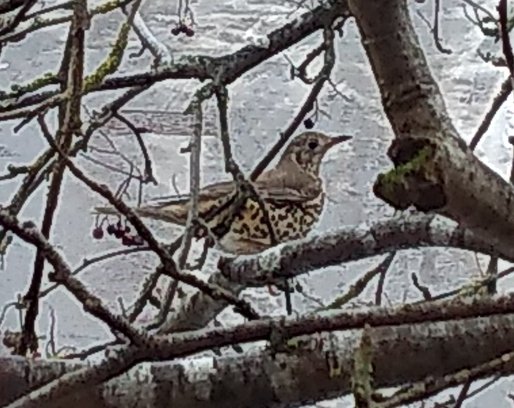
Throughout the week, as the snow slowly disappeared, I saw different birds visiting my Rowan (Sorbus) tree. I had never seen a Mistle thrush (Turdus viscivorus)

or male Chaffinch (Fringilla coelebs) visit the tree before.

Perhaps the reduced availability of food, during the snowy weather, made them search further afield than usual. Thankfully they found the remaining, mostly dried, berries on the Rowan tree outside my window.

Mistle thrush, so named because of their love of eating mistletoe (and guarding trees where it grows) also visit Rowan and Holly (Ilex) trees for their berries as well as eat worms, slugs and insects. They are larger and duller in colour than Song thrush (Turdus philomelos). Their spots are darker and rounder plus they have white tips to their tails. In fact they are larger than Blackbirds (unlike Song thrushes).

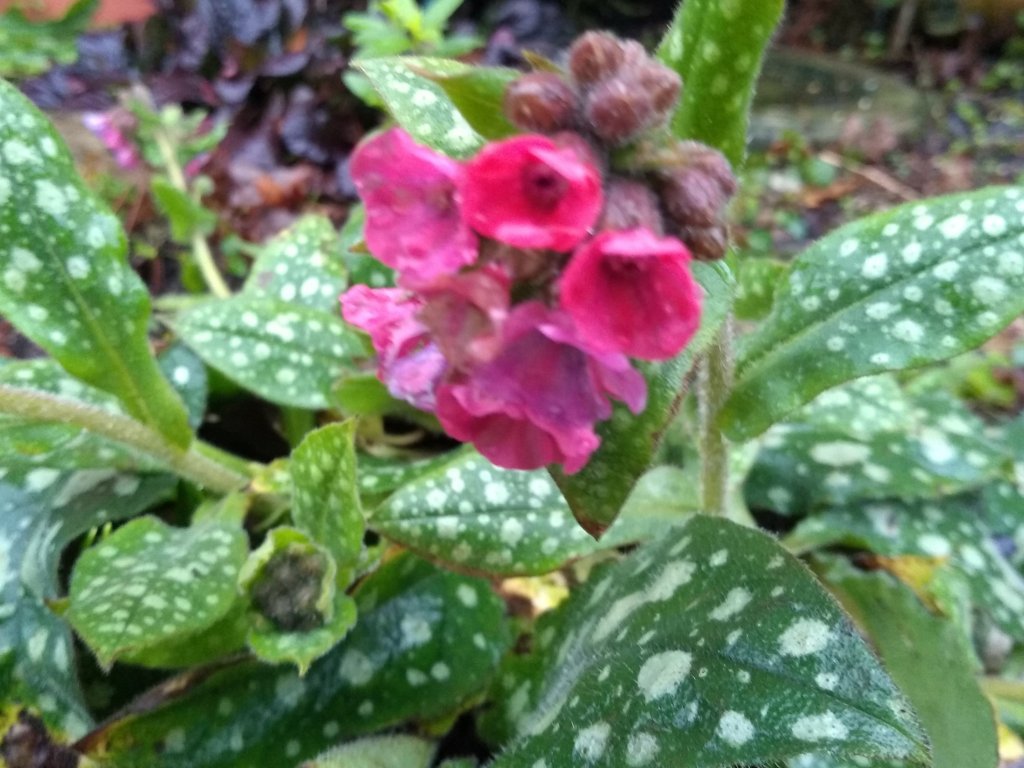
Wonderfully, there were even more flowers blooming in the garden too. I saw

Lungwort (Pulmonaria officinalis),

Crocus and

lots of Cyclamen.

Posted in nature

Small Body, Big Voice

Once again, watching birds on my local Rowan tree has become my therapy as I remain inside more.

Last week, along with the usual suspects of Blue tits (Cyanistes caeruleus), Starlings (Sturnus vulgaris), a Robin (Erithacus rubecula) and Blackbird (Turdus merula) was a Song thrush (Turdus philomelos) feasting on some berries as well as a female Chaffinch (Fringilla coelebs) making a pit stop.

Another bird I noticed last week, while working in one garden, was a Wren (Troglodytes troglodytes). I followed a loud bird call towards a hedgerow where I managed to discover this distinctive small bird. It was wonderful being able to connect the call to a Wren; partly because I didn’t recognise the call but mainly because I got to see a Wren (highly unusual in itself, as they often hide themselves away). I wasn’t sure why it was emitting an alarm call, possibly a cat was on the other side of the hedge, hopefully I wasn’t the reason. Almost as soon I saw the Wren it disappeared further into the hedge; my fleeting glimpse ended. The Wren alarm call can be heard on the following link British birdsong.

Posted in nature

All Four Seasons in One Week

The weather during the second week of lockdown was mixed. It began with snow flurries and sleet but ended with the warmest day of the year so far.

I continued my daily exercise walks around my area and saw more wild flowers, trees, bees and birds enjoy Spring.

Plants that began to bloom last week were;

– Shepherd’s Purse (Capsella bursa-pastoris),

– Snake’s head fritillary (Fritillaria meleagris),

– Herb Robert (Geranium robertianum),

– Annual honesty (Lunaria annua),

– Common Groundsel (Senecio vulgaris)

– and Laurel (Prunus laurocerasus).

I also noticed my first Dandelion (Taraxacum officinale) clock of the year 

Water droplets can be seen as frost began to melt on this Dandelion clock. A flower head will produce an average of 180 seeds.

along with Horse chestnut (Aesculus hippocastanum) trees budding at this time too.

One particularly special moment occurred last Wednesday when I visited my local woodland park. I went for my exercise as early as possible so that I would avoid too many people. As I entered the park I heard a sound of my childhood, that of Skylarks (Alauda arvensis). I grew up surrounded by farmland, similar to where I live now, and Skylarks singing was familiar to me (see RSPB). 

I knew there were nesting Skylarks in this area because of a notice I saw last year (see my blog post Relaxing into Autumn). There were three Skylarks, two were clearly a pair. Occasionally the third bird would get too close to the other two; causing a noisy aerial display before they all returned to the open ground apart once again. I watched this happen four times as I carefully moved around them; maintaining a distance so that I wouldn’t disturb them unnecessarily. Seeing and hearing these lovely birds was a beautiful experience to witness.

On Friday, while at home, I heard a group of Magpies (Pica pica). They were making such a raucous noise that I looked outside to see what was occurring. I was fascinated to see one Magpie (which was trying to escape) pinned down and being pecked at by another one. As this occurred, four more Magpies kept flying in, occasionally taking part in the attack. Eventually the bird which was under attack escaped and forced by the group to fly away. I have witnessed birds defend territories before but not like that.

Another sound I became aware of later in the week, were Greenfinch (Carduelis chloris), (See RSPB). Although I heard their call, I was unable to see them. However I have observed a Great tit (Parus major) and Coal tit (Periparus ater) and several Blue tits (Cyanistes caeruleus) visit the Rowan (Sorbus) tree outside my flat.

Posted in nature

Birdwatching and Blooming Flowers

The annual Big Garden Birdwatch returned last weekend. As usual I took part on a Sunday morning. As with the previous year, there were lots of birds to see in my little patch, namely;

– 2 Blackbirds (Turdus merula)
– 3 Magpies (Pica pica)
– 7 Starlings (Sturnus vulgaris)
– 1 Robin (Erithacus rubecula)
– 1 Dunnock (Prunella modularis)
– 5 Blue Tits (Cyanistes caeruleus)
– 2 Great Tits (Parus major)
– 2 Wood Pigeons (Columba palumbus)
– 1 Carrion Crow (Corvus corone)
– 1 Ring necked parakeet (Psittacula krameri) and
– 3 Common Gulls (Larus canus)

There were a few changes to my 2019 list, the Dunnock, Ring necked parakeet and Common gulls were not visible during surveys before. Although I have noticed these birds in the area many times.

I enjoy purposely sitting for an hour on a Sunday morning observing birds, especially at this time of year. It is a lovely reminder that if you atune yourself to nature you will notice it even in the depths of winter.

One bird I have been hoping to see all winter were Redwings (Turdus iliacus). In previous years there have always been a few visitors to the Rowan (Sorbus) tree. However the berries were quickly eaten this Winter, which may explain why I haven’t seen any. Although perhaps they arrived when I wasn’t around to see them.

It was fantastic to witness more flowers popping up last week too, they were;

– Crocus vernus

-Anemone blanda

-Iris reticulata

– and Primroses (Primula vulgaris)

Spring really does feel as though it is around the corner now we have entered February.

Posted in nature

One Day of Christmas

Having time off has allowed me to catch up on some reading, listening to the birds as I do so. In the mornings I usually notice Blue tits (Cyanistes caeruleus), Great tits, (Parus major), Robin (Erithacus rubecula), Blackbird (Turdus merula) and Magpie (Pica pica) until eventually a Pigeon (Columba palumbus) wakes up and joins in with the chorus. Although it has been nice to relax, it isn’t long before cabin fever kicks in and I need to be outdoors.

As I went for a walk last week, my mood was elevated. I noticed a red-legged partridge (Alectoris rufa) pecking at food along a path.

For a ground dwelling bird, that prefers to run than fly (in short bursts) when danger is near, it was no surprise that it wasn’t in a pear tree. However seeing this bird did feel appropriately festive.

I also saw some Winter jasmine (Jasminum sieboldianum) blooming; bringing a welcome burst of yellow at this time of year.

Upon my return home I caught the lovely sweet scent Sarcococca confusa too.

The small flowers are insignificant amongst the evergreen foliage but they have an intoxicating aroma that I love. I hope the birds find the black berries to eat.

My other winter flowering plants blooming at the moment are;

Sarcococca hookeriana

– and Witch hazel ‘Diane’

(Hamamelis × intermedia ‘Diane’)

Both of these plants are fragrant too but their scent is more subtle than that of the Sarcococca confusa.

I enjoy the transition between years. I don’t make resolutions but I love the positive feeling of renewal and freshness that occurs at New Year.

I also like to reflect on the previous twelve months. The highlight (rather predictably) was catching sight of some Painted lady butterflies (Vanessa cardui) after they migrated in large numbers to this shore in the summer.

I have learnt so much about the wildlife that I’ve seen as I have written my blog; it has been a very enjoyable experience. I am grateful for those of you who follow my discoveries, thank you for taking an interest in my ramblings

Best wishes for 2020!

🐝

Posted in nature

Growing Food for Birds

I saw contrasting images last week which made me think of feeding birds with plants from the garden.
I first observed the Rowan (Sorbus) tree outside, now stripped bare of it’s berries, before noticing some Cotoneaster

and Ivy (Hedera) full of berries. Clearly the pollinators had been busy during the Summer and Autumn months.

Along with supplementary food, on the ground and bird feeders, birds can also rely on trees and other plants in the garden for food in winter. Along with the examples already mentioned there are other berries, fruit, seeds and nuts which are enjoyed by birds.

Some other plants providing fruit and berries are;
Hawthorn (Crataegus)
Honeysuckle (Lonicera)
Guelder rose (Viburnum opulus)
Dog rose (Rosa canina)
Berberis
Bird cherry (Prunus padus)
Crab apple (Malus sylvestris)
Blackthorn (Prunus spinosa)
Pyracantha
Sarcococca hookeriana
Mahonia

Plants providing seeds and nuts include;
Oak (Quercus)
Beech (Fagus)
Hazel (Corylus)
Spindle (Euonymus europaeus)
Teasel (Dipsacus)
Sunflower (Helianthus)
Miscanthus
Bergamot (Monarda)
Verbena bonariensis
Lavender (Lavandula)
Yarrow (Achillea millefolium)
Asters

Leaving seedheads on perennials not only provides food for birds, they also give shelter to beneficial insects. In fact a little bit of leaf litter also has this affect which in turn helps feed birds who eat the insects.

Common birds to see in winter include;
Redwings (Turdus iliacus)
Waxwings (Bombycilla)
Starlings (Sturnidae
Blackbirds (Turdus merula
Robins (Erithacus rubecula
Chaffinches (Fringilla coelebs)
Bramblings (Fringilla)
Goldfinches (Carduelis carduelis)
Bullfinches (Pyrrhula pyrrhula)
Dunnocks (Prunella modularis)
Goldcrests (Regulus regulus)
Blue tits (Cyanistes caeruleus)
Long-tailed tits (Aegithalos caudatus)
Coal tits (Periparus ater)
Great tits (Parus major)
Fieldfares (Turdus pilaris)

The RSPB Big Garden Birdwatch, which takes place on the 25-27th Jan 2020, has been going for over 40 years. Surveying birds visiting your Garden or local park for one hour is calming and enjoyable. This citizen science continues to give the charity useful information on the numbers of birds in the UK.

Further information on feeding birds can be found in the book, ‘RSPB Pocket Bird Feeder Guide’ by Robert Burton (published by Dorking Kindersley) or on the Gardeners World website.

Posted in nature

Sparkling Fireworks on a Damp and Windy Saturday

The autumnal weather remains mostly damp with brief glimpses of sunshine. Even Saturday was wet and blustery, so it was lovely to see fireworks from the comfort of my sofa. Although I worry about fireworks disturbing wildlife and pets, it is lovely to have light festivals to brighten the spirits once the clocks go back. At this time of year I try to find enjoyment in small things each day to counteract the gloom; the beauty of autumn helps this. My main obsession at the moment continues to be fungi. They are as difficult to identify as moths which adds to the fascination. As with the previous two weeks, I have discovered more fungi as I work.

*Once again, please do not use this post as a guide to edible mushrooms. I have managed to identify some but have placed question marks next to those I am unsure of.*

Last weeks finds were;

– The deceiver (Laccaria laccata)?

– Fried chicken mushrooms (Lyophyllum decastes)

– Suede bolete (Xerocomus subtomentosus)

– Common rustgill (Xerocomus subtomentosus)?

– Porcelain fungus (Oudemansiella mucida)

– Wood blewit (Lepista nuda)

– Shaggy scalycap (Pholiota squarrosa)

– Tawney funnel cup (Lepista flaccida)?

Fungi haven’t been the only things I noticed last week. On Monday I saw two Long-tailed tits (Aegithalos caudatus) in my neighbouring Rowan (Sorbus) tree. These social birds were eating insects and spiders alongside the regular Blue tit (Cyanistes caeruleus) and Coal tit (Periparus ater) visitors.

I was surprised to see a Tree bumblebee (Bombus hypnorum) last week. It was resting in the sunshine on Tuesday morning.

I usually see them between March and July so I relied on the Norfolk Wildlife Trust website to explain this sighting. New queens can be seen feeding through to October before hibernating until February; therefore it was a female bee I saw.

Another insect I saw last week was a Feathered thorn (Colotois pennaria) moth.

Due to the presence of the feathered antenna I was able to identify it as male. The caterpillars of this moth feed on various deciduous trees and shrubs with the moths appearing between September and November.