Posted in nature

Lots of Fun Guys

The weather this year continues to be strange. Early October was relatively mild. Buddleias were still flowering and on the 7th, a very sunny day, I saw a Painted lady (Vanessa cardui), a few Red admirals (Vanessa atalanta) and many Comma (Polygonia c-album) butterflies visiting one, together with some Verbena bonariensis. There were lots of bees on these plants as well, along with lots of mining bee activity in lawns too.

Now, a month on, still milder than usual, the clocks have gone back and Samhain/ Halloween has passed. While the autumnal colour has been developing for a short while, leaves have only been falling in great numbers for the passed few weeks. Grass is still being mown although growth is slowing down.

It has been lovely watching the various birds visiting the Rowan tree (Sorbus) outside my flat. Alongside Redwings (Turdus iliacus) there have been a few Blackbirds (Turdus merula), Magpies (Pica pica) and many Starlings (Sturnus vulgaris) eating the berries.

I have also noticed a Winter flowering cherry (Prunus subhirtella Autumnalis) in bloom too. 

This small ornamental tree can continue flowering until February if the weather remains mild and gives a wonderful winter interest.

Fungi have been putting on a wonderful show over the past month; some providing a splash of colour to rival the leaves during this transitional period. I noticed Shaggy inkcaps (Coprinus comatus) in late October, followed by many others, including puffballs, Common bonnets (Mycena galericulata) as well as Scarlet waxcap (Hygrocybe coccinea) and Amethyst deceivers (Laccaria amethystina).

This aging Amethyst deceiver has lightened in colour.

The latter, as the common name suggests is a lovely purple colour that fades to lilac as it ages. The caps are typically 1.5 to 5 cm in diameter and height of stem 4-6 cm. This fungi has gills and is commonly found in broadleaf woodlands containing Beech (Fagus) and Oak (Quercus) between June and November. I noticed these under some Copper beech (Fagus sylvatica f. purpurea).

I also found a carpet of Scarlet waxcap on a lawn, unfortunately I didn’t manage to get a good photo of them. However, it was an amazing view, bright red caps with orange gills. Photographs and information on this fungi can be found on the Wild Food UK website here.

Posted in nature

Reawakening

There have been really cold moments this January, with temperatures barely reaching positive numbers here in the UK and some areas experiencing more snow; however nature has started to emerge once again.

On a walk a few weeks ago, I noticed Blackthorn (Prunus spinosa) buds ready to burst open and the tiny red female Hazel (Corylus avellana) flowers open alongside male catkins.

Blackthorn buds
Hazel flower and catkins

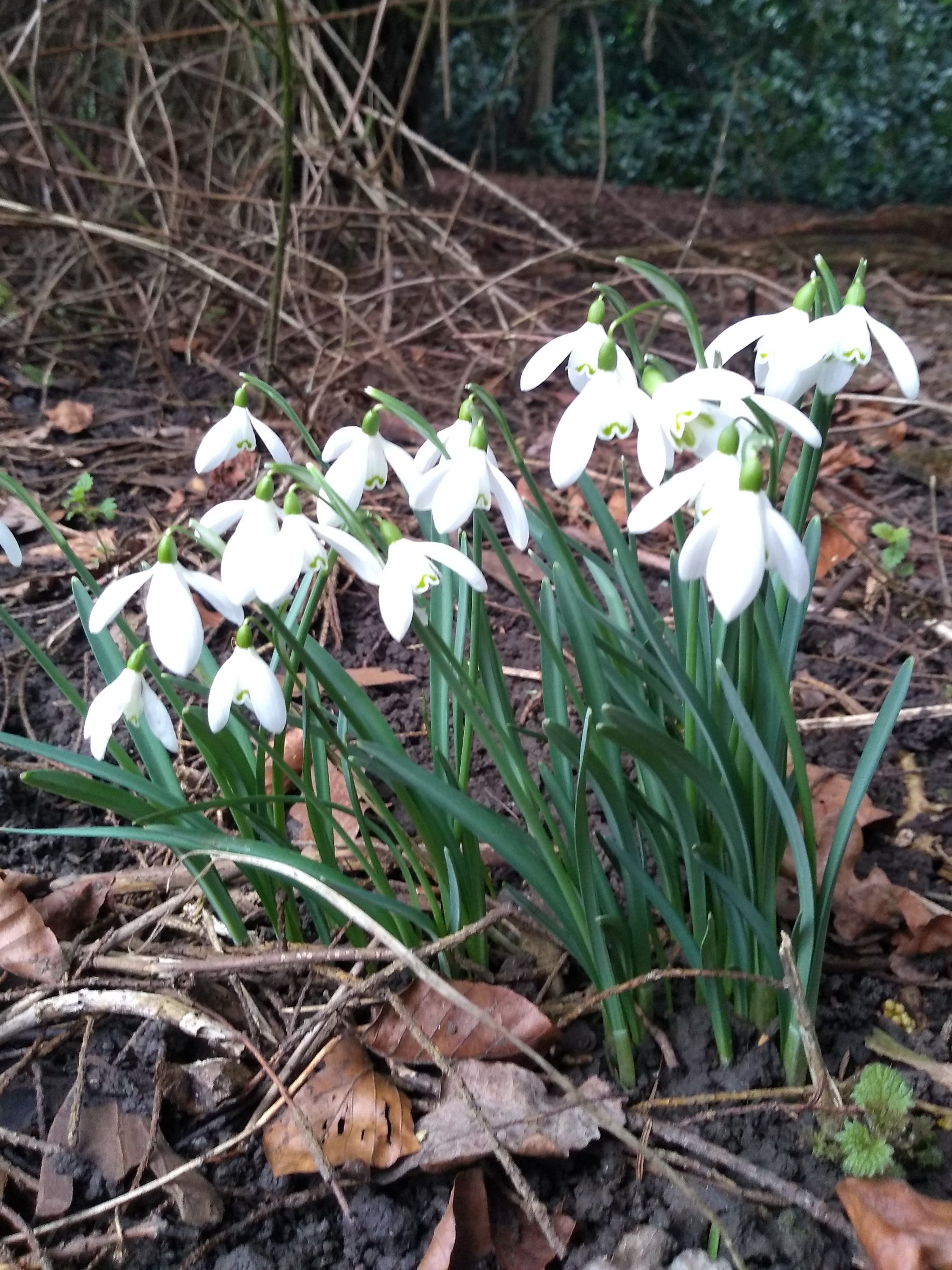
Cyclamen and Snowdrops (Galanthus) are also blooming now and even Daffodils (Narcissus) and Crocus are beginning to push through the now defrosted ground.

Last weekend was the annual RSPB’s Big Garden Birdwatch. My results this year were;
3 Wood pigeon (Columba palumbus)
5 Starlings (Sturnus vulgaris)
2 Blackbirds (Turdus merula)- 1 female and 1 male
2 Great tits (Parus major)
1 Magpie (Pica pica)
1 Robin (Erithacus rubecula)
3 Bluetits (Cyanistes caeruleus)
2 House sparrows (Passer domesticus)- 1 male and 1 female
2 Goldfinch (Carduelis carduelis) along with
2 Carrion crows (Corvus corone)

It’s hard to believe it’s now February. As usual during January I slowed and hunkered down, reflecting nature at this time. Yet the wild flowers are beginning to stir and birds pairing up. It isn’t long before spring arrives and I am already starting to plan what I shall grow on the allotment this year.

Posted in Bookworm review, nature

February Arrives

As another month rolls on, an initial glance may suggest that nothing is changing. Bare trees and quiet gardens with cold weather still nipping at fingertips and noses still persist, while sunny days bring glorious colourful skies.

A stripey sunset.

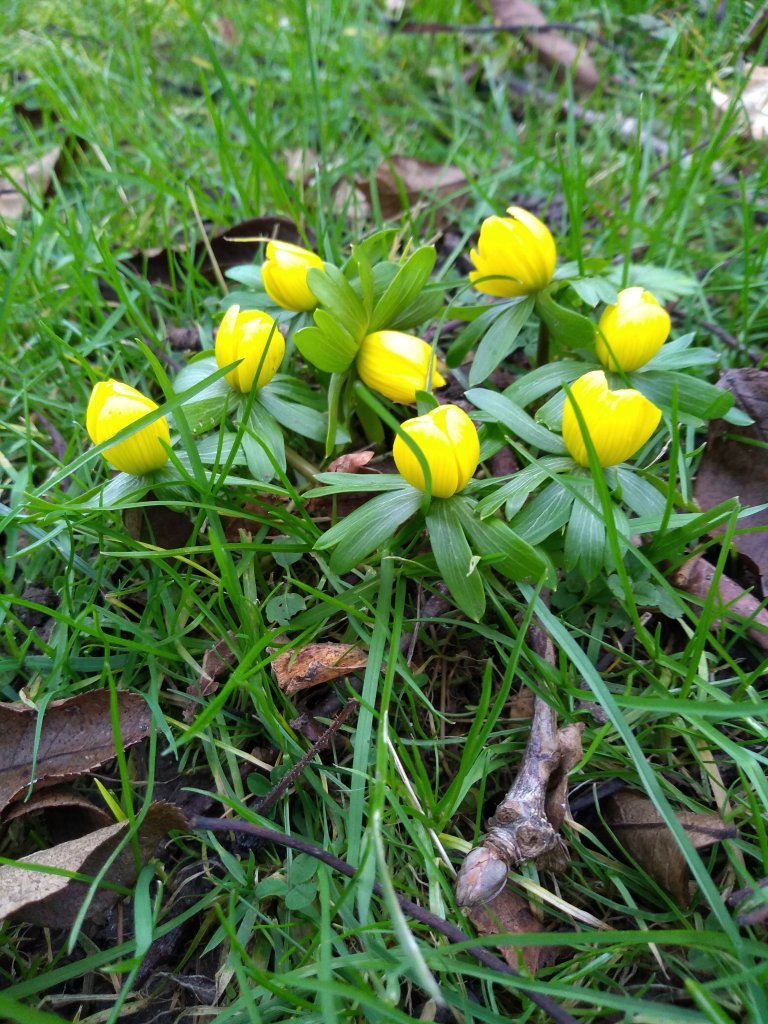
However, upon closer inspection small changes can be seen. The striking yellow of Winter aconites (Eranthis hyemalis) as well as delicate Early crocuses (Crocus tommasinianus) are beginning to bloom alongside the snowdrops (Galanthus).

The tiny red female flowers of Hazels (Corylus) have opened joining the male catkins. Plus, Blackthorn (Prunus spinosa) buds are ready to burst open (in fact on one walk, I saw a single flower already blooming).

I even witnessed a Red admiral (Vanessa atalanta) visit a flowering Mahonia on one sunny day; clearly making use of the milder weather before sheltering once again.

However the main focus of my attention, over the past few weeks, have been birds.

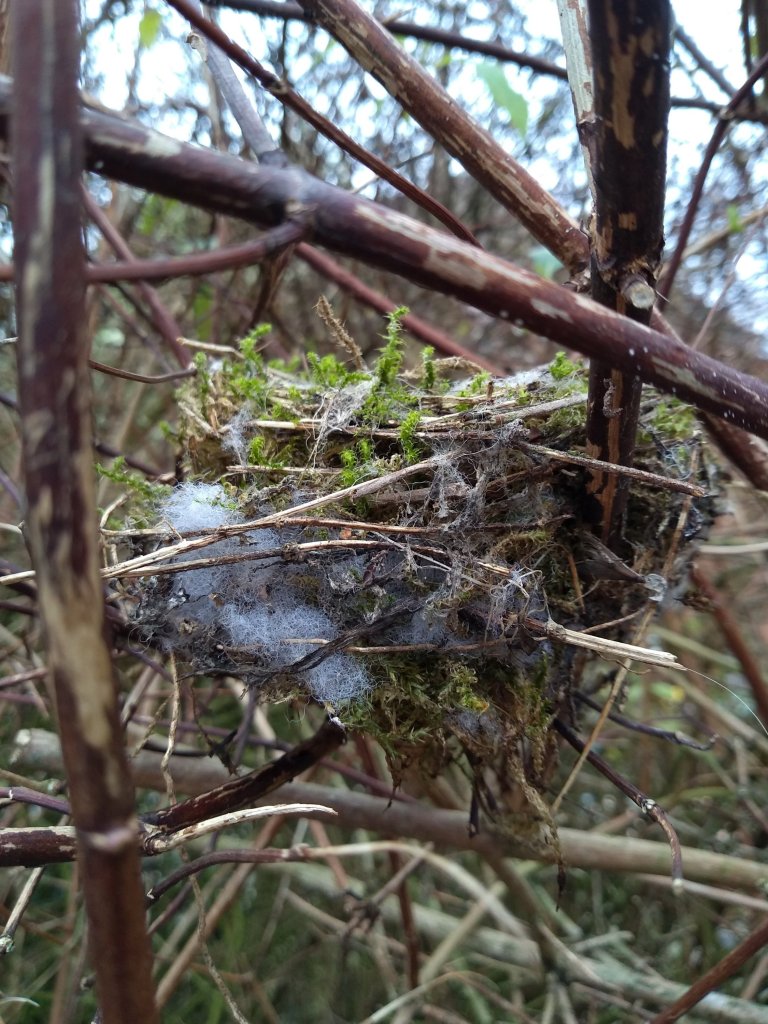
In one garden, I discovered a lovely little nest, from the previous year, in a shrub. Upon investigation I discovered it was either a Goldfinch (Carduelis carduelis) or Greenfinch (Chloris chloris) nest (most likely the former); it can be seen below.

I also saw a Lesser spotted woodpecker (Dendrocopos minor) perched on a tall tree in the distance. I was able to follow the sound of the drumming to watch it move around the trunk before flying off. Given the length of drumming and location of the red on it’s crown I was able to identify it as a male Lesser spotted woodpecker.

Then later in the week, while pruning roses, I watched a Wren (Troglodytes troglodytes) forage around the base of a hedge; I managed to film it briefly before it disappeared fully into the undergrowth.

I am currently reading ‘The Wren: A biography’ by Stephen Moss.

This charity shop find is a fascinating read. Chapters are set out month by month, each concentating on an aspect of a Wrens life. Included alongside facts about the Wren, are their involvement in human history, culture, literature, art and folklore together with beautiful illustrations. The chapter entitled February, for example, focuses on courtship and population. As with other books written by this author, such as ‘The Robin’, this book is definitely worth emmersing yourself in.

Lastly, once again I partook in the Big Garden Birdwatch. My results this year were-
7 Starlings (Sturnus vulgaris),
4 Magpies (Pica pica),
2 Bluetits (Cyanistes caeruleus),
2 Blackbirds (Turdus merula)- a male and female,
2 Wood pigeons (Columba palumbus),
1 Dunnock (Prunella modularis) as well as a Carrion crow (Corvus corone).

Although there weren’t any major surprises in what I saw, it was lovely that the Dunnock made an appearance (usually I only get to hear them). However the Red Kite (Milvus milvus), Ring-necked parakeets (Psittacula krameri), Great tit (Parus major) and Robin (Erithacus rubecula), that I regularly observe, all decided to have a lie in the previous weekend, most only making an appearance once my chosen hour had ended.

Posted in nature

Common Insects but an Uncommon Viewing Experience

It was great to still witness pollinators flying around last week. Even though, due to the colder weather numbers have greatly reduced, some insects are still foraging. I noticed the odd hardy Buff-tailed bumblebee (Bombus terrestris) as well as a few Honey bees (Apis mellifera) visiting autumn flowering perennials and shrubs. Currently the most wonderful spectacle is Common Ivy (Hedera helix) in full bloom. Loved by pollinators including butterflies, bees and hoverflies, ivy is a useful plant to have in flower at this time of year. It supports up to fifty species altogether, such as providing food for Holly blue Butterflies (Celastrina argiolus), along with the Small dusty wave (Idaea seriata), Angle shades (Phlogophora meticulosa)
and Swallow-tailed (Ourapteryx sambucaria) moths. Mature Ivy plants flower in September and October on clustered umbels. Eventually, pollinated flowers develop into fruit that provides food for Thrushes (Turdidae), Blackbirds (Turdus merula), Blackcaps (Sylvia atricapilla) and Wood pigeons (Columba palumbus). Ivy also provides shelter for hibernating insects over winter.

However the most prevalent insects I witnessed covering the ivy flowers last week were the Common wasp (Vespula vulgaris). They weren’t nesting amongst it but feeding on the abundant nectar. My confidence in their complete focus on the ivy flowers, and not being bothered by my presence, enabled me to unusually observe them up close. Each time I came across ivy covered with wasps, I would take a few moments to watch and listen. Unlike bees, their buzzing was very faint; you had to listen carefully to hear it. I had never been close enough to appreciate the wonderful pattern on their abdomen before or watch their activity as they hurriedly switched from one flower to another.

I would have been observing male and worker wasps obtain nectar from the ivy (which also visit other umbellifier flowers). Queens are active in spring, collecting nectar from Cotoneaster and other spring flowering shrubs.

These much hated creatures are useful pollinators (as the photo below proves) when not pestering us as we eat outdoors. We can’t really blame them trying to access an easy source of food or protecting nests when we stumble upon them.

Wasps also help keep insect numbers down which once captured, are chewed up and fed to the larvae.

Although I haven’t seen any yet, I am ever hopeful that I will see Ivy bees (Colletes hederae) as I look at ivy. Recorded for the first time in southern Britain as far back as 2001, these solitary bees feed on ivy nectar and are therefore only seen when ivy flowers. Since they were first noted in Britain the species has been spreading northwards, nesting in sandy soil. For further information see (Wildlife Trust).

More fungi started to appear last week too; I saw
– Common bonnets (Mycena galericulata)

– Shaggy ink caps (Xylaria hypoxylon) and

– Candlesnuff (also referred to as candlestick or stag’s horn) fungus (Xylaria hypoxylon).

You have to look closely to identify this minute fungi, found on decaying wood, it has a blackened base.

Lastly I was utterly surprised to witness a Fox (Vulpes vulpes) run across my allotment as I worked early on Saturday afternoon. It looked healthy so presumably had been disturbed with all the activity from allotmenteers tidying their plots.

Posted in nature

Birdwatching and Blooming Flowers

The annual Big Garden Birdwatch returned last weekend. As usual I took part on a Sunday morning. As with the previous year, there were lots of birds to see in my little patch, namely;

– 2 Blackbirds (Turdus merula)
– 3 Magpies (Pica pica)
– 7 Starlings (Sturnus vulgaris)
– 1 Robin (Erithacus rubecula)
– 1 Dunnock (Prunella modularis)
– 5 Blue Tits (Cyanistes caeruleus)
– 2 Great Tits (Parus major)
– 2 Wood Pigeons (Columba palumbus)
– 1 Carrion Crow (Corvus corone)
– 1 Ring necked parakeet (Psittacula krameri) and
– 3 Common Gulls (Larus canus)

There were a few changes to my 2019 list, the Dunnock, Ring necked parakeet and Common gulls were not visible during surveys before. Although I have noticed these birds in the area many times.

I enjoy purposely sitting for an hour on a Sunday morning observing birds, especially at this time of year. It is a lovely reminder that if you atune yourself to nature you will notice it even in the depths of winter.

One bird I have been hoping to see all winter were Redwings (Turdus iliacus). In previous years there have always been a few visitors to the Rowan (Sorbus) tree. However the berries were quickly eaten this Winter, which may explain why I haven’t seen any. Although perhaps they arrived when I wasn’t around to see them.

It was fantastic to witness more flowers popping up last week too, they were;

– Crocus vernus

-Anemone blanda

-Iris reticulata

– and Primroses (Primula vulgaris)

Spring really does feel as though it is around the corner now we have entered February.

Posted in nature

Growing Food for Birds

I saw contrasting images last week which made me think of feeding birds with plants from the garden.
I first observed the Rowan (Sorbus) tree outside, now stripped bare of it’s berries, before noticing some Cotoneaster

and Ivy (Hedera) full of berries. Clearly the pollinators had been busy during the Summer and Autumn months.

Along with supplementary food, on the ground and bird feeders, birds can also rely on trees and other plants in the garden for food in winter. Along with the examples already mentioned there are other berries, fruit, seeds and nuts which are enjoyed by birds.

Some other plants providing fruit and berries are;
Hawthorn (Crataegus)
Honeysuckle (Lonicera)
Guelder rose (Viburnum opulus)
Dog rose (Rosa canina)
Berberis
Bird cherry (Prunus padus)
Crab apple (Malus sylvestris)
Blackthorn (Prunus spinosa)
Pyracantha
Sarcococca hookeriana
Mahonia

Plants providing seeds and nuts include;
Oak (Quercus)
Beech (Fagus)
Hazel (Corylus)
Spindle (Euonymus europaeus)
Teasel (Dipsacus)
Sunflower (Helianthus)
Miscanthus
Bergamot (Monarda)
Verbena bonariensis
Lavender (Lavandula)
Yarrow (Achillea millefolium)
Asters

Leaving seedheads on perennials not only provides food for birds, they also give shelter to beneficial insects. In fact a little bit of leaf litter also has this affect which in turn helps feed birds who eat the insects.

Common birds to see in winter include;
Redwings (Turdus iliacus)
Waxwings (Bombycilla)
Starlings (Sturnidae
Blackbirds (Turdus merula
Robins (Erithacus rubecula
Chaffinches (Fringilla coelebs)
Bramblings (Fringilla)
Goldfinches (Carduelis carduelis)
Bullfinches (Pyrrhula pyrrhula)
Dunnocks (Prunella modularis)
Goldcrests (Regulus regulus)
Blue tits (Cyanistes caeruleus)
Long-tailed tits (Aegithalos caudatus)
Coal tits (Periparus ater)
Great tits (Parus major)
Fieldfares (Turdus pilaris)

The RSPB Big Garden Birdwatch, which takes place on the 25-27th Jan 2020, has been going for over 40 years. Surveying birds visiting your Garden or local park for one hour is calming and enjoyable. This citizen science continues to give the charity useful information on the numbers of birds in the UK.

Further information on feeding birds can be found in the book, ‘RSPB Pocket Bird Feeder Guide’ by Robert Burton (published by Dorking Kindersley) or on the Gardeners World website.