Posted in nature

Ciara and Dennis Visited.

After Ciara’s departure, last weekend was another wild one with Dennis’s arrival. Thankfully, apart from a few blown down fence panels and trees there wasn’t much destruction in the gardens. Once again we got off lightly compared to some parts of the country. Since then, the weather has cooled down slightly and it has remained windy and wet with occasional sunshine. 


Despite the topsy turvy weather Forsythia

Strachey’s elephant’s ears (Bergenia stracheyi)

and Blackthorn (Prunus spinosa)

are flowering. Plus as I have traveled round I have noticed that in some places Dandelions (Taraxacum officinalis) and Common gorse (Ulex europaeus) have begun blooming too.  

Posted in nature

A Little Love on Valentine’s Day

Over the last few weeks I have noticed several bees motionless on the ground. Thankfully they were just resting so each time I carefully moved them to a nectar source. It is so lovely to see them hungrily lap it up, getting covered in pollen as they go. Just shows how important it is to grow late winter flowering plants for bees to visit. Yesterday I found another Buff-tailed Bumblebee in the same predicament. Showing love to that bee made my Valentine’s day. ♥️ 🐝🌸

Posted in Bookworm review, nature

Bookworm Review- ‘Bird Therapy’ by Joe Harkness


I had downloaded this book ages ago and finally got round to reading it last month.

Part autobiographical and part informative this positive book is encouraging and so beautifully written that as the reader you are transported to his bird watching adventures.
Although Joe talks about his own experience with mental health, from his darkest days to eventually feeling better, it is never dwelt on. At the end of each chapter practical tips are given on how to engage in Bird therapy. He talks about different aspects of bird watching, anything from joining the serious world of twitchers through to taking part in the yearly RSPB Big Garden Birdwatch survey (describing his own explorations into each one as the book progresses).

Chapter eight ‘A sea-duck flotilla…’ particularly resonated with me. It describes birdwatching in winter. I also agree that watching birds is easier this time of year due to the bare trees and more birds taking advantage of bird feeders. Yet it is the time when I prefer to hibernate due to my Seasonal Affective Disorder. Having a bird feeder visible from my window helps encourage me to go out and face the world.

If you are dealing with mental health issues, know someone who is or feel a little bit low and stressed yourself then read this inspirational book. It proves how nature can help make you feel better and be part of the cure.

Posted in nature

Birdwatching and Blooming Flowers

The annual Big Garden Birdwatch returned last weekend. As usual I took part on a Sunday morning. As with the previous year, there were lots of birds to see in my little patch, namely;

– 2 Blackbirds (Turdus merula)
– 3 Magpies (Pica pica)
– 7 Starlings (Sturnus vulgaris)
– 1 Robin (Erithacus rubecula)
– 1 Dunnock (Prunella modularis)
– 5 Blue Tits (Cyanistes caeruleus)
– 2 Great Tits (Parus major)
– 2 Wood Pigeons (Columba palumbus)
– 1 Carrion Crow (Corvus corone)
– 1 Ring necked parakeet (Psittacula krameri) and
– 3 Common Gulls (Larus canus)

There were a few changes to my 2019 list, the Dunnock, Ring necked parakeet and Common gulls were not visible during surveys before. Although I have noticed these birds in the area many times.

I enjoy purposely sitting for an hour on a Sunday morning observing birds, especially at this time of year. It is a lovely reminder that if you atune yourself to nature you will notice it even in the depths of winter.

One bird I have been hoping to see all winter were Redwings (Turdus iliacus). In previous years there have always been a few visitors to the Rowan (Sorbus) tree. However the berries were quickly eaten this Winter, which may explain why I haven’t seen any. Although perhaps they arrived when I wasn’t around to see them.

It was fantastic to witness more flowers popping up last week too, they were;

– Crocus vernus

-Anemone blanda

-Iris reticulata

– and Primroses (Primula vulgaris)

Spring really does feel as though it is around the corner now we have entered February.

Posted in nature

Beautiful Colours Shining Through.

It has been lovely to see more colour shining through the gloom. Winter aconites (Eranthis hyemalis) are in full bloom now.

These Winter aconites should be flowering now unlike a Flowering Quince (Chaenomeles speciosa) that I noticed.

Clearly this shrub rather optimistically thinks it’s Spring. I guess it’s sheltered sunny position is helping to contribute along with the slightly milder weather we have been experiencing lately. Hopefully a few bees will find the flowers.

One more thing I noticed last week was some Oakmoss, (Evernia prunastri) that had fallen onto the lawn.

Confusingly, given its name, it is a Lichen and not a moss. Also, while usually found on Oak (Quercus) trees, it can be found on other species of tree too, like conifers (Pinophyta). There was a conifer nearby so it most likely originated from there. The resin from that tree will have been absorbed by the lichen and therefore shares the same turpentine quality as the tree.

This Lichen has been used in the perfume industry (for its earthy aroma), in cooking and as a dye. I wasn’t feeling adventurous so rather than take it I moved it to the nearby conifer. Lichen grows very slowly, hopefully it will survive for even longer.

Posted in nature

A London Adventure

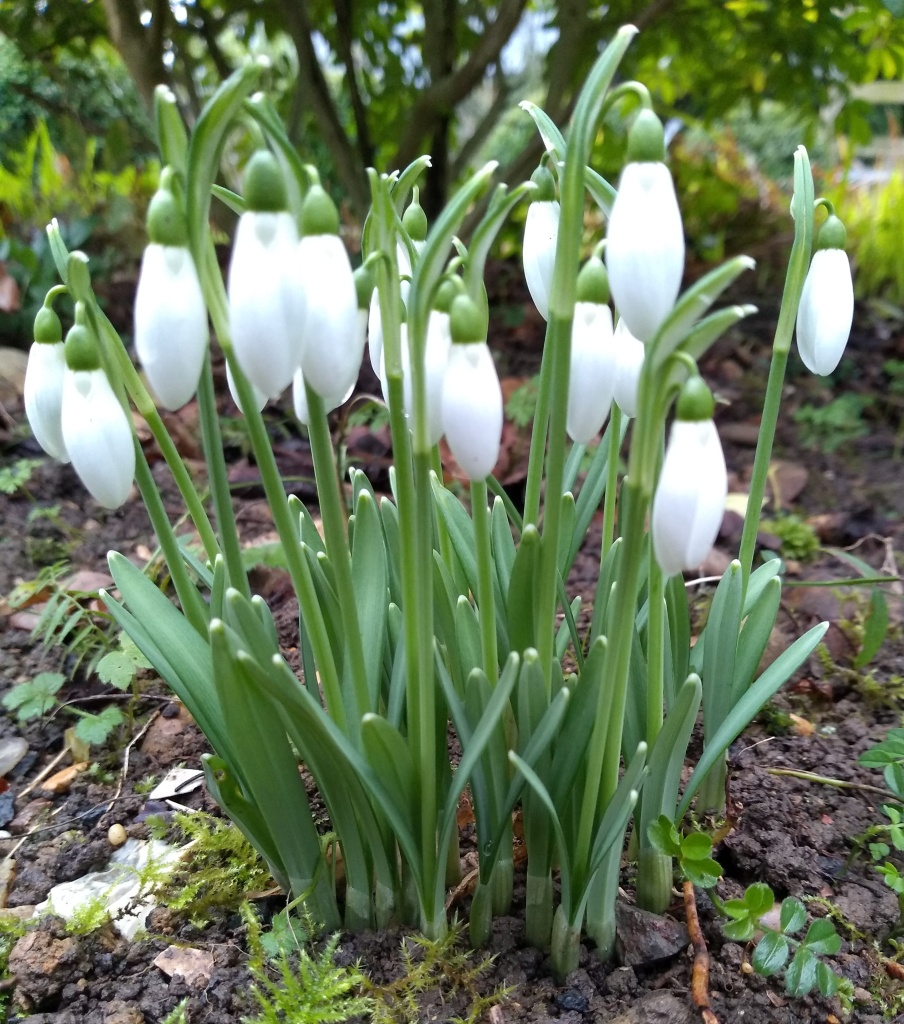
Last week saw Snowdrops (Galanthus) in full bloom

and Winter aconites (Eranthis hyemalis) starting to show themselves.

Robins (Erithacus rubecula) continued to follow me around, in the hope of a tasty meal, as I worked. Plus I noticed a Goldfinch (Carduelis cardueli) sing loudly on top of a fir tree, along with a Jay (Garrulus glandarius) retrieve buried acorns from a lawn.

However trees grabbed most of my attention last week. On Tuesday I noticed some lichen and moss on an old apple tree.

I love the different textures shown here.

Saturday was a glorious day, wonderfully warm in the sunshine. I spent the day in London, enjoying a picnic besides the Thames in Island gardens, under a large London plane tree (Platanus × acerifolia)


These trees are a hybrid from the American sycamore (Platanus occidentalis) and Oriental Plane (Platanus orientalis). They were first discovered in the 17th century, although it is unlikely that trees from that century still exist. They are commonly found in cities, especially London, as this tree can tolerate pollution and compacted soil.
London planes have a beautiful silhouette. Their seed clusters (seen below) hang like balls, remain on branches until spring when they are released and become airborne.

Male flowers are yellow while the female ones, also on the same tree, are red.

A close up of the bark on the trunk.

This camouflage patterned trunk occurs as bark flakes, when the tree grows, revealing newer bark beneath; meaning that pollution captured within it is discarded regularly.

Posted in nature

Is this a Weed? 🌱

Weeds are plants growing in the wrong place, or at least where we don’t want them to grow. After all weeds don’t exist without humans. We determine when a plant is a weed because we view them negatively rather than see their beauty or positive attributes. Usually wild flowers are called weeds when they grow in our gardens but it is possible for cultivated plants to become a nuisance and therefore a weed too.

I am often asked “Is this a weed?” I answer with the plants name and supply information on their growing habits together with their positive attributes (and any negative ones). For example, Dandelions (Taraxacum officinale) unwanted in immaculate lawns are great for early foraging bees (when there aren’t many other flowers about). Euphorbia characias subsp. wulfenii however is bought from garden centres and then freely self seeds where you don’t want it to. Then there are some Marmite plants like Forget-me-nots (Myosotis arvensis) that split opinion and therefore allowed in some gardens but not others.

Historically, some plants regarded as a nuisance now weren’t always disliked. They once had medical, culinary, cosmetic uses or were used as dyes; uses that now are not commonly known. What have the Romans done for us? Add bringing Ground elder (Aegopodium podagraria) to Britain to the list. Once used by the Romans as a herb and medicine (see Alys Fowler’s Guardian article).

I love wild flowers and am happy to allow space for them in a wildlife garden. One wildflower I leave is Garlic mustard (Alliaria petiolata) because it is eaten by Orange tip and Green-veined white caterpillars. Whilst nectar rich flowers are needed in gardens for butterflies, their caterpillars have specific plant requirements without which you won’t get more adults.

So when did our obsession for weeding begin? There is an fascinating extract from ‘The Climate Change Garden’ by Sally Morgan and Kim Stoddart.

‘much of what we consider traditional advice nowadays is based on the comparatively recent practices of Victorian country houses… Prior to this very controlled Victorian approach, in which outside spaces were kept meticulously tidy, the gardens of everyday working folk (aka peasants) exhibited a more free-spirited, practically-minded ethos. Their gardens had a much more ‘higgledy piggledy’ planting of crops, flowers and weeds, many of which were important for both their culinary and medicinal uses in the home.’ p116

So it’s something else the Victorians invented.

I find the subject of ‘weeds’ fascinating. Four wonderful books on the subject that I’ve read recently are,

1. ‘Weeds’ by Nina Edwards
2. ‘Weeds’ by Richard Mabey (For historical and cultural information.)

3. ‘Wild about Weeds; Garden Design with Rebel Plants’ by Jack Wallington (Which shows how to incorporate ‘weeds’ into garden design.)

4. ‘The Climate Change Garden’ mentioned above. It has a chapter entitled ‘Working with Wildlife’ (about wildlife gardening) as well as other chapters on how to adapt garden practices to future proof against long-term changes in climate, from flooding or drought to the importance of trees in combating climate change.

Reading these books will give you a different perspective on ‘weeds’.

Posted in nature

I Spy… Something Beginning With B

The mild temperature continued last week. When the sun came out on Wednesday and Friday mornings it almost felt like spring. Bees foraged on both days. Wednesday was the busiest as a [1] Buff-tailed Bumblebee (Bombus terrestris) and about five [2] Honeybees (Apis mellifera) were visiting a Winter honeysuckle (Lonicera fragrantissima).

[1]

[2]

While on Friday another Buff-tailed Bumblebee was collecting nectar from a Mahonia. I found the perfume from these shrubs hard to ignore so I am not surprised that the bees were intoxicated by them too. However I have never seen Honey bees active in January before.

Other things I noticed last week, usually associated with Spring, were lawns full of daisies (Bellis perennis) along with a Great tit (Parus major) loudly singing it’s repetitive two syllable song ‘tea-cher, tea-cher’.

[3]

Should I be concerned that I am noticing lots of spring activity in January? It is lovely to be reminded that Spring isn’t far away but hopefully it won’t be a continuing annual trend.