The lovely sunshine we’ve had on and off recently has encouraged lots of wildflowers to start blooming over the past week. Amongst the Daffodils were Daisies (Bellis perennis), Snake’s head Fritillary (Fritillaria meleagris),
Snake’s-head fritillary has become naturalised in the lawn of this woodland area of the garden.
Dandelions (Taraxacum),
Perfect for pollinators, especially bees but also butterflies.
Cowslip (Primula veris),
Primroses on my allotment adds a little colour at this time.
Green alkanet (Pentaglottis sempervirens) and Forgot-me-nots (Myosotis). Even brave Tulips were beginning to open up.
Last Tuesday I learnt another plant, the Marsh marigold (Caltha palustris).
This particular plant was in a raised water feature made from an old rectangular metal container which replicated it’s natural growing conditions. In the wild, Marsh marigold grows in damp conditions such as ponds, marshes and wet woodland and flowers from March to July. It’s common name ‘Kingcup’ is a reference to the large buttercup like flowers resemblance to large golden cups (therefore cup of the kings); Even the latin Caltha means goblet.
A wonderful addition to ponds in gardens, this perennial provides shelter for amphibians as well as nectar for pollinators (Bees, beetles and flies).
However, one word of warning, the sap can be an irritant as it contains glycoside protoanemonin, especially in the older growth.
Magnolias and Ornamental cherry trees, including my Prunus incisa ‘Kojo-no-mai’ on the allotment, joined the wonderful display of Blackthorn (Prunus spinosa) blossom.
Sunny blue skies are the perfect backdrop to this huge Magnolia and Ornamental cherry (see below).Along with the Cowslips, this ‘Kojo-no-mai’ cherry provides some pollen and nectar on my allotment.
I also noticed that Horse chestnut (Aesculus hippocastanum) trees were showing evidence of flower development alongside recently unfurled leaves; although they won’t bloom until May.
Will it be a good year for playing Conkers?
With all these flowers appearing, it was wonderful to see more bees take advantage of all the pollen and nectar available. On the sunniest days I even caught glimpses of the first Brimstone (Gonepteryx rhamni) and Peacock (Aglais io) butterflies of the year; venturing out of hibernation when it is warm enough too.
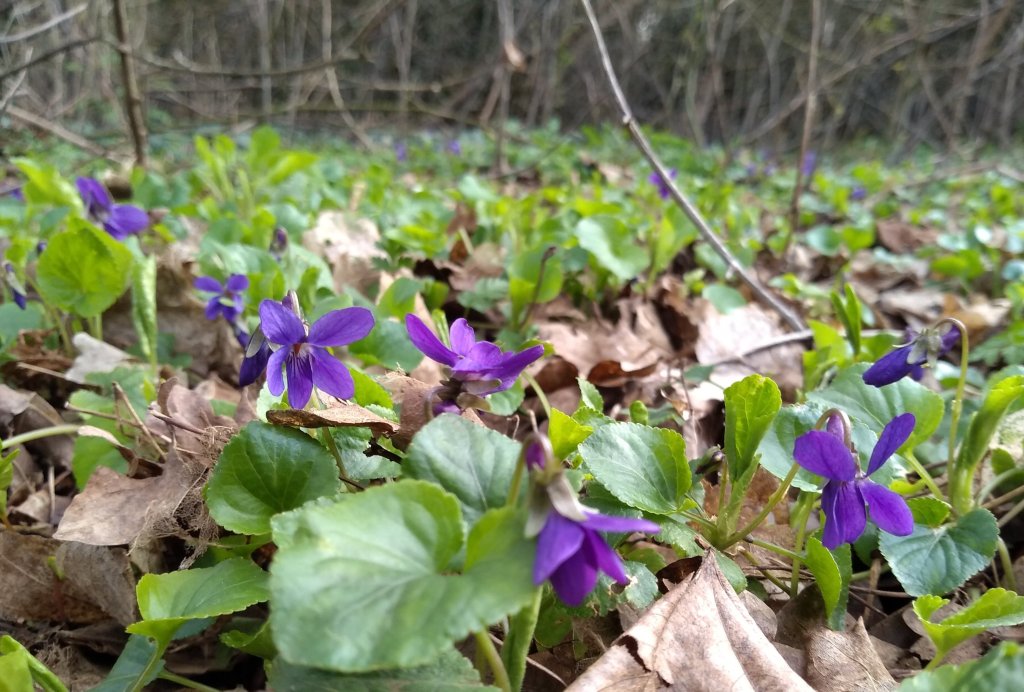
The Common Dog Violet (Viola riviniana) has begun to bloom, both in the wild (in woodlands, heaths and amongst hedgerows) as well as gardens.
This splash of purple usually arrives in April and lasts until June. If you are lucky, you may notice certain Fritillary butterflies feed from and lay their eggs on this plant (a spectacle I’ve yet to witness).
Willows were blooming last week too. There is one mature Goat Willow (Salix caprea) that I see regularly as I work. Another common name for the Salix caprea is Pussy willow, due to the male catkins resemblance to cats paws before they bloom.
Only males catkins turn yellow once they open.
Willow trees are dioecious; therefore females catkins, grow on separate trees to the male ones. Unlike the male catkins shown above, female ones are green and longer in length. Catkins appear on the trees before the leaves do.
So many catkins were open that the tree seemed alive with the sound of bees.I love the reddish tinge in the bark.
I am not sure how old this specific tree is but the species can live for about 300 years and grow up to 10 meters tall. The specimen in the garden I work at has definitely reached it full height.
The Kilmarnock willow (Salix caprea ‘Kilmarnock’) is a much smaller version of the Goat willow tree (grafted onto a dwarfing rootstock). I often see this tree in gardens and they were blooming last week too.
Unlike its larger counterpart, the Kilmarnock willow is a great addition to the average sized garden as it too is loved by bees.
The pollen covered Buff-tailed bumblebee pictured here clearly enjoyed visiting the male catkins on this Kilmarnock willow.
Goat willow trees are usually found in woodland, hedgerows and scrub, especially near waterways such as lakes, streams and canals.
Willows are a fantastic source of pollen and nectar for bees and other pollinators. They’re also a good food source for Sallow kitten (Furcula furcula), Sallow clearwing (Synanthedon flaviventris), Dusky clearwing (Paranthrene tabaniformis) and Lunar hornet clearwing (Sesia bembeciformis) moth caterpillars too. Even birds forage for insects amongst their branches.
As the wood burns well it is used to make charcoal. Plus it’s also used for wattle in timber frame houses.
My favourite fact is that the words witch, wicked and Wiccan are derived from Willow.
Traditionally, it was used to help treat toothache by chewing the bark and used to relieve diarrhoea, arthritis, sore throats, stop bleeding and clean wounds. In fact Aspirin, derived from salicin, was sourced from Willows.
The bacteria Brenneria salicis can cause Watermark disease in Willows which causes dieback and eventual death to the trees if left untreated.
If you are looking to add a small tree to your garden, the Kilmarnock willow is definitely worth looking into; unless you have a large garden then choose a mature male Goat willow instead (the bees will thank you for it).
The first of March, meteorological spring along with St Davids day all took place last Monday. Even the first grass cut of the season took place last week (albeit only a high cut to level off uneven growth).
Blackthorn was fully blossoming and spring flowers still bloomed as the birds, amphibians and insects continued to become more active. There were a few new observations; I noticed a single Two-leaf squill (Scillabifolia) growing in a lawn and, in the same garden, saw a male Ring necked Pheasant (Phasianuscolchicus) strutting his stuff.
Things are moving on at the allotment. Sweetpea and Vegetable seedlings are doing well as are the seeds sown for cut and wild flower areas on the plot. The beds are ready for direct sowing which I hope to undertake within the next few weeks and I wait for Yellow rattle (Rhinanthus minor) and Bird’s-foot trefoil (Lotuscorniculatus) to germinate. I also hope to get the shed painted, install a water conserving system and build a bigger greenhouse sometime in the future.
While I am looking forward to the new growing season to begin in earnest I am also mindful to enjoy this moment; to stop, observe, reflect and plan and allowing nature to dictate the speed when things need to begin.
Aubergine and Chilli seedlingsKale seedlingsTithonia, Scabious and White clover seedlings (Trifolium repens)
During a particularly difficult week, once again, nature has given me solace. I went on local walks for exercise as well as watch birds from my sofa, while they visited the Rowan tree (Sorbus) next to my flat. Several bird species visited even though it’s mostly stripped of berries now. I noticed bud development on the branches already too.
I have recently spent time catching up on some reading. The first book I read was ‘Witch’s Garden’ by Sandra Lawrence.
This book contains botanical illustrations along with other pictures, including those of specimens from KEW. Folklore as well as natural medicinal properties of fifty well known plants are explored.
One of the plants written about is the Rowan tree. In the past it has been associated with fairies, the Norse God Thor, Goddesses Hebe and Brid as well as St Brigid.
Also known as the Witches tree, traditionally Rowans were believed to offer protection against evil. Other common names for them are Lady of the Mountain, Quicken tree, Wildwood, Whispering tree and probably the most well known Mountain ash. The latter name is due to its ability to thrive in high regions and a similarly in the leaves, however it isn’t actually an Ash (Fraxinus). In fact Rowans are part of the Rosaceae family alongside Apple trees (Malus) Roses (Rosa) and Hawthorn (Crataegus). Just as the haws of the Hawthorn and Rose hips contain vitamin C, Rowan berries are high in this vitamin too. Although all require cooking before they can be eaten they were traditionally used to treat scurvy, sore throats and other ailments, especially during the World War Two.
The second book I read was ‘Back to Nature’ by Chris Packham and Megan McCubbin.
Containing personal stories and factual explanations, this book looks at the importance of nature for humans along with what actions can be undertaken to protect it.
I grew up avidly watching the Really Wild Show and love Springwatch and Autumnwatch. Part of my enjoyment of this book was ‘hearing’ Chris’ voice as I read the parts he’d written. His descriptions contain both urgency and hopefulness. He speaks about various topics from the importance of nature as therapy to wildlife issues that exist at this time.
He also mentions how during lockdown verges sprung into life as wildflowers were allowed to bloom, something that was great for pollinators. Chris talks about the worrying loss by 97% of wildflower meadows since the 1930s, attributing to a decrease in insect numbers. Therefore reversing this by councils allowing verges to grow is great. Yet, having a small wildflower patch in gardens is another achievable action that we can all undertake that will have a big impact on helping wildlife thrive.
Both books are great reads, they are informative and enjoyable; I highly recommend them both.
If I create a wildlife friendly allotment nature will come. My allotment is really filling up and blooming now even though I’ve only had it since February. Most of the plants are from seed, cuttings or rescued from other gardens. For the first year I plan to let the plants develop before harvesting properly.
We’ve had so much rain in recent days that I didn’t need to visit the allotment to water during the week. So last Saturday was the first time in seven days that I visited my plot to undertake major garden tasks. It was the summer solstice and the weather was glorious.
As I walked around to check how things were, I noticed a large number of wildlife; nature had come.
The first things I saw were two Small tortoiseshell Butterflies (Aglais urticae) pollinating the Thyme ‘Lemon curd’ (Thymus ‘Lemon curd’)
whilst Oedemera beetles were taking advantage of the Dandelions (Taraxacum officinale) left on the grassy walkways.
Several Buff-tailed bumblebees (Bombus terrestris) busily flew between the flowers on a neighbouring allotment’s Hebe and flowers on my patch, including the Lacy Phacelia (Phacelia tanacetifolia)
as well as the Borage (Borago officinalis).
A Honey bee (Apis mellifera) also visited the Borage.
There was even a solitary bee buzzing about; an Ashy mining bee (Andrena cineraria) pollinating the Hebe.
Most likely this is the bee that was accidentally unearthed the previous weekend while getting rid of bindweed from around the potatoes (see photo below).
I had contacted the Bumblebee Conservation Trust to see if they could identify this silvery bee, if indeed it was a bee. Stephanie Miles answered my query explaining; ‘This is indeed a bee! It’s a male solitary bee of the genus Andrena. When these bees first hatch from the pupa they’re completely silver-haired, like this – over a day or so they dry out, lay down pigmentation, and the normal colour appears. Once the normal colour appears they can be identified to species level. You disturbed this one before it was quite ready to be seen in public!’ Therefore the Ashy mining bee seen on the Hebe seems a likely candidate.
Seven-spot ladybirds (Coccinella septempunctata) in different stages of development were resting on potato, Calendula (Calendula officinalis) and Borage foliage. There were newly formed adults along with the larvae.
A young Seven-spot ladybird before the recognisable red and black beetle develops fully.
Outside of my allotment wildflowers that are beginning to bloom included;
On Saturday night I woke up to a beautiful duet. A pair of Tawny owls (Strix aluco) were calling to one another, reinforcing their territory. The male call sounds like ‘hooo, hu, huhuhuhooo’ while the female gives a ‘keewik’ sound (see BTO).
Tawny owls pair for life and remain in their territory (initially established in winter) throughout the year. Deciduous broadleaf woodland is their traditional habitat but sometimes they live in large gardens and parkland. They nest within tree cavities or nest boxes. Occasionally eggs are laid in February but more often between March and April. While the female is slightly larger than the male, these owls are the same size as a wood pigeon. They feed on small mammals, birds, rodents, fish, frogs, insects and worms. Their UK Conservation Status is Amber as their numbers are declining.
Another bird which caught my eye last week was a male House sparrow (PasserDomesticus). I was leaving the allotment when I observed him collecting nest material before flying off. As with the Tawny owl, House sparrows pair for life and their numbers have also been declining for a while; House sparrows are Red in the UK Conservation Status list. I grew up seeing lots of them but since moving down south, I haven’t seen one for years so this was a wonderful sight. I love these little birds, especially hearing their chattering and chirping in their colonies. Hopefully I will see him and more Sparrows soon.
As the week went on I noticed more flowers blooming in the hedgerows. Wild strawberry, also called Alpine strawberry (Fragariavesca), was the first one I saw.
The fruit of this strawberry can be eaten.
Others I saw were; Bugle (Ajuga reptans),
These flowers are visited by White-tailed bumblebees (Bombus lucorum), Common carder bees (Bombuspascuorum), Silver Y moths (Autographa gamma) alongwith Green-veined white butterflies (Pieris napi).
– Herb bennet/Wood avens (Geum urbanum) and
Grizzled skipper butterfly (Pyrgusmalvae) caterpillars feed on this plant.
– Bush vetch (Vicia sepium).
Bees and other pollinators enjoy these flowers.
I got to see a female Orange- tip (Anthocharis cardamines) butterfly, having seen a male one the other week. Males have the orange tips while the tips on the female’s forewings are black (both have the black spots). The female can be identified apart from other white butterflies by the mottled green and white underwings (also exhibited by the males). Caterpillars of this butterfly feed on Garlic mustard (Alliaria petiolata) and Cuckoo flower (Cardamine pratensis).
While flowers dominated my thoughts last week, there were moments when I enjoyed observing bees and butterflies too. I saw my first male Orange-tip butterfly (Anthocharis cardamines) and female Red-tailed bumblebee (Bombus lapidarius) of the season; both visiting Dandelions (Taraxacum officinale). Other butterflies I noticed were more Speckled woods (Pararge aegeria) and Peacocks (Aglais io). All were too busy making the most of the sun to remain still long enough for me to photograph them.
After threatening to rain last Sunday, with distant thunder in the afternoon and evening, wet weather eventually arrived the following weekend. On Friday it rained late in the day through to Saturday afternoon. The ground loved that sustained soaking and together with all the sunshine we’ve had recently the grass is beginning to flourish. Thankfully lots of wild flowers bloom despite the lack of water, including;
– Ivy-leaved toadflax which is also called Kenilworth ivy (Cymbalaria muralis),
– Lords and ladies, otherwise known as Cuckoo-pint (Arum maculatum),
– Ribwort plantain (Plantago lanceolata),
The seedheads are great for feeding birds in winter.
– Dog’s mercury (Mercurialis perennis),
The tiny flowers are easy to miss amongst the leaves.
– Ox-eye daisy (Leucanthemum vulgare) and
– Cuckoo flower (Cardamine pratensis).
The name for this comes from the belief that this plant blooms at the same time the first Cuckoo arrives in the UK.
The main spring spectacle of the English countryside however are English Bluebell (Hyacinthoides non-scripta) woods in full bloom. Photos of these have filled social media over the past week. I am lucky enough to live near to several woods where English bluebells flower, however due to the lockdown this year I have to make do with spotting the ones amongst the headgerow, on my way to the allotment. Thankfully even small scale sightings of these flowers makes my heart soar. Swathes of these beauties are an indicator of ancient woodland (they are slow growers with seeds taking five years to become bulbs, which then flower).
English bluebells continue to be under threat from the Spanish bluebell (Hyacinthoides hispanica) escaping from gardens, brought to these shores by the Victorians, which readily hybridise with English ones to produce the Hybrid bluebell (Hyacinthoides x massartiana). However, this isn’t the only threat to our native Bluebell. Habitat destruction is another reason for their decline. Simply walking on them can prevent them from flourishing for years afterwards as photosynthesis is prevented and the plant is weakened. They are a protected species under the ‘Wildlife and Countryside Act (1981)’. This means that people can be prosecuted for removing the plants and bulbs from their habitat and/ or selling them.
It is possible to tell the English and Spanish Bluebells apart. English Bluebells are a deep violet shade of blue with creamy-white pollen. The leaves are narrow (1-1.5mm wide) as are the flowers. The tips of each petal (six in total) curl up and inwards. The scented flowers grow on one side of the stem causing it to arch over to the one side (referred to as inflorescence).
Spanish bluebell flowers are pale blue (but can be pink or white), have a wider open bell shape with flared petal tips and bloom all around the stem, which therefore remains upright. The leaves are also wider (by 3cms) than its English counterpart and the flowers have no scent.
Unsurprisingly the hybrids possess characteristics of both parents, however their appearance tends to be more like the English Bluebell meaning distinguishing the two can sometimes be difficult.
Last week I saw both English and Spanish Bluebells on my daily exercise.
English Bluebells are great for long-tongued bumblebees. However previously I have seen evidence of short-tongued bumblebees visiting Bluebells. Unable to reach the nectar in the traditional method, I noticed a hole in the base of the flower where a bee had obtained the nectar without pollinating it. This is referred to as ‘nectar robbing’.Spanish bluebells found in a garden.
Bluebells are interwoven into our culture. In the past the sap was used to glue feathers to arrows and in book binding. Plus the Elizabethans used the bulbs to starch collar and sleeve ruffs.
In folklore they are associated with fairies while in the language of flowers (popular in the Victorian era) they represent humility, constancy, gratitude and everlasting love. What better flower to have bloom during this difficult time when we are showing our appreciation for the NHS and other frontline workers. It seems even nature has turned blue in solidarity.
The weather during the second week of lockdown was mixed. It began with snow flurries and sleet but ended with the warmest day of the year so far.
I continued my daily exercise walks around my area and saw more wild flowers, trees, bees and birds enjoy Spring.
Plants that began to bloom last week were;
– Shepherd’s Purse (Capsellabursa-pastoris),
– Snake’s head fritillary (Fritillaria meleagris),
– Herb Robert (Geranium robertianum),
– Annual honesty (Lunaria annua),
– Common Groundsel (Senecio vulgaris)
– and Laurel (Prunus laurocerasus).
I also noticed my first Dandelion (Taraxacumofficinale) clock of the year
Water droplets can be seen as frost began to melt on this Dandelion clock. A flower head will produce an average of 180 seeds.
along with Horse chestnut (Aesculus hippocastanum) trees budding at this time too.
One particularly special moment occurred last Wednesday when I visited my local woodland park. I went for my exercise as early as possible so that I would avoid too many people. As I entered the park I heard a sound of my childhood, that of Skylarks (Alaudaarvensis). I grew up surrounded by farmland, similar to where I live now, and Skylarks singing was familiar to me (see RSPB).
I knew there were nesting Skylarks in this area because of a notice I saw last year (see my blog post Relaxing into Autumn). There were three Skylarks, two were clearly a pair. Occasionally the third bird would get too close to the other two; causing a noisy aerial display before they all returned to the open ground apart once again. I watched this happen four times as I carefully moved around them; maintaining a distance so that I wouldn’t disturb them unnecessarily. Seeing and hearing these lovely birds was a beautiful experience to witness.
On Friday, while at home, I heard a group of Magpies (Pica pica). They were making such a raucous noise that I looked outside to see what was occurring. I was fascinated to see one Magpie (which was trying to escape) pinned down and being pecked at by another one. As this occurred, four more Magpies kept flying in, occasionally taking part in the attack. Eventually the bird which was under attack escaped and forced by the group to fly away. I have witnessed birds defend territories before but not like that.
Another sound I became aware of later in the week, were Greenfinch (Carduelis chloris), (See RSPB). Although I heard their call, I was unable to see them. However I have observed a Great tit (Parus major) and Coal tit (Periparus ater) and several Blue tits (Cyanistes caeruleus) visit the Rowan (Sorbus) tree outside my flat.
Weeds are plants growing in the wrong place, or at least where we don’t want them to grow. After all weeds don’t exist without humans. We determine when a plant is a weed because we view them negatively rather than see their beauty or positive attributes. Usually wild flowers are called weeds when they grow in our gardens but it is possible for cultivated plants to become a nuisance and therefore a weed too.
I am often asked “Is this a weed?” I answer with the plants name and supply information on their growing habits together with their positive attributes (and any negative ones). For example, Dandelions (Taraxacumofficinale) unwanted in immaculate lawns are great for early foraging bees (when there aren’t many other flowers about). Euphorbia characias subsp.wulfenii however is bought from garden centres and then freely self seeds where you don’t want it to. Then there are some Marmite plants like Forget-me-nots (Myosotisarvensis) that split opinion and therefore allowed in some gardens but not others.
Historically, some plants regarded as a nuisance now weren’t always disliked. They once had medical, culinary, cosmetic uses or were used as dyes; uses that now are not commonly known. What have the Romans done for us? Add bringing Ground elder (Aegopodiumpodagraria) to Britain to the list. Once used by the Romans as a herb and medicine (see Alys Fowler’s Guardian article).
I love wild flowers and am happy to allow space for them in a wildlife garden. One wildflower I leave is Garlic mustard (Alliariapetiolata) because it is eaten by Orange tip and Green-veined white caterpillars. Whilst nectar rich flowers are needed in gardens for butterflies, their caterpillars have specific plant requirements without which you won’t get more adults.
So when did our obsession for weeding begin? There is an fascinating extract from ‘The Climate Change Garden’ by Sally Morgan and Kim Stoddart.
‘much of what we consider traditional advice nowadays is based on the comparatively recent practices of Victorian country houses… Prior to this very controlled Victorian approach, in which outside spaces were kept meticulously tidy, the gardens of everyday working folk (aka peasants) exhibited a more free-spirited, practically-minded ethos. Their gardens had a much more ‘higgledy piggledy’ planting of crops, flowers and weeds, many of which were important for both their culinary and medicinal uses in the home.’ p116
So it’s something else the Victorians invented.
I find the subject of ‘weeds’ fascinating. Four wonderful books on the subject that I’ve read recently are,
1. ‘Weeds’ by Nina Edwards
2. ‘Weeds’ by Richard Mabey (For historical and cultural information.)
3. ‘Wild about Weeds; Garden Design with Rebel Plants’ by Jack Wallington (Which shows how to incorporate ‘weeds’ into garden design.)
4. ‘The Climate Change Garden’ mentioned above. It has a chapter entitled ‘Working with Wildlife’ (about wildlife gardening) as well as other chapters on how to adapt garden practices to future proof against long-term changes in climate, from flooding or drought to the importance of trees in combating climate change.
Reading these books will give you a different perspective on ‘weeds’.




 Bee in the Moment