Posted in Allotment, nature

Latest on the Allotment

After a slow start, due to the weather, things are growing nicely on the organic, no dig, wildlife friendly allotment.

The view of the allotment from the Buddleia shrub.
The view of the allotment from the apple tree.

While most of the soft fruit season has come to an end (apart from the autumn raspberries), the plums and apples continue to develop and are something to look forward to later in the season.

Thankfully the rhubarb has recovered a bit after a disappointing harvest. Rhubarb doesn’t like growing in waterlogged soil and although we have sandy free draining soil, I think it ended up being too wet over the winter. The rhubarb was on the plot when we took it over four years ago and had grown very large. Every five years Rhubarb can be divided when the growth has become weaker or leaves are overcrowded so I will do this around November and hopefully this will invigorate its growth next year.

The slightly depleted Rhubarb patch.

The vegetables remain on a three yearly rotation to maintain soil health and keep viruses at bay. Main crop potatoes, kale (Cottagers and Cavolo Nero), beetroot, radishes and courgettes are doing well as usual. This years addition are carrots. I always like to try something different each year and It’s been a while since I tried growing these; so far they are surviving. They are in a raised bed and were sown later and sparsely to help avoid detection by carrot fly (Psila rosae). They are also in a mixed raised bed which also helps. 

Along with covering vulnerable plants and growing sacrificial plants such as nasturtium (Tropaeolum majus) and marigolds (Tagetes), I intersperse herbs and other flowers in between the vegetables to help prevent too much loss from pests. I usually find beneficial insects soon appear when needed; there are lots of ladybirds on the plot at the moment. I also find the best way to deal with slugs and snails is to collect them and place them elsewhere; plus any plants with soft young growth are protected by copper tape on old pots and thorny material. I do allow some slugs to remain on the allotment however. The Leopard slug (Limax maximus) is one beneficial slug to have in a garden as they don’t eat living plant matter. They are great for the compost and also eat the eggs of other slugs.

Thorny material protecting new growth from slug and snail damage. Also a plastic bottle (with the bottom cut off) to allow water to be directed to the roots.
Copper tape around an old pot (with the bottom cut off) used as a guard around the base of an annual while it establishes itself.

We have a lot of wildlife visiting the allotment. There is often evidence of a fox (Vulpes vulpes) visitor (which we have seen on other plots). Plus we often see grasshoppers and Common blue Damselflies (Enallagma
cyathigerum) and frogs (at the moment we regularly notice one adult and one youngster hopping around). Last saturday, the sun was out and there was an abundance of bees on the Catmint (Nepeta), Red clover (Trifolium pratense), Lavender and Buddleia.

The wild area on the plot contains a bug hotel and is located near to a neighbouring pond. This is where the red clover grows.

This year, I decided to undertake the Big Butterfly Count at the allotment. The butterflies seen were;

2 Small skippers (Thymelicus sylvestris),
1 Comma (Polygonia c-album),
2 Gatekeepers (Pyronia tithonus),
1 Peacock (Aglais io) and 2 Large whites (Pieris brassicae)

Given the abundance of Cabbage whites (Pieris brassicae) nearby I have made sure my kale is covered up.

The perennial kale mixed in with the cut flower patch.

I find it reassuring to have seen so many butterflies and bees at the weekend, especially as overall there seems to be a reduction in numbers this year; partly due to the frequency of wet days.

I have noticed lots of moths this year too. Perhaps the most exotic looking one I have seen so far is the Scarlet tiger moth (Callimorpha dominula).

The creamy coloured spots on the top of the forewings can sometimes have a more vivid yellow tint.
The red underwings can be seen here. I also managed to capture some of the shimmering blues and greens of the forewings when the sun shone on the moth.

This moth is medium sized, at 23- 27mm (across the wings). It flies during the day and night through May and June; often noticed while resting on plants. The caterpillars of this moth feed on Comfrey (Symphytum), Hemp Agrimony (Eupatorium cannabinum),  Common Nettle (Urtica dioica), Bramble (Rubus fruticosus), Honeysuckle (Lonicera), Meadowsweet (Filipendula ulmaria) and Green alkanet (Pentaglottis sempervirens); they can be seen from August until May, overwintering into the following year. The habitats where the Scarlet tiger moth will be found are in areas of wetland, riverbanks, woodlands, gardens as well as coastal areas.

One sound and aerial display of summer which I enjoy is the return of Swifts (Apus apus). I have even been lucky enough to see them catching insects as they swoop over a pond (sometimes just skimming the water) along with another flock soaring high up the sky. I always treasure seeing these amazing birds as they are on the red list for Birds of Conservation Concern 5: (2021). A few things we can do to help them is to put up appropriate nest boxes, as well as adding swift bricks to new builds, giving them somewhere to raise their young. The RSPB also have a citizen science project where you can record their presence. Further information on how you can take part, can be found here.
Having arrived in Britain in April and May, it won’t be long before they return to Africa as they only remain here until August. Most of their time is spent on the wing, only stopping to nest in roofs especially of old buildings such as churches. If this isn’t incredible enough when feeding the young they regurgitate a bolus, (a pellet formed in the back of the birds throat) containing between three hundred to one thousand insects mixed with saliva. More information on swifts, including how to identify them can be found on the RSPB website, where you can also hear a recording of their distinctive call.

Swifts are not the only thing I have noticed around ponds lately. I recently learnt about another pond invertebrate, the Common backswimmer (Notonecta glauca). So called because they swim on their back just beneath the surface of the water. Not only do they feed on insects, but also tadpoles and small fish. They suck out the contents of their prey’s body after injecting it with toxic saliva. Found all year round they moult a few times before reaching their final length of one and half centimetres. It was quite fascinating to observe them swimming around.

Posted in Allotment, nature

Where Did May and June Go?

Time has flown since my last post. The allotment has kept my partner and I busy; It’s in full swing after a slow start, due to initial cold weather followed on by a hot dry spell. Soft fruit production has been good this year; Red and White currants, Strawberries as well as Gooseberries have been plentiful, plus the Rhubarb has been as reliable as always. Thankfully we have now had a fair bit of rain (along with thunder storms) here in the south, giving us a slight break in having to manually water. Plus the rain has finally encouraged the Popping corn, Courgettes, Radishes and Beetroot plants to flourish.

The Summer Solstice passed a while ago now and although the nights are noticeably beginning to lengthen once again, traditionally the hottest days are still to come (even though June 2023 was the hottest on record here in the UK).

Since the beginning of May all three St Albans Abbey Peregrine Falcon (Falco peregrinus) chicks fledged (there was one female and two male); It was so lovely to see them all successfully develop into juveniles.

Initially I was beginning to think that l wouldn’t see many insects, however they have started to show up now. Ladybirds (including young ladybirds), bees, butterflies and moths are becoming more noticeable (great news as the Big Butterfly Count started on 14th July and runs until the 6th August).

Over the last few months, I noticed the first Silver Y moth (Autographa gamma), Hummingbird hawk moth (Macroglossum stellatarum) Ashy mining bee (Andrena cineraria), False oil beetles (Oedemera nobilis) Red soldier beetles (Rhagonycha fulva), Ringlet butterfly (Aphantopus hyperantus), Small skipper butterflies (Thymelicus sylvestris), Hornet mimic hoverfly (Volucella zonaria), along with a grasshopper of the season.

Other insects I have seen include a
-Yellow shell moth (Camptogramma bilineata) so named because the wing patterns are said to look like the edges of some shells.

Yellow shell moth resting in a Yew hedge.

I saw this night flying moth as it sought shelter during the day. The caterpillars have a varied diet ranging from Bedstraw (Galium), Chickweed (Stellaria media), Docks (Rumex), Sorrels (Oxalis) to Dandelions (Taraxacum); wild flowers often seen as weeds. Seen on the wing from June to August, these moths are often found in urban areas, gardens, hedgerows and meadows throughout Britain.

– and a Broad-bodied chaser (Libellula depressa) dragonfly;

Photo of a male Broad-bodied chaser.


The female is disguinuishable from the male because it’s abdomen is golden brown with light markings each side. I had previously observed a female laying eggs in the freshly rejuvenated garden pond before seeing the male. These dragonflies are 39- 48mm long and seen from May to August in central and southern England as well as south Wales. Broad-bodied chasers are one of the first to visit and lay eggs in newly created ponds.

I have also learnt more wild flowers during my walks or at work. These are;

– Black medick (Medicago lupulina)

This wildflower is a lugume and therefore fixes nitrogen in the soil. Similar to true clovers, it is found on grassland and in lawns. The seedpod is black in colour, hence it’s common name. They are a great nectar source for bees, flowering between April and August. This plant is traditionally used as fodder for grazing livestock.

– Common agrimony (Agrimonia eupatoria)

Standing at 1.5 meters high this plant is also known as Church steeples because of the flower head spikes. In the Victorian language of flowers it represented gratitude and thankfulness. In folklore Agrimony was believed to ward off witchcraft and help the injured recover from musket wounds. It was also used to aid sleep if placed beneth a persons head, only for them to awaken once the flower was removed. Common agrimony is found in meadows and often visted by bees and hoverflies. It is also eaten by Grizzled skipper (Pyrgus malvae) caterpillars. More information on this increasingly rare butterfly can be found here.

– St johns wort (Hypericum perforatum)

Often found in wasteland but also in open areas of woodlands or along hedges and roads, it flowers from June through to September. This plant is strongly associated with the feast of St John the Baptist (hence the common name) which is observed on the 24th June, a few days after the Midsummer solstice. Both the red juice from the stem (representing blood) and the time it starts flowering were seen as associated with St John the Baptist. This wildflower is a traditional remedy for wounds and burns and also known for aiding mild depression.

– Great mullein (Verbascum thapsus)

This plant grows up to 2m high and has grey wooly foliage. It blooms in June, July and August, found along wasteland, verges, along roads and sometimes popping up in gardens. This plant is eaten by the mullein moth caterpillar. More information on Mullein moths (Cucullia verbasci) can be found on the Butterfly Conservation website.

– and Mugwort (Artemisia vulgaris)

This wildflower grows up to 1.3m high and blooms in late summer. The flowers are reddish brown developing from white buds. Mugwort is often found growing by roads on verges as well as amongst fields and wasteland.

Scientifically named Artemisia after the Greek goddess Artemis and Vulgaris meaning common. Partly due to it’s silvery appearance when light shines on the foliage it is connected to the moon and dreams.

Etymologically the common name is fascinating. Mentioned in the Anglo-Saxon Nine Herbs Charm, the spelling was Mucgwyrt. Giving some idea to the origin of the common name being linked to old English words for midge ‘mycg’ and root, herb or plant ‘wort’. Traditionally this plant was used as a deterrent for midges and moths. It was used as flavouring for food and before hops to flavour beer, Plus it was used medicinally and had spiritual significance. Mugwort is also linked to St John the Baptist as it was believed that he wore a girdle of it for protection while he was in the wilderness (possibly why placing it over doorways was believed to give protection too) therefore another name for this plant is St John’s plant. It was also used by Roman soldiers; placing it in their footwear was thought to ward off fatigue.

Posted in nature

Worm Moon Shining

The full moon in March, is commonly named the Worm moon in the UK as it coincides with the appearance of worm casts. Worm casts begin to appear as the soil warms up enabling worm activity on the top layers of soil. They are often the bain of those who love prestine lawns but easily dealt with by raking, to break them up before mowing (thus preventing small bare soil patches that encourages wild flower and moss growth). However, apart from this slight inconvenience for some, obviously worms are hugely beneficial creatures in nature. They help create a healthy soil ecosystem, aid the decomposition of organic matter, improve soil structure and increase available nutrients for plants.

In the UK there are 27 species of earthworm, which can be categorised into three types, Anecic, Endogeic and Epigeic. The latter are surface dwellers which breakdown vegetation lying on the ground. These small, usually red worms (or stripey in the case of Tiger worms- Eisenia fetida) are often seen in composts. The other two types of worm burrow. The most commonly seen in gardens are the Anecic worms (which pull leaves down into the soil). These large reddish brown worms are responsible for worm casts in lawns and burrow vertically while the paler coloured Endogeic worms burrow horizontally and live further down in the soil.  More information on earthworms can be discovered here on the Earthworm Society website.

Another notable date that occurred last week on the astronomical calender (in the northern hemisphere) was the Spring equinox. The moment in March when day and night length are equal and officially the first day of spring.  (Meteorologically this already occurred on the first of the month). Whichever date you prefer to observe as it’s start, Spring has definitely arrived here in the UK.

Nature seemed to celebrate the arrival of Spring with several days of unseasonably warm weather, together with the appearance of more butterflies, with Peacocks (Aglais io), Commas (Polygonia c-album) and yet more Brimstones (Gonepteryx rhamni) fluttering about, together with lots more bumblebees. So far I have seen lots of Buff-tailed bumblebee (Bombus terrestris) and a few Red-tailed bumblebees (Bombus lapidarius). Even Seven-spot ladybirds (Coccinella septempunctata) came out of hiding last week.

More trees are blossomimg too. Magnolias, Camellias, Forsythia, Gorse (Ulex) and Willows (Salix) are flowering now, joining the Blackthorn (Prunus spinosa). Plus yellow and green carpets of Lesser Celendine (Ficaria verna) have been popping up everywhere.

Posted in Allotment, nature

Time to Make Daisy Chains?

It was encouraging to witness dragonflies zipping about and mating over the past week; another sure sign of summers arrival for me.

Down at the allotment, it’s been wonderful to see the addition of a pond on a neighbouring plot. I’m excited to see what inhabits it; hopefully some beneficial wildlife will find it soon, perhaps some dragonflies of our own.

The predominant flowers on on recently mown grass are still daisies (Bellis perennis) although White clover (Trifolium repens) and Bird’s-foot trefoil (Lotus corniculatus) have begun to bloom alongside them.

My White clover and Bird’s-foot trefoil seedlings, down at the allotment, are coming along fantastically; I look forward to eventually transplanting them to my wild flower patch. Unfortunately, the Yellow rattle (Rhinanthus minor) seeds didn’t take.  Perhaps the weather earlier on in the year wasn’t conducive to their germination so I’ll try to obtain plants in autumn instead. Ideally I need them to control the grass so the other wild flowers have a chance to thrive.

I love seeing daisies everywhere. I love their simplicity, abundance, cheerful yellow center along with the fact they open during the day and close at night. Seeing them always brings back memories of making daisy chains as a child, which makes me smile. When I doodle flowers, it’s the daisy shape I always begin with before venturing onto others such as dandelions and foxgloves.

Therefore, I also enjoy seeing Oxeye daisies (Leucanthemum vulgare) join in the grassland mix as well which they did last week. When the grass on the verges is left to grow long for pollinators, it is these taller daisy flowers that can be seen looking upwards towards the sun.

Other tall wildflowers that began to bloom in the unmown grass last week were Yarrow (Achillea millefolium), Common  mallow (Malva sylvestris) and White campion (Silene latifolia). These plants are also great for pollinators, especially the latter whose might time scent is a temptation for moths. In fact this flower was added into Elizabethan pot pourri due to its clove aroma.

Posted in nature

Amazing Auburn Beauty Spotted

Annual honesty (Lunaria annua), Shepherd’s purse (Capsella bursa-pastoris) and Hedge garlic (Alliara petiolata) were all blooming last week, which is great for the increasing numbers of pollinators I saw flying around.

Some flowers began to open up on a Crab apple (Malus spectabilis) I saw in in one garden too.

As alluded to above, more insects were prominent throughout last week compared to earlier in the month. I saw my first male Orange-tip butterfly (Anthocharis cardamines) and undisturbed Seven-spot ladybirds (Coccinella septempunctata) of the year.
Yet more species of bee were buzzing about too; I observed female Early bumblebees (Bombus pratorum) one Hairy-footed flower (Anthophora plumipes) bee queen, along with several female Red-tailed (Bombus lapidarius) bumblebees.
A great Bumblebee ID guide can be viewed at Blooms for Bees; this website also includes ways to encourage bees into your garden.

Then on Thursday, as I was clearing wildflower seedlings from a path, I noticed a beautiful redhead resting next to me.

This photo doesn’t do the vibrant colouration of this bee justice.

I recognized it was a bee but was initially unsure of the species. Upon further investigation, via Google lens, I discovered it was a female Tawny mining bee (Andrena fulva).

Given the place I saw the bee, I was unable to locate it’s nest, in fact it may have flown in from another garden anyway. Their burrow is usually located in lawns (sometimes flower beds); identifiable from a mound of earth with a hole at the top for the entrance. Often described as having a volcano like appearance it can be differentiated from ants nests which are flatter and have no distinguishable hole at the summit. After several weeks these mounds are no where to be found, so they can be left undisturbed without any worry of damage to lawns.

These solitary bees (which do not sting) can be seen between April and June in gardens and parkland as well as along the edges of fields and orchards.

The appearance of these beautiful bees coincides with the flowing of Cherry (Prunus), Pear (Pyrus), Hawthorn (Crataegus), Blackthorn (Prunus spinosa), Maple (Acer), Willow (Sallows) and Apple (Malus) trees, along with other plants such as Buttercups (Ranunculus) and Dandelions (Taraxacum). Nectar and Pollen from these blooms is collected for the bee larvae that develop in the nest beneath the ground. Once the young become pupa, they continue to hibernate through winter to eventually emerge the following spring.

Males are smaller than the female Tawny bees and are a dull brown colour. They do not take any part in creating nests or rearing the young, the females will undertake these jobs alone.

Posted in nature

New House Build. 🐝

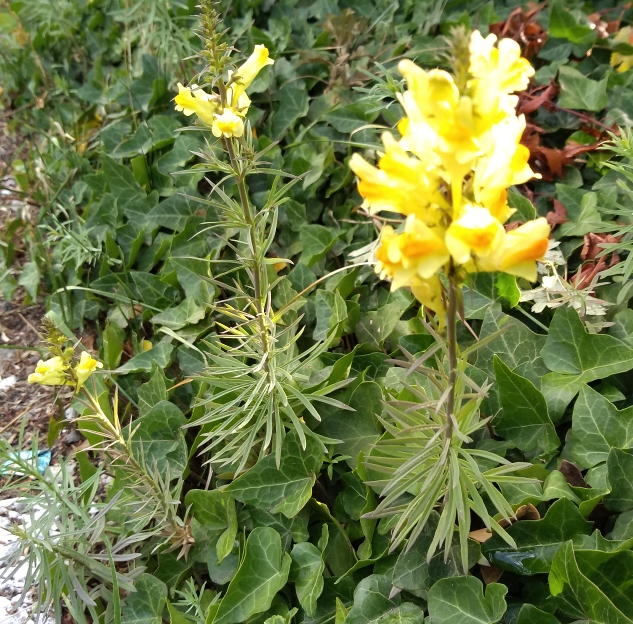
Some fields along my journey to and from work contain a lovely combination of pink Rosebay Willowherb (Chamaenerion angustifolium), purple Buddleia and white Wild carrot (Daucus carota) flowers. Not only do they compliment one another visually but they are all loved by pollinators too. Yellow toadflax (Linaria vulgaris) has started to bloom along the roadside as well.

One special moment occurred on the Monday. As I worked within a border I noticed a Buff-tailed bumblebee (Bombus terrestris) queen flying around a patch of grass. Eventually she began to settle and after a few more large sweeping flights began making a nest in the lawn.

It didn’t take her long to dig into the soil beneath the grass.

She will remain under ground until spring when she will start her own colony.

It was also great to finally get some photos of insects that have have alluded my photographic capture so far this year.

– The first is the Red admiral (Vanessa atalanta),

– Some Hoverflies, including a Hornet mimic (Volucella zonaria) hoverfly,

Hornet mimic Hoverfly pollinating Wisteria flowers that were still blooming.
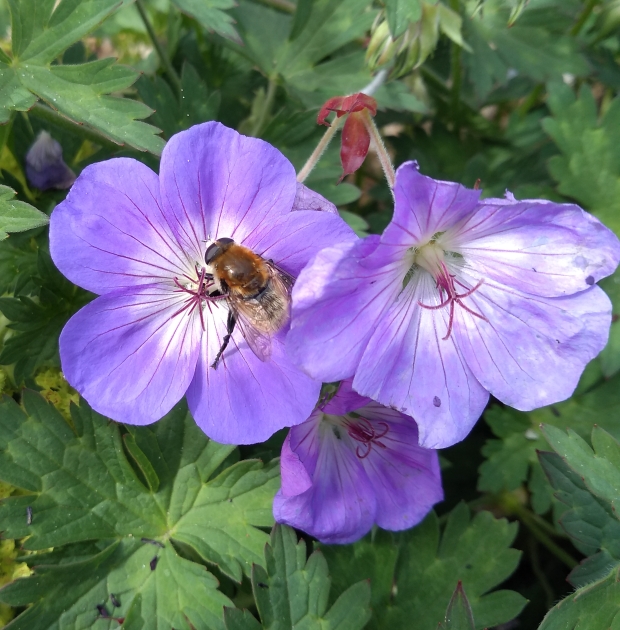
Hoverfly pollinating Geranium flowers.

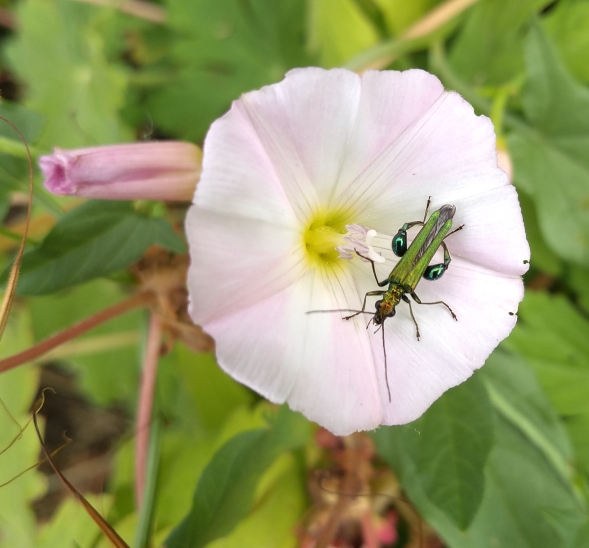
– as well as a Male False oil beetle (Oedemera nobilis), to compliment the female one seen on a walk earlier in the year.

A False oil beetle pollinating a Field bindweed (Convolvulus arvensis) flower.

The males are easily identified due to their large metallic thighs, explaining the reason behind the other common name for this insect the Swollen-thighed beetle.

Posted in nature

All You Need is Love and Nature

Last week love was definitely in the air as I saw numerous Dragonflies and a couple of Buff-tailed bumblebees (Bombus terrestris) mating. New generations were also evident as several young species of insects and an amphibian were noticeable during the week.

Firstly a European gypsy moth (Lymantria dispar) caterpillar was discovered beneath some rhubarb that was being harvested.

Wind disperses these caterpillars when very young. So this one could have travelled several miles.

These caterpillars feed on Creeping Willow (Salix repens) and Bog-myrtle (Myrica gale) along with a few broadleaf trees and bushes. I guess this one could have been feeding on the Rhubarb; however as it was the only caterpillar and the rhubarb patch is very healthy, it was left. This moth was believed to be instinct in the UK during the early 20th century. However in recent years a few have established themselves in Jersey but also in areas of southern England.

I was happy to see the Seven-spot ladybirds on the allotment were happily munching their way through the white fly (Aleyrodidae) on the Calendula flowers. They have definitely grown in size.

Last Wednesday was the first time this year that I saw lots of Harlequin ladybirds (Harmonia axyridis), or more precisely their pupae as I cutback a Clematis in one garden. These ladybirds established themselves in the same garden last year so it wasn’t too surprising to rediscover them there.

Photo of this Harlequin ladybird pupae has been enlarged.

On the same day I also noticed a baby frog (Rana temporaria) hopping from a rejuvenated pond.

This photo is enlarged; It was smaller than my thumbnail so it was lucky I saw a small movement in the lawn.

I helped it escape the mower blades as my colleague cut the grass.

With the topsy turvy weather at the moment some days go by when I don’t see any pollinators; while other times they fill the air between visiting flowers. Along with bees and butterflies, lots of Hoverflies and day flying moths were about too.

I also saw Field Scabious
(Knautia arvensis) blooming along the verge as I walked towards my allotment.

This beautiful plant, loved by pollinators, flowers between July and October, so it isn’t that early.

Last week was uplifting, seeing nature continue to prosper. It fills me with hope for a wonderfully diverse world, something humans to reflect upon during these times.

Posted in nature

The Birds and the Bees

Two creatures were evident last week even though I didn’t actually see them.

Firstly Wrens (Troglodytes troglodytes) sung loudly in different areas, including near my home. It was a joy to hear them throughout the mornings.

These brown, diminutive birds with upturned tails, weigh about 7-10 grams; only Goldcrests (Regulus regulus)
are smaller. Wrens are rarely seen as their nests (made from moss and twigs) are positioned beneath shrubs or in rock crevices. Plus they mostly feed on insects and spiders and therefore remain hidden for a large amount of time. However they make their presence known due to their powerful song which can be heard at some distance. Their distinctive song contains a trill at the end, often discribed as sounding like a machine gun (see RSPB).

Secondly, on Thursday, I discovered that female Leaf-cutter bee(s) had visited one of the gardens I help look after. The evidence was semi-circular shapes cut around the edges of Broad-leaved enchanter’s nightshade (Circaea lutetiana) leaves.

The Broad-leaved enchanter’s nightshade is part of the Willowherb family.

The bits of leaf will have been carried to a nest, chewed and mixed with saliva to form walls to create the cells if the bees nest. Commonly Bee hotels are used by these solitary bees with lots of cells within each piece of bamboo or hole. Each cell contains an egg and pollen so that the larvae has a food source when it hatches. Although they become adults in autumn, the newly formed bees hibernate during winter, emerging in spring when the new generation repeats the process.

The most common Leaf-cutter bee found in gardens is the Patchwork leaf-cutter bee (Megachile centuncularis); for more information see The Bumblebee Conservation Trust.

Common plant leaves used for this purpose by Leaf-cutter bees are those from Roses, Wisteria, honeysuckle, several tree species and Willowherbs. As at least one bee was clearly using these plants for it’s nest, patches of these wild flowers were left at the back of the borders and the client was informed. Thankfully they are a fellow bee lover and happy to allow them to remain. I feel it’s important to point out, that no lasting damage is done to the plants. Therefore if you find such holes cut in your roses, please don’t panic.

I have yet to see a Leaf cutter bee, especially one ‘surfing’ with a leaf. I would love to see one of these bees so I got incredibly excited to see this evidence. Unfortunately my search was in vain but I am one step closer.

Posted in nature

Early Transition into Summer.

Last week began with Spring bank holiday monday. I went for a socially distant walk around the village with my partner. Thankfully he was very patient as I constantly stopped to take photos with my phone.

There were lots of sights and sounds to observe and it really felt like a summers day (which aren’t far off). Some I have noticed for a while like Orange-tip Butterflies (Anthocharis cardamines), Red-tailed bumblebees (Bombus lapidarius), Skylarks (Alauda arvensis), Red kites (Milvus milvus) and House sparrows (Passer domesticus).

Yet amongst the Elderflowers (Sambucus nigra) and Brambles (Rubus fruticosus), which are blooming at this time of year,

These flowers are great for making Elderflower cordial.
Looks like there will be lots of Blackberries this year.

were many more plants flowering too. The explosion of colour within our countryside is fantastic for pollinators. One insect I saw on Mondays walk, in a field busily pollinating Buttercups (Ranunculus), was the False oil beetle (Oedemera nobilis). This very small beetle is a vibrant metallic green colour. When it’s wings glistened in the sun, they changed from mid to light green.

Unfortunately this is the best photo I managed to get of this tiny beetle.

Upon my return to work, I noticed other insects flying about. Several small tortoiseshell Butterflies (Aglais urticae) were too quick for me to photograph, however I did capture Common carder bees (Bombus pascuorum) on Common comfrey (Symphytum officinale) and

a Cream Spot Ladybird (Calvia quattuordecimguttata)

Once again, another ladybird determined to get my attention by falling on my sunglasses while I wore them.

The Cream Spot ladybird has fourteen spots and survives winter in tree bark and Beech masts. Although it is usually found amongst hedgerows rather than gardens.

Wildflowers that were in full bloom last week were;

-Purple toadflax (Linaria purpurea),

-Field scabious (Knautia arvensis),

– Common stork’s-bill (Erodium cicutarium),

This plant is a good food source for Brown argus Butterfly (Aricia agestis) caterpillars, along with Meadow and Dove’s-foot Crane’s-bills (mentioned below). This butterfly is often found in southern chalk and limestone grassland but it can also inhabit places with disturbed soil like verges and coastal areas. In fact this plant was found on disturbed soil edging a field.

-Meadow crane’s-bill (Geranium pratense),

-Creeping cinquefoil (Potentilla reptans),

-Common poppy (Papaver rhoeas),

-Dove’s-foot Crane’s-bill (Geranium molle),

-Field bindweed (Convolvulus arvensis),

-Common mallow (Malva sylvestris),

-Creeping woodsorrel (Oxalis corniculata),

-Birds-foot trefoil (Lotus corniculatus) and

-White clover (Trifolium repens).

Found amongst lawns, this is a wonderful food source for the Common blue butterfly (Polyommatus icarus) and some bumblebees

Recent weather conditions have caused dryness within nature that normally exists during summertime. Water is already required and talk of conserving water has already begun to help prevent restrictions later in the year. I shall be interested to see how nature deals with this early warm dry weather, especially with less human disturbance due to lockdown. Will it be another great year for butterflies? I look forward to discovering more as we spring into summer.

Posted in nature

Things Come in Threes

At least in several gardens last week, things with three leaves appeared as several Trefoils began to flower.

In some lawns the yellow flowering Slender hop clover (Trifolium micranthum) has shown itself along with Red clover (Trifolium pratense).

Slender hop clover
Red clover

Red clover is also called Bee-bread (along with White clover- Trifolium repens) due to its popularity with bees. It’s nectar is especially loved by Common carder bees (Bombus pascuorum), Honeybees (Apis mellifera) and Red-tailed bumblebees (Bombus lapidarius). Red clover, which is less commonly found in nature than White clover, is used for livestock feed and crop rotation (due to its nitrogen fixation abilities). It is also used in herbal medicine to treat respiratory and skin ailments,along with menopausal and PMS symptoms because the flower contains isoflavones. When taken internally, isoflavones become phytoestrogens which has similar affects in the body as estrogen (see Plantlife)

I will have to wait a little longer to see White clover flowering as it blooms from June. However White clover is commonly found in verges and grassland so I’m sure to see some eventually.

Unfortunately I have never spotted a four leaf clover (or five leaved). I am ever hopeful, just for the challenge because they are so hard to spot in the wild.

Several trees are blooming at the moment. Along with Hawthorn (Crataegus monogyna- the May tree flowers referred to in the rhyme ‘Cast ne’er a clout ere May is out’) the Horse chestnut (Aesculus hippocastanum) is also in flower; they have white flowers with a pink tinge.

I also see the Red horse chestnut tree (Aesculus x carnea Briotii) on my travels, both trees have very showy flowers.

It was great to see lots of bees about last week and various species too.

The first type of bee I saw was a Hairy-footed flower bee (Anthophora plumipes) around some forget me nots (Myosotis).

I also noticed lots of Buff-tailed bumblebees (Bombus terrestris),
Honey bees and Early bumblebees (Bombus pratorum) throughout the week too.

This Cotoneaster hedge was alive with Honey bees. Make sure the sound is on to listen to their relaxing buzzing.
The Early bumblebees were also visiting the Cotoneaster flowers.
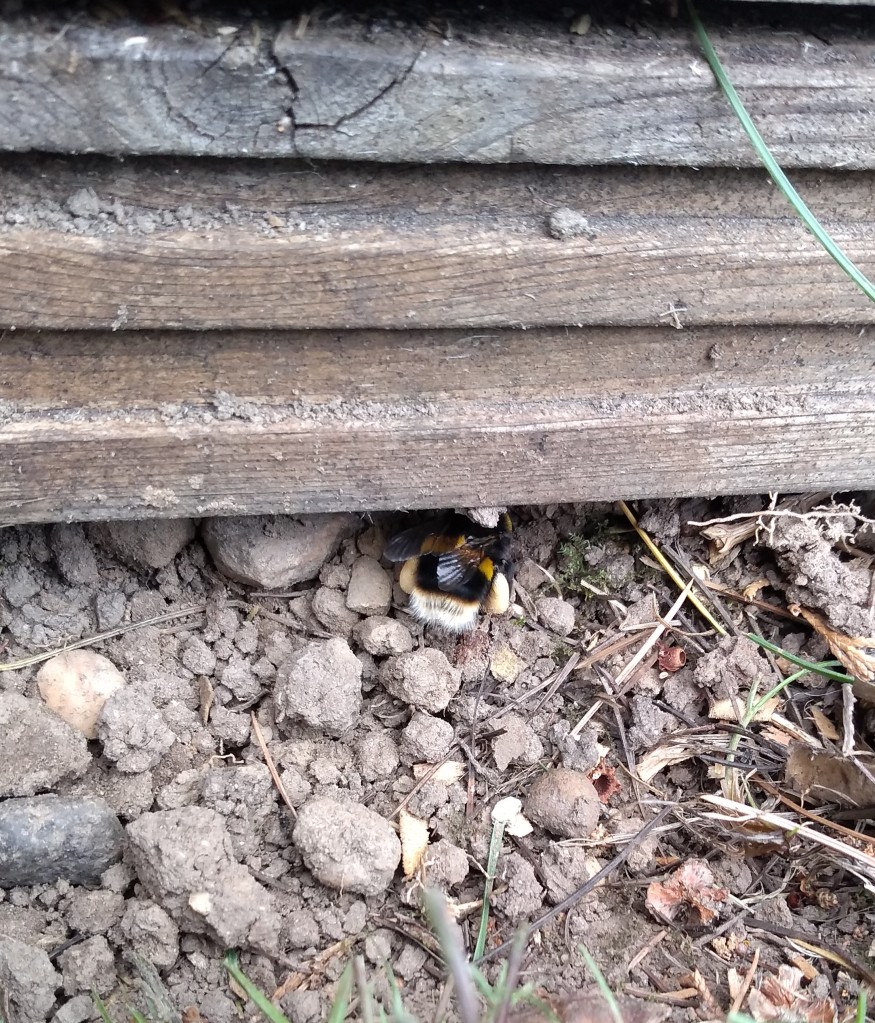
I noticed five Buff-tailed bumblebees coming and going from a nest under some decking in one garden.