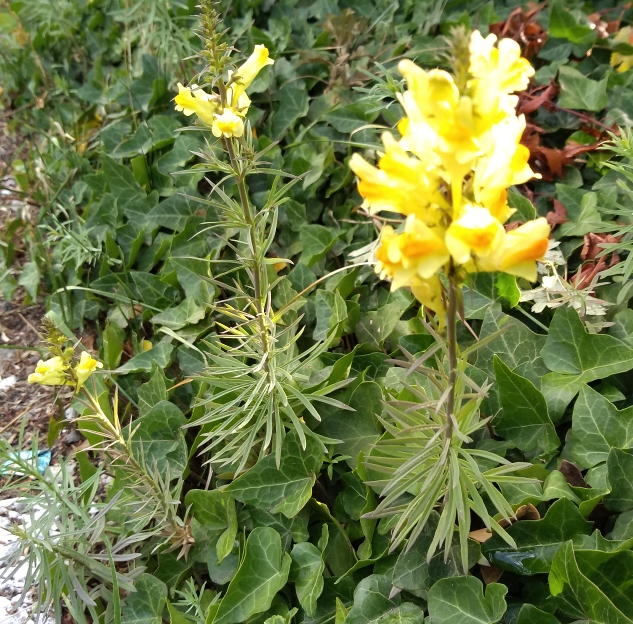
Some fields along my journey to and from work contain a lovely combination of pink Rosebay Willowherb (Chamaenerion angustifolium), purple Buddleia and white Wild carrot (Daucus carota) flowers. Not only do they compliment one another visually but they are all loved by pollinators too. Yellow toadflax (Linaria vulgaris) has started to bloom along the roadside as well.
One special moment occurred on the Monday. As I worked within a border I noticed a Buff-tailed bumblebee (Bombus terrestris) queen flying around a patch of grass. Eventually she began to settle and after a few more large sweeping flights began making a nest in the lawn.
It didn’t take her long to dig into the soil beneath the grass.
She will remain under ground until spring when she will start her own colony.
It was also great to finally get some photos of insects that have have alluded my photographic capture so far this year.
– The first is the Red admiral (Vanessa atalanta),
– Some Hoverflies, including a Hornet mimic (Volucellazonaria) hoverfly,
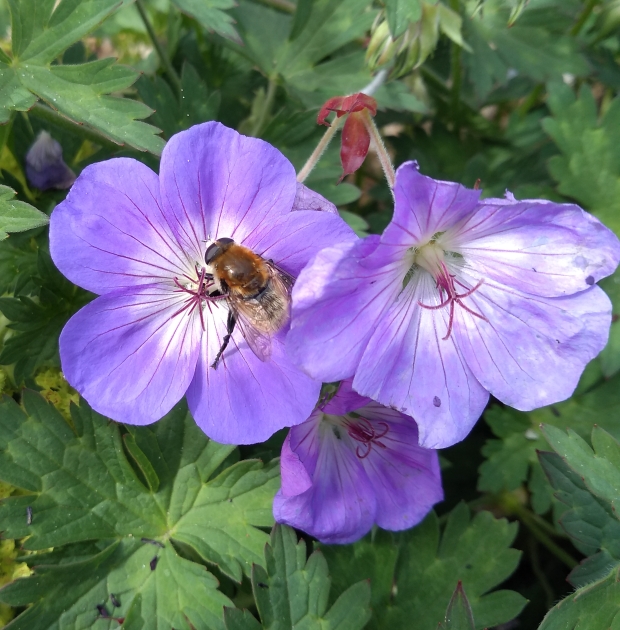
Hornet mimic Hoverfly pollinating Wisteria flowers that were still blooming.Hoverfly pollinating Geranium flowers.
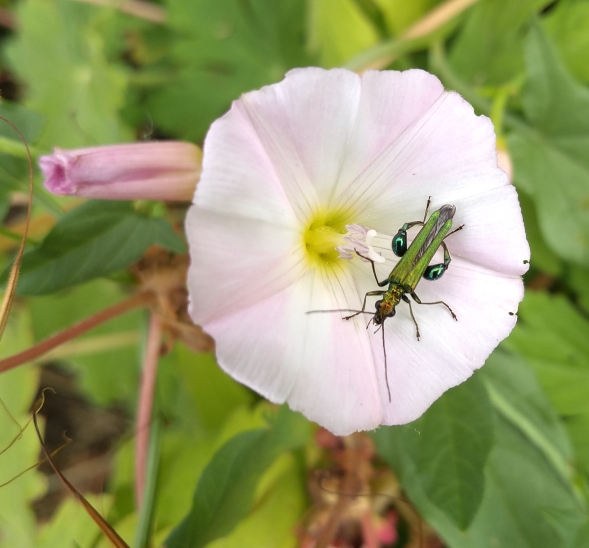
– as well as a Male False oil beetle (Oedemera nobilis), to compliment the female one seen on a walk earlier in the year.
A False oil beetle pollinating a Field bindweed (Convolvulus arvensis) flower.
The males are easily identified due to their large metallic thighs, explaining the reason behind the other common name for this insect the Swollen-thighed beetle.
A month ago I had a weeks holiday. Signs of autumn were beginning to mingle with late summer. Now October is here autumn has definitely arrived.
As I had another week off I decided to revisit my local park, observing changes from a month ago.
In September Roesel’s bush crickets (Metrioptera roeselii) were chirping everywhere, butterflies were flitting about and some flowers still bloomed amongst the meadow (see Relaxing into Autumn).
Upon my return last Tuesday the only sounds I heard were birds singing and the meadow area had been cut and baled. Cobwebs were visible in the long dew dampened grass around the edges of the woodland too.
Hawkweed, Ragwort (Jacobaea vulgaris), Red clover (Trifolium pratense) and Yarrow (Achillea millefolium) were only just flowering still while the Ivy (Hedera) was in full bloom.
Ivy is fantastic for pollinators at this of year. I saw a few hoverflies flying to and from several flowers but the Honey bees (Apis mellifera), that were still active from the nearby hives would probably visit them too.
It was lovely to see dried seedheads of Wild carrot (Daucus carota)
and Cow parsley (Anthriscus sylvestris)
as I wondered around the park. They look beautiful but they are useful for insects to shelter in as well. In fact I noticed a ladybird snuggling amongst one of the Cow parsley seedheads. I also discovered field mushrooms (Agaricuscampestris) growing amongst the grass.
Trees and shrubs were starting to show autumnal colours along with their ripe fruits. I found elderberries, sloe as well as haws on the Hawthorn (Crataegus monogyna) alongside Rosehips. However there were no longer any blackberries left on the brambles.
I noticed the leaves of one Horse chestnut tree (Aesculus hippocastanum) affected by the Horse chestnut leaf miner (Cameraria ohridella) moth.
Similarly there was evidence of caterpillars (most likely another moth) having been on a Silver maple (Acer saccharinum) tree.
The eggs and excrement are still visible on the nibbled leaves.
I ended my weeks holiday with a visit the Horniman museum in London.
On route to the train station I saw a Brown rat (Rattus norvegicus) running across a path. It attempted to cross the road until either the traffic or pedestrians scared it into fleeing towards a nearby hedge. Once I arrived in London I realised that I never see rats in the underground any more. I used to enjoy seeing them scurrying between the tracks. I have owned pet rats for many years so I find wild rats intriguing. I also like to watch Squirrels as rodents tend to act in similar ways to one another. After lunch I observed two Grey Squirrels (Sciuruscarolinensis) scamper about.
The nearest squirrel had an acorn in its mouth and appeared to bury it in different places. I once saw a television programme on squirrels in which one was observed ‘pretending’ to bury a nut in several places while in the presence of other squirrels to avoid their stash being taken. Presumably this was occurring with the squirrels I was watching on Friday.
There is a butterfly house and aquarium at the Horniman museum. The butterflies were looking a little aged with their wings rather worn, however they were still beautiful. As soon as I entered the butterfly house a Malachite butterfly (Siproetastelenes) landed on me which felt wonderfully welcoming.
The photo below shows a selection of the many butterflies I saw.
Feeding on the fruit are one Blue morpho (Morpho peleides), one Brown clipper (Parthenos Sylvia philippinensis), two Blue clipper (Parthenos Sylvia) and three Owl butterflies (Caligo memnon).
There were lots to see in the aquarium as well but my favourites were the White spotted jellyfish (Phyllorhizapunctata); watching them was so relaxing.
Even at the weekend nature was visible. As I ate breakfast on Saturday morning I heard and watched a group of Coal tits (Periparus ater) on the Rowan tree (Sorbusaucuparia) outside. I have never seen Coal tits on this tree before, I hope to see them again.
Another animal I became aware of last week was a Red fox (Vulpes vulpes). I first noticed it on my way home on Wednesday night and again on Sunday morning. It was making itself known on Saturday night too as it was being very vocal.





 Bee in the Moment