Posted in nature

Further Easing into Summer

I am constantly amazed by the natural world. Last week I saw something that, as a gardener, I’m surprised I’ve never noticed before. A few White-tailed bumblebees (Bombus lucorum) flew to and from a nest in a wall, via the damp proofing brickwork, of an old house. What I wasn’t expecting to see were the blue pollen baskets.

I had never thought of pollen as anything other than varying shades of yellow. After researching this I found that different coloured pollen often shows up in nests and hives. Charts have been produced enabling beekeepers to identify which flowers their bees have visited by the colour and shade of the pollen found. The most likely candidates in this instance, given the time of year and dark blue shade, is Purple tansy (Phacelia tanacetifolia), see the North Shropshire Bee Keepers Association website.

Phacelia is loved by bees. These photos are from a neighbouring allotment plot.

As well as Phacelia other flowers currently blooming include;

– Hedge woundwort (Stachys sylvatica),

– Pineappleweed (Matricaria discoidea),

A close up view of Pineappleweed. When crushed, the flowers have a refreshing pineapple scent.

– Stinking iris also called Roast-beef plant (Iris foetidissima),

This plant has two colour variations. It thrives in shady areas.

– Scarlet pimpernel (Anagallis arvensis) and

– Pyramidal orchid (Anacamptis pyramidalis)

This orchid is attractive to butterflies and moths.

Birds are particularly noticeable at this time of year as they feed youngsters and defend territories. Last week I was able to listen to Song thrush (Turdus philomelos), Chiff chaff (Phylloscopus collybita), Robin (Erithacus rubecula) Great spotted woodpecker (Dendrocopos major) and Swifts (Apus apus).  I saw the Swifts’ arial display as they soared and dived in the distance while I ate lunch last Wednesday. They were too high and quick for me to identify visually but their vocalisations gave them away. The Swifts’ call can be heard on the RSPB website.

Ladybirds continued to show up last week, but mostly the Seven-spot ladybird (Coccinella septempunctata).

Eventually, the weather turned and rain finally arrived by Friday. It has been much needed and continued throughout the weekend. It was fantastic to watch thunder and lightening from the comfort of my sofa on Saturday afternoon.

Posted in nature

More Fabulous Fungi

The autumn colours were glorious last week; particularly the Acers like the Acer dissectum below.

Another tree that I loved seeing was a Tulip tree (Liriodendron tulipfera).

This tree is so called because the flowers look similar to tulips. I have never noticed it flower but I will try to remember to keep an eye out for them next summer.

The recent wet weather has had opposite affects on wildlife. I haven’t seen many pollinators lately but have continued to see lots of fungi. Infact the timing of this wet weather has meant it’s been a bumper year for fungi.

The few pollinators that I have noticed include Common wasps (Vespula vulgaris) on some Ivy (Hedera helix) flowers

and one White tailed bumblebee (Bombus lucorum) on Monday.

I also saw a couple of moths at the end of the week too. The first one was a Winter moth (Operophtera brumata)

and the second one was a Scarce bordered straw (Helicoverpa armigera). The latter moth is a migrant visiting the UK.

I was a little surprised to see some Feverfew (Tanacetum parthenium) still flowering in one garden. I enjoy seeing this daisy like wild flower and like it’s common name Bachelor buttons.

The mushrooms I noticed last week were varied in size and colour.

*Once again, please do not use this post as a guide to edible mushrooms.*

I have managed to identify some but have placed question marks next to those I am unsure of.

The mushrooms I saw last week were;

– the Common puffball (Lycoperdon perlatum).

[The second photo was from a few days later. I noticed that they had matured, ready to release their spores].

-Orange Bonnet (Mycena acicula)

-Purple brittlegill (Russula atropurpurea)

-Turkey tail (Trametes versicolor)

-Lilac bonnet (Mycena pura)?

-Rosy bonnet (Mycena rosea)

-Milking bonnet (Mycena galopus)?

-Horse mushroom (Agaricus arvensis)?

-and Cortinarius umbrinolens?

The week ended with a brief visit from a Jay (Garrulus glandarius) to the Rowan tree outside my home. I can’t wait to see if I get Redwings (Turdus iliacus) visit soon as well. I usually have a few snacking on the berries each year; hopefully they come before all the berries disappear. The UK conservation status of this thrush is red so it’s always special to see them. Redwings look similar to thrushes but have a splash of red under their wings.

Posted in nature

Music to my Ears

While my colleagues listen to their music via headphones I prefer to listen to nature as I work; especially birdsong which I find uplifting. Recently I have started to really tune in and distinguish different songs and calls as I attempt to identify particular birds. By teaching myself I now recognise Great tit (Parus major) song, Coal Tit (Parus ater) song and Tawny Owl (Strix aluco) call. However I still find it difficult to pick out certain sounds which is why last Sunday I went to an ‘Introduction to bird calls and songs’ nature talk and walk at a local park. We were introduced to 12 birds that we would most likely hear during our afternoon stroll. Most were already familiar to me however I did learn the songs of Chiffchaff (Phylloscopus collybita) and Greenfinch (Carduelis chloris).

The birds we ended up hearing (above the wind and sirens) were;
-Woodpigeon (Columba Livia)
-Carion crow (Corvus corone)
-Magpie (Pica pica)
-Wren (Troglodytidae)
-Chiffchaff
-Blackbird (Turdus merula)
-Great Spotted Woodpecker (Dendrocopus major)
-Blackcap warbler (Sylvia atricapilla)
– and Song thrush (Turdus philomelos).

We also saw a (quiet) Jay (Garrulus glandarius) along with a Speckled wood butterfly (Pararge aegeria), Red admiral butterfly (Vanessa atalanta) and some White-tailed bumblebees (Bombus lucorum).

Last week I combined what I learned at this event with my previous knowledge; the birds I was confident I identified correctly were;
-Woodpigeons
-Magpies
-Blackbirds
-Robin (Erithacus rubecula)
-Ring necked parakeets (Psittacula krameri)
-Blue Tits (Parus caeruleus).
-Chiffchaffs
-Mallard (Anas platyrhynchos)
-Red kite (Milvus milvus)
-and House sparrows (Passer domesticus)

On several mornings I also watched the family of Blue tits on the Rowan tree as I ate breakfast. The parents had nested in the eaves around Easter (see Different sort of Easter Chicks) so it was great to discover they had a successfully reared a brood. I counted 6 fledged youngsters return to the tree and feed on insects together.

Blue Tit acrobatics- One of the youngsters feeding itself.

These weren’t the only sightings last week as I also saw;
-another Red Admiral butterfly

-a Cinnabar moth (Tyria jacobaeae)

-some Ivy-leaved toadflax (Cymbalaria muralis)

-Common spotted orchid (Dactylorhiza fuchsii)

-Pineappleweed (Matricaria discoidea)

-As well as a common frog (Rana temporaria)

Posted in nature

Working with Insects can be Frustrating

More colour is showing up along the road as the purple of the Common mallow (Malva sylvestris) blooms amongst Common Poppies (Papaver rhoeas) and Ox-eye daisies (Leucanthemum vulgare); a lovely sight as I travel on the bus.

Another plant that is flowering on the verges and lawns now is White Clover (Trifolium repens).

I first saw it on Monday, at the bus stop, as I listened to a Goldfinch (Carduelis carduelis).

The Goldfinch can just be heard singing above the drone of the traffic.

A group of Goldfinches is a ‘Charm’ from the old English word c’irm, referring to their singing.

Last monday was the day for noticing Goldfinch as later in the morning I watched a couple of Goldfinch on a nest in a Buddleia (Buddleja davidii).

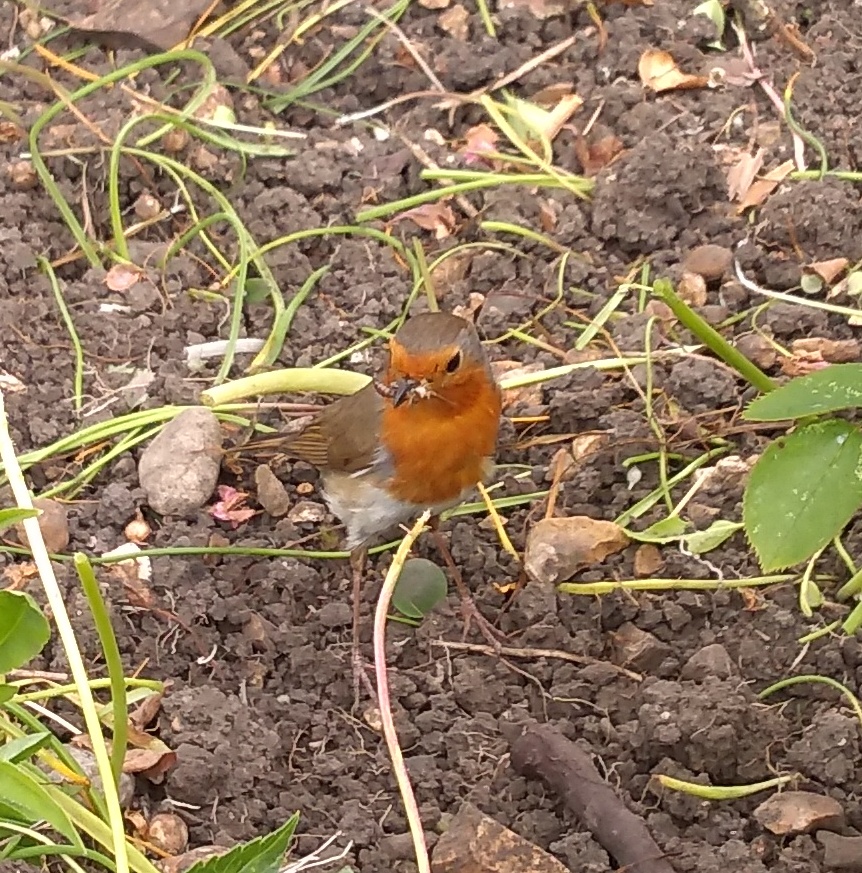
They weren’t the only birds I noticed that day. In the afternoon a Robin (Erithacus rubecula) kept me company as I weeded. It was quite fearless, frequently getting close to me to collect food as I worked.

I noticed some Scarlet Pimpernel (Anagallis arvensis) flowering too. Other common names for it include Poor man’s Barometer or Shepherd’s clock because the flowers open in sunny weather and close when it is dull.

As it was a a warm sunny day lots of bees were out. On the Catmint (Nepeta) there were Early Bumblebees (Bombus pratorum), White-tailed Bumblebees (Bombus lucorum), Tree Bumblebees (Bombus hypnorum) and Honey Bees (Apis mellifera).

A White-tailed bumblebee busy working.

As the week went on I continued to notice a greater variety of bees visiting the garden;

– Tree Bumblebees, Early Bumblebees, White-tailed Bumblebees as well as female Red tailed bumblebees (Bombus lapidarius) on a weigela.

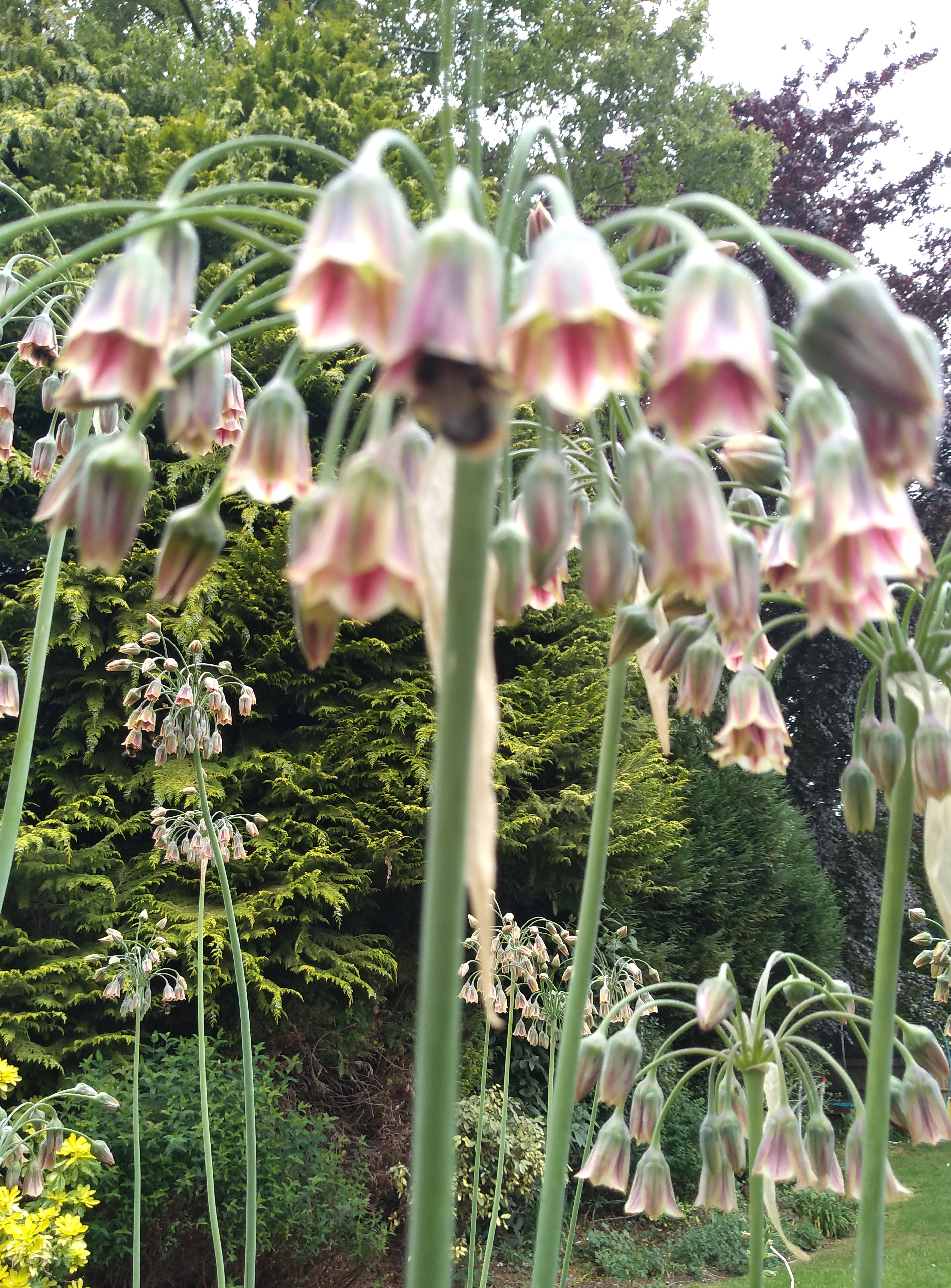
-Early Bumblebees and White-tailed Bumblebees on some Pale Garlic (Allium paniculatum).

This is the best photo I managed to obtain. The saying about not working with children or animals (or in this case insects) came to mind on Tuesday and Wednesday; descent photos were severely lacking midweek.

On Thursday, as I undertook more weeding, I unfortunately disturbed a beautiful White plume moth (Pterophorus pentadactyla) in the border. The caterpillars, which are green and yellow, feed on bindweed so this was a welcome sighting.

Posted in nature

Summer is Nearly Here (plus a belated Mental Health Awareness Week special)

Mental health awareness week was 13-19th May this year. I didn’t get round to writing a piece for it then; better late than never.

I think it is important to talk about mental health and I am open about my own experiences when the subject is mentioned.

I have dealt with Social anxiety and Seasonal Affective Disorder for a long time, although my mental health has improved over the years. Through medication, Cognitive behavioural therapy, healthy eating, exercise, mindfulness, along with getting outdoors and immersing myself in nature I manage these conditions. I started this blog to help give me focus too.

Thankfully I am at a stage where I can manage these conditions without them causing much disruption to my life. However some days are more difficult to deal with than others, Tuesday started out as one of those days. For some reason my anxiety level was high first thing. After forcing myself to open the curtains I noticed a Great Tit (Parus major) fledgling, with an adult, in the Rowan tree (Sorbus). They were feeding on insects before they flew onto a neighboring Rowan tree. This start to the day reminded me to be in the moment and enabled me to work on my thoughts and face the day ahead.

As the day continued, my anxiety wained. Being outdoors with nature helps.
In the afternoon I noticed a mature male Large Red Damselfly (Pyrrhosoma nymphula). I was able to identify it as male due to the red shoulder strips (they are yellow in immature males) and lack of yellow stripes on the segments of the abdomen, which the females exhibit. Plus the black legs identifies it as the Large Red Damselfly rather than the Small Red Damselfly (Ceriagrion tenellum) which has brown legs. The differences between a Damselfly and Dragonfly is the latter is larger, has thicker bodies and the wings are outstretched when they are resting. The Large Red Damselfly regularly visits garden ponds. However this one seemed happy on the window sill chomping on the insects in the cobweb.

On Wednesday I saw some
Cut-leaved Crane’s-bill (Geranium dissectum) in the lawn.

Then on Thursday I noticed this Early bumblebee (Bombus pratorum) on a Salvia (Salvia X sylvestris) plant.

Friday was quite muggy and rain was threatening to fall in the morning. However a Small Blood-vein moth (Scopula imitaria) was flying around as I worked.

I also saw some Creeping Cinquefoil (Potentilla reptans) flowering on the verge on my way home.

Astronomically summer starts on the summer solstice (21st June) however today (1st June) is the first day of summer meteorologically, as the calendar months are grouped into seasons (therefore summer is June, July and August). Whichever date you prefer to go with we are certainly experiencing summery temperatures this weekend and I was helping to water the garden. Unfortunately a few insects weren’t happy with the shower they suddenly experienced. One insect was a photo shy Hoverfly. I did capture a few insects though,
– a Tree bumblebee (Bombus hypnorum) resting.

-a White-tailed Bumblebee (Bombus lucorum) on Purple toadflax (Linaria purpurea).

– and a Yellow-faced Bell moth (Notocelia cynosbatella).

Posted in nature

Blooms, Bees and Bugs

There were lots of observations last week. As the weather continued to warm up further I saw even more bees and Seven-spot Ladybirds (Coccinella septempunctata).

I also noticed more wildflowers as I walked to work on Tuesday. This relaxed start to the day enabled me to observe;
– White Campion (Silene latifolia).

This flower is great for moths as the flower’s scent is obvious at night.

– Wood Avens (Geum urbanum)

– Cleavers (Galium aparine) with its tiny white flowers.

– Black medick (Medicago lupulina)

– and Annual honesty (Lunaria annua)

During my journey, I also heard a Coal Tit (Periparus ater) singing. Similar to the Great Tit’s (Parus major) song but faster and higher pitched, it is not a bird I hear often.

On Wednesday afternoon I observed lots of insects. Two that were camera shy were a Hawthorn Shield Bug (Acanthosoma haemorrhoidale) and Violet Ground Beetle (Carabus violaceus).

Other sightings which I managed to photograph were;

– Early Bumblebees (Bombus pratorum) on Rosemary
(Rosmarinus officinalis) and on Ajuga reptans ‘Atropurpurea’ (a cultivated variety of Bugle).

The Early Bumblebee is the UK’s smallest Bumblebee.

I also saw Rosemary Beetles (Chrysolina americana) on a few Rosemary plants.

This pest is beautiful when it glistens in the sun. Thankfully the amount I found didn’t warrant drastic intervention. The RHS is undertaking a survey to discover their advancement within the UK (see Royal Horticultural Society) so I uploaded my findings.

I also found an insect on some lavender (Lavandula) that I didn’t recognise.

This terrible photo is due to the constant movement of the plant in the breeze (it was the best one I managed to take). I only include it as a demonstration on the brilliance of the Natural History Museum. Occasionally I have difficulty in identifying my findings and at that point I rely on the Natural History Museum’s identification service. I was clutching at straws that they could see through the blurred image and be able to identify the bug. To my surprise they managed to tell me it was a Cinnamon bug (Corizus hyoscyami). If you ever need help identifying insects then I highly recommend this brilliant service (see Natural History Museum).

I saw yet more bees on Friday, including a Honey bee (Apis mellifera) on a Cornflower (Centaurea cyanus) plant

along with a
Buff-tailed bumblebee (Bombus terrestris) on Welsh poppy (Meconopsis cambrica)

Even yesterday, as I visited Shaw’s Corner (a lovely small National Trust house and garden) I noticed more wildlife;
-Common Bird’s-foot Trefoil (Lotus corniculatus)

-Red Clover (Trifolium pratense)

– and some wild Bugle (Ajuga Reptans) amongst the grass which had purposely been left long.

Plus I also noticed a Marmalade Hoverfly (Episyrphus balteatus) and a Tree bumblebee (Bombus hypnorum) on some Dog rose (Rosa canina)

as well as a Red-headed Cardinal Beetle (Pyrochroa serraticornis) balancing precariously on a blade of grass.

Posted in nature

World Bee Day 🐝🐝🐝🐝🐝🐝🐝🐝🐝🐝

Today is World Bee Day; a day that publicises the decline in bee numbers, the affect that has in the world as well as what we can do to reverse this problem ( BBC Newsround).

I was keeping a special lookout for bees today. Two species of bees that I noticed were;

-Red-tailed Bumblebees (Bombus lapidarius) on a group of Alliums.

– White-tailed Bumblebees (Bombus lucornum) on some Dusky Cranesbill (Geranium phaeum)