Posted in Allotment, nature

Time to Make Daisy Chains?

It was encouraging to witness dragonflies zipping about and mating over the past week; another sure sign of summers arrival for me.

Down at the allotment, it’s been wonderful to see the addition of a pond on a neighbouring plot. I’m excited to see what inhabits it; hopefully some beneficial wildlife will find it soon, perhaps some dragonflies of our own.

The predominant flowers on on recently mown grass are still daisies (Bellis perennis) although White clover (Trifolium repens) and Bird’s-foot trefoil (Lotus corniculatus) have begun to bloom alongside them.

My White clover and Bird’s-foot trefoil seedlings, down at the allotment, are coming along fantastically; I look forward to eventually transplanting them to my wild flower patch. Unfortunately, the Yellow rattle (Rhinanthus minor) seeds didn’t take.  Perhaps the weather earlier on in the year wasn’t conducive to their germination so I’ll try to obtain plants in autumn instead. Ideally I need them to control the grass so the other wild flowers have a chance to thrive.

I love seeing daisies everywhere. I love their simplicity, abundance, cheerful yellow center along with the fact they open during the day and close at night. Seeing them always brings back memories of making daisy chains as a child, which makes me smile. When I doodle flowers, it’s the daisy shape I always begin with before venturing onto others such as dandelions and foxgloves.

Therefore, I also enjoy seeing Oxeye daisies (Leucanthemum vulgare) join in the grassland mix as well which they did last week. When the grass on the verges is left to grow long for pollinators, it is these taller daisy flowers that can be seen looking upwards towards the sun.

Other tall wildflowers that began to bloom in the unmown grass last week were Yarrow (Achillea millefolium), Common  mallow (Malva sylvestris) and White campion (Silene latifolia). These plants are also great for pollinators, especially the latter whose might time scent is a temptation for moths. In fact this flower was added into Elizabethan pot pourri due to its clove aroma.

Posted in Allotment, nature

A Spring into New Beginnings

The first of March, meteorological spring along with St Davids day all took place last Monday. Even the first grass cut of the season took place last week (albeit only a high cut to level off uneven growth).

Blackthorn was fully blossoming and spring flowers still bloomed as the birds, amphibians and insects continued to become more active. There were a few new observations; I noticed a single Two-leaf squill (Scilla bifolia) growing in a lawn and, in the same garden, saw a male Ring necked Pheasant (Phasianus colchicus) strutting his stuff.

Things are moving on at the allotment. Sweetpea and Vegetable seedlings are doing well as are the seeds sown for cut and wild flower areas on the plot. The beds are ready for direct sowing which I hope to undertake within the next few weeks and I wait for Yellow rattle (Rhinanthus minor) and Bird’s-foot trefoil (Lotus corniculatus) to germinate. I also hope to get the shed painted, install a water conserving system and build a bigger greenhouse sometime in the future.

While I am looking forward to the new growing season to begin in earnest I am also mindful to enjoy this moment; to stop, observe, reflect and plan and allowing nature to dictate the speed when things need to begin.

Aubergine and Chilli seedlings
Kale seedlings
Tithonia, Scabious and White clover seedlings (Trifolium repens)
Posted in nature

Early Transition into Summer.

Last week began with Spring bank holiday monday. I went for a socially distant walk around the village with my partner. Thankfully he was very patient as I constantly stopped to take photos with my phone.

There were lots of sights and sounds to observe and it really felt like a summers day (which aren’t far off). Some I have noticed for a while like Orange-tip Butterflies (Anthocharis cardamines), Red-tailed bumblebees (Bombus lapidarius), Skylarks (Alauda arvensis), Red kites (Milvus milvus) and House sparrows (Passer domesticus).

Yet amongst the Elderflowers (Sambucus nigra) and Brambles (Rubus fruticosus), which are blooming at this time of year,

These flowers are great for making Elderflower cordial.
Looks like there will be lots of Blackberries this year.

were many more plants flowering too. The explosion of colour within our countryside is fantastic for pollinators. One insect I saw on Mondays walk, in a field busily pollinating Buttercups (Ranunculus), was the False oil beetle (Oedemera nobilis). This very small beetle is a vibrant metallic green colour. When it’s wings glistened in the sun, they changed from mid to light green.

Unfortunately this is the best photo I managed to get of this tiny beetle.

Upon my return to work, I noticed other insects flying about. Several small tortoiseshell Butterflies (Aglais urticae) were too quick for me to photograph, however I did capture Common carder bees (Bombus pascuorum) on Common comfrey (Symphytum officinale) and

a Cream Spot Ladybird (Calvia quattuordecimguttata)

Once again, another ladybird determined to get my attention by falling on my sunglasses while I wore them.

The Cream Spot ladybird has fourteen spots and survives winter in tree bark and Beech masts. Although it is usually found amongst hedgerows rather than gardens.

Wildflowers that were in full bloom last week were;

-Purple toadflax (Linaria purpurea),

-Field scabious (Knautia arvensis),

– Common stork’s-bill (Erodium cicutarium),

This plant is a good food source for Brown argus Butterfly (Aricia agestis) caterpillars, along with Meadow and Dove’s-foot Crane’s-bills (mentioned below). This butterfly is often found in southern chalk and limestone grassland but it can also inhabit places with disturbed soil like verges and coastal areas. In fact this plant was found on disturbed soil edging a field.

-Meadow crane’s-bill (Geranium pratense),

-Creeping cinquefoil (Potentilla reptans),

-Common poppy (Papaver rhoeas),

-Dove’s-foot Crane’s-bill (Geranium molle),

-Field bindweed (Convolvulus arvensis),

-Common mallow (Malva sylvestris),

-Creeping woodsorrel (Oxalis corniculata),

-Birds-foot trefoil (Lotus corniculatus) and

-White clover (Trifolium repens).

Found amongst lawns, this is a wonderful food source for the Common blue butterfly (Polyommatus icarus) and some bumblebees

Recent weather conditions have caused dryness within nature that normally exists during summertime. Water is already required and talk of conserving water has already begun to help prevent restrictions later in the year. I shall be interested to see how nature deals with this early warm dry weather, especially with less human disturbance due to lockdown. Will it be another great year for butterflies? I look forward to discovering more as we spring into summer.

Posted in nature

Things Come in Threes

At least in several gardens last week, things with three leaves appeared as several Trefoils began to flower.

In some lawns the yellow flowering Slender hop clover (Trifolium micranthum) has shown itself along with Red clover (Trifolium pratense).

Slender hop clover
Red clover

Red clover is also called Bee-bread (along with White clover- Trifolium repens) due to its popularity with bees. It’s nectar is especially loved by Common carder bees (Bombus pascuorum), Honeybees (Apis mellifera) and Red-tailed bumblebees (Bombus lapidarius). Red clover, which is less commonly found in nature than White clover, is used for livestock feed and crop rotation (due to its nitrogen fixation abilities). It is also used in herbal medicine to treat respiratory and skin ailments,along with menopausal and PMS symptoms because the flower contains isoflavones. When taken internally, isoflavones become phytoestrogens which has similar affects in the body as estrogen (see Plantlife)

I will have to wait a little longer to see White clover flowering as it blooms from June. However White clover is commonly found in verges and grassland so I’m sure to see some eventually.

Unfortunately I have never spotted a four leaf clover (or five leaved). I am ever hopeful, just for the challenge because they are so hard to spot in the wild.

Several trees are blooming at the moment. Along with Hawthorn (Crataegus monogyna- the May tree flowers referred to in the rhyme ‘Cast ne’er a clout ere May is out’) the Horse chestnut (Aesculus hippocastanum) is also in flower; they have white flowers with a pink tinge.

I also see the Red horse chestnut tree (Aesculus x carnea Briotii) on my travels, both trees have very showy flowers.

It was great to see lots of bees about last week and various species too.

The first type of bee I saw was a Hairy-footed flower bee (Anthophora plumipes) around some forget me nots (Myosotis).

I also noticed lots of Buff-tailed bumblebees (Bombus terrestris),
Honey bees and Early bumblebees (Bombus pratorum) throughout the week too.

This Cotoneaster hedge was alive with Honey bees. Make sure the sound is on to listen to their relaxing buzzing.
The Early bumblebees were also visiting the Cotoneaster flowers.
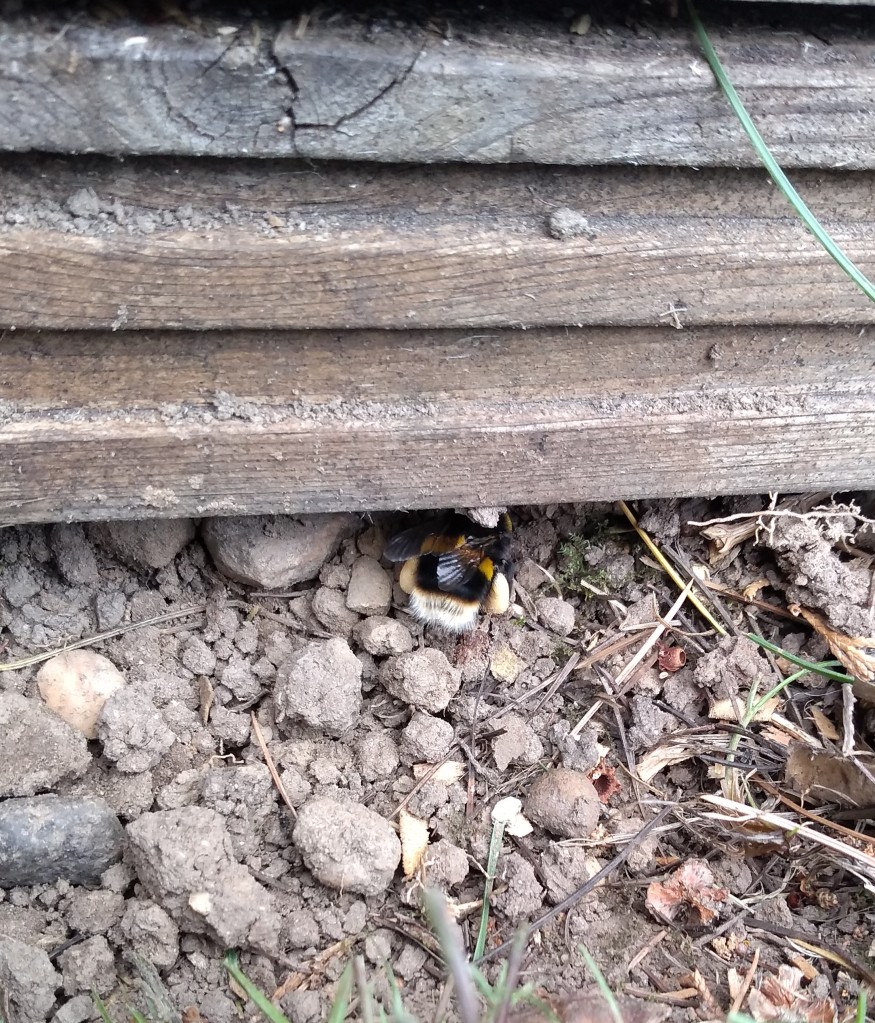
I noticed five Buff-tailed bumblebees coming and going from a nest under some decking in one garden.
Posted in nature

Working with Insects can be Frustrating

More colour is showing up along the road as the purple of the Common mallow (Malva sylvestris) blooms amongst Common Poppies (Papaver rhoeas) and Ox-eye daisies (Leucanthemum vulgare); a lovely sight as I travel on the bus.

Another plant that is flowering on the verges and lawns now is White Clover (Trifolium repens).

I first saw it on Monday, at the bus stop, as I listened to a Goldfinch (Carduelis carduelis).

The Goldfinch can just be heard singing above the drone of the traffic.

A group of Goldfinches is a ‘Charm’ from the old English word c’irm, referring to their singing.

Last monday was the day for noticing Goldfinch as later in the morning I watched a couple of Goldfinch on a nest in a Buddleia (Buddleja davidii).

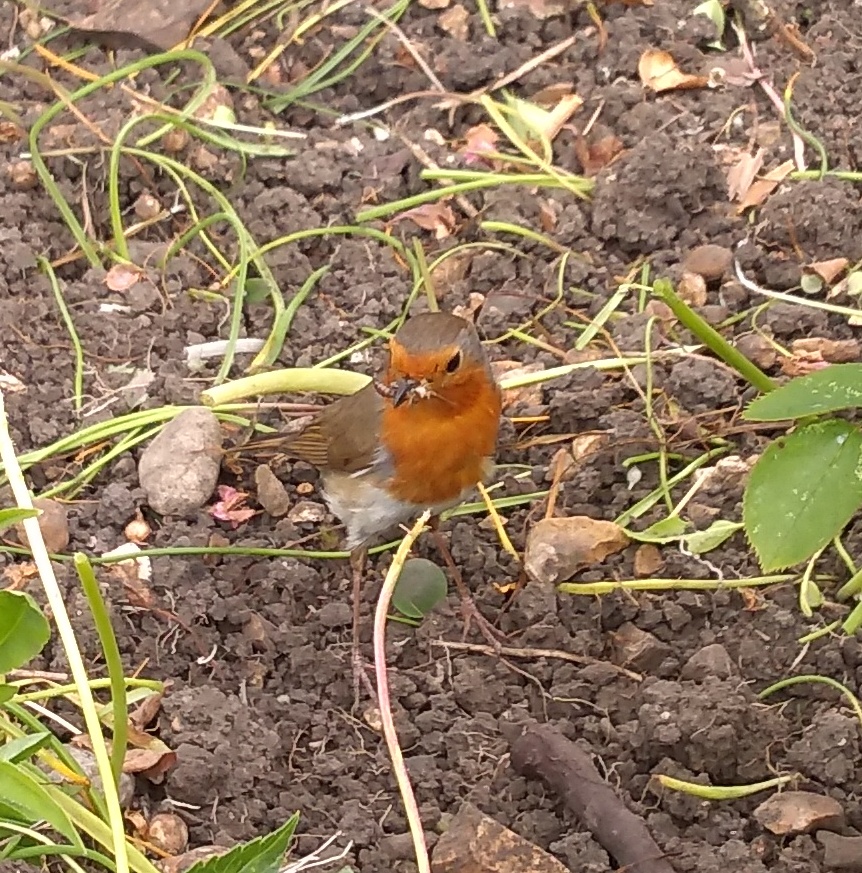
They weren’t the only birds I noticed that day. In the afternoon a Robin (Erithacus rubecula) kept me company as I weeded. It was quite fearless, frequently getting close to me to collect food as I worked.

I noticed some Scarlet Pimpernel (Anagallis arvensis) flowering too. Other common names for it include Poor man’s Barometer or Shepherd’s clock because the flowers open in sunny weather and close when it is dull.

As it was a a warm sunny day lots of bees were out. On the Catmint (Nepeta) there were Early Bumblebees (Bombus pratorum), White-tailed Bumblebees (Bombus lucorum), Tree Bumblebees (Bombus hypnorum) and Honey Bees (Apis mellifera).

A White-tailed bumblebee busy working.

As the week went on I continued to notice a greater variety of bees visiting the garden;

– Tree Bumblebees, Early Bumblebees, White-tailed Bumblebees as well as female Red tailed bumblebees (Bombus lapidarius) on a weigela.

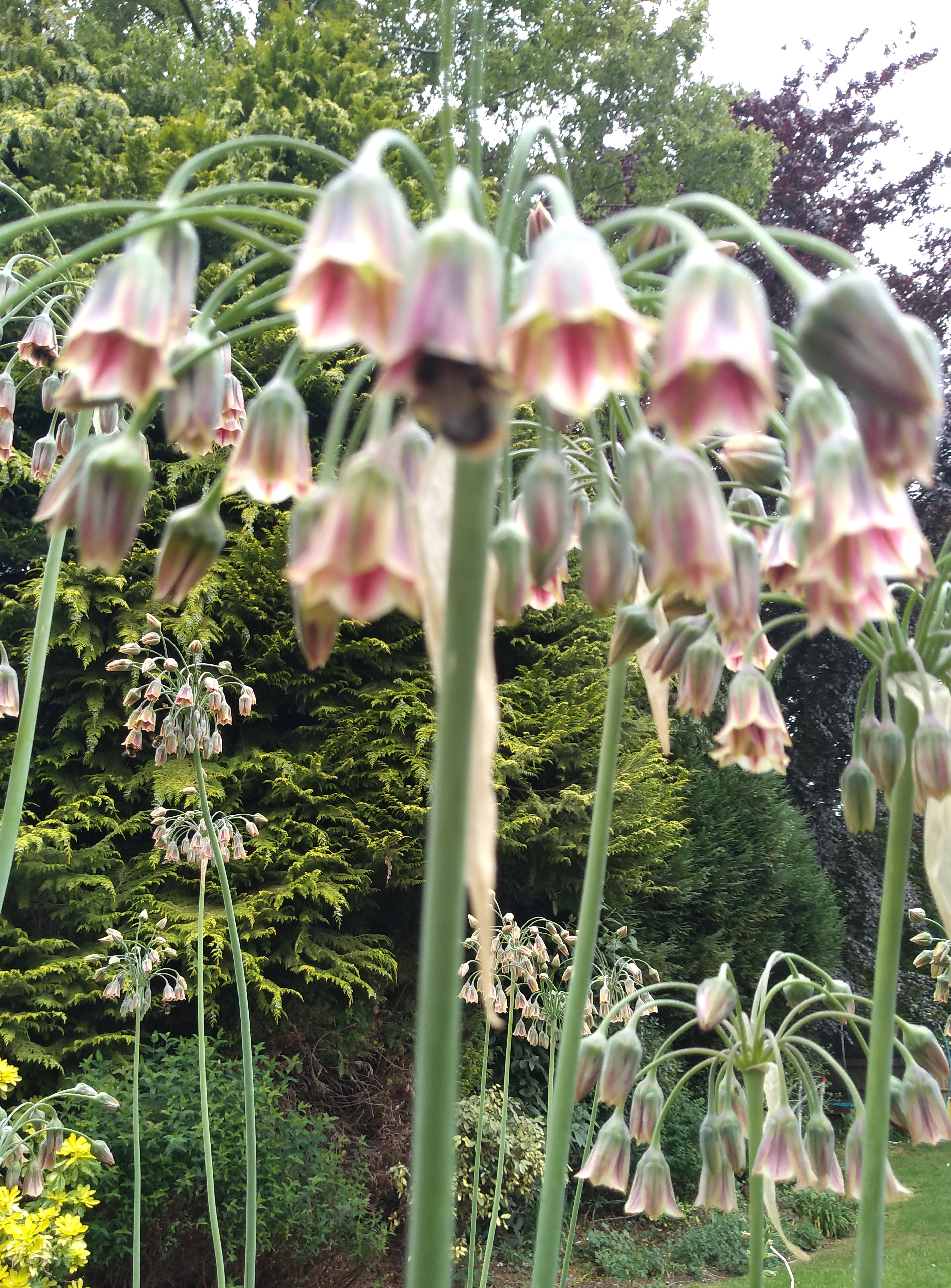
-Early Bumblebees and White-tailed Bumblebees on some Pale Garlic (Allium paniculatum).

This is the best photo I managed to obtain. The saying about not working with children or animals (or in this case insects) came to mind on Tuesday and Wednesday; descent photos were severely lacking midweek.

On Thursday, as I undertook more weeding, I unfortunately disturbed a beautiful White plume moth (Pterophorus pentadactyla) in the border. The caterpillars, which are green and yellow, feed on bindweed so this was a welcome sighting.