Posted in Allotment, nature

Time to Make Daisy Chains?

It was encouraging to witness dragonflies zipping about and mating over the past week; another sure sign of summers arrival for me.

Down at the allotment, it’s been wonderful to see the addition of a pond on a neighbouring plot. I’m excited to see what inhabits it; hopefully some beneficial wildlife will find it soon, perhaps some dragonflies of our own.

The predominant flowers on on recently mown grass are still daisies (Bellis perennis) although White clover (Trifolium repens) and Bird’s-foot trefoil (Lotus corniculatus) have begun to bloom alongside them.

My White clover and Bird’s-foot trefoil seedlings, down at the allotment, are coming along fantastically; I look forward to eventually transplanting them to my wild flower patch. Unfortunately, the Yellow rattle (Rhinanthus minor) seeds didn’t take.  Perhaps the weather earlier on in the year wasn’t conducive to their germination so I’ll try to obtain plants in autumn instead. Ideally I need them to control the grass so the other wild flowers have a chance to thrive.

I love seeing daisies everywhere. I love their simplicity, abundance, cheerful yellow center along with the fact they open during the day and close at night. Seeing them always brings back memories of making daisy chains as a child, which makes me smile. When I doodle flowers, it’s the daisy shape I always begin with before venturing onto others such as dandelions and foxgloves.

Therefore, I also enjoy seeing Oxeye daisies (Leucanthemum vulgare) join in the grassland mix as well which they did last week. When the grass on the verges is left to grow long for pollinators, it is these taller daisy flowers that can be seen looking upwards towards the sun.

Other tall wildflowers that began to bloom in the unmown grass last week were Yarrow (Achillea millefolium), Common  mallow (Malva sylvestris) and White campion (Silene latifolia). These plants are also great for pollinators, especially the latter whose might time scent is a temptation for moths. In fact this flower was added into Elizabethan pot pourri due to its clove aroma.

Posted in nature

Every Day is a School Day

No doubt due to the recent weather, I have noticed more flowers blooming earlier than their traditional start time of June. One example is the Common nipplewort (Lapsana communis).

The Common nipplewort is part of the sunflower family.

Other plants flowering at the moment are Greater celandine (Chelidonium majus),

This isn’t a relative of the Lesser celandine (Ficaria verna) despite its name. It is part of the poppy rather than buttercup family.

– Three-cornered garlic (Allium triquetrum),

Ants spread the seeds of this wild flower.

– Red campion (Silene dioica),

A dioecious plant, male flowers bloom on separate plants to the female flowers.

– White campion (Silene latifolia),

White campion is pollinated by moths because it is night scented

– Cleavers (Galium aparine),

The flowers of Cleavers are tiny. This photograph has been enlarged so they can be seen more clearly.

– Common honeysuckle (Lonicera periclymenum),

I noticed the sweet scent first. This plant is beneficial for a variety of butterflies, like the White admiral (Limenitis camilla), bumblebees and moths. Birds such as Thrushes (Turdidae), Warblers (Sylvidae) and Bullfinches (Pyrrhula pyrrhula) also eat its berries. Plus Dormice (Muscardinus avellanarius) inhabit and feed on this plant.

– A sow thistle (Sonchus),

– A Hawkweed (Hieracium),

– Mouse-ear Hawkweed (Hieracium pilosella)

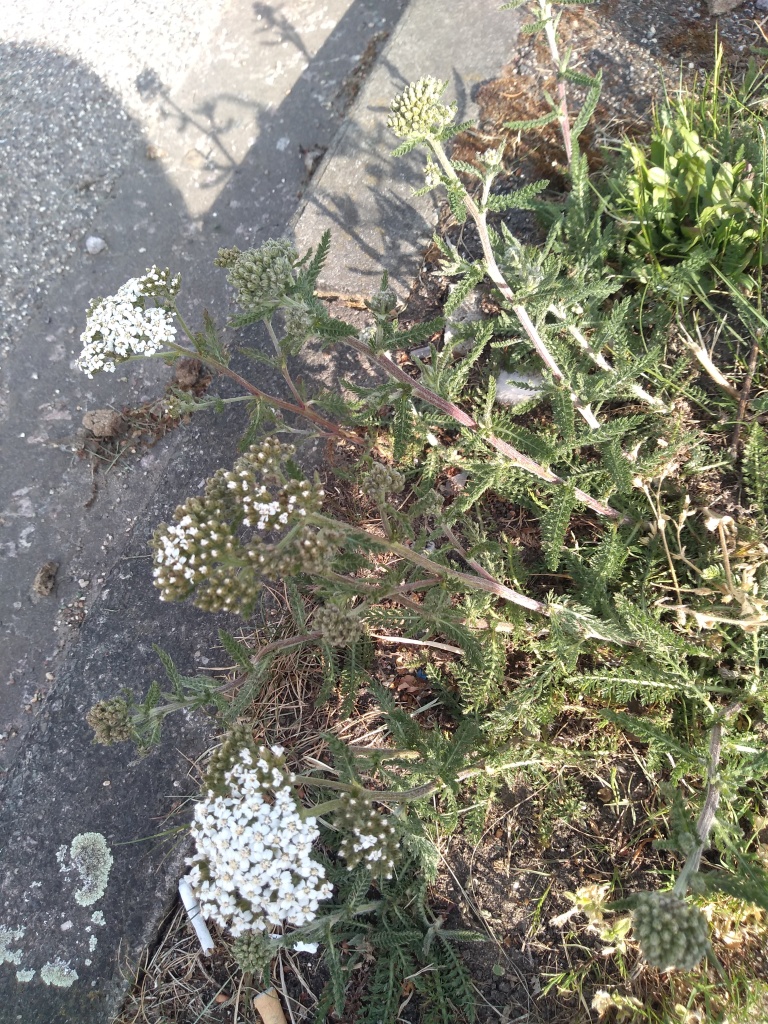
– and Yarrow (Achillea millefolium).

A plant that was new to me was Common knapweed (Centaurea nigra).

Along with all the wild flowers I noticed last week, the warm weather continued to encourage lots of insects out. There were more Holly blue (Celastrina argiolus) and Orange-tip (Anthocharis cardamines) butterflies along with bumblebees.

I also saw a Cinnabar moth (Tyria jacobaeae) at the allotment, amongst the long grass.

This moth flies flies during the day as well as at night time.

The most interesting insect I observed last week was a Pine ladybird (Exochomus qadripustulatus).

I have never seen this species of ladybird before. It dropped onto my sunglasses as I worked. Due to its small size (3mm in length), to begin with I thought it was a bit of dirt. As the name suggests, this beetle inhabits Pine (Pinus) trees. However they can also be found around other trees and shrubs especially Hawthorn (Crataegus monogyna).

Posted in nature

Blooms, Bees and Bugs

There were lots of observations last week. As the weather continued to warm up further I saw even more bees and Seven-spot Ladybirds (Coccinella septempunctata).

I also noticed more wildflowers as I walked to work on Tuesday. This relaxed start to the day enabled me to observe;
– White Campion (Silene latifolia).

This flower is great for moths as the flower’s scent is obvious at night.

– Wood Avens (Geum urbanum)

– Cleavers (Galium aparine) with its tiny white flowers.

– Black medick (Medicago lupulina)

– and Annual honesty (Lunaria annua)

During my journey, I also heard a Coal Tit (Periparus ater) singing. Similar to the Great Tit’s (Parus major) song but faster and higher pitched, it is not a bird I hear often.

On Wednesday afternoon I observed lots of insects. Two that were camera shy were a Hawthorn Shield Bug (Acanthosoma haemorrhoidale) and Violet Ground Beetle (Carabus violaceus).

Other sightings which I managed to photograph were;

– Early Bumblebees (Bombus pratorum) on Rosemary
(Rosmarinus officinalis) and on Ajuga reptans ‘Atropurpurea’ (a cultivated variety of Bugle).

The Early Bumblebee is the UK’s smallest Bumblebee.

I also saw Rosemary Beetles (Chrysolina americana) on a few Rosemary plants.

This pest is beautiful when it glistens in the sun. Thankfully the amount I found didn’t warrant drastic intervention. The RHS is undertaking a survey to discover their advancement within the UK (see Royal Horticultural Society) so I uploaded my findings.

I also found an insect on some lavender (Lavandula) that I didn’t recognise.

This terrible photo is due to the constant movement of the plant in the breeze (it was the best one I managed to take). I only include it as a demonstration on the brilliance of the Natural History Museum. Occasionally I have difficulty in identifying my findings and at that point I rely on the Natural History Museum’s identification service. I was clutching at straws that they could see through the blurred image and be able to identify the bug. To my surprise they managed to tell me it was a Cinnamon bug (Corizus hyoscyami). If you ever need help identifying insects then I highly recommend this brilliant service (see Natural History Museum).

I saw yet more bees on Friday, including a Honey bee (Apis mellifera) on a Cornflower (Centaurea cyanus) plant

along with a
Buff-tailed bumblebee (Bombus terrestris) on Welsh poppy (Meconopsis cambrica)

Even yesterday, as I visited Shaw’s Corner (a lovely small National Trust house and garden) I noticed more wildlife;
-Common Bird’s-foot Trefoil (Lotus corniculatus)

-Red Clover (Trifolium pratense)

– and some wild Bugle (Ajuga Reptans) amongst the grass which had purposely been left long.

Plus I also noticed a Marmalade Hoverfly (Episyrphus balteatus) and a Tree bumblebee (Bombus hypnorum) on some Dog rose (Rosa canina)

as well as a Red-headed Cardinal Beetle (Pyrochroa serraticornis) balancing precariously on a blade of grass.