Posted in Allotment, nature

Autumns Arrival

Now September has arrived, there is definitely an Autumnal feeling in the air. Similar to March, this month often has a transitional effect on me; especially once the Autumn equinox arrives on the 22nd. The nights are noticeably getting colder and drawing in. Over the past few weeks, some mornings have been misty and there has been a mixture of weather throughout the weeks; humid and stormy one moment and colder and sunny another. Spiders and their webs have become more visible, helped in part by morning dew, plus leaves are beginning to turn on some trees while autumn Cyclamen and crocuses (Colchicum autumnale) are starting to flower. I love September after the intense heat of August I long for a bit of relief.

On the allotment, autumn raspberries (Rubus idaeus) and apples are ready to pick along with pears, damsons (Prunus domestica subsp insititia),

Damsons ready to pick.

elderberries (Sambucus) and blackberries (Rubus). Conkers are falling now too, although the walnut and hazelnut harvests have passed.

Sweet chestnuts are almost ready to fall.

On the last bank holiday of the year (almost a month ago), I visited Minster-on-sea with my partner and his parents. It was an ideal day for walking along the beach searching for treasure, perhaps fossils, sharks teeth, sea glass, pieces of broken pottery and the occasional sea lego.  Washed up along the beach were lots of Slipper limpets (Crepidula fornicata). 

These limpets arrived on these shores from America via ships in the 1800s and thrived in the UK; especially southern England and Wales, where they have become a pest to muscle and oyster beds (competing for food and space). They are edible themselves.

It is usual to see individual empty shells, in fact they are found in huge numbers on beaches in the Solent. The common name of this sea snail refers to the appearance of an individual shell when it is viewed upside down; similarly the latin means small boot. When alive, these gastropod molluscs are rarely found alone (as shown in the photo above). Up to 12 Slipper limpets can be stacked together with the female, the largest and oldest, at the bottom; all the others are male or, in the case of the second from bottom, in the process of transforming into a female. When the one at the bottom dies and falls off, the next one up then becomes female. Further information on these fascinating creatures can be found in an article written by Nick Baker here.

The Slipper limpet isn’t the only snail that I noticed recently. I often get to see land snails but I noticed this beautiful orange coloured Brown lipped snail (Cepaea nemoralis) hanging around after a rainy morning. Snail shells can be very beautiful and I am intrigued by their structure.

Whatever your view on snails it’s hard to look at their shells without admiring the beauty.

I have become more aware of insects lately, mostly when cutting back perennials at work. Although I try to be careful as much as possible, occasionally I disturb a few. I always make a point of replacing or moving them to a safe place. Mostly it is ladybirds but I have also noticed a few other species, such as Common earwigs (Forficula auricularia) and the Rusty tussock (Orgyia antiqua) and Knot grass (Acronicta rumicis) moth caterpillars

Common earwigs feed on organic matter and like to hide away in dark areas of the garden (not in human ears).

Earwigs are useful garden recyclers.

Once eggs are laid, the females diligently clean them and constantly guards the nest only stopping when the young can fend for themselves. While the adults can nip humans and predators, it is only as a warning.


Caterpillars of the medium sized Rusty tussock moth can be seen between May and September.


The males and females of this moth, also called the Vapourer, look different from on another. The males are orangey-brown while the female has a more grey colouration and also lacks any significant wings; therefore it is only the males of this species that are active (mostly flying during the day). The young feed on broadleaf trees and shrubs in gardens and parks, as well as along hedgerows, heaths, moorland and woodland. The adult female and male moths can be seen here .

Knot grass caterpillars (see photo above) can often be found in late summer (and even as late as October in Southern Britain; although these are usually a second generation). Pupa of this moth survive the winter in leaf litter. The grey coloured adults (with a wingspan of 3-3.5 cms) can be seen from May through to September. The caterpillars can be observed on herbaceous or woody plants such as knotgrass (Polygonum aviculare), bramble (Rubus), hawthorn (Crataegus), common sorrel (Rumex acetosa), heather (Calluna), plantains (Plantago), docks (Rumex) and purple loosestrife (Lythrum salicaria). It makes sense therefore that this one was found nibbling on a raspberry leaf on the allotment. The numbers of this moth are declining and while they are still commonly found in gardens, heathland and grassland, it is thought that the  species is becoming vulnerable. I was happy to share my raspberry plant with this caterpillar; raspberries are my favourite fruit but it certainly wouldn’t do any major damage. A photo of the moth can be seen on the UK Moths website.

Sadly the results of the Butterfly count for this year came out last week. They confirmed people’s  suspicion that it hasn’t been good for butterflies and moths (as well as bees). Many butterfly and moth numbers continue to fall, and significantly so from previous years results, due to a variety of factors including the cold wet weather we’ve experienced this year. Further information can be found on the butterfly conservation website here.

Thankfully last Friday, I witnessed a wonderful sight during a warm sunny afternoon. A huge area of ivy in full bloom was covered in so many bees that it stopped me in my tracks. I stood nearby and listened to the wonderful buzzing sound, it was so relaxing. There were so many Ivy bees (Colletes hederae) alongside buff tailed bumblebees (Bombus terrestris) and honey bees (Apis mellifera) visiting the ivy flowers. It was the first time I was able to definitely identify ivy bees which was amazing (see below). 

First recorded in the UK in 2001, Ivy bees are becoming more common. They look very similar to honey bees but can be distinguished by the stripes on their abdomens; the bright yellow stripes are distinctly separate from the black ones than they are with honey bees. Unlike honey bees these are solitary, however there can be lots of nests close to one another and these bees will forage together when opportunity allows. As their name suggests, they feed predominantly on the nectar of ivy flowers and therefore their appearance coincides with this plant flowering (between September and November). I have been searching for a definite sighting of these bees for years and finally I have been rewarded for my patience.

I’ve found more galls, over the last few weeks, this time on the ground surrounding a few Pedunculate Oaks (Quercus robur).

These galls remind me a little of the Facehugger in the Alien film franchise.

They are produced by these trees as a result of the Knopper gall wasp (Andricus quercuscalicis) laying young in the acorns. As with the Oak apple gall wasps (Biorhiza pallida) mentioned in a previous post ‘Relaxing Evening Birdsong’ , they are not detrimental to these majestic trees and don’t appear on many of the fallen acorns.  Interestingly each generation of the wasp will change between sexual and asexual each alternate year.

I also saw my first Goldcrest (Regulus regulus) in a cypress tree near the beginning of the month. Although I could see the silhouette of this tiny bird moving around the top of the tree. I was only able to identify it using the Chirp-o-matic app on my phone, due to its loud singing. The Goldcrests song can be heard on the Woodland trust website here , where you can also see a photo of this diminutive bird. I wish I could have viewed it at closer range, then I would have been able to see the wonderful plumage on the crown (yellow for females and orange for males). The Goldcrest is the smallest bird in Britain, even smaller than the Wren (Troglodytes troglodytes). Hold a 20 pence piece in your hand, and you will have an idea of the birds weight (just 5 grams). They inhabit mixed woodland and conifers along with parks and gardens. The numbers of our resident birds increase with the migration of others from Scandinavian countries during the winter. They feed on insects and other invertebrates. It is always lovely when I am still able to witness new things in nature like this. It gives me a buzz, allowing me to learn through research.

Posted in nature

October Treats (Tricks not Included) 🎃

It is Halloween, British Summer Time ended last night and initially today was a stereotypically autumnal day; windy and very wet. However now it’s less blustery and the sun is shining. Throughout the day, I’ve kept hearing Carrion crows (Corvus corone) call too; I love their haunting sound. Autumn has definitely taken hold over the past few weeks and there have been lots of treats to see.

Fungi continued to appear, showing biodiversity in untreated lawns. I managed to spot one of my favourites again this year, the Shaggy mane (Coprinus comatus) in various stages of development.

Also called Shaggy inkcaps or Lawyers mane.
Here the gills have turned black and have begun to ‘drip’ onto the lawn, resembling ink.

I also saw Yellow club fungus (Clavulinopsis helvola).

The photo was taken after the grass had been mown so the very tip of the fungi had been cut off.

As with other fungi, Yellow club fungus has no negative affect on lawns. It likes acidic mossy lawns appearing between September and November.

There was one more fungi that I noticed (see below), possibly a Honey waxcap (Hygrocybe reidii) although I am not entirely sure my identification of this one is correct.

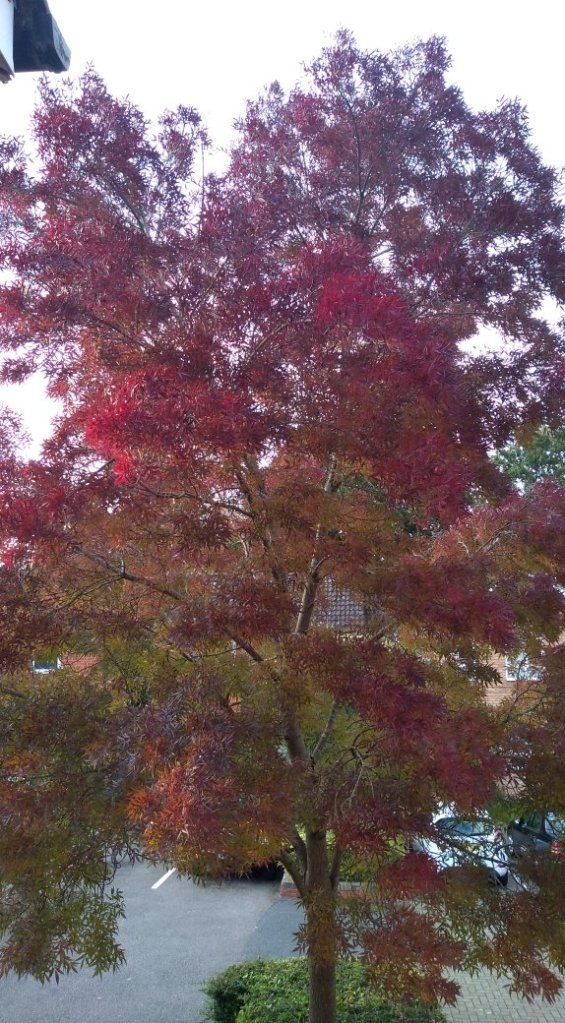
The tree that has already shown it’s autumn colours is the Claret ash or ash ‘Raywood’
(Fraxinus angustifolia ‘Raywood‘). There are a couple in the car park, one of which is now completely bare.

The deep claret coloured leaves glow bright red in the sunlight.
The bark of the Claret ash.

I have noticed the occasional pollinator still flying around during the last fortnight. One observation was some Common wasps (Vespula vulgaris) visiting Common ivy (Hedera helix) flowers. Evidence that Ivy is a wonderful source of pollen and nectar late in the year along with that fact that wasps have a purpose.

Along with pollination, there are many wasps that are useful predators of spiders and insects which are fed to their young. Unfortunately the adult wasps need for sugar means they are often disliked by humans, but can we really blame them for having a sweet tooth just like us or trying to get to something that is easily accessible? A fascinating article about wasps and their usefulness in the world, published by the Natural History Museum, can be viewed here.

Posted in nature

Out and About

I spent a lovely day catching up with friends at Windsor Great Park.

Before setting off I noticed a Common rustic (Mesapamea secalis) moth in the hallway. The caterpillars of his moth feed on grasses and cereal crops.

Upon arrival at the park there was a lovely sight of wildflowers on the banks leading to the entrance.

While walking around we spotted a swan (Cygnus olor), some Mallard ducks (Anas platyrhynchos), a crow (Corvus corone) as well as several wasps (Vespula vulgaris) obviously when we were eating our picnic. However before returning home I meandered round the plant shop. There were some Honey (Apis mellifera) and Bumble bees (Bombus) around the usual suspects like Lavender (Lavandula) and Catmint (Nepeta). However, eventually I saw a Mint (Pyrausta aurata) moth feeding on a Delosperma ‘Jewel of the Desert Grenade’ flower.

This is a day and night flying moth whose caterpillars eat plants such as Mints (Mentha) Catmint, Thyme (Thymus vulgaris).
and Lemon balm (Melissa officinalis).

Posted in nature

Amphibians and Insects

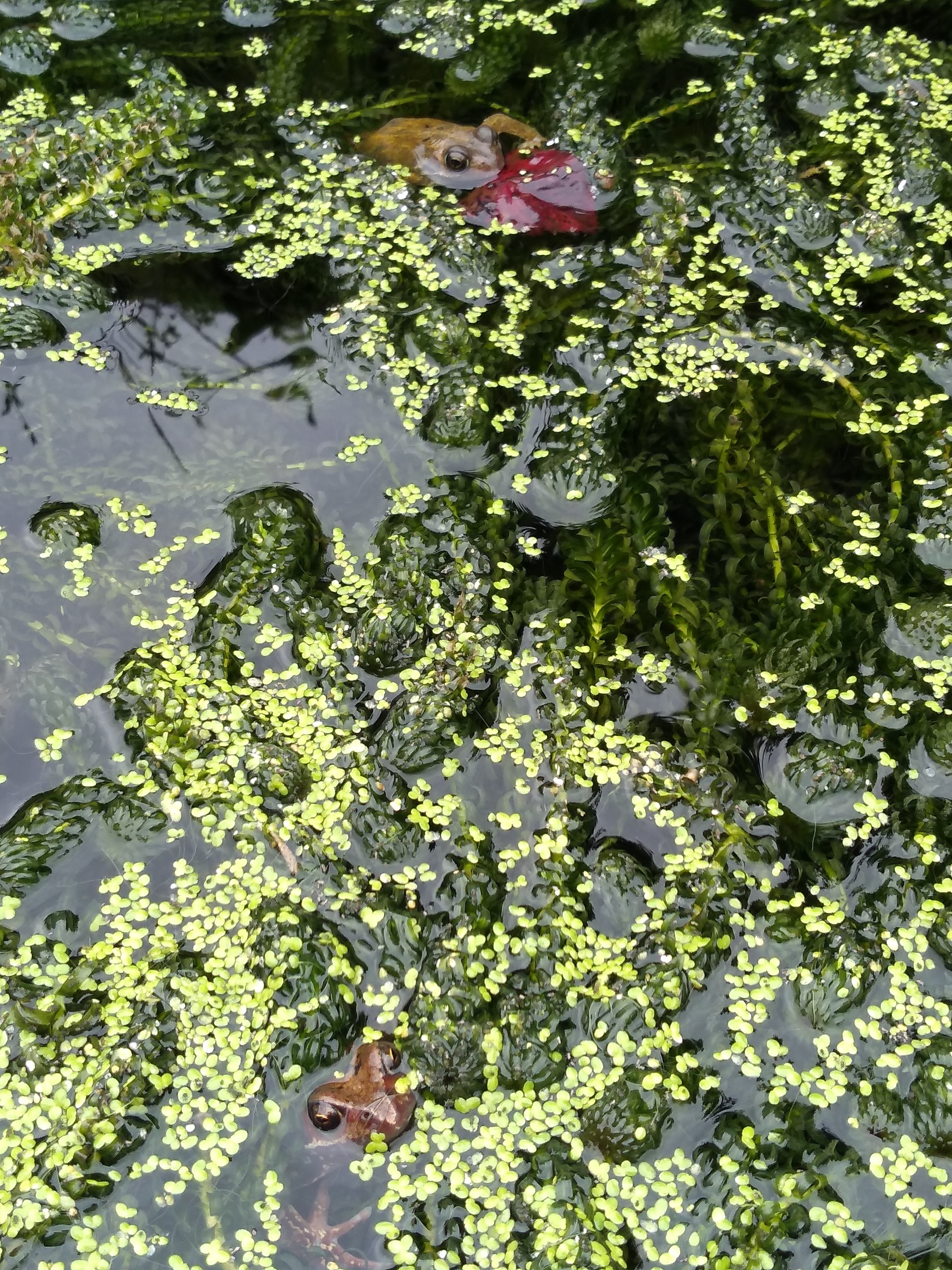
My week started and ended working next to ponds. The first was a small natural pond with a couple of frogs (Rana temporaria) sitting in it.

The other was a large disused outdoor swimming pool. In its neglected state rainwater collects within the concrete walls and nature is taking over. Given the murkiness of the water I was unable to obtain decent photos of my findings; however I saw another frog, (surrounded by lots and lots of tadpoles) along with a dragonfly nymph and a newt. It should be interesting to discover how many tadpoles survive to adulthood.

For the rest of the week insects were centre stage, especially on Wednesday when flying ants took to the sky. Flying ant season really tests my resolve to work through my dislike of ants (which originated in childhood). Thankfully I now find them more fascinating than loathsome, mostly.

The other insects I saw that day were;
– A (Chrysotoxum cautum) hoverfly on some Pyracantha.

– Honey bees (Apis mellifera) and a Red-tailed bumblebee (Bombus lapidarius) visiting a Geranium ‘Rozanne’ plant.

– Lavender (Lavandula) full of bees and butterflies, including more Honey bees as well as Buff-tailed bumblebees (Bombus terrestris), Meadow browns (Maniola jurtina) and a Ringlet (Aphantopus hyperantus) butterfly.

The Meadow brown butterflies also enjoyed visiting the Echinops bannaticus flowers too.

Even as I returned home I noticed a Willow Beauty (Peribatodes rhomboidaria) moth on the hall window.

The adults feed on Creeping thistle (Cirsium arvense) and Ragwort (Senecio jacobaea) both of these plants are common around this area. The caterpillars feed on various trees, shrubs as well as climbers ranging from Yew (Taxus baccata), Birch (Betula), ivy (Hedera helix), honeysuckle (Lonicera) and the wild Clematis, Traveller’s joy (Clematis vitalba).

The previous day I came across more insects that I was previously unaware of.

The first one was the Common red soldier beetle (Rhagonycha fulva).

It is a beneficial insect as adults eat aphids and are pollinators (feeding on nectar and pollen from open flat flowers such daisies and hogweed) while the larvae feed on slugs and snails along with other ground dwelling invertebrates.

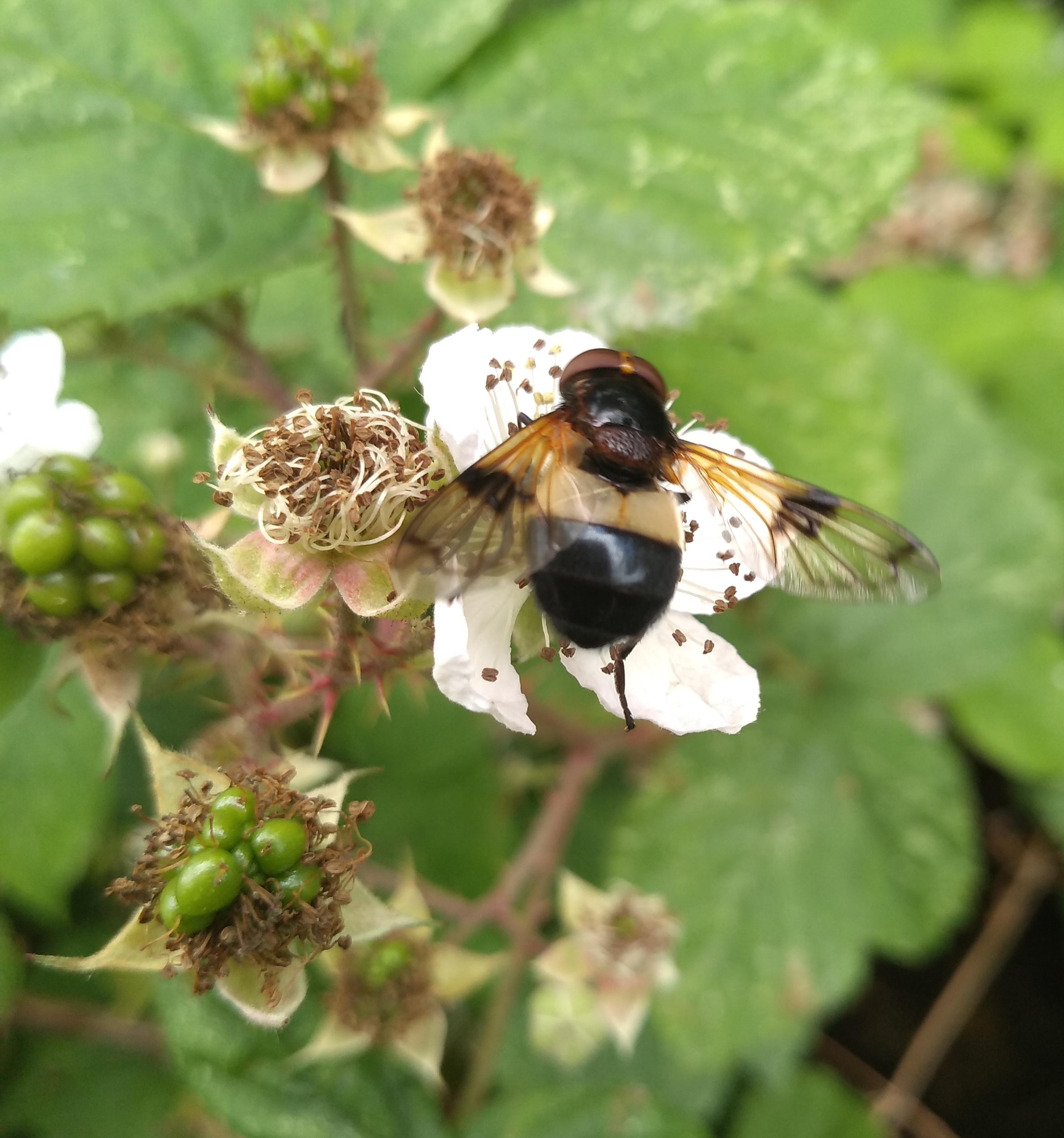
The other insect I saw on Tuesday was a female Volucella pellucens hoverfly feeding on nectar and pollen from Bramble (Rubus fruticosus).

These hoverflies also pollinate umbellifers; However as larvae they inhabit Bumblebee and wasp nests eating any waste produced along with their hosts larvae.

Posted in nature

An Enchanting Week

My interest in plants extends to herbal medicine and floral folklore. Often found in gardens, such plants are easily accessible.

I find poisonous plants fascinating too. I would like to visit the Chelsea Physics garden as well as the Alnwick Poison Garden in Northumberland. Over the past week, a few wild flowers that I have noticed blooming would probably be found in these gardens, these are;

– White bryony (Bryonia dioica) scrambling over Dogwood (Cornus). White Bryony has poisonous berries and the plant has a very strong unpleasant purgative affect. A few deaths linked to this plant have been recorded.

– Woody Nightshade (Solanum dulcamara).

Also called Bittersweet the plant would make someone incredibly ill; the berries if eaten would cause vomiting and convulsions. There have been a few deaths linked to this plant. It is from the same family as Deadly nightshade (Atropa belladonna, See Woodland Trust).

I saw other wildflowers blooming too such as the intriguingly named Enchanter’s nightshade (Circaea lutetiana). Confusingly this flower isn’t from the nightshade family at all but is actually a Willowherb. One folkloric belief was that this plant would give protection against Elvish spells.

I also saw Field bindweed (Convolvulus arvensis) along the verges.

I continued to see many birds and insects throughout the week. After many days since the last time, I was happy to see the juvenile Blue tits (Cyanistes caeruleus) back in the Rowan tree (Sorbus). Also on Monday I had a Juvenile Robin (Erithacus rubecula) follow me around. Clearly the instincts for locating food near gardeners starts early.

The first moth I saw last week was an adult female Bee moth (Aphomia sociella). These moths are so called because they lay eggs in bee and wasp nests and also bee hives. Their larvae eat the comb, causing damage and are therefore a pest for beekeepers.

Other moths I saw were two Rosy tabby (Endotricha flammealis) moths

and a Dark arches (Apamea monoglypha) moth.

On Wednesday I was working near a fantastic old Sweet chestnut (Castanea sativa) tree. Countless Honey bees (Apis mellifera) and Marmalade hoverflies (Episyrphus balteatus) were busy flying to and fro pollinating the flowers.

As the summer continues more and more butterflies become visible. I have seen lots more Meadow brown (Maniola jurtina), Small tortoiseshell (Aglais urticae) and Large white butterflies (Pieris brassicae). One of them seen here on some lavender (Lavandula).

Also on Wednesday I observed two butterflies that I have never seen before, a Marbled white (Melanargia galathea) on Verbena bonariensis

and a Small skipper butterfly (Thymelicus sylvestris), also seen on the Verbena bonariensis.

Later on the same day I also saw ten Azure damselflies (Coenagrion puella) around the pond.

On Friday morning, as I was going to work, I had to usher a Common green lacewing (Chrysoperla carnea) outside so it could find some aphids to munch on.

Then lastly on Friday I saw a Harlequin ladybird (Harmonia axyridis) on Brunnera macrophylla ‘Jack Frost’.