Posted in nature

The Birds and the Trees

On the 31st January, I undertook the RSPBs Big Garden bird watch. Most birds, I’d normally see, were clearly hiding but I did notice some within the hour. Those birds I saw were; 1 Carrion crow (Corvus corone), 2 Robins (Erithacus rubecula), 1 Coal tit (Periparus ater), 1 Blackbird (Turdus merula) and 2 Mistle thrush (Turdus viscivorus). I enjoy taking part in this citizen science project each year; it’s interesting to see how the results differ each time.

Due to the frozen ground last week, I was still able to go for my regular exercise in the local woodland park. Various tree species were waking up from their winter sleep. Beech (Fagus) and Oak (Quercus) had started budding while others were developing catkins.

Last years leaves and new buds on a Beech tree.
Old Oak leaves alongside new buds.

As well as the Hazel (Corylus avellana) other trees had catkins hanging from them too. Hazel catkins are the earliest to flower in the year, from January to March (see my previous post A Snowy Adventure).

Then the Alder (Alnus glutinosa) is the next tree to bloom with both male and female catkins. The male catkins are longer than the female ones which flower from February to March. Also hanging from the Alder trees were some small dark brown shapes. These woody cone-like fruit develop from the previous seasons fertilised female catkins; these can remain on the tree (even when the seeds have been shed) well into the following year alongside the newly formed catkins. I also noticed leaf buds growing on the trees last week too. When the buds burst, I shall update the Woodland trust Nature’s calendar with my findings.

Unfortunately I was unable to capture decent photos on location so I collected part of a fallen branch to take home.

One small female catkin above a group of larger male catkins. On the tree (before fertilisation when they develop into the rounder, woody fruit) the female catkins point upwards while the male ones hang down.
A magnified view of two unfertilised female catkins.
A leaf bud with one of last years fertilised female catkins.
A magnified view of the Alder tree seeds that had remained in last seasons female catkin.

I find Alder trees fascinating and the rough, fissured bark beautiful.
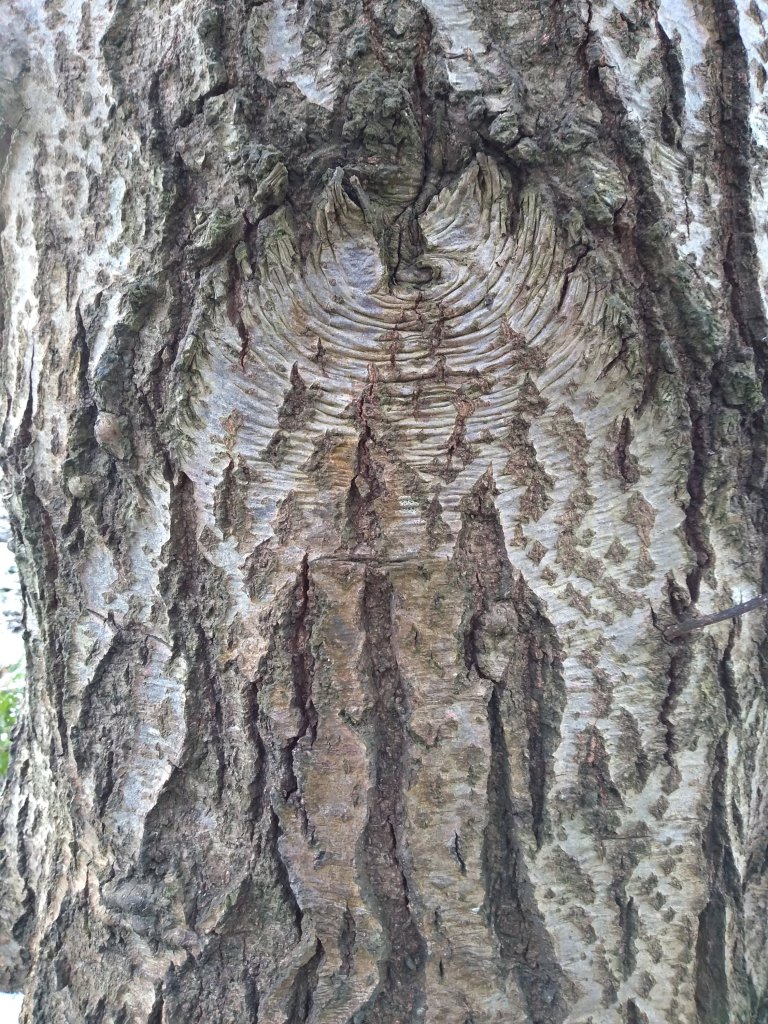
Alder are native to Britain and found on wet land, next to water or in marshes and woodlands. They naturally thrive in moist conditions although can also grow in drier areas such as the edges of mixed woodland. Alder wood is durable when wet and actually becomes stronger rather than rot when submerged in water; a characteristic that makes them useful in flood mitigation, boat building, sluice gates, and even the construction of Venice which is mostly built on Alder piles. Alder wood is also used in the creation of charcoal, gunpowder and making clogs.

The pale wood turns a deep orange colour at the point at which it’s cut (while the rest of the wood remains pale); leading to a superstition, in Ireland, that it was bad luck to walk past an Alder tree on your travels. However, traditionally alder branches were also taken into houses to prevent Woodworm. Alder wood is particularly liked by various species of beetle larvae (collectively referred to as Woodworm). It is hoped that the beetles will lay eggs in the Alder rather than the furniture or fixtures; the branches once infested can then be removed.

There is also a traditional use for Alder flowers as a green dye; believed to be used as camouflage by outlaws like Robin hood and fairies.

For fun, I looked up Alder wands used in the Harry potter series. Only one is mentioned, that owned by Quirinus Quirrell. The wands qualities are described on the Wizarding world website.

The roots of Alder are nitrogen fixers. Nitrogen from the air is fixed into the soil, replenishing the levels and aiding soil fertility, through the bacterium Frankia alni.

As well as improving soil, Alder are great for wildlife too. The seeds are eaten by Redpoll (Acanthis flammea), Siskin (Spinus spinus) and Goldfinch (Carduelis carduelis). The leaves are food for the caterpillars of the Alder kitten (Furcula bicuspis), Pebble hook-tip (Drepana falcataria), Autumn green carpet (Chloroclysta miata) and Blue-bordered carpet (Plemyria rubiginata) moths. Bees visit the catkins for an early source of nectar plus Alders provide habitats for the Checkered skipper (Carterocephalus palaemon) butterfly, Small pearl-bordered fritillary (Boloria selene) butterfly, some species of Crane fly, Otters (which create nests amongst the roots) along with mosses, lichens and fungi that like damp conditions.

However, these trees are also threatened through infection by the Phytophthora fungus (together with some other broadleaf tree species). In Alder this disease is referred to as Alder dieback and eventually causes the death of any infected tree. For more information see the Forest research website. There aren’t many Alders in my local woodland park compared to other tree species so it would be sad to see them disappear. Given my newly acquired knowledge I will keep a special lookout for any ill health in these trees; thankfully no infection is being exhibited at the moment.
Posted in nature

Splashes of Red and Gold

The walk on Sunday 10th January was an adventure, having wondered down a previouly unwalked route.

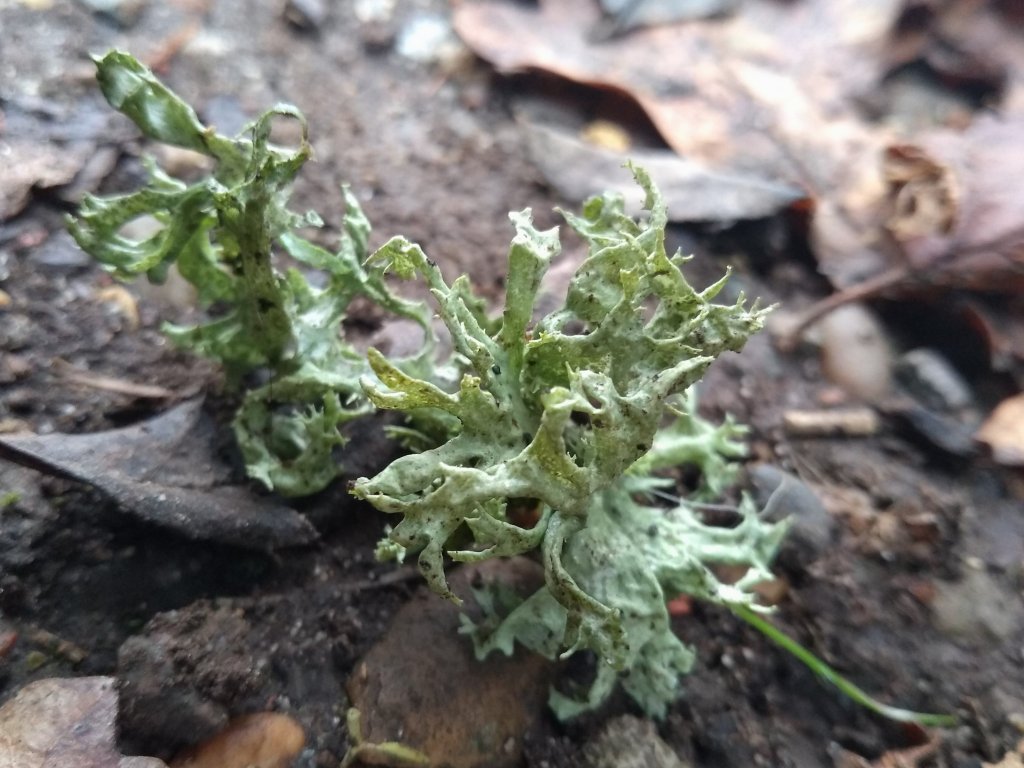
One thing I noticed on the roadside as I walked, was some Oakmoss (Evernia prunastri) which must have fallen from a nearby tree.

Oakmoss

It’s also called Stag lichen, a slightly more appropriate name given that it’s a lichen and looks like a collection of antlers. It isn’t exclusively found on Oaks trees (Quercus) either. Oakmoss can grow on other broadleaf tree species along with conifers. In fact when it grows on conifers it takes on a turpentine aroma rather than a mossy earthy one.

Traditionally Oakmoss is used in the perfume industry, for its earthy scent and fixative properties, as well as in soaps, hair products and pot pourri. Thankfully it is grown commercially for this purpose. A couple of examples in which Oakmoss is used are the perfume Channel No. 19 and Ralph Lauren’s ‘Polo’ aftershave.

Since that Sunday I’ve also had new visitors to the Rowan tree (Sorbus). Most days afterwards I saw five goldfinch (Carduelis carduelis) eat the leftover dried out rowan berries. It was lovely to see the splash of colour these birds provide on gloomy days. 

The best photos I could obtain through a window.
Posted in nature

Gardens and Nature Never Sleep

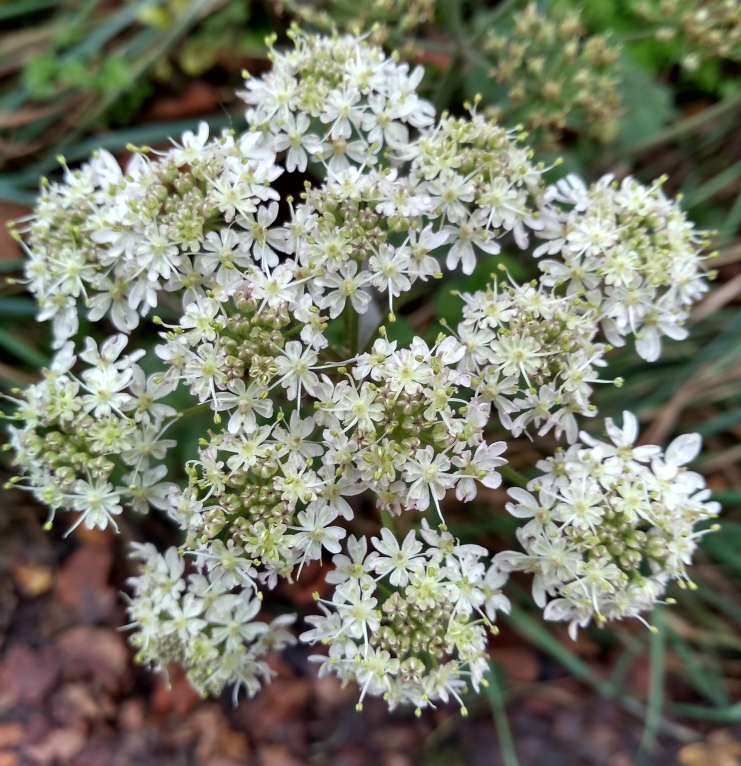
It is always nice to see flowers begin to bloom while others, that have performed throughout the year, wain. On one walk last week I came across a patch of Common Hogweed (Heracleum sphondylium) flowering.

It usually blooms between June and September so it must have been having one last flourish.
Common hogweed is from the same plant family as Ground elder (Aegopodium podagraria) and Cow parsley (Anthriscus sylvestris). All three native umbellifer plants are great for pollinators like hoverflies, Soldier beetles, some butterflies along with short-tongued bees, because these insects need flat flowers in order to gain access to pollen and nectar. Common hogweed is a tall wildflower growing up to six feet in damp conditions along waysides, open woodland, next to riverbanks and amongst rough grassland. It is also called Cow parsnip and had some other interesting names in the past, including Limberscrimps (in Cornwall), Wippul-Squip (Northamptonshire), Cowbumble (gloucestershire).

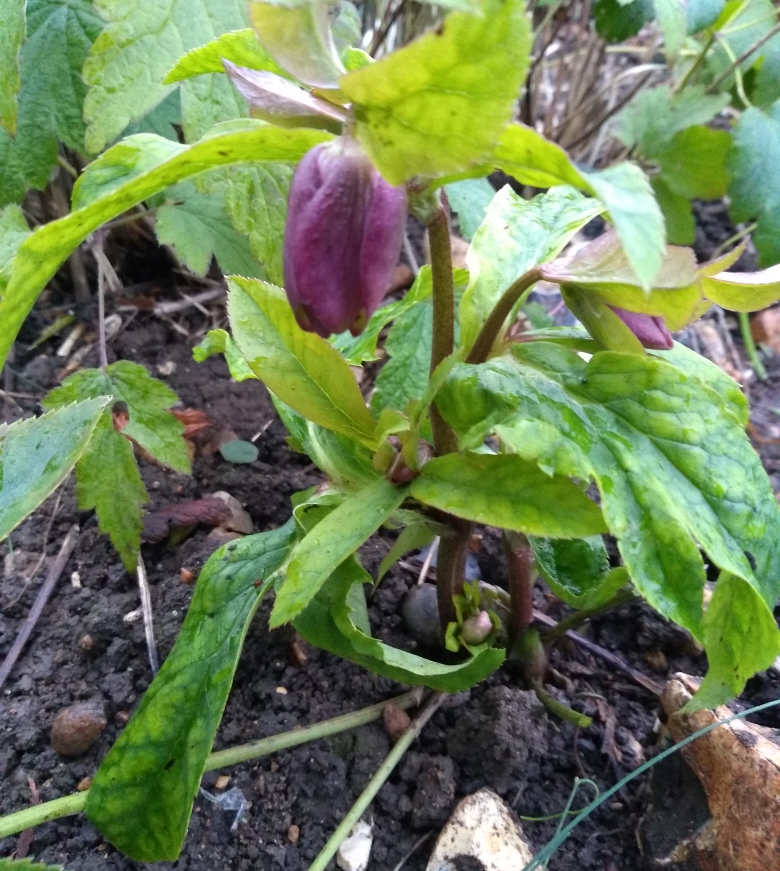
Gardens also continue to show signs of life at this time. The phrase ‘putting gardens to bed’ in winter is often a misnomer and rarely happens. They are never entirely in hibernation as something is usually awake, even if it is only visiting birds. Plus winter or spring flowering plants begin to bloom and grow now. Last week I noticed Hellebores starting to flower

along with Snowdrops (Galanthus)

and Daffodils (Narcissus)

peaking through the soil.

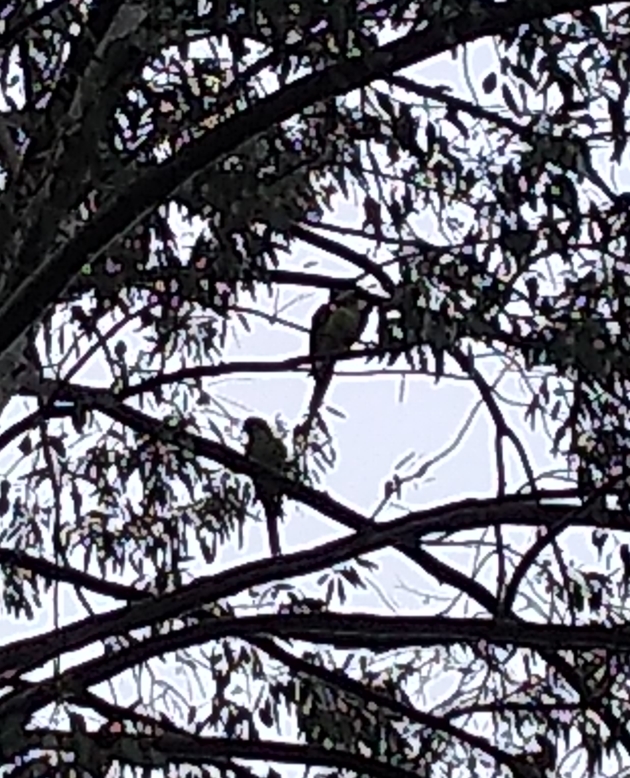
A bird that is easier to see these days are Ring-necked parakeets (Psittacula krameri). They were particularly prominent in one garden I worked at last week where a group kept flying between several trees, before eventually settling within a Eucalyptus tree.

Two parakeets silhouetted in a Eucalyptus tree.

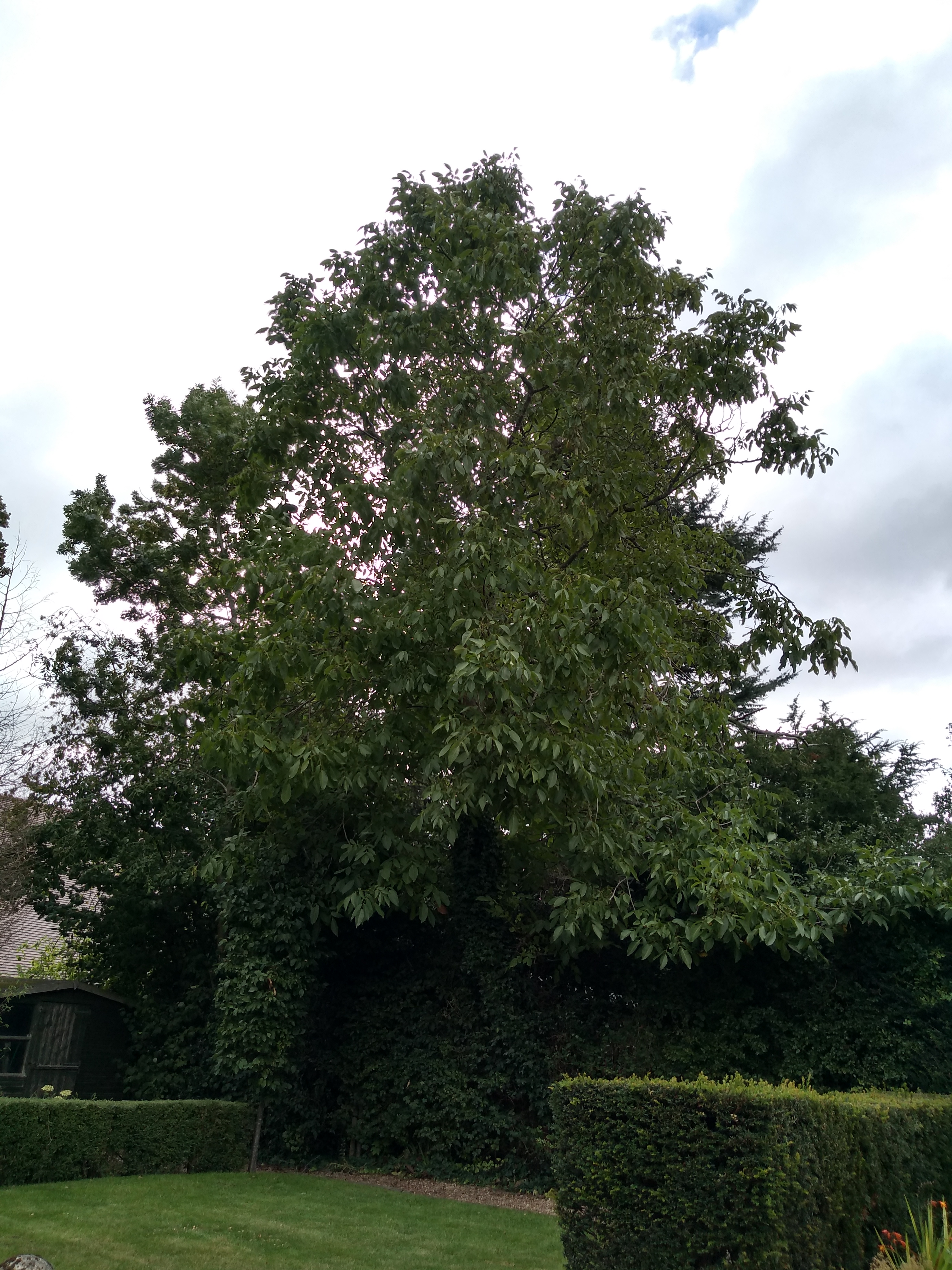
These birds and trees were introduced into this country from warmer areas of the world, yet both species can cope with the colder uk climate.

The evergreen Eucalyptus tree leaves are a bluish green colour when mature. Eucalyptus oil is obtained from the mature leaves, known for its antiseptic properties together with a distinctive aroma.  Immature leaves are more rounded and a bluish shade. The tree flowers from July to October and are especially liked by bees and other pollinators.

Ring-necked parakeets (Psittacula krameri) are parrots that originated from Asia. The history of their introduction to the UK is explained by the RSPB here.

These birds have successfully breeded in this country for years to become a familiar sight in the south-east, particularly urban areas of Hertfordshire, Kent, Surrey and Sussex; their range extending further and further from London. Although they can be observed (and more often heard) throughout the year winter, when the trees are bare, is the best time to see them perched upon branches; unless you are lucky enough to have them visiting bird tables in your garden. They eat a variety of food, having developed an omnivorous diet as they naturalised over here (even though they remain vegetarian in Asia). While they usually eat seeds, fruit, nuts and berries they have been known to feast on scraps left out, including meat scraps. In fact it’s believed they can survive UK winters because they feed from bird tables.

Ring-necked parakeets are very social and can be seen in large flocks containing hundreds of birds. This can make them very noisy and therefore a nuisance in some peoples eyes. Yet whatever your opinion on these birds there is no denying their beautiful colours which seem to become more vivid at this time of year. Even on bleak days beauty exists; sometimes you just have to amend your focus to see it.

Posted in nature

Fantastic Beasts and Where to Find Them

This years fireworks have been matched by the incredibly vivid colours on deciduous trees. Due to the weather in 2020, nature has put on a spectacular display in the UK.

We had quite a few cold and frosty mornings last week. I like waking up to them because it means the sun will shine in a clear sky.

Last Thursday, was one such morning. At one job, leaves had to be cleared near an old swimming pool, which has become a natural pond over years of neglect and a wildlife haven throughout the year. I was conscious of needing to be careful when undertaking this task, due to possible wildlife hiding amongst the debris. I knew there were newts in the pool during the summer and wondered if some might be keeping warm under the fallen leaves; this meant the job would take longer to complete.

Unfortunately there was a group of four in one leaf pile. I didn’t take photos as I didn’t want them to be exposed for too long. Instead I quickly relocated them to a hidden corner nearby and covered them in a thick layer if leaves so they wouldn’t be disturbed again. Consequently I was unable to identify them quickly enough. 

In the UK we have three native species of Newt. (See the ARC Trust for identification)

The most likely species candidate for the ones I found is the Smooth newt (Lissotriton vulgaris) However they could have been Palmate newts (Lissotriton helveticus). Less likely was that they were Great crested newts (Triturus cristatus) as they weren’t dark or warty enough.

I often see frogs in gardens so it’s always a bonus to see other amphibians for a change. I am glad some survived through to Autumn.

The ARC trust have the Garden dragon watch where you can help with a survey, to keep track of Newts living in gardens.These wonderful creatures aren’t quite dragons but in my imagination they a mini version of a fantastic beast.

Posted in nature

Tolkien’s Words of Wisdom are Still Appropriate.

Last week ended with a wonderful announcement in the news, the Great fox-spider (Alopecosa fabrilis), presumed extinct since 1993, has been refound alive (see the BBC News report). This highlights, both the amazing work undertaken by naturalists, as well as the importance of protecting wildlife and their habitats.

As an amateur naturalist and gardener, I haven’t undertaken such groundbreaking work but I try to do my bit whenever and wherever I can. I think of J.R.R. Tolkien’s quote ‘Even the smallest person can change the course of the future.’ from The Fellowship of the Ring (The Lord of the Rings trilogy) in these moments. We can all play a small part in saving nature’s wonderful diversity so that it has a future.

With this at the forefront of my mind I think back to one small act I hope made a difference last week. I noticed a female Common carder bee (Bombus pascuorum), identified by the white hairs on the sides of its thorax. It isn’t unusual to see these females fly this late in the season, (possibly a new queen getting ready for hibernation before starting a new nest in spring). However the one I saw was very still; I was concerned it was worn out and required help so I gathered some Verbena bonariensis and Salvia flowers to revive it. Thankfully my instinct was probably correct because it fed from the nectar contained within the posy I laid next to it.

Along with some cultivated plants, a few wild flowers were still blooming, Red clover (Trifolium pratense) and Yarrow (Achillea millefolium). Even though the latter flowers through to November, Red clover usually only blooms until October. The Common carder bee feeds from the Red clover flowers along with Honeybees (Apis mellifera) and Red-tailed bumblebees (Bombus lapidarius).

I also learnt some new fungi last week. The Golden waxcap (Hygrocybe chlorophana) which grows on grassland.

This fungi is on red list for threatened fungi in some European countries such as poland and Switzerland but not in the UK

Plus the other fungi I noticed, the Shaggy scalycap (Pholiota squarrosa) at the base of a tree stump.

This is often found next to broadleaf trees stumps, particularly beech (Fagus), and occasionally spruces (Picea) between August and November. 
Posted in nature

Unusual Trees for Suburban Gardens

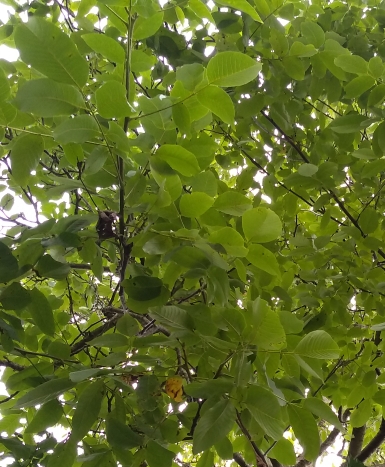
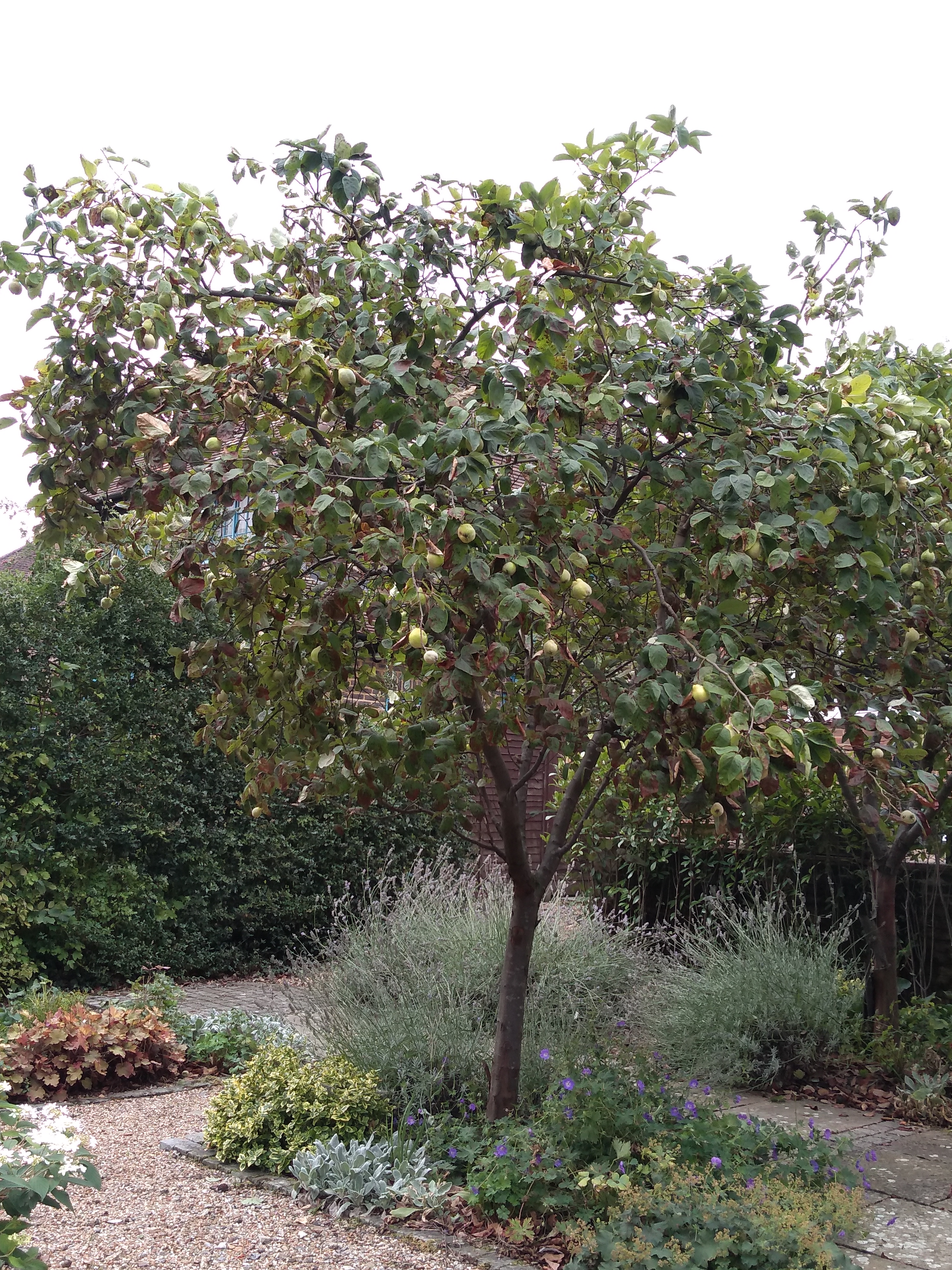
I’m lucky to work in a wide variety of gardens and occasionally come across trees which aren’t normally found in smaller suburban settings. Last week three such trees, a Walnut (Juglans regia), Quince (Cydonia oblonga) and Sweet Chestnut (Castanea sativa) were showing evidence that Autumn had arrived. Interestingly all three have links to, or were introduced to Britain by, the Romans (just like Ground Elder, Aegopodium podagraria, which they ate).

The Latin name for Walnut translates to ‘Royal nut of Jupiter’ and is referred to as ‘food of the gods, medicine for the people’. However, you’ll be lucky to get your hands on any before Squirrels (or Mice) do.

Presumably that’s the reason why these trees have naturalised in UK gardens and parks so well; as hidden walnuts are left to germinate and grow into mature trees.

The leaves of Walnut trees are a good source of food for some micro moths too.

The Sweet chestnut is another tree introduced into this country by the Romans. These days roasted Chestnuts are associated with winter and Christmas. They contain Vitamins C and Bs along with the minerals magnesium, potassium and iron.

I remember collecting Chestnuts at a local wood when I was young; I particularly enjoyed eating them raw. These days, on the odd occasion when I do discover a Chestnut tree, the nuts are usually too small to eat. Horse Chestnut (Aesculus hippocastanum) trees on the other hand are more commonly found around Britain. I noticed that Conker season had also begun last week, as I traveled to and from work. There are several myths linked with Conkers (see The Woodland Trust).

The last of the unusual trees I saw last week was the Quince. This tree is a lot smaller than the ones previously mentioned, making collection of the fruit easier. In fact the garden I worked at has four planted in a formal arrangement.

Quince fruit have tough flesh with skin that turns yellow as it ripens and has a honey aroma. They need to be cooked to soften and become edible.

Recipes for Quince Jam and Jelly can be found on the internet. Originally from Turkey and Asia, recipes using Quince can be found in Roman cooking.

There were other Autumnal signs around last week, along with the ones mentioned above, including the appearance of fungi and leaves falling. Autumn is definitely settling in even though Meteorological Autumn didn’t start until this Tuesday (1st September) with Astronomical Autumn (the Autumn Equinox) to follow on the 22nd September.

Posted in nature

Early Transition into Summer.

Last week began with Spring bank holiday monday. I went for a socially distant walk around the village with my partner. Thankfully he was very patient as I constantly stopped to take photos with my phone.

There were lots of sights and sounds to observe and it really felt like a summers day (which aren’t far off). Some I have noticed for a while like Orange-tip Butterflies (Anthocharis cardamines), Red-tailed bumblebees (Bombus lapidarius), Skylarks (Alauda arvensis), Red kites (Milvus milvus) and House sparrows (Passer domesticus).

Yet amongst the Elderflowers (Sambucus nigra) and Brambles (Rubus fruticosus), which are blooming at this time of year,

These flowers are great for making Elderflower cordial.
Looks like there will be lots of Blackberries this year.

were many more plants flowering too. The explosion of colour within our countryside is fantastic for pollinators. One insect I saw on Mondays walk, in a field busily pollinating Buttercups (Ranunculus), was the False oil beetle (Oedemera nobilis). This very small beetle is a vibrant metallic green colour. When it’s wings glistened in the sun, they changed from mid to light green.

Unfortunately this is the best photo I managed to get of this tiny beetle.

Upon my return to work, I noticed other insects flying about. Several small tortoiseshell Butterflies (Aglais urticae) were too quick for me to photograph, however I did capture Common carder bees (Bombus pascuorum) on Common comfrey (Symphytum officinale) and

a Cream Spot Ladybird (Calvia quattuordecimguttata)

Once again, another ladybird determined to get my attention by falling on my sunglasses while I wore them.

The Cream Spot ladybird has fourteen spots and survives winter in tree bark and Beech masts. Although it is usually found amongst hedgerows rather than gardens.

Wildflowers that were in full bloom last week were;

-Purple toadflax (Linaria purpurea),

-Field scabious (Knautia arvensis),

– Common stork’s-bill (Erodium cicutarium),

This plant is a good food source for Brown argus Butterfly (Aricia agestis) caterpillars, along with Meadow and Dove’s-foot Crane’s-bills (mentioned below). This butterfly is often found in southern chalk and limestone grassland but it can also inhabit places with disturbed soil like verges and coastal areas. In fact this plant was found on disturbed soil edging a field.

-Meadow crane’s-bill (Geranium pratense),

-Creeping cinquefoil (Potentilla reptans),

-Common poppy (Papaver rhoeas),

-Dove’s-foot Crane’s-bill (Geranium molle),

-Field bindweed (Convolvulus arvensis),

-Common mallow (Malva sylvestris),

-Creeping woodsorrel (Oxalis corniculata),

-Birds-foot trefoil (Lotus corniculatus) and

-White clover (Trifolium repens).

Found amongst lawns, this is a wonderful food source for the Common blue butterfly (Polyommatus icarus) and some bumblebees

Recent weather conditions have caused dryness within nature that normally exists during summertime. Water is already required and talk of conserving water has already begun to help prevent restrictions later in the year. I shall be interested to see how nature deals with this early warm dry weather, especially with less human disturbance due to lockdown. Will it be another great year for butterflies? I look forward to discovering more as we spring into summer.

Posted in nature

🎵The Heat Is On. 🎤 🎹🎷🎶


“Tell me can you feel it, tell me can you feel it, tell me can you feel it, the heat is on…”

The 80’s song from the Beverly Hills Cop soundtrack with Glenn Frey’s voice, synthesizer and saxophone was my earworm as the temperature soared last week. The temperature increased to around 27°C mid week, which meant lots more insects ventured out as it felt like summer.

I was happy to see my first Red admiral (Vanessa atalanta) butterfly of the year, however my main observations were bees including the Red-tailed bumblebee (Bombus lapidarius) and Honey bees (Apis mellifera).

A Red-tailed bumblebee pollinating some geranium.
Honey bees visited Nepeta.

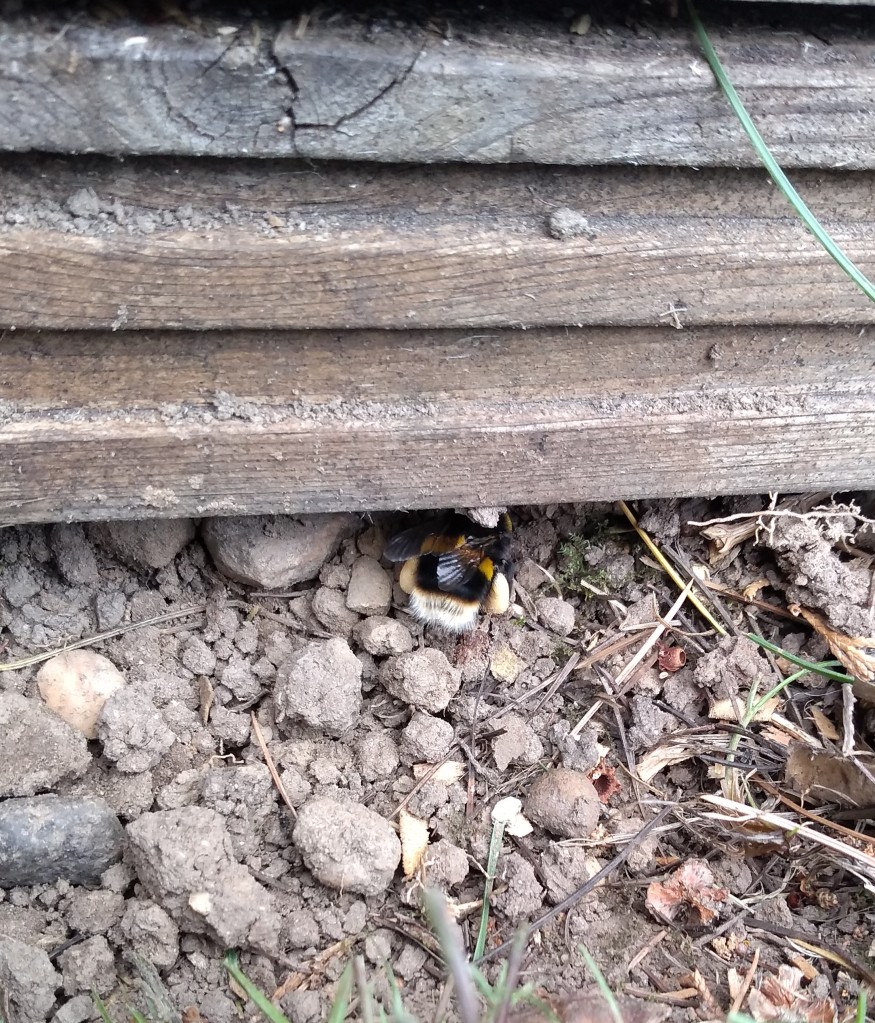
Another bee I started seeing last week was the Tree bumblebee (Bombus hypnorum). I noticed a nest inside a compost bin as I emptied grass clippings from the mower bag.

I have seen Tree bumblebees nest in bird houses before but not under compost. I made sure I avoided tipping grass onto their home and used the next bin along. I couldn’t help watching them for a little while as I stopped for a breather on the very hot Wednesday.

Moths were prominent throughout the week too. Unfortunately Box tree moth (Cydalima perspectalis) caterpillars and the signs of heavy infestation (foliage that had been eaten and covered with webbing) was noticeably present in several gardens. Therefore, I spent lots of time picking them off buxus topiary and informing clients to keep an eye out for them as well. For more information on this pest see the RHS website.

I discovered this years first sighting of a Silver Y (Autographa gamma) moth.

A Silver Y moth resting on a Heuchera leaf.

This immigrant is one of the few brown moths I can identify easily, mostly due to the clear y markings on it’s forewings but also because of their size and shape. This is a day and night flying moth which can be observed visiting flowers to obtain nectar.

However my most exciting moth sighting was the Lime hawk-moth (Mimas tiliae).

This spectacular large moth is night flying. It’s wingspan is 4.6-7.8cms and it can be found in broadleaf woodland, parks and gardens between May and July. I accidentally disturbed it as I pruned some shrubs under a Lime (Tilia sp.) tree. Thankfully it didn’t seem bothered by the disruption and it was carefully placed back near the lime tree. While adult moths of this species don’t feed, the caterpillars do. Once they have emerged from overwintering pupa, the caterpillars will eat Lime, elms (Ulmus sp.), Alder (Alnus glutinosa), Downy Birch (Betula pubescens) and Silver Birch (Betula pendula), Plane (Platanus x hispanica) along with some Cherry cultivars. This was the first Hawk-moth I have ever seen. There are a few that exist in the UK. The nearest I came to seeing one before was observing caterpillars of the Elephant hawk-moth (Deilephila elpenor) eating away at some Fuchsia. For more information on these Hawk-moths see the Butterfly Conservation website (Lime hawk-moth and Elephant hawk-moth)

I also saw hoverflies. I am still learning about these insects and learnt another one last week.

The photo above shows a Narcissus bulb fly (Merodon equestris). The maggots eat away at the centre of bulbs from the Amaryllidaceae family. However even though the maggots are a pest, the adult hoverflies are pollinators.

Posted in nature

Things Come in Threes

At least in several gardens last week, things with three leaves appeared as several Trefoils began to flower.

In some lawns the yellow flowering Slender hop clover (Trifolium micranthum) has shown itself along with Red clover (Trifolium pratense).

Slender hop clover
Red clover

Red clover is also called Bee-bread (along with White clover- Trifolium repens) due to its popularity with bees. It’s nectar is especially loved by Common carder bees (Bombus pascuorum), Honeybees (Apis mellifera) and Red-tailed bumblebees (Bombus lapidarius). Red clover, which is less commonly found in nature than White clover, is used for livestock feed and crop rotation (due to its nitrogen fixation abilities). It is also used in herbal medicine to treat respiratory and skin ailments,along with menopausal and PMS symptoms because the flower contains isoflavones. When taken internally, isoflavones become phytoestrogens which has similar affects in the body as estrogen (see Plantlife)

I will have to wait a little longer to see White clover flowering as it blooms from June. However White clover is commonly found in verges and grassland so I’m sure to see some eventually.

Unfortunately I have never spotted a four leaf clover (or five leaved). I am ever hopeful, just for the challenge because they are so hard to spot in the wild.

Several trees are blooming at the moment. Along with Hawthorn (Crataegus monogyna- the May tree flowers referred to in the rhyme ‘Cast ne’er a clout ere May is out’) the Horse chestnut (Aesculus hippocastanum) is also in flower; they have white flowers with a pink tinge.

I also see the Red horse chestnut tree (Aesculus x carnea Briotii) on my travels, both trees have very showy flowers.

It was great to see lots of bees about last week and various species too.

The first type of bee I saw was a Hairy-footed flower bee (Anthophora plumipes) around some forget me nots (Myosotis).

I also noticed lots of Buff-tailed bumblebees (Bombus terrestris),
Honey bees and Early bumblebees (Bombus pratorum) throughout the week too.

This Cotoneaster hedge was alive with Honey bees. Make sure the sound is on to listen to their relaxing buzzing.
The Early bumblebees were also visiting the Cotoneaster flowers.
I noticed five Buff-tailed bumblebees coming and going from a nest under some decking in one garden.
Posted in nature

All Four Seasons in One Week

The weather during the second week of lockdown was mixed. It began with snow flurries and sleet but ended with the warmest day of the year so far.

I continued my daily exercise walks around my area and saw more wild flowers, trees, bees and birds enjoy Spring.

Plants that began to bloom last week were;

– Shepherd’s Purse (Capsella bursa-pastoris),

– Snake’s head fritillary (Fritillaria meleagris),

– Herb Robert (Geranium robertianum),

– Annual honesty (Lunaria annua),

– Common Groundsel (Senecio vulgaris)

– and Laurel (Prunus laurocerasus).

I also noticed my first Dandelion (Taraxacum officinale) clock of the year 

Water droplets can be seen as frost began to melt on this Dandelion clock. A flower head will produce an average of 180 seeds.

along with Horse chestnut (Aesculus hippocastanum) trees budding at this time too.

One particularly special moment occurred last Wednesday when I visited my local woodland park. I went for my exercise as early as possible so that I would avoid too many people. As I entered the park I heard a sound of my childhood, that of Skylarks (Alauda arvensis). I grew up surrounded by farmland, similar to where I live now, and Skylarks singing was familiar to me (see RSPB). 

I knew there were nesting Skylarks in this area because of a notice I saw last year (see my blog post Relaxing into Autumn). There were three Skylarks, two were clearly a pair. Occasionally the third bird would get too close to the other two; causing a noisy aerial display before they all returned to the open ground apart once again. I watched this happen four times as I carefully moved around them; maintaining a distance so that I wouldn’t disturb them unnecessarily. Seeing and hearing these lovely birds was a beautiful experience to witness.

On Friday, while at home, I heard a group of Magpies (Pica pica). They were making such a raucous noise that I looked outside to see what was occurring. I was fascinated to see one Magpie (which was trying to escape) pinned down and being pecked at by another one. As this occurred, four more Magpies kept flying in, occasionally taking part in the attack. Eventually the bird which was under attack escaped and forced by the group to fly away. I have witnessed birds defend territories before but not like that.

Another sound I became aware of later in the week, were Greenfinch (Carduelis chloris), (See RSPB). Although I heard their call, I was unable to see them. However I have observed a Great tit (Parus major) and Coal tit (Periparus ater) and several Blue tits (Cyanistes caeruleus) visit the Rowan (Sorbus) tree outside my flat.