Posted in Allotment, nature

A Couple of Welcome Visitors

During the previous week there were the few days of unusually high temperatures for the time of year; a final flourish for late summer?

The heat encouraged lots of bees, especially Honey bees (Apis mellifera) to visit Hylotelephium (once called Sedums) which began to bloom. The sound was amazing and it was so relaxing to work near them; you could almost feel the buzz it was so intense.

How many bees can you spot?

Things have been ticking over nicely on the allotment for the past month. Corn and Squash are developing nicely while the supply of Sweetpeas and Beetroot keep coming. Plus the Potatoes have been dug up and Apples are ready to pick too.

Time spent planning next years harvest is in full swing, while changes to the allotment occur. I began to create a space for a wild flower area next to a patch of long grass, where a resident frog is no doubt loving the huge supply of slugs this year. Plus work has begun on transforming the veg patches into raised beds.

Away from the allotment, on Friday 10th September, I noticed a rather large moth in the hallway. It was an Old lady/ black underwing (Mormo maura) moth. The wingspan of the Mormo maura is between 55 and 65mm.

The common name of Old Lady is due to the colouration and pattern on the forewings, which resemble the shawls of old Victorian ladies. There is only one generation per year and adults fly between July and August; as I noticed this one in September it must be near the end of its lifespan. A nocturnal moth it is attracted to light (and sugar if you place feeding stations for moths). Clearly the open window had encouraged it into the building. The main habitat for this moth are gardens and waste ground, particularly in damp locations. In spring, after overwintering, the caterpillars will feed on various trees and shrubs, such as Blackthorn (Prunus spinosa).

Then last Friday, another moth found its way to the hall. Also a nocturnal moth attracted by light, the Snout moth (Hypena proboscidalis), so called for obvious reasons.

There are two generations per year of the Hypena proboscidalis, adults initially fly between June and August and again later in autumn. The wingspan of the Snout moth is approximately 30 to 38mm. Like the Old lady moth it also frequents gardens and wasteland, along with woodlands; essentially it can be found anywhere nettles (Urtica dioica) are found, which the caterpillars feed on.

Posted in Allotment, nature

Solace in Nature

It definitely feels like late summer now. Nights are noticeably drawing in, the sun is lower and my spidey senses have noticed a change in the air too.

The highlights of last week were seeing a Painted Lady (Vanessa cardui) on a Buddleja and noticing the harvests developing.

Autumn, my favourite season, is nearly here. The apples at the allotment are coming along nicely, almost ready to eat, along with the ripening blackberries. Plus hazelnuts and walnuts can be picked soon too.

Rowan berries have ripened now, their beautiful red colour showing through the green foliage. Last Thursday I noticed a female blackbird pick some before flying off with them.

It’s also been lovely to see my resident family of Blue tits on the Rowan tree (Sorbus), as I enjoy breakfast before my days work.

These small moments bring me so much joy and are a fantastic way to begin the day. I am grateful for natures restorative ability. Finding solace in it helps ground me while enabling me to remain in the moment and appreciate the small things. This time of year, when nature starts to slow down, also reminds me to take things more easily too. I do love this time of year. For me, the transition into Autumn, is a time of contemplation and preparation for the future.

Posted in nature

Flowers Bloom in Spite of the Weather

Much needed rain arrived last Wednesday evening, lasting through the night; followed by another short downpour later in the week. Unfortunately, these weren’t enough to replenish the parched ground which currently resembles crazy paving. It’s hard to believe we experienced a cold damp winter when cracks in the earth are so deep.

Somehow, even with of the lack of rain, wildflowers still bloom regardless. Buttercups (Ranunculus), Cow parsley (Anthriscus sylvestris) and Stitchwort (Stellaria) have joined the early spring bloomers; replacing the faded Lesser Celandine (Ficaria verna). Unlike the pinks of the ornamental Cherry trees (currently blooming), the predominant colours lower to the ground are blue, yellow and white.

Another plant I noticed was Ground ivy (Glechoma hederacea).

Usually found on damp ground, amongst woodlands, hedgerows, wasteland and in lawns, It’s violet flowers appear between March and June. Surprisingly, it was flowering last week, even with the current dry conditions.

The common name, Ground ivy, is rather misleading as it belongs to the same family as dead-nettles (Lamiaceae) and isn’t ivy. This evergreen perennial most likely obtained the name due to its spreading nature, which occurs overground, rooting from stolons. In fact this plant has numerous common names including, Alehoof, Gill-over-the-ground, Creeping Charlie, Run-away Robin and even (during medieval times) Our Lady’s Vine. A more comprehensive list can be viewed on the RHS website, along with how to grow it if you want to introduce it into your garden.

This herb releases a scent when disturbed. As I crushed some leaves, the smell reminded me of a slightly medicinal thyme aroma, actually quite pleasant.

In times past Ground ivy was used to flavour beer, thanks to its bitter taste (before it was replaced with hops) and as a rennet substitute in cheese making.

I am always intreagued at a plants ability to thrive in unusual places or difficult situations; I love spotting plants growing in such circumstances. Last week I was amazed to see a foxglove (Digitalis) growing without soil on an old wall.

Normally I would only see plants such as Buddleja, Ferns or Yellow corydalis (Pseudofumaria lutea) thriving in this way; their shallow root systems able to anchor themselves amongst the bricks.

Last week wasn’t solely dominated by plant observations. After the previous weeks sighting of the Tawny Mining bee (Andrena fulva), see Auburn Beauty Spotted, it was nice to follow up with sightings of some Mining bee nests. Unfortunately I don’t know whether these nests had or were housing Tawny or Ashy Andrena cineraria) mining bees.

The second nest was spotted on Saturday, while going for a lovely walk with friends. On that sunny day we also witnessed three Speckled wood (Pararge aegeria) butterflies flitting about; clearly enjoying the sunshine and great company as much as I was.

Posted in nature

Flowers to Lift the Spirit


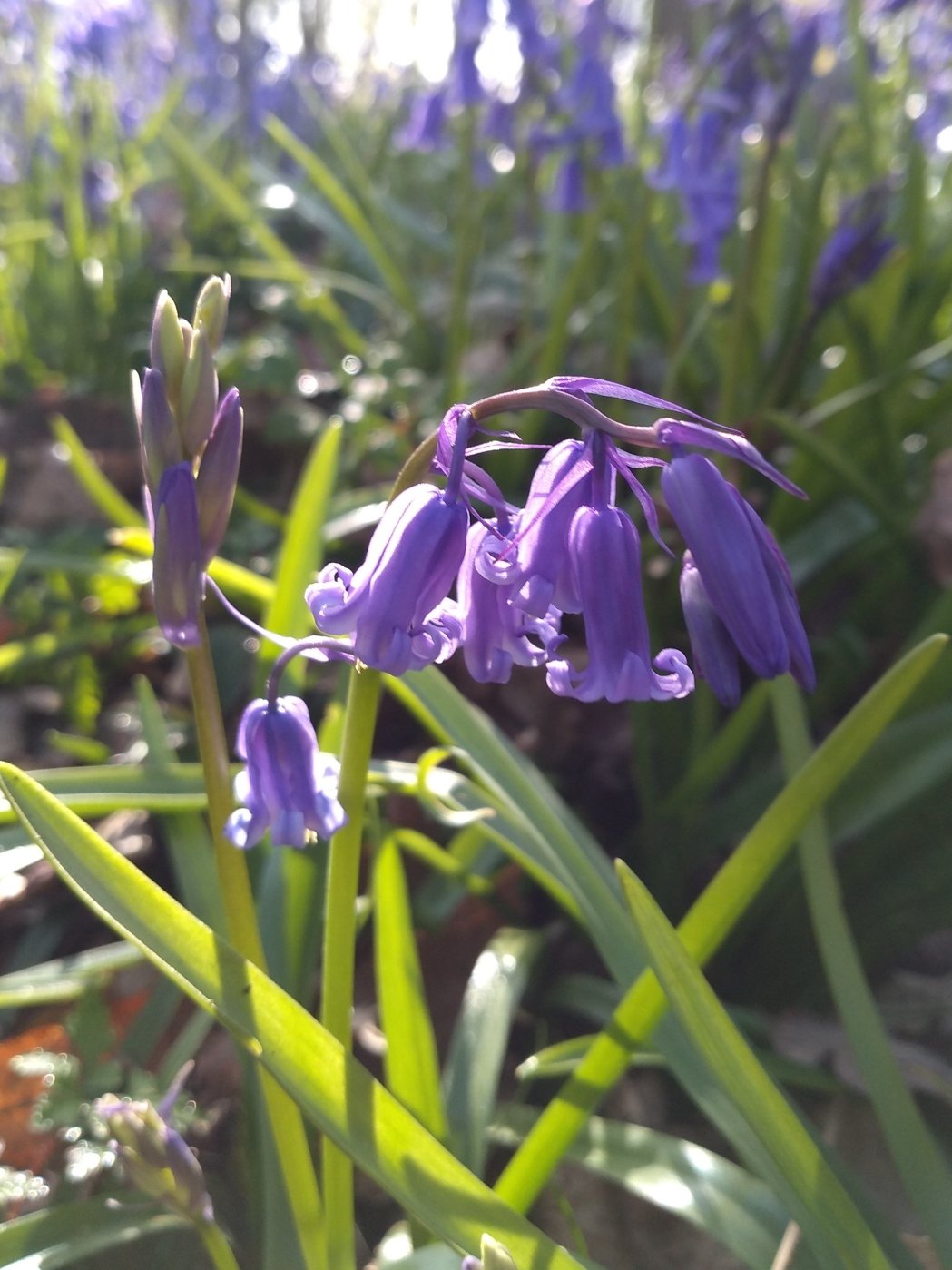
Last week the Bluebells (Hyacinthoides non-scripta) were just beginning to open. I always look forward to seeing these delicate flowers appear; it brings such joy to see their destinctive shade of blue on mass. Although not yet in full bloom, as I knelt down to take photographs I caught their delicate aroma.

Then later the same day, I got my first sighting of a Common carder (Bombus pascuorum) bee of the year, as it took advantage of the apple tree blosom.

I will never tire of hearing birdsong, it’s a wonderful soundtrack to have as I work. Not only is birdsong relaxing to me but it gives me the opportunity to keep learning too. The bird I became most aware of last Tuesday was the Nuthatch (Sitta europaea). Amongst all the birds I could here on that day, this was the clearest (it can be heard here on the RSPB website).

Unfortunately I didn’t get to see it. Having never seen one before I would have loved to see it’s mostly bluish grey and chestnut plumage (with hints white along with a black stripe across the eyes).

Similar in size to a Great tit (Parus major) these birds resemble a small Woodpecker as they climb trees. Nuthatches can be seen clinging to trunks or branches, as they climb up or down headfirst (the only British bird to descend trees in this way). They forage for insects and invertebrates, as well as feast on seeds and nuts (including beechmasts, hazel nuts and acorns) using tree crevices to store food for later. They also bury food and hide it beneath stones.

Nuthatches are found in mixed  broadleaf woodlands, parkland or urban gardens which have sufficient tree cover; occasionally eating from bird feeders. They particularly like areas with mature Oak (Quercus) trees. There was an established Oak nearby where I worked, so perhaps that’s where it was singing from.

They remain close to the nesting site where they fledged and are mostly seen in England and Wales; although their range is expanding into Scotland. Nests are holes in trees such as old Woodpecker nests.


Posted in nature

Amazing Auburn Beauty Spotted

Annual honesty (Lunaria annua), Shepherd’s purse (Capsella bursa-pastoris) and Hedge garlic (Alliara petiolata) were all blooming last week, which is great for the increasing numbers of pollinators I saw flying around.

Some flowers began to open up on a Crab apple (Malus spectabilis) I saw in in one garden too.

As alluded to above, more insects were prominent throughout last week compared to earlier in the month. I saw my first male Orange-tip butterfly (Anthocharis cardamines) and undisturbed Seven-spot ladybirds (Coccinella septempunctata) of the year.
Yet more species of bee were buzzing about too; I observed female Early bumblebees (Bombus pratorum) one Hairy-footed flower (Anthophora plumipes) bee queen, along with several female Red-tailed (Bombus lapidarius) bumblebees.
A great Bumblebee ID guide can be viewed at Blooms for Bees; this website also includes ways to encourage bees into your garden.

Then on Thursday, as I was clearing wildflower seedlings from a path, I noticed a beautiful redhead resting next to me.

This photo doesn’t do the vibrant colouration of this bee justice.

I recognized it was a bee but was initially unsure of the species. Upon further investigation, via Google lens, I discovered it was a female Tawny mining bee (Andrena fulva).

Given the place I saw the bee, I was unable to locate it’s nest, in fact it may have flown in from another garden anyway. Their burrow is usually located in lawns (sometimes flower beds); identifiable from a mound of earth with a hole at the top for the entrance. Often described as having a volcano like appearance it can be differentiated from ants nests which are flatter and have no distinguishable hole at the summit. After several weeks these mounds are no where to be found, so they can be left undisturbed without any worry of damage to lawns.

These solitary bees (which do not sting) can be seen between April and June in gardens and parkland as well as along the edges of fields and orchards.

The appearance of these beautiful bees coincides with the flowing of Cherry (Prunus), Pear (Pyrus), Hawthorn (Crataegus), Blackthorn (Prunus spinosa), Maple (Acer), Willow (Sallows) and Apple (Malus) trees, along with other plants such as Buttercups (Ranunculus) and Dandelions (Taraxacum). Nectar and Pollen from these blooms is collected for the bee larvae that develop in the nest beneath the ground. Once the young become pupa, they continue to hibernate through winter to eventually emerge the following spring.

Males are smaller than the female Tawny bees and are a dull brown colour. They do not take any part in creating nests or rearing the young, the females will undertake these jobs alone.

Posted in nature

Hints of Summer with Winter Showers; Must be April.

Last week had very mixed weather. Easter Sunday was sunny and warm (a hint that summer isn’t far away) replaced by snow showers and frost on Monday and Tuesday; eventually cold days with occasional sunny spells remained.

I took advantage of the glorious weather last Sunday and went for a walk around my local woodland park. More Brimstone (Gonepteryx rhamni) butterflies were flitting about, along with one Comma (Polygonia c-album) and several Peacock (Aglais io) butterflies too.
Blackthorn was still blossoming in earnest, attracting these butterflies as well as bees and hoverflies.

A Peacock butterfly feeding in the sun.

Pollinators weren’t the only wildlife noticeable; lots of Squirrels (Sciurus carolinensis) were running between and up the surrounding trees while birds were singing.

I even noticed a couple of Blackcaps (Sylvi atricapilla). I’m not sure if these birds are resident to the woodland or migrated from Europe or northern Africa. Since the 1960’s records of these Warblers remaining in the UK all year round exhist and since then numbers have increased. Those not living the UK full time visit from April or May and remain until September or October.

It is the first time I have ever seen Blackcaps (presumably a pair given how they were interacting with each other).
As they were so high up in the tree, completely unaware I was watching from below, I was unable to actually see their caps (males have black caps while females have a chestnut colouration to the top of their head) however I was able to identify them from their bird song. An example of this can be heard on the RSPB website.

This wasn’t the only amazing experience I had with a bird last week. On the following Tuesday I was privileged to witness a Wren (Troglodytes troglodytes) flying around me as I worked, singing as it did so. At one point it landed on a shrub within a few feet from me; I remained as still as I possibly could, watching this amazing spectacle. Usually remaining near cover Wrens are usually heard but not seen so this was lovely to see; plus I managed to obtain footage.

Posted in nature

Tuesday was a School Day

The lovely sunshine we’ve had on and off recently has encouraged lots of wildflowers to start blooming over the past week. Amongst the Daffodils were Daisies (Bellis perennis), Snake’s head Fritillary (Fritillaria meleagris),

Snake’s-head fritillary has become naturalised in the lawn of this woodland area of the garden.

Dandelions (Taraxacum),

Perfect for pollinators, especially bees but also butterflies.

Cowslip (Primula veris),

Primroses on my allotment adds a little colour at this time.

Green alkanet (Pentaglottis sempervirens) and Forgot-me-nots (Myosotis). Even brave Tulips were beginning to open up.

Last Tuesday I learnt another plant, the Marsh marigold (Caltha palustris).

This particular plant was in a raised water feature made from an old rectangular metal container which replicated it’s natural growing conditions. In the wild, Marsh marigold grows in damp conditions such as ponds, marshes and wet woodland and flowers from March to July. It’s common name ‘Kingcup’ is a reference to the large buttercup like flowers resemblance to large golden cups (therefore cup of the kings); Even the latin Caltha means goblet.

A wonderful addition to ponds in gardens, this perennial provides shelter for amphibians as well as nectar for pollinators (Bees, beetles and flies).

However, one word of warning, the sap can be an irritant as it contains glycoside protoanemonin, especially in the older growth.

Magnolias and Ornamental cherry trees, including my Prunus incisa ‘Kojo-no-mai’ on the allotment, joined the wonderful display of Blackthorn (Prunus spinosa) blossom.

Sunny blue skies are the perfect backdrop to this huge Magnolia and Ornamental cherry (see below).
Along with the Cowslips, this ‘Kojo-no-mai’ cherry provides some pollen and nectar on my allotment.

I also noticed that Horse chestnut (Aesculus hippocastanum) trees were showing evidence of flower development alongside recently unfurled leaves; although they won’t bloom until May.

Will it be a good year for playing Conkers?

With all these flowers appearing, it was wonderful to see more bees take advantage of all the pollen and nectar available. On the sunniest days I even caught glimpses of the first Brimstone (Gonepteryx rhamni) and Peacock (Aglais io) butterflies of the year; venturing out of hibernation when it is warm enough too.

Posted in nature

A Splash of Purple

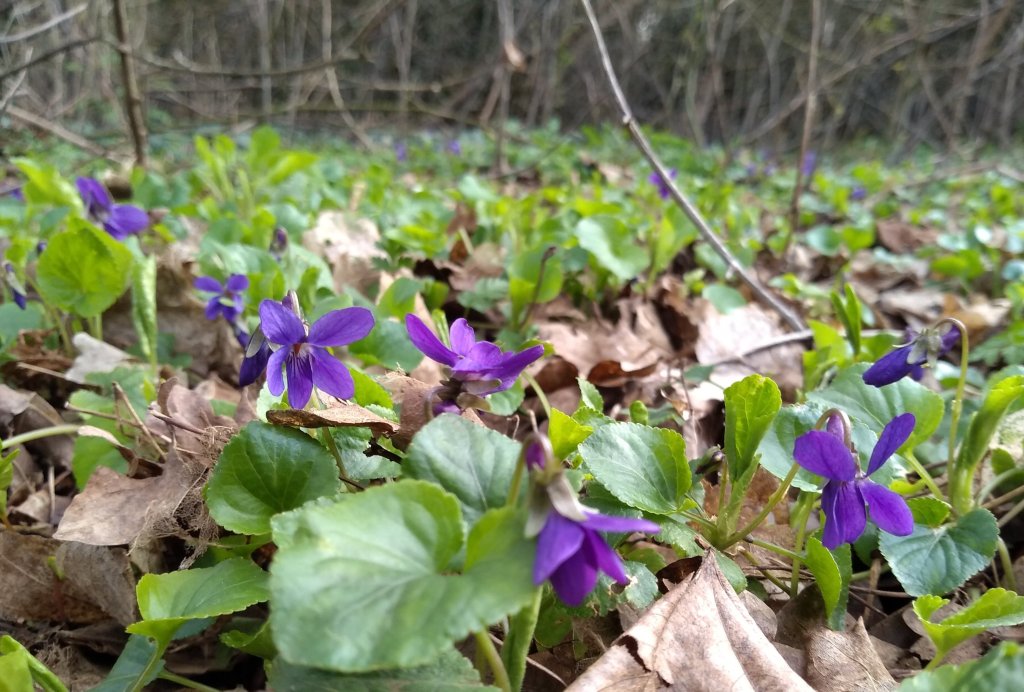
The Common Dog Violet (Viola riviniana) has begun to bloom, both in the wild (in woodlands, heaths and amongst hedgerows)
as well as gardens.

This splash of purple usually arrives in April and lasts until June. If you are lucky, you may notice certain Fritillary butterflies feed from and lay their eggs on this plant (a spectacle I’ve yet to witness).

Willows were blooming last week too. There is one mature Goat Willow (Salix caprea) that I see regularly as I work. Another common name for the Salix caprea is Pussy willow, due to the male catkins resemblance to cats paws before they bloom.

Only males catkins turn yellow once they open.

Willow trees are dioecious; therefore females catkins, grow on separate trees to the male ones. Unlike the male catkins shown above, female ones are green and longer in length. Catkins appear on the trees before the leaves do.

So many catkins were open that the tree seemed alive with the sound of bees.
I love the reddish tinge in the bark.

I am not sure how old this specific tree is but the species can live for about 300 years and grow up to 10 meters tall. The specimen in the garden I work at has definitely reached it full height.

The Kilmarnock willow (Salix caprea ‘Kilmarnock’) is a much smaller version of the Goat willow tree (grafted onto a dwarfing rootstock). I often see this tree in gardens and they were blooming last week too.

Unlike its larger counterpart, the Kilmarnock willow is a great addition to the average sized garden as it too is loved by bees.

The pollen covered Buff-tailed bumblebee pictured here clearly enjoyed visiting the male catkins on this Kilmarnock willow.

Goat willow trees are usually found in woodland, hedgerows and scrub, especially near waterways such as lakes, streams and canals.

Willows are a fantastic source of pollen and nectar for bees and other pollinators. They’re also a good food source for Sallow kitten (Furcula furcula), Sallow clearwing (Synanthedon flaviventris), Dusky clearwing (Paranthrene tabaniformis) and Lunar hornet clearwing (Sesia bembeciformis) moth caterpillars too. Even birds forage for insects amongst their branches.

As the wood burns well it is used to make charcoal. Plus it’s also used for wattle in timber frame houses.

My favourite fact is that the words witch, wicked and Wiccan are derived from Willow.

Traditionally, it was used to help treat toothache by chewing the bark and used to relieve diarrhoea, arthritis, sore throats, stop bleeding and clean wounds. In fact Aspirin, derived from salicin, was sourced from Willows.

The bacteria Brenneria salicis can cause Watermark disease in Willows which causes dieback and eventual death to the trees if left untreated.

If you are looking to add a small tree to your garden, the Kilmarnock willow is definitely worth looking into; unless you have a large garden then choose a mature male Goat willow instead (the bees will thank you for it).

Posted in Allotment, nature

New Life

What a week; variable weather (rain, sun and strong winds), new life (in the form of frogspawn) was evident and the Primroses (Primula) finally began to bloom.

After three weeks, the frogspawn of the Common frog (Rana temporaria) become tadpoles. Initially they eat algae before feeding on leaves, moss and small insects.

From about fourteen weeks they metamorphose from tadpoles into froglets (young frogs). The rate of metamorphosis depends on environmental factors. Tadpoles can delay their transformation, for several months, if there isn’t enough food, there are lots of predators to escape or the weather is too cold (they are also susceptible to frosts). When they become Froglets they start to eat invertebrates such as snails, slugs and flies just as mature frogs do.

Frogs can live between five and ten years (if they manage to avoid being eaten by snakes, owls, herons, otters, badgers and weasels) reaching sexual maturity at two or three years of age. Frogspawn can become food for fish, beetles, newts, dragonfly larvae, rats, foxes and hedgehogs.

I became aware of another trees lifecycle last week, the non-native Sweet gum (Liquidambar styraciflua). This is of my favourite ornamental trees along with Gingko biloba, Magnolia stellata, Tibetan cherry (Prunus serrula) and Acers.

Although I noticed this tree last Friday, it really comes into its own during autumn when the leaves produce a brilliant display of crimson, oranges and purples.

I love the first part of it’s name, Liquidambar, named by Carl Linnaeus, who combined the Latin ‘Liquidus’ with the Arabic ‘Ambar’ (for amber); it refers to the gum that the tree exudes when the trunk is wounded.

The mature fruit remain on the trees throughout winter and can be seen as the the leafbuds appear.

Elsewhere last week, the Rhubarb on the plot continued to grow and one of my houseplants, the Small-leafed spiderwort (Tradescantia fluminensis) began to bloom.

I am salivating just looking at this photo; looking forward to harvesting it when ready.
I almost missed these small delicate flowers as they blend in with the leaves. Tradescantia are so easy to look after and propagate.
Posted in nature

Silver Beauties

The Silver birch (Betula pendula) is from the Betulaceae family, just like Hazel (Corylus) and Alder (Alnus), which also have flowers in the form of catkins (see my previous two posts A Snowy Adventure and The Birds and the Trees).

At the moment only the immature male catkins are visible (as they have been since autumn) dangling at the end of tree shoots.

Silhouette of male catkins on the ends of high branches.

Female Catkins develop after the leaves unfurl in spring. They face upwards, are bright green and smaller than the male ones; flowering between April and May. Unlike the fertilized Alder catkins these do not become woody and remain on the tree for seeds to disperse from there. Instead seed dispersal occurs as the female catkins disintegrate and are carried away by the wind as they fall from the tree.

The paper like white bark of the Birch sheds to uncover newer, cleaner bark underneath; plus dark diamond shaped fissures develop as the tree ages.

Fissures developing on the trunk of a Silver birch from my local woodland park.

Two birch trees are native to the UK, the other is the Downy birch (Betula pubescens). It is possible for these to hybridize with one another however individually they can be differentiated. The Downy birch has hairy, single-toothed leaves and hairy shoots (which is how it gets its name); plus the leaf base is rounder. The leaves of the Silver birch are more angular, double toothed around the edges and hairless (the shoots are also hairless). The Downy birch also prefers damper soil than the Silver birch but both are naturally found in woodlands.

The Silver and Downy Birches have open canopies allowing flowers such as violets (Viola), Primrose (Primula vulgaris), Bluebells (Hyacinthoides non-scripta) and Wood anemone (Anemone nemorosa) to florish beneath them. Several fungi are linked with Birch trees too, such as Fly agaric (Amanita muscaria), Woolly milk cap (Lactarius torminosus), Birch milk cap (Lactarius tabidus), Birch brittlegill (Russula betularum), Birch knight (Tricholoma fulvum) and the Birch polypore (Fomitopsis betulina).

These trees can support over 300 insect species. They are a good food source for the caterpillars of Angle-shades (Phlogophora meticulosa), Buff tip (Phalera bucephala), Pebble hook-tip (Drepana falcataria), and Kentish glory (Endromis versicolora) moths. Several Bird species make use of these trees including woodpeckers (Picidae), which nest in the trunks, along with Siskins (Spinus spinus), Greenfinch (Chloris chloris) and Redpolls (Acanthis) that feed on the seeds.

Uses for Birch trees include the manufacture of furniture, handles and toys as well as the process of tanning leather.

In times gone by it was used to make bobbins, spools and reels for the Lancashire cotton industry as well. To the Celts Birches symbolised purity, renewal and love. Later on brooms were made using birch twigs in order to clean rooms. In Finland they are the national tree.

There are several threats to Birch trees, two fungal pathogens (Marssonina betulae and Anisogramma virgultorum) which can cause Birch dieback and eventual death. Bronze birch borer (Agrilus anxius) can also attack native trees.
More information on both can be found on the Forest research website, see the links Birch dieback and Bronze birch borer.