I have managed to learn more fungi over the past winter months, both at work and during woodland walks. I have seen these, mentioned below, between November 2025 through to mid January 2026.
1) Common stinkhorn (Phallus impudicus).
The common name is very appropriate, as Stinkhorn suggests, it does produce a very strong (foul) odour; in fact you become aware of it well before seeing it. The smell resembles blocked drains or a decaying animal. Flies land on it, spreading the spores as they continue to move around.
2) Wrinkled club (Clavulina rugosa).
This fungi is often found near pathways. These specimens were located on the edge of the lawn.
3) Jelly ear (Auricularia auricula-judae). I have seen this fungi before but I find it fascinating. I noticed a young slug seeking shelter amongst it.
4) False turkey tail (Stereum hirsutum).
False turkey tail is found growing on fallen branches or those dying on hardwood trees (as shown here). It is much smaller than Turkey tail fungi (Trametes versicolor).
5) Leaf Parachute (Marasmius epiphyllus).
These tiny fungi develop on leaf litter of Ash or Poplar trees.
6) White Saddle (Helvella crispa).
These pretty fungi develop near paths amongst Beech (Fagus) and Oak (Quercus) trees.
7) Candle snuff (Xylaria hypoxylon).
Candle snuff grows on moss and the decaying wood of broadleaf trees. Starting off greyish white, it releases spores that turns it black.
8) Oakbug Milkcap (Lactarius quietus), found them beneath Oak trees.
As the name suggests, milkcaps produce a milky substance (latex) when bruised as a form of protection, like putting on a plaster to cover the injured area. They form a cooperative relationship with specific trees, this one is only found under Oak trees.
9) Some Oysterlings, possibly Variable oystering (Crepidotus variabilis). Oysterlings are very small and difficult to distinguish from one another.
Developing on woody debris such as twigs from Broadleaf trees on woodland floors these white fungi are tiny.
Now that we are well into January flowers are starting to show signs of life. Snowdrops are beginning to bud and female Hazel (Corylus) flowers as well as Winter aconites (Eranthis hyemalis) are blooming. Plus I have seen lots of ladybirds sheltering through this harsh season.
7-spot ladybird (Coccinella septempunctata) found on a dead tree trunk.
The weather this year continues to be strange. Early October was relatively mild. Buddleias were still flowering and on the 7th, a very sunny day, I saw a Painted lady (Vanessa cardui), a few Red admirals (Vanessa atalanta) and many Comma (Polygonia c-album) butterflies visiting one, together with some Verbena bonariensis. There were lots of bees on these plants as well, along with lots of mining bee activity in lawns too.
Now, a month on, still milder than usual, the clocks have gone back and Samhain/ Halloween has passed. While the autumnal colour has been developing for a short while, leaves have only been falling in great numbers for the passed few weeks. Grass is still being mown although growth is slowing down.
It has been lovely watching the various birds visiting the Rowan tree (Sorbus) outside my flat. Alongside Redwings (Turdus iliacus) there have been a few Blackbirds (Turdus merula), Magpies (Pica pica) and many Starlings (Sturnus vulgaris) eating the berries.
I have also noticed a Winter flowering cherry (Prunus subhirtella Autumnalis) in bloom too.
This small ornamental tree can continue flowering until February if the weather remains mild and gives a wonderful winter interest.
Fungi have been putting on a wonderful show over the past month; some providing a splash of colour to rival the leaves during this transitional period. I noticed Shaggy inkcaps (Coprinus comatus) in late October, followed by many others, including puffballs, Common bonnets (Mycena galericulata) as well as Scarlet waxcap (Hygrocybe coccinea) and Amethyst deceivers (Laccaria amethystina).
This aging Amethyst deceiver has lightened in colour.
The latter, as the common name suggests is a lovely purple colour that fades to lilac as it ages. The caps are typically 1.5 to 5 cm in diameter and height of stem 4-6 cm. This fungi has gills and is commonly found in broadleaf woodlands containing Beech (Fagus) and Oak (Quercus) between June and November. I noticed these under some Copper beech (Fagus sylvatica f. purpurea).
I also found a carpet of Scarlet waxcap on a lawn, unfortunately I didn’t manage to get a good photo of them. However, it was an amazing view, bright red caps with orange gills. Photographs and information on this fungi can be found on the Wild Food UK website here.
Now September has arrived, there is definitely an Autumnal feeling in the air. Similar to March, this month often has a transitional effect on me; especially once the Autumn equinox arrives on the 22nd. The nights are noticeably getting colder and drawing in. Over the past few weeks, some mornings have been misty and there has been a mixture of weather throughout the weeks; humid and stormy one moment and colder and sunny another. Spiders and their webs have become more visible, helped in part by morning dew, plus leaves are beginning to turn on some trees while autumn Cyclamen and crocuses (Colchicum autumnale) are starting to flower. I love September after the intense heat of August I long for a bit of relief.
On the allotment, autumn raspberries (Rubus idaeus) and apples are ready to pick along with pears, damsons (Prunus domestica subsp insititia),
Damsons ready to pick.
elderberries (Sambucus) and blackberries (Rubus). Conkers are falling now too, although the walnut and hazelnut harvests have passed.
Sweet chestnuts are almost ready to fall.
On the last bank holiday of the year (almost a month ago), I visited Minster-on-sea with my partner and his parents. It was an ideal day for walking along the beach searching for treasure, perhaps fossils, sharks teeth, sea glass, pieces of broken pottery and the occasional sea lego. Washed up along the beach were lots of Slipper limpets (Crepidula fornicata).
These limpets arrived on these shores from America via ships in the 1800s and thrived in the UK; especially southern England and Wales, where they have become a pest to muscle and oyster beds (competing for food and space). They are edible themselves.
It is usual to see individual empty shells, in fact they are found in huge numbers on beaches in the Solent. The common name of this sea snail refers to the appearance of an individual shell when it is viewed upside down; similarly the latin means small boot. When alive, these gastropod molluscs are rarely found alone (as shown in the photo above). Up to 12 Slipper limpets can be stacked together with the female, the largest and oldest, at the bottom; all the others are male or, in the case of the second from bottom, in the process of transforming into a female. When the one at the bottom dies and falls off, the next one up then becomes female. Further information on these fascinating creatures can be found in an article written by Nick Baker here.
The Slipper limpet isn’t the only snail that I noticed recently. I often get to see land snails but I noticed this beautiful orange coloured Brown lipped snail (Cepaea nemoralis) hanging around after a rainy morning. Snail shells can be very beautiful and I am intrigued by their structure.
Whatever your view on snails it’s hard to look at their shells without admiring the beauty.
I have become more aware of insects lately, mostly when cutting back perennials at work. Although I try to be careful as much as possible, occasionally I disturb a few. I always make a point of replacing or moving them to a safe place. Mostly it is ladybirds but I have also noticed a few other species, such as Common earwigs (Forficula auricularia) and the Rusty tussock (Orgyia antiqua) and Knot grass (Acronicta rumicis) moth caterpillars
Common earwigs feed on organic matter and like to hide away in dark areas of the garden (not in human ears).
Earwigs are useful garden recyclers.
Once eggs are laid, the females diligently clean them and constantly guards the nest only stopping when the young can fend for themselves. While the adults can nip humans and predators, it is only as a warning.
Caterpillars of the medium sized Rusty tussock moth can be seen between May and September.
The males and females of this moth, also called the Vapourer, look different from on another. The males are orangey-brown while the female has a more grey colouration and also lacks any significant wings; therefore it is only the males of this species that are active (mostly flying during the day). The young feed on broadleaf trees and shrubs in gardens and parks, as well as along hedgerows, heaths, moorland and woodland. The adult female and male moths can be seen here .
Knot grass caterpillars (see photo above) can often be found in late summer (and even as late as October in Southern Britain; although these are usually a second generation). Pupa of this moth survive the winter in leaf litter. The grey coloured adults (with a wingspan of 3-3.5 cms) can be seen from May through to September. The caterpillars can be observed on herbaceous or woody plants such as knotgrass (Polygonum aviculare), bramble (Rubus), hawthorn (Crataegus), common sorrel (Rumex acetosa), heather (Calluna), plantains (Plantago), docks (Rumex) and purple loosestrife (Lythrum salicaria). It makes sense therefore that this one was found nibbling on a raspberry leaf on the allotment. The numbers of this moth are declining and while they are still commonly found in gardens, heathland and grassland, it is thought that the species is becoming vulnerable. I was happy to share my raspberry plant with this caterpillar; raspberries are my favourite fruit but it certainly wouldn’t do any major damage. A photo of the moth can be seen on the UK Moths website.
Sadly the results of the Butterfly count for this year came out last week. They confirmed people’s suspicion that it hasn’t been good for butterflies and moths (as well as bees). Many butterfly and moth numbers continue to fall, and significantly so from previous years results, due to a variety of factors including the cold wet weather we’ve experienced this year. Further information can be found on the butterfly conservation website here.
Thankfully last Friday, I witnessed a wonderful sight during a warm sunny afternoon. A huge area of ivy in full bloom was covered in so many bees that it stopped me in my tracks. I stood nearby and listened to the wonderful buzzing sound, it was so relaxing. There were so many Ivy bees (Colletes hederae) alongside buff tailed bumblebees (Bombus terrestris) and honey bees (Apis mellifera) visiting the ivy flowers. It was the first time I was able to definitely identify ivy bees which was amazing (see below).
First recorded in the UK in 2001, Ivy bees are becoming more common. They look very similar to honey bees but can be distinguished by the stripes on their abdomens; the bright yellow stripes are distinctly separate from the black ones than they are with honey bees. Unlike honey bees these are solitary, however there can be lots of nests close to one another and these bees will forage together when opportunity allows. As their name suggests, they feed predominantly on the nectar of ivy flowers and therefore their appearance coincides with this plant flowering (between September and November). I have been searching for a definite sighting of these bees for years and finally I have been rewarded for my patience.
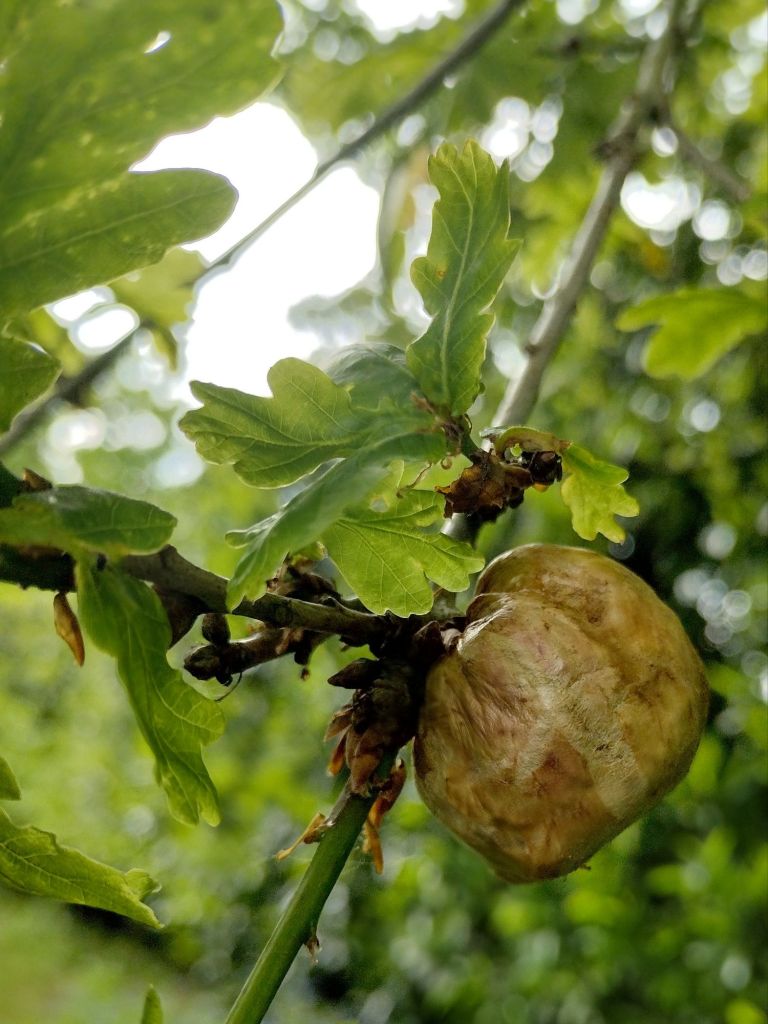
I’ve found more galls, over the last few weeks, this time on the ground surrounding a few Pedunculate Oaks (Quercus robur).
These galls remind me a little of the Facehugger in the Alien film franchise.
They are produced by these trees as a result of the Knopper gall wasp (Andricus quercuscalicis) laying young in the acorns. As with the Oak apple gall wasps (Biorhiza pallida) mentioned in a previous post ‘Relaxing Evening Birdsong’ , they are not detrimental to these majestic trees and don’t appear on many of the fallen acorns. Interestingly each generation of the wasp will change between sexual and asexual each alternate year.
I also saw my first Goldcrest (Regulus regulus) in a cypress tree near the beginning of the month. Although I could see the silhouette of this tiny bird moving around the top of the tree. I was only able to identify it using the Chirp-o-matic app on my phone, due to its loud singing. The Goldcrests song can be heard on the Woodland trust website here , where you can also see a photo of this diminutive bird. I wish I could have viewed it at closer range, then I would have been able to see the wonderful plumage on the crown (yellow for females and orange for males). The Goldcrest is the smallest bird in Britain, even smaller than the Wren (Troglodytes troglodytes). Hold a 20 pence piece in your hand, and you will have an idea of the birds weight (just 5 grams). They inhabit mixed woodland and conifers along with parks and gardens. The numbers of our resident birds increase with the migration of others from Scandinavian countries during the winter. They feed on insects and other invertebrates. It is always lovely when I am still able to witness new things in nature like this. It gives me a buzz, allowing me to learn through research.
After a slow start, due to the weather, things are growing nicely on the organic, no dig, wildlife friendly allotment.
The view of the allotment from the Buddleia shrub.The view of the allotment from the apple tree.
While most of the soft fruit season has come to an end (apart from the autumn raspberries), the plums and apples continue to develop and are something to look forward to later in the season.
Thankfully the rhubarb has recovered a bit after a disappointing harvest. Rhubarb doesn’t like growing in waterlogged soil and although we have sandy free draining soil, I think it ended up being too wet over the winter. The rhubarb was on the plot when we took it over four years ago and had grown very large. Every five years Rhubarb can be divided when the growth has become weaker or leaves are overcrowded so I will do this around November and hopefully this will invigorate its growth next year.
The slightly depleted Rhubarb patch.
The vegetables remain on a three yearly rotation to maintain soil health and keep viruses at bay. Main crop potatoes, kale (Cottagers and Cavolo Nero), beetroot, radishes and courgettes are doing well as usual. This years addition are carrots. I always like to try something different each year and It’s been a while since I tried growing these; so far they are surviving. They are in a raised bed and were sown later and sparsely to help avoid detection by carrot fly (Psila rosae). They are also in a mixed raised bed which also helps.
Along with covering vulnerable plants and growing sacrificial plants such as nasturtium (Tropaeolum majus) and marigolds (Tagetes), I intersperse herbs and other flowers in between the vegetables to help prevent too much loss from pests. I usually find beneficial insects soon appear when needed; there are lots of ladybirds on the plot at the moment. I also find the best way to deal with slugs and snails is to collect them and place them elsewhere; plus any plants with soft young growth are protected by copper tape on old pots and thorny material. I do allow some slugs to remain on the allotment however. The Leopard slug (Limax maximus) is one beneficial slug to have in a garden as they don’t eat living plant matter. They are great for the compost and also eat the eggs of other slugs.
Thorny material protecting new growth from slug and snail damage. Also a plastic bottle (with the bottom cut off) to allow water to be directed to the roots.Copper tape around an old pot (with the bottom cut off) used as a guard around the base of an annual while it establishes itself.
We have a lot of wildlife visiting the allotment. There is often evidence of a fox (Vulpes vulpes) visitor (which we have seen on other plots). Plus we often see grasshoppers and Common blue Damselflies (Enallagma cyathigerum) and frogs (at the moment we regularly notice one adult and one youngster hopping around). Last saturday, the sun was out and there was an abundance of bees on the Catmint (Nepeta), Red clover (Trifolium pratense), Lavender and Buddleia.
The wild area on the plot contains a bug hotel and is located near to a neighbouring pond. This is where the red clover grows.
This year, I decided to undertake the Big Butterfly Count at the allotment. The butterflies seen were;
2 Small skippers (Thymelicus sylvestris), 1 Comma (Polygonia c-album), 2 Gatekeepers (Pyronia tithonus), 1 Peacock (Aglais io) and 2 Large whites (Pieris brassicae)
Given the abundance of Cabbage whites (Pieris brassicae) nearby I have made sure my kale is covered up.
The perennial kale mixed in with the cut flower patch.
I find it reassuring to have seen so many butterflies and bees at the weekend, especially as overall there seems to be a reduction in numbers this year; partly due to the frequency of wet days.
I have noticed lots of moths this year too. Perhaps the most exotic looking one I have seen so far is the Scarlet tiger moth (Callimorpha dominula).
The creamy coloured spots on the top of the forewings can sometimes have a more vivid yellow tint.The red underwings can be seen here. I also managed to capture some of the shimmering blues and greens of the forewings when the sun shone on the moth.
This moth is medium sized, at 23- 27mm (across the wings). It flies during the day and night through May and June; often noticed while resting on plants. The caterpillars of this moth feed on Comfrey (Symphytum), Hemp Agrimony (Eupatoriumcannabinum), Common Nettle (Urtica dioica), Bramble (Rubus fruticosus), Honeysuckle (Lonicera), Meadowsweet (Filipendula ulmaria) and Green alkanet (Pentaglottis sempervirens); they can be seen from August until May, overwintering into the following year. The habitats where the Scarlet tiger moth will be found are in areas of wetland, riverbanks, woodlands, gardens as well as coastal areas.
One sound and aerial display of summer which I enjoy is the return of Swifts (Apus apus). I have even been lucky enough to see them catching insects as they swoop over a pond (sometimes just skimming the water) along with another flock soaring high up the sky. I always treasure seeing these amazing birds as they are on the red list for Birds of Conservation Concern 5: (2021). A few things we can do to help them is to put up appropriate nest boxes, as well as adding swift bricks to new builds, giving them somewhere to raise their young. The RSPB also have a citizen science project where you can record their presence. Further information on how you can take part, can be found here. Having arrived in Britain in April and May, it won’t be long before they return to Africa as they only remain here until August. Most of their time is spent on the wing, only stopping to nest in roofs especially of old buildings such as churches. If this isn’t incredible enough when feeding the young they regurgitate a bolus, (a pellet formed in the back of the birds throat) containing between three hundred to one thousand insects mixed with saliva. More information on swifts, including how to identify them can be found on the RSPB website, where you can also hear a recording of their distinctive call.
Swifts are not the only thing I have noticed around ponds lately. I recently learnt about another pond invertebrate, the Common backswimmer (Notonecta glauca). So called because they swim on their back just beneath the surface of the water. Not only do they feed on insects, but also tadpoles and small fish. They suck out the contents of their prey’s body after injecting it with toxic saliva. Found all year round they moult a few times before reaching their final length of one and half centimetres. It was quite fascinating to observe them swimming around.
Although it’s close to the Summer Solstice, the weather remains very changeable; regularly alternating from sunny to dull and wet. However this is enabling vegetation to thrive. It is lovely to hear birdsong still. One in particular the blackbird (Turdus merula) is a joy to hear, especially in the evening. Sadly Blackbird numbers have reduced in recent years, due to the Usutu virus (increasing because of warmer winters), and the BTO are asking for help with a citizen science survey. If you have a garden and could spend some time recording your local blackbirds then please consider taking part. The link, for more information can be found here.
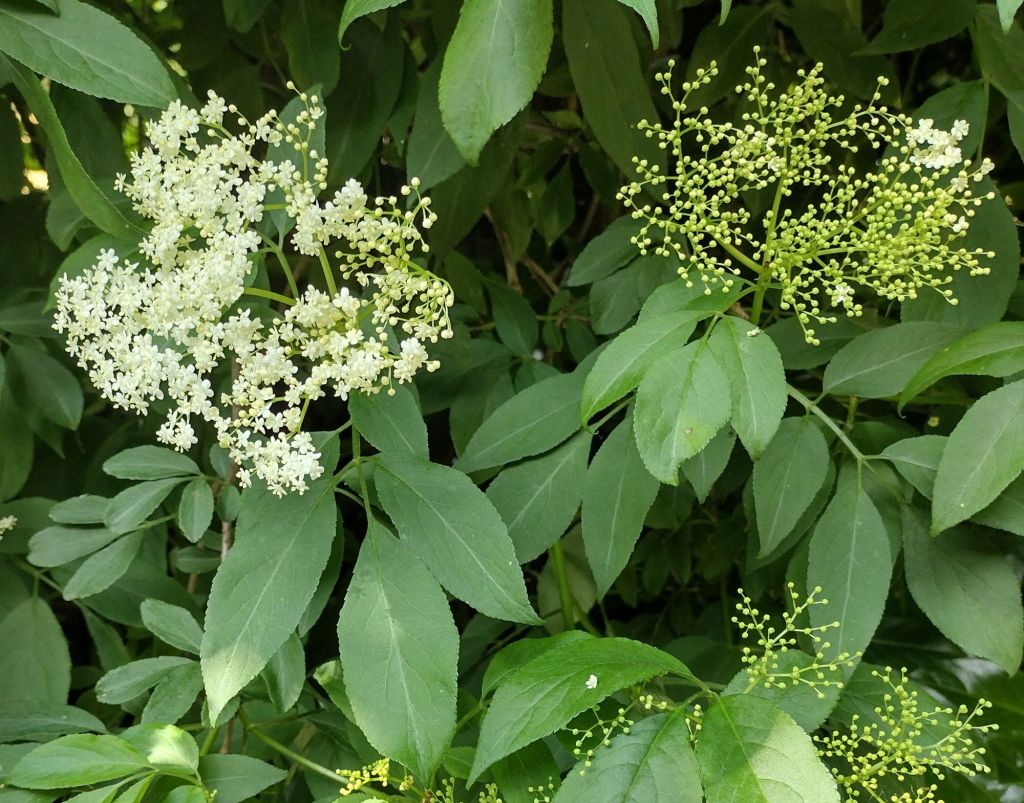
Elder (Sambucus nigra) is flowering now in woodlands, amongst hedgerows and in gardens, taking over from the Hawthorn (Crataegus monogyna).
Elder can thrive for up to 60 years and reach 15 meters in height. It is thought that the common name developed from ‘aeld’ the Anglo-Saxon word for fire as the spongy centre of the branches can be hollowed out, enabling it to be used as a bellow to help ignite fires. As with the Rowan (Sorbus) tree, it was thought that the Elder could ward off evil spirits, along with the devil and witches. It was also believed that breaking or cutting any part of an elder would bring misfortune to the person responsible unless permission was granted from the elder mother (regarded as the witch or guardian within the tree) beforehand. However, the Elder tree is great for foragers. Both the flowers and vitamin c rich berries can be used for making cordials and preserves; although it is important to remember to cook the berries, making them safe, before consuming. Other uses for Elder have included whittling the stem into craft items such as beads, making whistles, using the foliage as a fly repellent in dairies as well as to create dyes. Historically all the dyes for Harris tweed came from the Elder, with each part of the plant resulting in different colours. The berries produced Blues and purples, the leaves created yellow and green while the bark was used to gain the greys and black dyes. Small mammals eat both the flowers and berries whilst birds such as Blackcaps (Sylvia atricapilla), Wood pigeon (Columba palumbus) and Thrushes (Turdus) enjoy the berries which ripen from late summer through to autumn. The flowers are also great for pollinators. Plus the caterpillars of the White-spotted pug (Eupithecia tripunctaria), Swallowtail (Papilionidae), Dot moth (Melanchra persicariae) and Buff ermine moths (Spilarctia luteum) will eat the leaves.
I have noticed a few Oak apples on several oak trees (Quercus) recently.
The growth of galls is a reaction to the Oak apple gall wasp (Biorhiza pallida) laying eggs in the leaf bud. They can reach up to 5cms in diameter and contain wasp larvae in chambers. While the larvae eat the tissue of the host tree, they do little long-term damage so the Oaks remain largely unscathed. The galls can be found in the tree canopy in May and June and the adult wasps will emerge in June and July. It is also possible to have a second generation within the same year with eggs being laid in the ground next to the roots. A picture of the wasp can be found at Naturespot. Once the galls are empty (they will have holes once the wasps have gone) they can be collected and made into oak gall ink. I look forward to giving this a go later in the year. Instructions on how to make this ink can be found here.
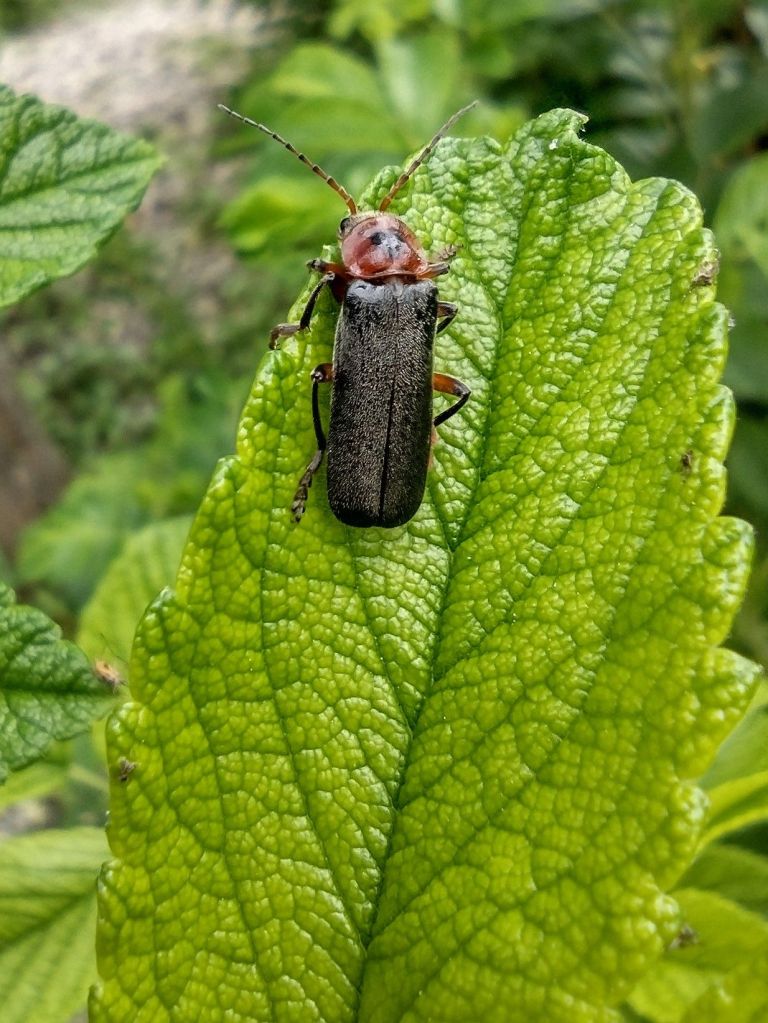
Some insects that I was able to see have been beetles. Unlike those which remain at ground level, some can be found on flowers as they wait for prey; this is where I saw these, a Malachite beetle (Malachius bipustulatus) and a Soldier beetle (Cantharis rustica).
The Malachite beetle is greener (emerald-like except for the red spots) than this photo is able to show, hence the common name given to it.
Malachite beetle adults are about 6mm in length and can be found between April and August. Later in the year they can also be found on tree bark where they lay larvae for the following year.
The soldier beetle is larger (between 9-13mm in length) again they consume other insects.
Black and red in colour, the Cantharis rustica is one of the UKs largest soldier beetles. Snails, worms and other invertebrates are eaten by its larvae, which can be found under rocks and leaf litter throughout winter.
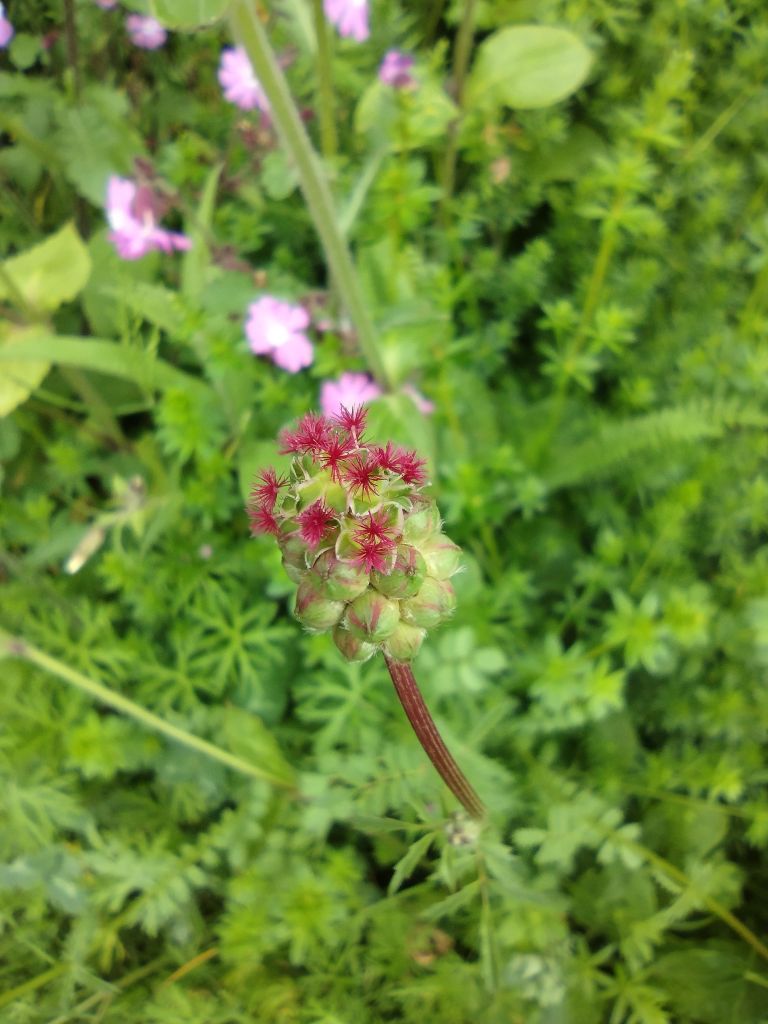
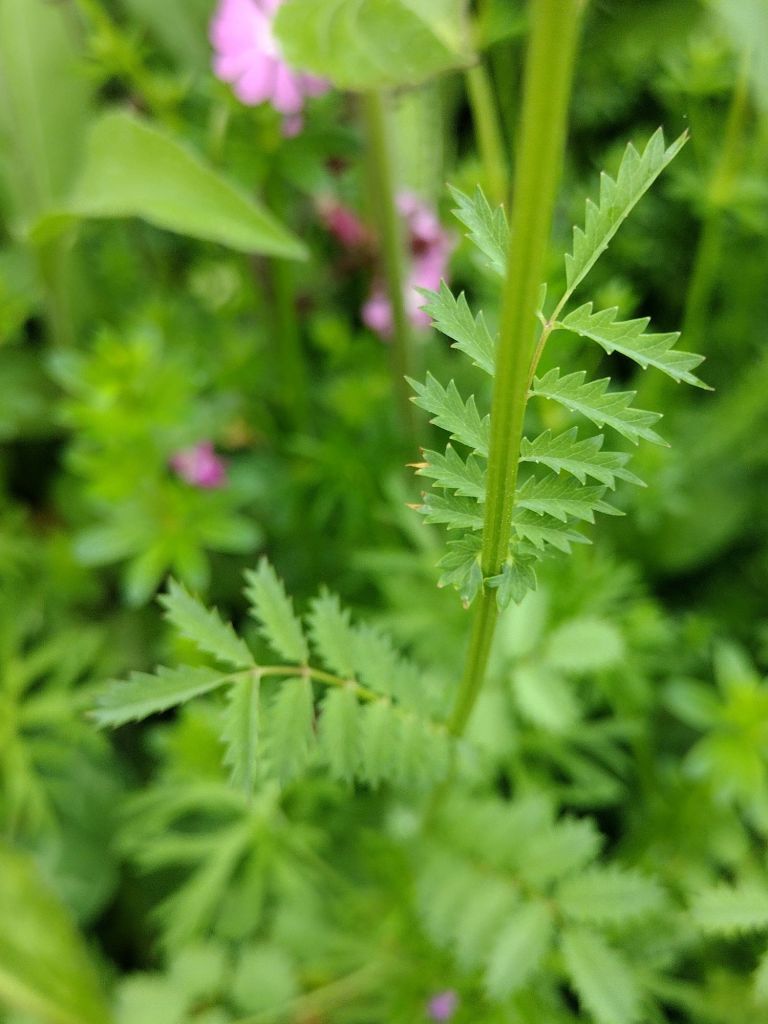
There are lots of flowers blooming now and it is lovely to have the opportunity to learn more about wildflowers. Two new additions to my knowledge are, Salad burnet (Sanguisorba minor)
The delicate red flowers of the Salad burnet.
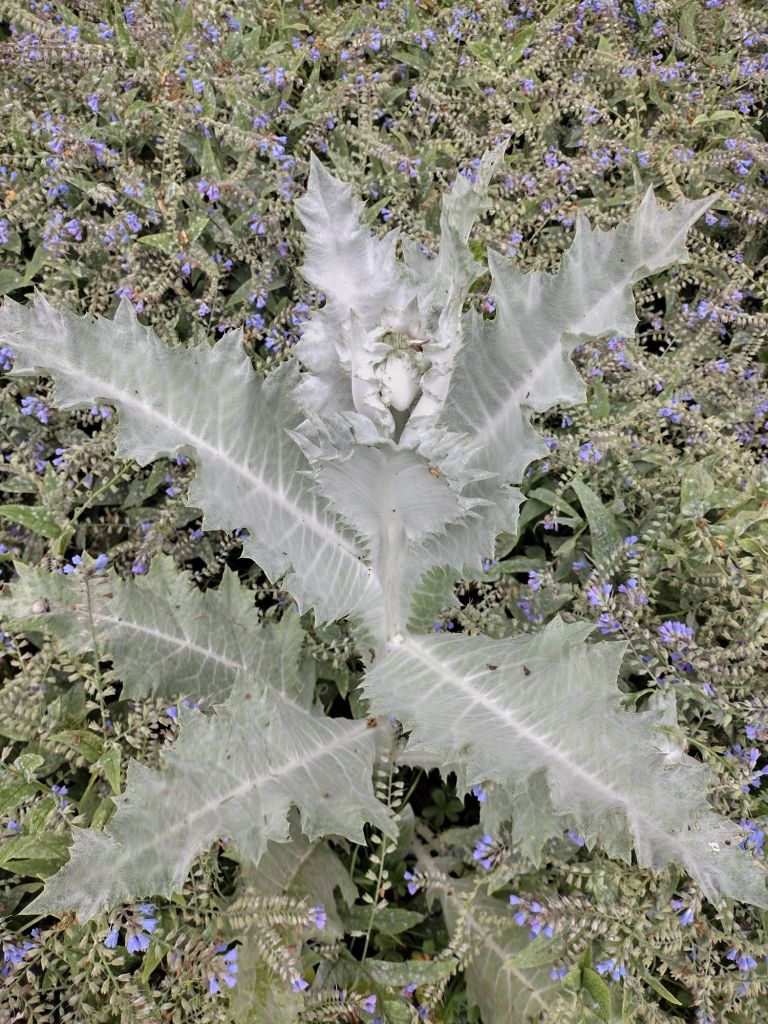
and Cotton thistle (Onopordum acanthium)- see below.
Salad burnet grows on chalky, limestone grassland. Part of the Rosacea family, as the common name suggests, its leaves (which have a cucumber scent when crushed) can be added to salads as well as summer drinks.
A poultice made from the flowerheads can be used to treat wounds as compounds within them can stem bleeding. It can grow up to 50 cms tall and spreads via rhizomes.
The common name of Cotton thistle derives from the hairs on the leaves which resemble cotton. This thistle has many names including the Giant thistle, Silver thistle, Scots thistle as well as Queen Mary’s thistle. Although this plant is often connected to Scotland, the emblem used in Scottish heraldry and the national emblem of Scotland is most likely to be the Spear thistle (Cirsium vulgare). The large silvery foliage of the Cotton thistle makes this wildflower quite striking. A biennial, the growth in the second year can reach up to 3 meters high and the leaves 10-50 cms in width. It particularly enjoys growing in fertile soil in areas that have been disturbed, along with roadsides and fields. Its pinky purple flowers bloom in summer. Some caterpillars like those of the Thistle ermine moth (Myelois circumvoluta) will eat the leaves. Pollinators and Goldfinch (Carduelis carduelis) also visit the flower heads, the latter eating the seeds.
Spring is in full swing now. The Spring equinox has passed, clocks have been changed to welcome in British summer time, april showers often appear (and disappear just as quickly) and the Bluebell (Hyacinthoides non-scripta) season has begun. It has been a while since my last post and a lot has happened since then. Back in early march, I noticed lots of frogspawn appear, they have since developed into tadpoles and some now resemble small versions of the adults. Male Smooth newts (also called Common newts- Lissotriton vulgaris) were undertaking courtship displays, swishing their tails to waft pheromones towards the females. The video below shows this courtship display; I managed to capture it back on the 7th of march.
Newt eggs are laid individually wrapped in the foliage of aquatic plants and therefore not as obvious as frogspawn. I haven’t noticed any Efts (young newts) yet though but hopefully I will soon.
Hawthorn (Crataegus) blossom has replaced those of Blackthorn (Prunus spinosa) now. Plus alongside the flowering Bluebells, many more spring flowers are currently blooming including, Cuckoo flower (Cardamine pratensis), Lesser stitchwort (Stellaria graminea) and Cow parsley (Anthriscus sylvestris).
Butterflies are more noticeable these days. Recently I have seen Holly blue (Celastrina argiolus), Speckled wood (Pararge aegeria) and Small tortoiseshell (Aglais urticae) butterflies, as well as plenty more Brimstone (Gonepteryx rhamni).
More bee species have emerged over the past month; even the Leafcutter (Megachilidae) bees from the bee hotel on the allotment. Together with Red tailed bumblebees (Bombus lapidarius), Buff tailed bumblebees (Bombus terrestris), a Common carder bumblebee (Bombus pascuorum), and an Ashy mining bee (Andrena cineraria) I also noticed a Tawny Mining Bee (Andrena fulva)- The latter (shown below) was seen carefully exiting a hole on the side of the Wrekin.
I visited the Wrekin in Shropshire last weekend. A woodland surrounds the base of the hill which is quite a contrast from the more open areas at the top. Here Wood sorrel (Oxalis acetosella), an ancient forest indicator, could be seen blooming alongside ferns and moss. It was lovely to see patches of bluebells while listening to water trickling down the hillside (from the previous nights downpour).
Wood sorrel
At the summit of the igneous bedrock, Common heather (Calluna vulgaris) and Bilberry (Vaccinium myrtillus) are seen growing. Both plants grow on nutrient poor acidic soil. The Bilberries (also called Whinberry or Wimberry in Shropshire) were flowering but the edible fruit will be ripe in the summer.
Bilberry shrubs in flower.
It was also wonderful to see a couple of Buzzards (Buteo buteo) soaring and hovering around, ignoring us humans that had completed the ascent.
Lastly, since the Spring equinox, I have been watching the Peregrine falcons (Falco peregrinus) at St Albans cathedral on the live webcam here. Once again the pair have three eggs, the same as last year. Currently we are all waiting to see if they all successfully hatch and fledge. It is far more entertaining than any tv drama.
I’ve slowly started to emerge from hibernation now that Imbolc, the half way point between the Winter solstice and Spring equinox, (meaning ‘In the belly of the mother’- referring to the first stirrings of the years new growth) has passed; mirroring the snowdrops, winter aconites and hazel flowers (the first signs of the transition into the next season).
The scents of Daphne, Mahonia and Sarcococca fill the air alongside the arrival of other spring flowers; daffodils, cyclamen, crocus and hellebores. Willow (Salix) catkins are also opening while Blackthorn (Prunus spinosa) blossoms fill the roadsides with glorious white clouds.
Although it has still been too early for most allotment activities, the rhubarb has been emerging on the plot for the last month. I still haven’t cut back perennials as I want to allow cover for beneficial insects such as sheltering ladybirds (Coccinellidae) until the weather makes their survival easier. Instead February is mainly a month for planning the forthcoming years growing (thinking about chitting potatoes and planning seed sowing). One job I have begun however is the indoor Sweet pea and Chilli seed sowing. This small step gives me hope that I will soon be able to sow other seeds soon.
Although I am beginning to think ahead, I am still fondly holding on to snuggly sofa moments such as reading and partaking in arts and crafts, especially on wet days.
Through the winter I still immersed myself in nature. In January I pruned my apple tree on the allotment, blessing and giving thanks through Wassailing. Although symbolic, it was a nice way to feel deeply connected to the plot. I am grateful to be a guardian over it and receive the abundance of fruit, veg and flowers in return.
I saw quite a few foxes (Vulpes vulpes) over the winter too, including one on the allotment. It was such a beautiful moment to watch it foraging under trees.
Once again, I took part in the RSPB Big Garden Bird Watch in January. The list of birds I saw this time were; 4 Long-tailed tits (Aegithalos caudatus) 5 Starlings (Sturnus vulgaris) 1 Blackbird (Turdus merula) 3 Wood pigeons (Columba palumbus) 5 Sparrows (Passer domesticus) 2 Blue tits (Cyanistes caeruleus) 1 Greenfinch (Chloris chloris) 1 Great tit (Parus major) 6 Magpies (Pica pica) 1 Gull (Larinae) and 1 Red kite (Milvus milvus)
There is a small group of Ring-necked Parakeet (Psittacula krameri) that visit a nearby tree of late but frustratingly they didn’t show up during the observation hour.
During February, bird song continued to fill the skies, growing in frequency and volume. Also occasionally insects have boldly buzzed and fluttered about on the odd sunny days. Butterflies I noticed were a Brimstone (Gonepteryx rhamni) and Peacock (Aglais io); the latter I saved from an abandoned spider web. I have also seen bees visiting mahonia, crocuses and hellebores, especially queen bumblebees.
Last week, I was excited to find some Jelly ear fungus (Auricularia auricula-judae) for the first time. They were growing on a Buddleia bush. Although this fungus is usually associated with elder (Sambucus) it can also be found on other hard woods like sycamore (Acer pseudoplatanus), ash (Fraxinus) and beech (Fagus) in damp shady conditions. Perhaps the fungus was thriving on the Buddleia, in the garden I visited, because of the recent weather as well as it being planted near a beech hedge. Interestingly this fungus can continue to grow on dying wood that has been thawed, once frozen; hence it can survive really cold winters. The common name was given to this fungi because of how it looks and also its jelly-like texture.
Worryingly, it has been a very mild winter overall with lots of flooding occurring in Britain; certainly very different from last winter. So far the wet weather is continuing into March; hopefully the month will exit like a lamb and the roaring weather won’t continue too much in spring, as it will have an affect pollinators. We will have to see what the rest of 2024 has in store.
There was a definite change in the air last week. Autumn colours have really begun to show themselves with leaves falling in greater numbers now too. Storms have been hitting areas of the UK as well, bringing increased rainfall throughout the country. On one wet day a few weeks ago, I caught a Jay (Garrulus glandarius) foraging nearby as I worked.
I remained as silent and still as possible; thankfully it was unperturbed by my presence as it searched for seeds and insects beneath the birch.
Halloween, Bonfire night and Diwali have passed and Christmas lights are already being switched on which seems strange when the weather remains quite mild. While there have been a couple of frosts recently, I can’t help but wonder if we will get a repeat of last year when the cold weather abruptly arrived and affected plants that were continuing to grow (not yet acclimatised to the changing season). Unnervingly, strawberries and raspberries have still been ripening up until a few weeks ago (not something I have encountered in October before). However, small changes are occurring slowly. While grass is still growing, the rate has slowed and overall growth on the allotment and in gardens has reduced too (plus the vegetable beds have been covered for winter).
At this time when accepting hibernation feels easy, it’s possible to observe the small things in nature that can bring joy; Observing sunrises and sunsets, seeing the stars and tree silhouettes, the crisp sunny days and Robins becoming bolder.
While cutting back some perennials I witnessed a Leopard slug (Limax maximus) laying eggs; seeing this was a first for me and made me so happy.
They can produce between 50- 130 eggs under cover which can overwinter if protected. I made sure I covered them up again after accidentally disturbing them. The common name for this slug is due to the wonderful pattern on its skin. These common slugs prefer to eat decaying material and fungi, along with other slugs, rather than living plant matter, so they are beneficial in gardens; adding nutrients into soil. They can live for three years and grow up to 150mm (in fact they are the largest slug in the UK- hence the latin name).
Another find that brought me joy was finding a Belemnite (Belemnitida) amongst some driveway gravel- shown below on my nature tray.
Often found amongst gravel, they are fossils of a marine mollusc resembling squid and cuttlefish in oceans today; Creatures which lived in the Jurassic and Cretaceous period of earth’s history, at the same time as dinosaurs. A diagram of them an be found at British Geological Survey.
August disappeared quickly and September is zooming by, even the Autumn equinox has been and gone. Apart from the heatwave a few weeks ago (with the highest temperatures of the year being reached) it is beginning to feel autumnal. Fungi has appeared, leaves have started turning, plus nights are drawing in and cooler misty mornings have returned highlighting once hidden spiders and their cobwebs.
Foraging blackberries had begun early this year but the extreme heat meant that the remaining flowers and berries dried up; the same is true of elderberries, although sloes, haws, rosehips and rowan berries are abundant. Unlike last year, apple and pear trees, that I see regularly, have struggled with the weather this year as well. Thankfully harvesting on the allotment is still going strong; potatoes, kale, beetroot, radishes, chillies, courgettes and rhubarb have been keeping us fed. The popping corn will soon be ready too. I have also been harvesting calendula, lavender and other herbs recently.
There has been a few changes on my plot. I had finally collected enough items to be able to construct ‘the bug snug’.
It is an addition to the wildlife section containing wildflowers and long grass (which also links to a pond on the adjoining plot). I know we have a couple of frogs visiting us so hopefully it encourages more to inhabit our allotment (to help keep slug and snail population down). I still hear the grasshopper when we are nearby too. There has also been evidence of a fox visitor; random toys get left near the water I leave out, along with poo on the grassy paths between plots.
Last week I also noticed that the Bee house, at the opposite end of the plot, was finally being used.
I found it hard to contain my excitement as it has been there for a few years and I was beginning to think it would never be used. There is evidence that it has been used by a Leaf-cutter bee and Mason bees too. Although it is difficult to know which ones specifically, the most commonly found in gardens are the Patchwork leaf-cutter bees (Megachile centuncularis) and Red mason bees (Osmia bicornis). As the name suggests Leaf-cutter bees used leaf particles to plug one piece of bamboo while those used by the Mason bees were plugged with soil. Each cell contains larvae as well as some pollen and nectar for the developing young. Male bees fly out before the females as they are near the entrance. The developing bees will remain there over winter and emerge as adults next spring, at the around April.
In other news… While clearing a gravel footpath of wildflowers at work, I accidentally disturbed a Devil’s coach-horse beetle (Staphylinus olens). I stopped weeding that section to enable it to hide for the rest of the day.
Devil’s coach-horse beetle
These beetles can raise their abdomens (resembling a scorpion), release an odour and even bite when they need to defend themselves (thankfully it didn’t feel threatened by my presence). They grow up to 2cms 8mm in length and are commonly found in gardens from April till October (when accidentally disturbed as they are active at night). The young overwinter in the soil as pupae until the following spring when they emerge as adults. The adults can fly but usually quickly run away from danger or to catch prey eating larvae, insects, spiders and slugs.
The Big butterfly count results came out this month. The long term trend of many species of butterfly and daytime flying moths recorded continue to fall, although the numbers were the highest since 2022 (with an average of 12 butterflies being spotted compared to 9 back then). The most commonly recorded were Red admiral (Vanessa atalanta), Gatekeeper (Pyronia tithonus), Small and Large whites (Pieris rapae and Pieris brassicae) as well as Holly blue (Celastrina argiolus). While those which are in significant decline are Ringlet (Aphantopus hyperantus), Common blue (Polyommatus icarus) and Speckled wood (Pararge aegeria). Over the last few days I have seen several Red admirals and even one Speckled wood making the most of the Autumn sun.
Upon visiting the Chiltern Open Air museum on the last bank holiday weekend, we walked through the meadow and woodland that is there. In the woodland, a couple of Silver-washed fritillary (Argynnis paphia) butterflies fluttered in amongst the brambles (the flowers of which give nectar for these fritillaries along with thistle blooms.
Silver-washed Fritillary
There were lots of Dog violets (Viola riviniana) on the woodland floor too, which is the food source for their caterpillars. The wingspan of this butterfly is between 7.2cms and 7cms 6mm. They are found in most areas of the UK (apart from Scotland) and often in oak woodland.
The meadow was full of wildflowers, but it was particularly lovely to see Harebell (Campanula rotundifolia) and Wild basil (Clinopodium vulgare) amongst them.
Harebell
The delicate looking Harebells bloom from late summer into autumn. They can be used as an indicator of dry nutrient poor chalky limestone soil which they require to thrive. Along with dry undisturbed grassland and heathland Harebells will flower in walls, cliffs and even on sand dunes.
Wild basil
Wild basil is a mound forming perennial which also likes the same soil conditions as the Harebell. This wildflower can be seen blooming in July, August and September.
It was lovely to see Tansy (Tanacetum vulgare) growing in the wild too; found in a few areas including near the iron age roundhouse located on the museum grounds.
Tansy
It starts flowering in July through to October. While used as an insect repellent to keep ants and flies away, some insects, especially the Tansy beetle (Chrysolina graminis) are resistant to the toxins produced by the plant. Tansy beetles are endangered in the UK; only found in two places in York along the River Ouse and in Cambridgeshire at the Woodwalton Fen nature reserve. We are at risk of losing this once common beetle due to habitat loss (wetlands), where their entire lifecycle occurs, and loss of suitable food source (mainly Tansy); however in the Fens its been seen eating Water mint (Mentha aquatica) and Gypsywort (Lycopus europaeus) too. It’s conservation status is known to be Nationally Scarce and is a UK BAP priority species that is Protected in the UK under the Wildlife and Countryside Act, 1981. More can be found on this beautiful beetle on the Buglife website (see web pages below), including how to help with its conservation.
It’s hard to believe that it’s May already, the months are certainly rolling on quickly. I feel like I have only just left winter behind. The weather continues to be mixed with many heavy rain showers combined with thunder passing through. Temperatures have increased though with warmer sunny days reaching 18 degrees celsius, encouraging Tree (Bombus hypnorum) and Buff-tailed bumblebees (Bombus terrestris) to buzz about. I also noticed three Peacock (Aglais io) butterflies dancing around a couple of weeks ago; perhaps two males trying to attract a female? Plus I saw the first Holly blue (Celastrina argiolus) butterfly of the season as well.
Cherry blossom is blooming at the moment and Bluebells (Hyacinthoides non-scripta) are out in force too; it’s the height of their season which is quite a contrast from the beginning of the month when a few were slowly unfurling.
Birds are prominent at the moment as the dawn chorus is reaching its crescendo. Birdsong can be heard clearly throughout the day as I work in gardens. I have seen several House martins (Delichon urbicum) swoop past me. These summer visitors from Africa return to the same nests (made of mud) under ledges such as the eaves of houses or cliffs. I am very privileged to have seen so many lately as they are categorised red under the Birds of Conservation Concern 5: the Red List for Birds (2021) and therefore protected by the Wildlife and Countryside Act 1981. They eat flying insects so living in a rural area no doubt helps. House martins can be distinguished from similar birds using the Wildlife Trusts information here. There is a call to help reverse the decline of House martins; advice on ways to help them can be found on the RSPB website.
Another bird I came across recently which I haven’t observed before is the Rook (Corvus frugilegu). Not as common as some other Corvids their UK conservation status is amber. Similar to Carrion crows (Corvus corone) they are identifiable by their off white beaks. Their diet varies from fruit, nuts and grain to invertebrates and worms. Rooks are sociable birds. Unlike Crows which are seen by themselves or in pairs, Rooks are often seen in groups, just like Jackdaws (Corvus monedula). Infact groups of Rooks and Jackdaws can be seen together; this is how I saw the Rooks, alongside Jackdaws in a busy carpark where humans often dropped scraps of food.
Several Robin (Erithacus rubecula) couples and even one bold male Blackbird (Turdus merula) have come inches away from me to feed and collect food for their young as I work in gardens over the past few weeks. I like to think of their broods back in the nests as I see them fly away with the unearthed bounty towards hedges and trees nearby.
On the 28th March I got to see an amazing spectacle. Two Buzzards (Buteo buteo) were being faught off by a couple of Red kites (Milvus milvus). The thermals aided one Buzzard to appear to briefly hover over some fir trees. I was working in an area with a woodland where Red kites nest. The buzzards (which I often see at the other end of the wood) had ventured over the the Kite territory. Maybe the Red kites were protecting some young or eggs? This I was unable to determin, however the kites were clearly concerned about having the Buzzards near their territory. It was unusual to witness the Red kites attack another bird usually they are the ones being warned away. I frequently see birds attacking kites when they venture too near a nest (even though they don’t predate young but scavange for food). It was lovely to hear the Buzzards calling to one another, an example of which can be heard on the RSPB website along with a picture for identification.
Buzzards are now the most common birds of prey in the UK, and widespread across the land inhabiting woodland, moorland and farmland areas (after a comeback from years of persecution). They are brown in colour and they are 51-57cm in length with a wingspan between 113-128cm. Along with being predators they will also scavenge; their diet consists of birds as well as small mammals and invertebrates. Hardly surprising then that the Red Kites didn’t want them in their territory if they had a brood.
Since then, I have seen other Buzzards in a few areas near roads along with a male Sparrowhawk (Accipiter nisus) by the road side (near to where I had already witnessed a female (see previous post- Daffodils in Snow).
These are not the only large birds that feature prominently in my life at the moment. I have also been keeping an eye on the Peregrine falcon (Falco peregrinus) nest at St Albans abbey. So far Alban and Boudica have three eggs yet to hatch. Incubation usually takes about a month (29-32 days) for each egg, so they are due to hatch beginning of May and fledge by the start of July. This is the pairs second breeding season. Peregrines pair for life and return to the same nest site each year. Alban mostly hunts (birds or rodents) but does incubate the eggs too, enabling boudica to hunt occasionally. The live cam to watch them is here.





 Bee in the Moment