Posted in nature

A Long Wait

A Tree bumblebee (Bombus hypnorum) resting on a Lime tree (Tilia) leaf.

Often one of the earliest bumblebees to emerge, I thought I wouldn’t notice any Tree bumblebees this year. Colonies of this bee are mostly active from March to July so by now my chances had reduced.

The first record of these bees in this country was in Wiltshire, in 2001. Now they are seen in Scotland (by 2013) and Northern Ireland (in 2017) having become one of the most common eight in the UK (see PDF from the BBCT below); especially making use of bird boxes for their nests.

Early in the year, they forage for nectar and pollen at plants such as Winter heathers (Erica carnea), Pussy willow (Salix caprea), Apple (Malus), Cotoneaster, Ceanothus and Chives. While later on, in early summer, they will favour the flowers of Lime trees, Fuchsias Raspberries and Blackberries

Posted in nature

🎵The Heat Is On. 🎤 🎹🎷🎶


“Tell me can you feel it, tell me can you feel it, tell me can you feel it, the heat is on…”

The 80’s song from the Beverly Hills Cop soundtrack with Glenn Frey’s voice, synthesizer and saxophone was my earworm as the temperature soared last week. The temperature increased to around 27°C mid week, which meant lots more insects ventured out as it felt like summer.

I was happy to see my first Red admiral (Vanessa atalanta) butterfly of the year, however my main observations were bees including the Red-tailed bumblebee (Bombus lapidarius) and Honey bees (Apis mellifera).

A Red-tailed bumblebee pollinating some geranium.
Honey bees visited Nepeta.

Another bee I started seeing last week was the Tree bumblebee (Bombus hypnorum). I noticed a nest inside a compost bin as I emptied grass clippings from the mower bag.

I have seen Tree bumblebees nest in bird houses before but not under compost. I made sure I avoided tipping grass onto their home and used the next bin along. I couldn’t help watching them for a little while as I stopped for a breather on the very hot Wednesday.

Moths were prominent throughout the week too. Unfortunately Box tree moth (Cydalima perspectalis) caterpillars and the signs of heavy infestation (foliage that had been eaten and covered with webbing) was noticeably present in several gardens. Therefore, I spent lots of time picking them off buxus topiary and informing clients to keep an eye out for them as well. For more information on this pest see the RHS website.

I discovered this years first sighting of a Silver Y (Autographa gamma) moth.

A Silver Y moth resting on a Heuchera leaf.

This immigrant is one of the few brown moths I can identify easily, mostly due to the clear y markings on it’s forewings but also because of their size and shape. This is a day and night flying moth which can be observed visiting flowers to obtain nectar.

However my most exciting moth sighting was the Lime hawk-moth (Mimas tiliae).

This spectacular large moth is night flying. It’s wingspan is 4.6-7.8cms and it can be found in broadleaf woodland, parks and gardens between May and July. I accidentally disturbed it as I pruned some shrubs under a Lime (Tilia sp.) tree. Thankfully it didn’t seem bothered by the disruption and it was carefully placed back near the lime tree. While adult moths of this species don’t feed, the caterpillars do. Once they have emerged from overwintering pupa, the caterpillars will eat Lime, elms (Ulmus sp.), Alder (Alnus glutinosa), Downy Birch (Betula pubescens) and Silver Birch (Betula pendula), Plane (Platanus x hispanica) along with some Cherry cultivars. This was the first Hawk-moth I have ever seen. There are a few that exist in the UK. The nearest I came to seeing one before was observing caterpillars of the Elephant hawk-moth (Deilephila elpenor) eating away at some Fuchsia. For more information on these Hawk-moths see the Butterfly Conservation website (Lime hawk-moth and Elephant hawk-moth)

I also saw hoverflies. I am still learning about these insects and learnt another one last week.

The photo above shows a Narcissus bulb fly (Merodon equestris). The maggots eat away at the centre of bulbs from the Amaryllidaceae family. However even though the maggots are a pest, the adult hoverflies are pollinators.

Posted in nature

Sparkling Fireworks on a Damp and Windy Saturday

The autumnal weather remains mostly damp with brief glimpses of sunshine. Even Saturday was wet and blustery, so it was lovely to see fireworks from the comfort of my sofa. Although I worry about fireworks disturbing wildlife and pets, it is lovely to have light festivals to brighten the spirits once the clocks go back. At this time of year I try to find enjoyment in small things each day to counteract the gloom; the beauty of autumn helps this. My main obsession at the moment continues to be fungi. They are as difficult to identify as moths which adds to the fascination. As with the previous two weeks, I have discovered more fungi as I work.

*Once again, please do not use this post as a guide to edible mushrooms. I have managed to identify some but have placed question marks next to those I am unsure of.*

Last weeks finds were;

– The deceiver (Laccaria laccata)?

– Fried chicken mushrooms (Lyophyllum decastes)

– Suede bolete (Xerocomus subtomentosus)

– Common rustgill (Xerocomus subtomentosus)?

– Porcelain fungus (Oudemansiella mucida)

– Wood blewit (Lepista nuda)

– Shaggy scalycap (Pholiota squarrosa)

– Tawney funnel cup (Lepista flaccida)?

Fungi haven’t been the only things I noticed last week. On Monday I saw two Long-tailed tits (Aegithalos caudatus) in my neighbouring Rowan (Sorbus) tree. These social birds were eating insects and spiders alongside the regular Blue tit (Cyanistes caeruleus) and Coal tit (Periparus ater) visitors.

I was surprised to see a Tree bumblebee (Bombus hypnorum) last week. It was resting in the sunshine on Tuesday morning.

I usually see them between March and July so I relied on the Norfolk Wildlife Trust website to explain this sighting. New queens can be seen feeding through to October before hibernating until February; therefore it was a female bee I saw.

Another insect I saw last week was a Feathered thorn (Colotois pennaria) moth.

Due to the presence of the feathered antenna I was able to identify it as male. The caterpillars of this moth feed on various deciduous trees and shrubs with the moths appearing between September and November.

Posted in nature

Quieter Days Ahead

We finally have some rain today, the start of some wetter weather this week. It looks very autumnal and very different from the weather of late. Although last week was still sunny and dry the amount of butterflies have reduced. However I do still see some Small white butterflies (Pieris rapae) flitting about. Wednesday was the best day for seeing these butterflies along with bees.

In a few gardens many late flowering plants are blooming nicely; this is especially important for pollinators that are still around in Autumn. Extending the season at the beginning of the year is just as helpful too. Early flowering bulbs, shrubs, wildflowers (including dandelions) Hellebores and Pulmonaria are great for the bees that forage in early spring. The first bees of spring are various solitary bees and the queens of some bumblebees (see Wildlife Trusts).

On Wednesday I saw;

– a Buff-tailed bumblebee (Nimbus terrestris) and Tree bumblebee (Bombus hypnorum) on Helianthus ‘Lemon queen’ flowers,

Buff-tailed bumblebee

Tree bumblebee

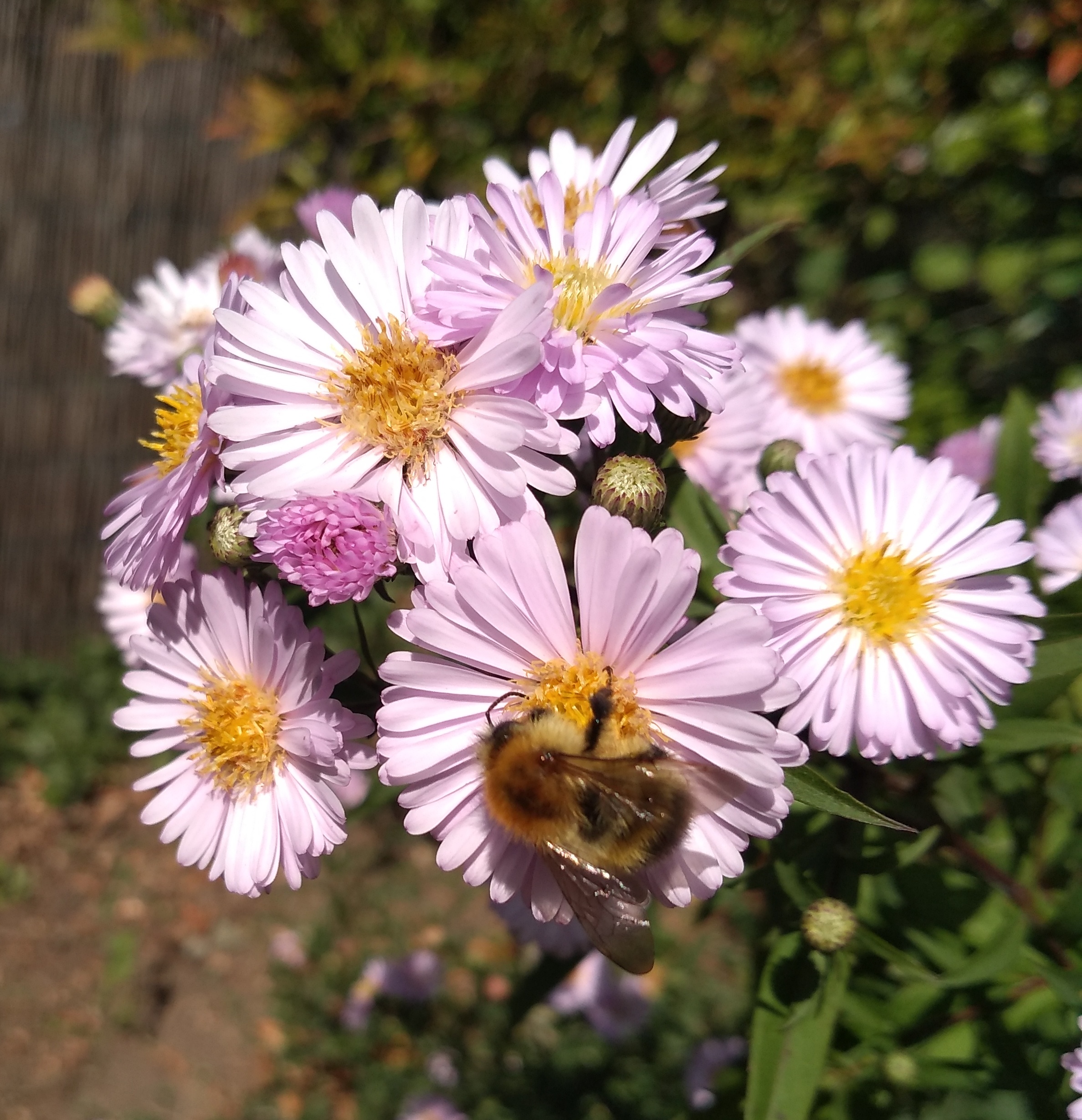
-Common carder bees (Bombus pascuorum) visiting Aster, Verbena bonariensis and Rudbeckia,

Aster

Verbena bonariensis

Rudbeckia

– and a Small white butterfly on Aster flowers.

On Friday I noticed more Common carder bees as they visited a hardy Fushia. This was the first time I noticed bees visit a Fushia so it was lovely to see it happen. These bees have long tongues and because they are small can collect nectar easily from Fushia flowers. However the two bumblebees I saw this week are larger and have short tongues which explains why I saw them visiting the Helianthus. Interestingly though Buff-tailed bumblebees are able to ‘rob’ nectar from bell shaped flowers by cutting a hole in the side of the flower to access the nectar. White-tailed bumblebees (Bombus lucorum) can also undertake nectar robbing. Even so single flowers, together with a variety of flower shapes are important for bees and other pollinators. Plus night scented flowers are beneficial for moths.

Another sighting from Wednesday was watching a Red Kite (Milvus milvus) soaring in circles above where I worked. I love hearing Red kites repeatedly call as they fly; it is a beautiful sound.

As well as insects and birds, occasionally I get to see wild mammals as I work too. There was an instance of this last Monday. I noticed a Fox (Vulpes vulpes) exiting a hedge and run into the neighbouring garden while I ate my lunch.

Posted in nature

Working with Insects can be Frustrating

More colour is showing up along the road as the purple of the Common mallow (Malva sylvestris) blooms amongst Common Poppies (Papaver rhoeas) and Ox-eye daisies (Leucanthemum vulgare); a lovely sight as I travel on the bus.

Another plant that is flowering on the verges and lawns now is White Clover (Trifolium repens).

I first saw it on Monday, at the bus stop, as I listened to a Goldfinch (Carduelis carduelis).

The Goldfinch can just be heard singing above the drone of the traffic.

A group of Goldfinches is a ‘Charm’ from the old English word c’irm, referring to their singing.

Last monday was the day for noticing Goldfinch as later in the morning I watched a couple of Goldfinch on a nest in a Buddleia (Buddleja davidii).

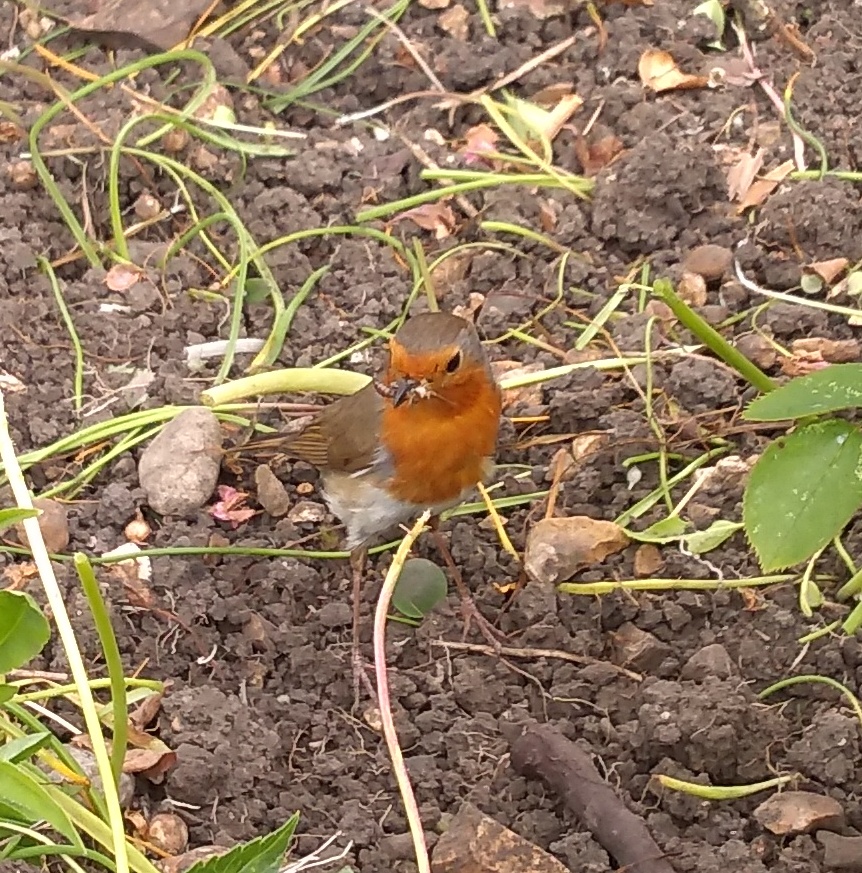
They weren’t the only birds I noticed that day. In the afternoon a Robin (Erithacus rubecula) kept me company as I weeded. It was quite fearless, frequently getting close to me to collect food as I worked.

I noticed some Scarlet Pimpernel (Anagallis arvensis) flowering too. Other common names for it include Poor man’s Barometer or Shepherd’s clock because the flowers open in sunny weather and close when it is dull.

As it was a a warm sunny day lots of bees were out. On the Catmint (Nepeta) there were Early Bumblebees (Bombus pratorum), White-tailed Bumblebees (Bombus lucorum), Tree Bumblebees (Bombus hypnorum) and Honey Bees (Apis mellifera).

A White-tailed bumblebee busy working.

As the week went on I continued to notice a greater variety of bees visiting the garden;

– Tree Bumblebees, Early Bumblebees, White-tailed Bumblebees as well as female Red tailed bumblebees (Bombus lapidarius) on a weigela.

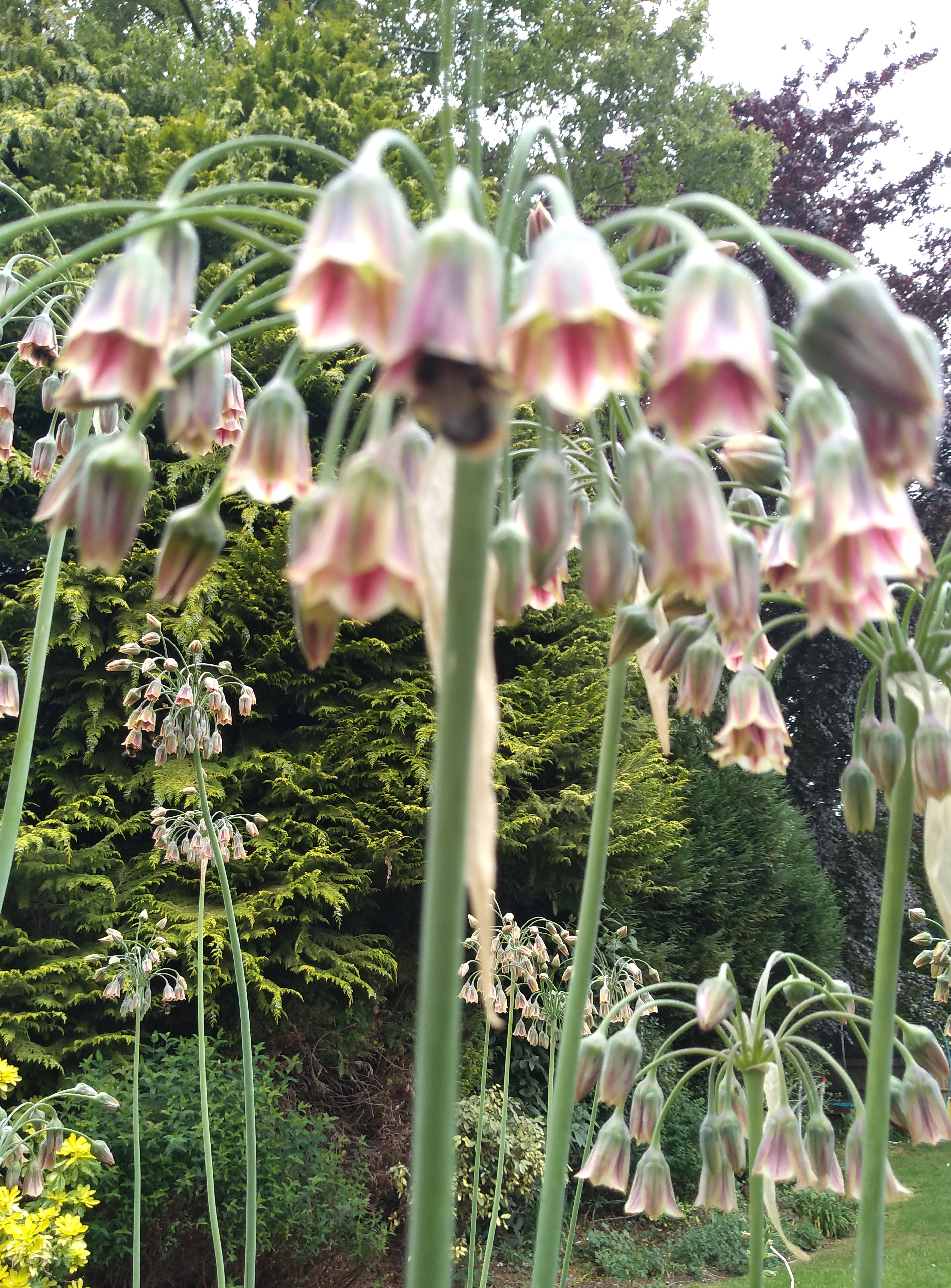
-Early Bumblebees and White-tailed Bumblebees on some Pale Garlic (Allium paniculatum).

This is the best photo I managed to obtain. The saying about not working with children or animals (or in this case insects) came to mind on Tuesday and Wednesday; descent photos were severely lacking midweek.

On Thursday, as I undertook more weeding, I unfortunately disturbed a beautiful White plume moth (Pterophorus pentadactyla) in the border. The caterpillars, which are green and yellow, feed on bindweed so this was a welcome sighting.

Posted in nature

Summer is Nearly Here (plus a belated Mental Health Awareness Week special)

Mental health awareness week was 13-19th May this year. I didn’t get round to writing a piece for it then; better late than never.

I think it is important to talk about mental health and I am open about my own experiences when the subject is mentioned.

I have dealt with Social anxiety and Seasonal Affective Disorder for a long time, although my mental health has improved over the years. Through medication, Cognitive behavioural therapy, healthy eating, exercise, mindfulness, along with getting outdoors and immersing myself in nature I manage these conditions. I started this blog to help give me focus too.

Thankfully I am at a stage where I can manage these conditions without them causing much disruption to my life. However some days are more difficult to deal with than others, Tuesday started out as one of those days. For some reason my anxiety level was high first thing. After forcing myself to open the curtains I noticed a Great Tit (Parus major) fledgling, with an adult, in the Rowan tree (Sorbus). They were feeding on insects before they flew onto a neighboring Rowan tree. This start to the day reminded me to be in the moment and enabled me to work on my thoughts and face the day ahead.

As the day continued, my anxiety wained. Being outdoors with nature helps.
In the afternoon I noticed a mature male Large Red Damselfly (Pyrrhosoma nymphula). I was able to identify it as male due to the red shoulder strips (they are yellow in immature males) and lack of yellow stripes on the segments of the abdomen, which the females exhibit. Plus the black legs identifies it as the Large Red Damselfly rather than the Small Red Damselfly (Ceriagrion tenellum) which has brown legs. The differences between a Damselfly and Dragonfly is the latter is larger, has thicker bodies and the wings are outstretched when they are resting. The Large Red Damselfly regularly visits garden ponds. However this one seemed happy on the window sill chomping on the insects in the cobweb.

On Wednesday I saw some
Cut-leaved Crane’s-bill (Geranium dissectum) in the lawn.

Then on Thursday I noticed this Early bumblebee (Bombus pratorum) on a Salvia (Salvia X sylvestris) plant.

Friday was quite muggy and rain was threatening to fall in the morning. However a Small Blood-vein moth (Scopula imitaria) was flying around as I worked.

I also saw some Creeping Cinquefoil (Potentilla reptans) flowering on the verge on my way home.

Astronomically summer starts on the summer solstice (21st June) however today (1st June) is the first day of summer meteorologically, as the calendar months are grouped into seasons (therefore summer is June, July and August). Whichever date you prefer to go with we are certainly experiencing summery temperatures this weekend and I was helping to water the garden. Unfortunately a few insects weren’t happy with the shower they suddenly experienced. One insect was a photo shy Hoverfly. I did capture a few insects though,
– a Tree bumblebee (Bombus hypnorum) resting.

-a White-tailed Bumblebee (Bombus lucorum) on Purple toadflax (Linaria purpurea).

– and a Yellow-faced Bell moth (Notocelia cynosbatella).

Posted in nature

Blooms, Bees and Bugs

There were lots of observations last week. As the weather continued to warm up further I saw even more bees and Seven-spot Ladybirds (Coccinella septempunctata).

I also noticed more wildflowers as I walked to work on Tuesday. This relaxed start to the day enabled me to observe;
– White Campion (Silene latifolia).

This flower is great for moths as the flower’s scent is obvious at night.

– Wood Avens (Geum urbanum)

– Cleavers (Galium aparine) with its tiny white flowers.

– Black medick (Medicago lupulina)

– and Annual honesty (Lunaria annua)

During my journey, I also heard a Coal Tit (Periparus ater) singing. Similar to the Great Tit’s (Parus major) song but faster and higher pitched, it is not a bird I hear often.

On Wednesday afternoon I observed lots of insects. Two that were camera shy were a Hawthorn Shield Bug (Acanthosoma haemorrhoidale) and Violet Ground Beetle (Carabus violaceus).

Other sightings which I managed to photograph were;

– Early Bumblebees (Bombus pratorum) on Rosemary
(Rosmarinus officinalis) and on Ajuga reptans ‘Atropurpurea’ (a cultivated variety of Bugle).

The Early Bumblebee is the UK’s smallest Bumblebee.

I also saw Rosemary Beetles (Chrysolina americana) on a few Rosemary plants.

This pest is beautiful when it glistens in the sun. Thankfully the amount I found didn’t warrant drastic intervention. The RHS is undertaking a survey to discover their advancement within the UK (see Royal Horticultural Society) so I uploaded my findings.

I also found an insect on some lavender (Lavandula) that I didn’t recognise.

This terrible photo is due to the constant movement of the plant in the breeze (it was the best one I managed to take). I only include it as a demonstration on the brilliance of the Natural History Museum. Occasionally I have difficulty in identifying my findings and at that point I rely on the Natural History Museum’s identification service. I was clutching at straws that they could see through the blurred image and be able to identify the bug. To my surprise they managed to tell me it was a Cinnamon bug (Corizus hyoscyami). If you ever need help identifying insects then I highly recommend this brilliant service (see Natural History Museum).

I saw yet more bees on Friday, including a Honey bee (Apis mellifera) on a Cornflower (Centaurea cyanus) plant

along with a
Buff-tailed bumblebee (Bombus terrestris) on Welsh poppy (Meconopsis cambrica)

Even yesterday, as I visited Shaw’s Corner (a lovely small National Trust house and garden) I noticed more wildlife;
-Common Bird’s-foot Trefoil (Lotus corniculatus)

-Red Clover (Trifolium pratense)

– and some wild Bugle (Ajuga Reptans) amongst the grass which had purposely been left long.

Plus I also noticed a Marmalade Hoverfly (Episyrphus balteatus) and a Tree bumblebee (Bombus hypnorum) on some Dog rose (Rosa canina)

as well as a Red-headed Cardinal Beetle (Pyrochroa serraticornis) balancing precariously on a blade of grass.

Posted in nature

🐝Beeing Happy in the Sunshine 🌞

The warmer weather this week brought with it many bee sightings, including Honey bees (Apis mellifera). The plants where they were most abundant were the Californian Lilac (the Ceanothus seen in the first photo) and the Cotoneaster in the second photo. Both Shrubs, full of small flowers, are loved by Honey bees. In fact there were so many bees on them that the amazing buzzing sound filled the air.

There were also lots of Tree bumblebees (Bombus hypnorum) on the Cotoneaster too, as shown below.

This hasn’t been the only time I noticed Tree Bumblebees this week. This the weekend I was walking around a local charity allotment when I saw a bird box being occupied by bees. This is a commonly used structure for Tree Bumblebees.

I was also lucky to notice three female Hairy-footed flower bees (Anthophora plumipes) while weeding a border. These are solitary bees who care for their own young; however they can live within close proximity to one another. The three that I noticed had nests in the bare earth about 10cms apart. The females are black with yellow legs. Unfortunately I was not able to obtain a decent photo of them for this post.

Other observations this week have included more Seven-spot ladybirds (Coccinella septempunctata), Holly blue butterflies (Celastrina argiolus) and Orange-tip butterflies (Anthocharis cardamines).

I have also managed to go on a couple of short walks this week and discovered more wildflowers blooming. These were;

– Ox-eye daisy (Leucanthemum vulgare).

The Ox-eye daisy flowers were originally used for the ‘He loves me, he loves me not’ petal plucking activity.

* Dog-rose (Rosa canina). The hips from this plant are enjoyed by blackbirds (Turdus merula), Redwings. (Turdus iliacus) and Waxwings (Bombycilla garrulus). They are also used to make syrups and jellies to be used in winter (due to the very high vitamin C content). The hips from this rose also contain irritating hairs which can be used as itching powder.

-Smooth sow-thistle (Sonchus oleraceus)

– Common Vetch (Vicia sativa). This plant is a member of the Legume family so it causes nitrogen fixation in the soil therefore it can be used as a soil fertilizer.

On my way home from one of my walks I manage to capture this Grey squirrel (Sciurus carolinensis) on a photo too.

This weekend I saw this Feral Pigeon (Columba livia domestica) as I enjoyed a coffee.

I couldn’t resist adding this photo, sadly it doesn’t do it justice. When the sun shone, the green and purple neck feathers where incredibly vibrant and against the unusual white; I thought it was beautiful.