Posted in nature

Liminality

February is a liminal month, it holds the hope of spring alongside the grip of winter. Just when glimmers of warmer weathers arrival brings dull wet conditions, clear nights followed by cold frosty mornings bite you back to reality in the glimmering sunshine. Even my activities have a duality to them. February is the time when I organize my seeds, sew Sweetpeas and chillies as well as check my houseplants; however I want to continue hibernationing. I find myself quite hopeful in this month and overwhelmed at the same time.

It is always lovely to see the first stirrings of spring, especially the arrival of Snowdrops, (Galanthus) and Winter aconites (Eranthis hyemalis). I often hear foxes  (Vulpes vulpes) calling at night at this time too. It’s no coincidence that the celebration of the lands awakening after winter, Imbolc, is on the 1st February. The biggest indicator that spring is on its way are the birds beginning to pair up; boldly singing to alert prospective mates of their whereabouts whilst also holding onto territory. I was fascinated, one rather cold but not frozen day, to see a Robin (Erithacus rubecula) defend a feeder, chasing off a Tree creeper (Certhia familiaris). I have never seen a Tree creeper venture onto a bird feeder before, nor a Robin actually (but I have previously seen the latter fight other birds for resources).

An image of a Tree creeper can be seen on the RSPB website here;

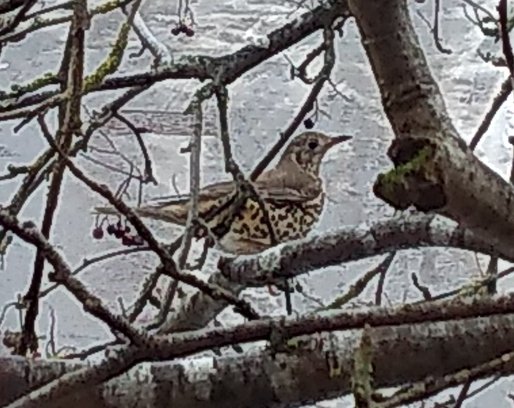
Other birds that have been particularly vocal in recent weeks have been the Mistle thrush (Turdus viscivorus), Great spotted Woodpecker (Dendrocopos major) and Dunnock (Prunella modularis).

The Mistle thrush is one of the UK’s largest songbirds, even larger than the Blackbird (Turdus
merula) with a body length of 27 cms and wingspan of 45 cms. Although similar in looks to the Song thrush (Turdus philomelos), it’s more grey tonally. While this bird is named due to its love of mistletoe (Phoradendron serotinum), it also eats worms, slugs, insects and berries and is found in parks, gardens, farmland and woodland often singing at the top of tall trees. It is not as commonly seen as the Song thrush as its status is Red under the Birds of Conservation Concern 5: the Red List for Birds. It has been a joy to hear the sound of the Mistle thrush as I worked, an example of which can be heard here.

I have also loved hearing a Great spotted Woodpecker (Dendrocopos major). Interestingly it has sung at the top of the same fir tree as the Mistle thrush, albeit at different moments. I also heard it drumming on the trunk of a dead and Oak (Quercus) tree that had a hole in the side, see below. Perhaps that is where the woodpecker lives.


The Great spotted woodpecker call can be heard on the Woodland trust website. 

Lastly, in a different garden, I was able to witness a Dunnock (Prunella modularis) singing sweetly, an example of this bird’s song, can be found on the RSPB website here .

At the end of January, once again I took part in the annual RSPB Big garden birdwatch; my results this year were-

1 Carrion crow (Corvus corone)
5 Goldfinch (Carduelis carduelis)
2 Wood pigeon (Columba palumbus)
3 Starlings (Sturnus vulgaris)
2 Magpie (Pica pica)
1 Blackbird (Turdus merula)
2 Great tit (Parus major)
1 Red kite (Milvus milvus)

Posted in nature

Frosts, Fog and Snow Arrived

Cold weather from the north arrived over the past few weeks. Initially hard frosts covered the earth along with foggy mornings; then snow arrived overnight on the 11th December. Due to the below average temperatures it lasted for a week but once the warmer southern weather and rain arrived (last Sunday) the snow disappeared as quickly as it arrived; It was beautiful while it lasted.

Also I finally caught Covid (after avoiding it until now). Thankfully, apart from leaving me with a cough I am much better, however for a while my world was reduced to watching birds from my flat. The Rowan (Sorbus aucuparia) outside has been stripped of all berries, no doubt the snow last week was a factor as birds had less places to forage and migratory birds arrived. A group of Redwings (Turdus iliacus) visited the tree along with Starlings (Sturnus vulgaris) and also a Song thrush (Turdus philomelos). Further information on Redwings can be found via the RSPB website.

A Song thrush visiting a snowy Rowan tree while berries still hung from it.

It was also nice to see my resident Blue tits (Cyanistes caeruleus) and a Robin (Erithacus rubecula) appear too.

I can’t believe it’s the Winter Solstice already. I am looking forward to taking a few weeks off; I will take the time to relax, reflect and look to the year ahead.

Posted in nature

A Snowy Adventure

The previous Sunday brought a little light relief as snow covered most of the UK. My childhood excitement of seeing the snow returned, so the days exercise was a walk through the local woodland park.

As I wondered past trees I began to notice odd glimpses of colour amongst the white and greys. Upon closer inspection I could see catkins already dangling along with female flowers ready to bloom on the Hazel (Corylus avellana) trees.

The male catkins are more showy than the tiny female flowers (which appear at the end of buds and harder to spot).
A very enlarged photo showing the red styles of the female flowers.

I also saw female flowers and cones on several Scots pine (Pinus sylvestris).

A closer view of the female flowers at the end of new shoots.

Surprisingly, given it was still snowing at the time, lots of birds were about too. I saw Redwing (Turdus iliacus), Blue tits (Cyanistes caeruleus), a small group of noisy Long tailed tits (Aegithalos caudatus) as well as a male Chaffinch (Fringilla coelebs) amongst the trees.

Redwings are migratory birds, from Iceland, Scandinavia and even Russia. Named after the red area under the wings, they can be seen in the UK between October and spring.

Throughout the week, as the snow slowly disappeared, I saw different birds visiting my Rowan (Sorbus) tree. I had never seen a Mistle thrush (Turdus viscivorus)

or male Chaffinch (Fringilla coelebs) visit the tree before.

Perhaps the reduced availability of food, during the snowy weather, made them search further afield than usual. Thankfully they found the remaining, mostly dried, berries on the Rowan tree outside my window.

Mistle thrush, so named because of their love of eating mistletoe (and guarding trees where it grows) also visit Rowan and Holly (Ilex) trees for their berries as well as eat worms, slugs and insects. They are larger and duller in colour than Song thrush (Turdus philomelos). Their spots are darker and rounder plus they have white tips to their tails. In fact they are larger than Blackbirds (unlike Song thrushes).

Wonderfully, there were even more flowers blooming in the garden too. I saw

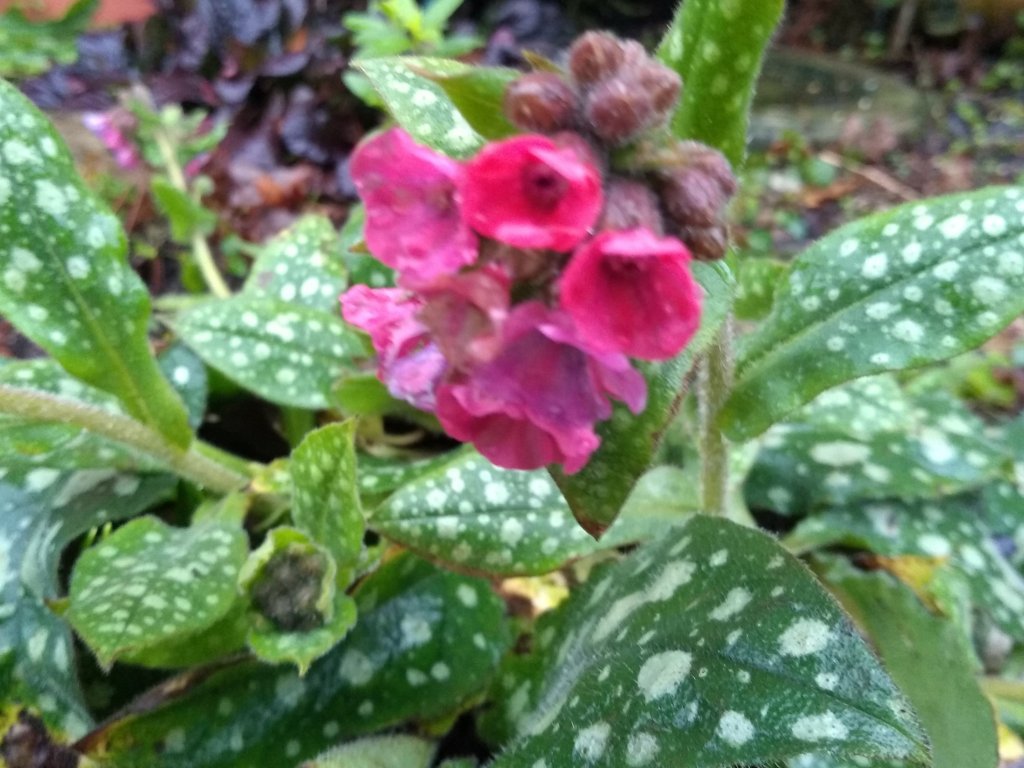
Lungwort (Pulmonaria officinalis),

Crocus and

lots of Cyclamen.

Posted in nature

Small Body, Big Voice

Once again, watching birds on my local Rowan tree has become my therapy as I remain inside more.

Last week, along with the usual suspects of Blue tits (Cyanistes caeruleus), Starlings (Sturnus vulgaris), a Robin (Erithacus rubecula) and Blackbird (Turdus merula) was a Song thrush (Turdus philomelos) feasting on some berries as well as a female Chaffinch (Fringilla coelebs) making a pit stop.

Another bird I noticed last week, while working in one garden, was a Wren (Troglodytes troglodytes). I followed a loud bird call towards a hedgerow where I managed to discover this distinctive small bird. It was wonderful being able to connect the call to a Wren; partly because I didn’t recognise the call but mainly because I got to see a Wren (highly unusual in itself, as they often hide themselves away). I wasn’t sure why it was emitting an alarm call, possibly a cat was on the other side of the hedge, hopefully I wasn’t the reason. Almost as soon I saw the Wren it disappeared further into the hedge; my fleeting glimpse ended. The Wren alarm call can be heard on the following link British birdsong.

Posted in nature

Further Easing into Summer

I am constantly amazed by the natural world. Last week I saw something that, as a gardener, I’m surprised I’ve never noticed before. A few White-tailed bumblebees (Bombus lucorum) flew to and from a nest in a wall, via the damp proofing brickwork, of an old house. What I wasn’t expecting to see were the blue pollen baskets.

I had never thought of pollen as anything other than varying shades of yellow. After researching this I found that different coloured pollen often shows up in nests and hives. Charts have been produced enabling beekeepers to identify which flowers their bees have visited by the colour and shade of the pollen found. The most likely candidates in this instance, given the time of year and dark blue shade, is Purple tansy (Phacelia tanacetifolia), see the North Shropshire Bee Keepers Association website.

Phacelia is loved by bees. These photos are from a neighbouring allotment plot.

As well as Phacelia other flowers currently blooming include;

– Hedge woundwort (Stachys sylvatica),

– Pineappleweed (Matricaria discoidea),

A close up view of Pineappleweed. When crushed, the flowers have a refreshing pineapple scent.

– Stinking iris also called Roast-beef plant (Iris foetidissima),

This plant has two colour variations. It thrives in shady areas.

– Scarlet pimpernel (Anagallis arvensis) and

– Pyramidal orchid (Anacamptis pyramidalis)

This orchid is attractive to butterflies and moths.

Birds are particularly noticeable at this time of year as they feed youngsters and defend territories. Last week I was able to listen to Song thrush (Turdus philomelos), Chiff chaff (Phylloscopus collybita), Robin (Erithacus rubecula) Great spotted woodpecker (Dendrocopos major) and Swifts (Apus apus).  I saw the Swifts’ arial display as they soared and dived in the distance while I ate lunch last Wednesday. They were too high and quick for me to identify visually but their vocalisations gave them away. The Swifts’ call can be heard on the RSPB website.

Ladybirds continued to show up last week, but mostly the Seven-spot ladybird (Coccinella septempunctata).

Eventually, the weather turned and rain finally arrived by Friday. It has been much needed and continued throughout the weekend. It was fantastic to watch thunder and lightening from the comfort of my sofa on Saturday afternoon.

Posted in nature

No Rain but Rainbows Everywhere

I continue to get my daily exercise outdoors and enjoy seeing rainbows drawn by children in windows or on driveways. Although we had sun last week there was no rain so these cheerful rainbows of unity were the only ones that have appeared.

The lovely weather encouraged many insects out. Last week I managed to count eight Peacock (Aglais io) butterflies. I also saw one Brimstone (Gonepteryx rhamni) butterfly visiting some Dog violets (Viola riviniana). I have never noticed insects pollinate these pretty flowers before so it was lovely to observe that. These dainty plants are very useful additions to wildlife gardens for another reason too; several fritillery butterflies lay eggs on them. During that same walk I also saw lots of seven-spot (Coccinella septempunctata) ladybirds as well as a few Dark-edged bee-flies (Bombylius major).

A Dark-edged bee-fly pollinating some Forget-me-not (Myosotis sylvatica) flowers.

I have never seen these parasitic flies before whose host is the Tawny mining bee (Andrena fulva). The Tawny mining bee is commonly found in urban areas especially in lawns, although I have yet to see one (to find out more see the Bumblebee Conservation Trust). There is a recording scheme for Bee-flies so I shall pass this information on to the (BRC).

On Friday mornings exercise I saw a Song thrush (Turdus philomelos). The last time I saw one was a couple of years ago but this probably isn’t surprising because they are on the red UK conservation status list (see RSPB). It was great to see this one, although I wonder if I accidentally disturbed it looking for food; I came across it on a path before it flew into some trees.

As I walked further, I noticed more plants beginning to bloom. These were;

-Bulbous buttercups (Ranunculus bulbosus),

Identified by the reflexed sepals (turned downward), leaf shape, furrowed stems and the fact it is flowering before May.

-Danish scurveygrass (Cochlearia danica),

Once only found in coastal areas this plant now thrives here because of the salted roads during winter.

-Garlic mustard (Alliaria petiolata),

-Yellow corydalis (Pseudofumaria lutea) and

This often grows in the gaps in old walls.

-Dove’s-foot Crane’s-bill (Geranium molle).

Even without natural rainbows nature was still full of colour last week.

Posted in nature

More Wonderful Singing

Last Monday lunchtime I got to hear a wonderful song. A Song thrush (Turdus philomelos) was singing loudly from an Oak (Quercus) tree. It’s repeated phrases made it easy to identify even though I couldn’t locate it visually. Their conservation status in the UK is red (see RSPB) so was nice to hear it. I have also seen one in the past but observations of Song thrushes are rare for me.

I haven’t noticed the young Bluetits (Cyanistes caeruleus) in the Rowan (Sorbus) tree for several days now. However while I ate my breakfast on Wednesday I
briefly saw a young Jay (Garrulus glandarius) instead. It didn’t remain for long, perhaps realising that it hadn’t landed on an Oak tree (a favourite of Jays as they love acorns). It was a great sighting; unfortunately in my sleepy state I wasn’t quick enough to get a photo.

The observations for the rest of the week were of insects. On my way to work I saw a Riband Wave moth (Idaea aversata).

Plants which their caterpillars feed on are Wood Aven (Geum urbanum), Primrose (Primula vulgaris), dandelions (Taraxacum) and dock (Rumex). I also saw another Cinnabar moth (Tyria jacobaeae) on my travels. Common Ragwort (Jacobaea vulgaris) is the main food source for their caterpillars. I often see these wildflowers around this area. I love to learn about plants that are beneficial for wildlife so I can undertake wildlife-friendly weeding. I allow ‘weeds’ to flower, remove seed heads before they set seed and control them via digging to prevent them from taking over a patch. With the exception of a few (which could remain in wild uncultivated areas of a garden) I find wildflowers can complement a border. I read an interesting article about this subject yesterday (see The Guardian).

I recently discovered that the collective noun for a group of Ladybirds is a loveliness. I saw loveliness of Seven spot ladybirds (Coccinella septempunctata) on a geranium on Tuesday afternoon.

They were a bit pale so it is possible they had only recently emerged; their wings not hardened properly or developed from pink to bright red. At one point I counted 10 and eventually noticed a Green shield bug (Palomena prasina) nymph too.

This wasn’t the only encounter with ladybirds last week. On Thursday a Harlequin ladybird (Harmonia axyridis) larvae attached itself to my colleague’s t-shirt.

I have started noticing more moths lately, especially different species. I tried to discover the collective noun for moths. I couldn’t find an official word but one suggestion online was a whisper of moths which I like.

Another moth that I saw was a Large Yellow Underwing (Noctua pronuba).

Unfortunately it had a slightly damaged wing. It must have been disturbed because it isn’t a day flying moth. It soon sought shelter under the Hebe I photographed it resting on.

Posted in nature

Music to my Ears

While my colleagues listen to their music via headphones I prefer to listen to nature as I work; especially birdsong which I find uplifting. Recently I have started to really tune in and distinguish different songs and calls as I attempt to identify particular birds. By teaching myself I now recognise Great tit (Parus major) song, Coal Tit (Parus ater) song and Tawny Owl (Strix aluco) call. However I still find it difficult to pick out certain sounds which is why last Sunday I went to an ‘Introduction to bird calls and songs’ nature talk and walk at a local park. We were introduced to 12 birds that we would most likely hear during our afternoon stroll. Most were already familiar to me however I did learn the songs of Chiffchaff (Phylloscopus collybita) and Greenfinch (Carduelis chloris).

The birds we ended up hearing (above the wind and sirens) were;
-Woodpigeon (Columba Livia)
-Carion crow (Corvus corone)
-Magpie (Pica pica)
-Wren (Troglodytidae)
-Chiffchaff
-Blackbird (Turdus merula)
-Great Spotted Woodpecker (Dendrocopus major)
-Blackcap warbler (Sylvia atricapilla)
– and Song thrush (Turdus philomelos).

We also saw a (quiet) Jay (Garrulus glandarius) along with a Speckled wood butterfly (Pararge aegeria), Red admiral butterfly (Vanessa atalanta) and some White-tailed bumblebees (Bombus lucorum).

Last week I combined what I learned at this event with my previous knowledge; the birds I was confident I identified correctly were;
-Woodpigeons
-Magpies
-Blackbirds
-Robin (Erithacus rubecula)
-Ring necked parakeets (Psittacula krameri)
-Blue Tits (Parus caeruleus).
-Chiffchaffs
-Mallard (Anas platyrhynchos)
-Red kite (Milvus milvus)
-and House sparrows (Passer domesticus)

On several mornings I also watched the family of Blue tits on the Rowan tree as I ate breakfast. The parents had nested in the eaves around Easter (see Different sort of Easter Chicks) so it was great to discover they had a successfully reared a brood. I counted 6 fledged youngsters return to the tree and feed on insects together.

Blue Tit acrobatics- One of the youngsters feeding itself.

These weren’t the only sightings last week as I also saw;
-another Red Admiral butterfly

-a Cinnabar moth (Tyria jacobaeae)

-some Ivy-leaved toadflax (Cymbalaria muralis)

-Common spotted orchid (Dactylorhiza fuchsii)

-Pineappleweed (Matricaria discoidea)

-As well as a common frog (Rana temporaria)