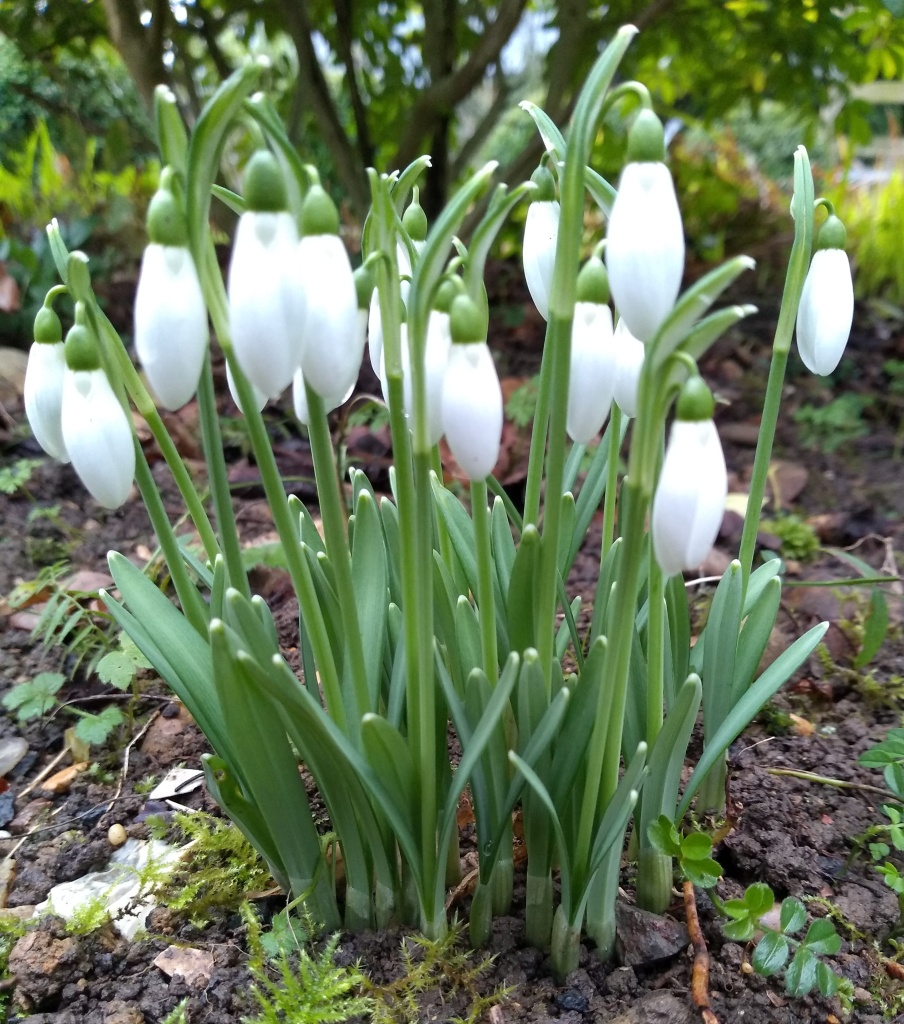
The cold weather is setting in, days continue to shorten and the gardens seem dorment; it is easy to feel gloomy when the sun isn’t shining. Yet, even at this time of year, life is beginning to break through. Last week Snowdrops (Galanthus nivalis), Daffodils (Narcissus) and Hellebore flowers (Helleborus) started to show themselves. It is lovely to see these small signs of growth. It is a reminder that even in the darkest days small glimmers of hope can be found if you look carefully.
Snowdrops (the Latin name meaning ‘Milk flower of the snow’) are simple yet elegant. There are 2,500 varieties, the rarest are highly prized. Some gardens have collections of snowdrops which can be visited in February such as
Colesbourne gardens and
Benington Lordship garden.
The substance galantamine (contained in Snowdrops and other plants from the Amaryllidaceae family) has been used in the drug Reminyl for the treatment of Alzheimer’s. A fact I discovered when I visited the Chelsea Physics Garden earlier in the year.
Hellebores complement Snowdrops nicely. The Hellebore traditionally associated with Christmas is the early flowering Christmas Rose (Helleborus Niger). It is referred to as a rose because the flower resembles those of wild roses; it isn’t part of the Rosa genus. Other Hellebores (Helleborus hybridus) begin to flower a little later. There are different varieties of each species. Hellebores have a long flowering season, blooming until March.
Cutting back the old leaves of this perennial from late autumn has two advantages. Firstly it enables you to see the beautiful flowers more clearly and secondly it prevents leaf spot from spreading further.
Hellebores are great for pollinators, like solitary bees which are searching for food in early spring. They can also make lovely cut flowers.
Hellebores have a tendency to cross pollinate and self seed easily, producing increasingly murky colours if left to keep growing on. However, the seeds can be cleared quickly by hoeing or by cutting the flowers off before germination can occur.
If these two plants aren’t enough to bring joy at this time of year then hearing Robins (Erithacus rubecula) sing loudly is wonderfully uplifting. Along with Robins other birds are easy to spot now trees are bare.
I had an unusual sighting last week, that of a Great Spotted Woodpecker (Dendrocopos major). It held onto the side of a tree trunk as I entered a garden. I accidentally disturbed it so it crept round to the back of the tree before eventually flying off. It appeared to be feeding. Woodpeckers capture insects or larvae with their long sticky tongues; however during winter they can start eating berries and from bird feeders too.
On route to Wales, at the weekend, I noticed a Kestral (Falco tinnunculus) hovering alongside the motorway. Clearly it was making the most of the brief break in the clouds looking for small mammals, birds, worms or insects.
It was lovely to see the Woodpecker and Kestral last week as I don’t often see these birds.



 Bee in the Moment