
The previous Sunday brought a little light relief as snow covered most of the UK. My childhood excitement of seeing the snow returned, so the days exercise was a walk through the local woodland park.
As I wondered past trees I began to notice odd glimpses of colour amongst the white and greys. Upon closer inspection I could see catkins already dangling along with female flowers ready to bloom on the Hazel (Corylus avellana) trees.


I also saw female flowers and cones on several Scots pine (Pinus sylvestris).


Surprisingly, given it was still snowing at the time, lots of birds were about too. I saw Redwing (Turdus iliacus), Blue tits (Cyanistes caeruleus), a small group of noisy Long tailed tits (Aegithalos caudatus) as well as a male Chaffinch (Fringilla coelebs) amongst the trees.
Redwings are migratory birds, from Iceland, Scandinavia and even Russia. Named after the red area under the wings, they can be seen in the UK between October and spring.
Throughout the week, as the snow slowly disappeared, I saw different birds visiting my Rowan (Sorbus) tree. I had never seen a Mistle thrush (Turdus viscivorus)
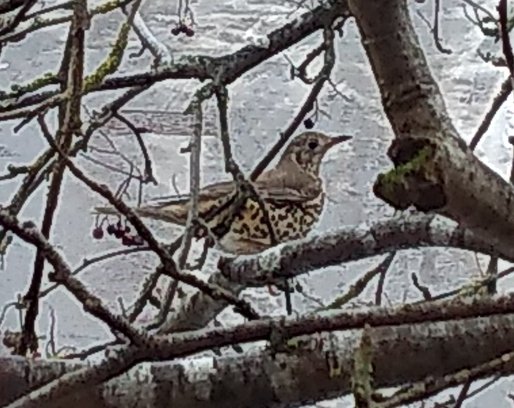
or male Chaffinch (Fringilla coelebs) visit the tree before.

Perhaps the reduced availability of food, during the snowy weather, made them search further afield than usual. Thankfully they found the remaining, mostly dried, berries on the Rowan tree outside my window.
Mistle thrush, so named because of their love of eating mistletoe (and guarding trees where it grows) also visit Rowan and Holly (Ilex) trees for their berries as well as eat worms, slugs and insects. They are larger and duller in colour than Song thrush (Turdus philomelos). Their spots are darker and rounder plus they have white tips to their tails. In fact they are larger than Blackbirds (unlike Song thrushes).
Wonderfully, there were even more flowers blooming in the garden too. I saw
Lungwort (Pulmonaria officinalis),
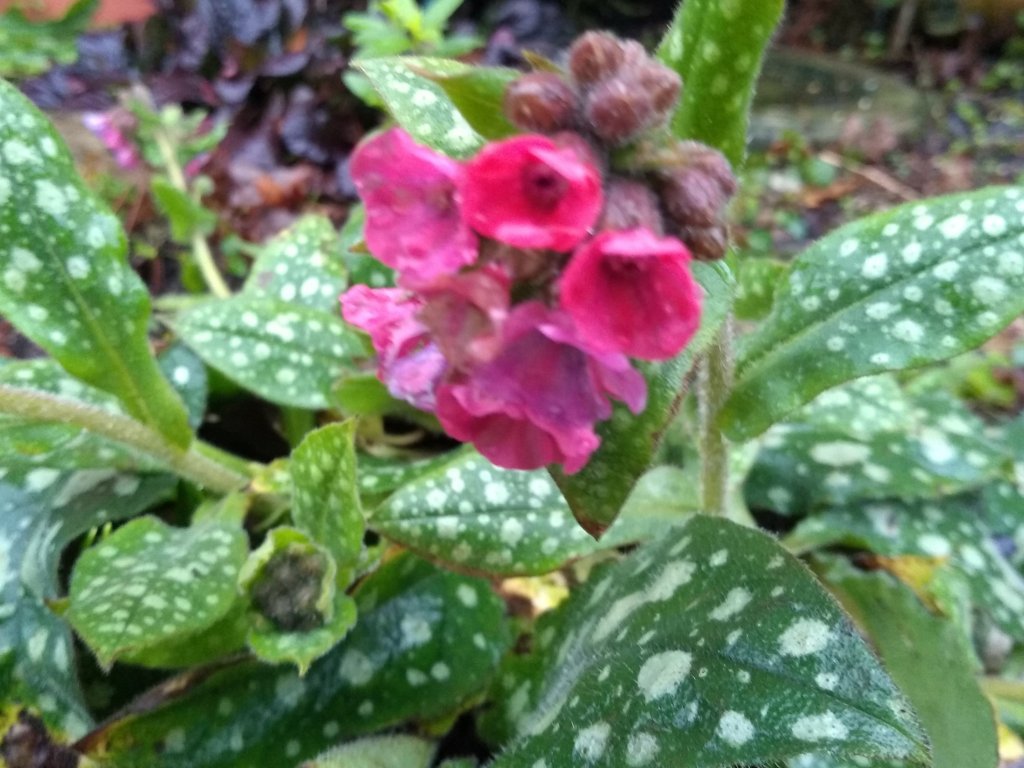
Crocus and

lots of Cyclamen.


 Bee in the Moment