February is a liminal month, it holds the hope of spring alongside the grip of winter. Just when glimmers of warmer weathers arrival brings dull wet conditions, clear nights followed by cold frosty mornings bite you back to reality in the glimmering sunshine. Even my activities have a duality to them. February is the time when I organize my seeds, sew Sweetpeas and chillies as well as check my houseplants; however I want to continue hibernationing. I find myself quite hopeful in this month and overwhelmed at the same time.
It is always lovely to see the first stirrings of spring, especially the arrival of Snowdrops, (Galanthus) and Winter aconites (Eranthis hyemalis). I often hear foxes (Vulpes vulpes) calling at night at this time too. It’s no coincidence that the celebration of the lands awakening after winter, Imbolc, is on the 1st February. The biggest indicator that spring is on its way are the birds beginning to pair up; boldly singing to alert prospective mates of their whereabouts whilst also holding onto territory. I was fascinated, one rather cold but not frozen day, to see a Robin (Erithacus rubecula) defend a feeder, chasing off a Tree creeper (Certhia familiaris). I have never seen a Tree creeper venture onto a bird feeder before, nor a Robin actually (but I have previously seen the latter fight other birds for resources).
An image of a Tree creeper can be seen on the RSPB website here;
Other birds that have been particularly vocal in recent weeks have been the Mistle thrush (Turdus viscivorus), Great spotted Woodpecker (Dendrocopos major) and Dunnock (Prunella modularis).
The Mistle thrush is one of the UK’s largest songbirds, even larger than the Blackbird (Turdus merula) with a body length of 27 cms and wingspan of 45 cms. Although similar in looks to the Song thrush (Turdus philomelos), it’s more grey tonally. While this bird is named due to its love of mistletoe (Phoradendron serotinum), it also eats worms, slugs, insects and berries and is found in parks, gardens, farmland and woodland often singing at the top of tall trees. It is not as commonly seen as the Song thrush as its status is Red under the Birds of Conservation Concern 5: the Red List for Birds. It has been a joy to hear the sound of the Mistle thrush as I worked, an example of which can be heard here.
I have also loved hearing a Great spotted Woodpecker (Dendrocopos major). Interestingly it has sung at the top of the same fir tree as the Mistle thrush, albeit at different moments. I also heard it drumming on the trunk of a dead and Oak (Quercus) tree that had a hole in the side, see below. Perhaps that is where the woodpecker lives.
The Great spotted woodpecker call can be heard on the Woodland trust website.
Lastly, in a different garden, I was able to witness a Dunnock (Prunella modularis) singing sweetly, an example of this bird’s song, can be found on the RSPB website here .
At the end of January, once again I took part in the annual RSPB Big garden birdwatch; my results this year were-
After a slow start, due to the weather, things are growing nicely on the organic, no dig, wildlife friendly allotment.
The view of the allotment from the Buddleia shrub.The view of the allotment from the apple tree.
While most of the soft fruit season has come to an end (apart from the autumn raspberries), the plums and apples continue to develop and are something to look forward to later in the season.
Thankfully the rhubarb has recovered a bit after a disappointing harvest. Rhubarb doesn’t like growing in waterlogged soil and although we have sandy free draining soil, I think it ended up being too wet over the winter. The rhubarb was on the plot when we took it over four years ago and had grown very large. Every five years Rhubarb can be divided when the growth has become weaker or leaves are overcrowded so I will do this around November and hopefully this will invigorate its growth next year.
The slightly depleted Rhubarb patch.
The vegetables remain on a three yearly rotation to maintain soil health and keep viruses at bay. Main crop potatoes, kale (Cottagers and Cavolo Nero), beetroot, radishes and courgettes are doing well as usual. This years addition are carrots. I always like to try something different each year and It’s been a while since I tried growing these; so far they are surviving. They are in a raised bed and were sown later and sparsely to help avoid detection by carrot fly (Psila rosae). They are also in a mixed raised bed which also helps.
Along with covering vulnerable plants and growing sacrificial plants such as nasturtium (Tropaeolum majus) and marigolds (Tagetes), I intersperse herbs and other flowers in between the vegetables to help prevent too much loss from pests. I usually find beneficial insects soon appear when needed; there are lots of ladybirds on the plot at the moment. I also find the best way to deal with slugs and snails is to collect them and place them elsewhere; plus any plants with soft young growth are protected by copper tape on old pots and thorny material. I do allow some slugs to remain on the allotment however. The Leopard slug (Limax maximus) is one beneficial slug to have in a garden as they don’t eat living plant matter. They are great for the compost and also eat the eggs of other slugs.
Thorny material protecting new growth from slug and snail damage. Also a plastic bottle (with the bottom cut off) to allow water to be directed to the roots.Copper tape around an old pot (with the bottom cut off) used as a guard around the base of an annual while it establishes itself.
We have a lot of wildlife visiting the allotment. There is often evidence of a fox (Vulpes vulpes) visitor (which we have seen on other plots). Plus we often see grasshoppers and Common blue Damselflies (Enallagma cyathigerum) and frogs (at the moment we regularly notice one adult and one youngster hopping around). Last saturday, the sun was out and there was an abundance of bees on the Catmint (Nepeta), Red clover (Trifolium pratense), Lavender and Buddleia.
The wild area on the plot contains a bug hotel and is located near to a neighbouring pond. This is where the red clover grows.
This year, I decided to undertake the Big Butterfly Count at the allotment. The butterflies seen were;
2 Small skippers (Thymelicus sylvestris), 1 Comma (Polygonia c-album), 2 Gatekeepers (Pyronia tithonus), 1 Peacock (Aglais io) and 2 Large whites (Pieris brassicae)
Given the abundance of Cabbage whites (Pieris brassicae) nearby I have made sure my kale is covered up.
The perennial kale mixed in with the cut flower patch.
I find it reassuring to have seen so many butterflies and bees at the weekend, especially as overall there seems to be a reduction in numbers this year; partly due to the frequency of wet days.
I have noticed lots of moths this year too. Perhaps the most exotic looking one I have seen so far is the Scarlet tiger moth (Callimorpha dominula).
The creamy coloured spots on the top of the forewings can sometimes have a more vivid yellow tint.The red underwings can be seen here. I also managed to capture some of the shimmering blues and greens of the forewings when the sun shone on the moth.
This moth is medium sized, at 23- 27mm (across the wings). It flies during the day and night through May and June; often noticed while resting on plants. The caterpillars of this moth feed on Comfrey (Symphytum), Hemp Agrimony (Eupatoriumcannabinum), Common Nettle (Urtica dioica), Bramble (Rubus fruticosus), Honeysuckle (Lonicera), Meadowsweet (Filipendula ulmaria) and Green alkanet (Pentaglottis sempervirens); they can be seen from August until May, overwintering into the following year. The habitats where the Scarlet tiger moth will be found are in areas of wetland, riverbanks, woodlands, gardens as well as coastal areas.
One sound and aerial display of summer which I enjoy is the return of Swifts (Apus apus). I have even been lucky enough to see them catching insects as they swoop over a pond (sometimes just skimming the water) along with another flock soaring high up the sky. I always treasure seeing these amazing birds as they are on the red list for Birds of Conservation Concern 5: (2021). A few things we can do to help them is to put up appropriate nest boxes, as well as adding swift bricks to new builds, giving them somewhere to raise their young. The RSPB also have a citizen science project where you can record their presence. Further information on how you can take part, can be found here. Having arrived in Britain in April and May, it won’t be long before they return to Africa as they only remain here until August. Most of their time is spent on the wing, only stopping to nest in roofs especially of old buildings such as churches. If this isn’t incredible enough when feeding the young they regurgitate a bolus, (a pellet formed in the back of the birds throat) containing between three hundred to one thousand insects mixed with saliva. More information on swifts, including how to identify them can be found on the RSPB website, where you can also hear a recording of their distinctive call.
Swifts are not the only thing I have noticed around ponds lately. I recently learnt about another pond invertebrate, the Common backswimmer (Notonecta glauca). So called because they swim on their back just beneath the surface of the water. Not only do they feed on insects, but also tadpoles and small fish. They suck out the contents of their prey’s body after injecting it with toxic saliva. Found all year round they moult a few times before reaching their final length of one and half centimetres. It was quite fascinating to observe them swimming around.
It’s hard to believe that it’s May already, the months are certainly rolling on quickly. I feel like I have only just left winter behind. The weather continues to be mixed with many heavy rain showers combined with thunder passing through. Temperatures have increased though with warmer sunny days reaching 18 degrees celsius, encouraging Tree (Bombus hypnorum) and Buff-tailed bumblebees (Bombus terrestris) to buzz about. I also noticed three Peacock (Aglais io) butterflies dancing around a couple of weeks ago; perhaps two males trying to attract a female? Plus I saw the first Holly blue (Celastrina argiolus) butterfly of the season as well.
Cherry blossom is blooming at the moment and Bluebells (Hyacinthoides non-scripta) are out in force too; it’s the height of their season which is quite a contrast from the beginning of the month when a few were slowly unfurling.
Birds are prominent at the moment as the dawn chorus is reaching its crescendo. Birdsong can be heard clearly throughout the day as I work in gardens. I have seen several House martins (Delichon urbicum) swoop past me. These summer visitors from Africa return to the same nests (made of mud) under ledges such as the eaves of houses or cliffs. I am very privileged to have seen so many lately as they are categorised red under the Birds of Conservation Concern 5: the Red List for Birds (2021) and therefore protected by the Wildlife and Countryside Act 1981. They eat flying insects so living in a rural area no doubt helps. House martins can be distinguished from similar birds using the Wildlife Trusts information here. There is a call to help reverse the decline of House martins; advice on ways to help them can be found on the RSPB website.
Another bird I came across recently which I haven’t observed before is the Rook (Corvus frugilegu). Not as common as some other Corvids their UK conservation status is amber. Similar to Carrion crows (Corvus corone) they are identifiable by their off white beaks. Their diet varies from fruit, nuts and grain to invertebrates and worms. Rooks are sociable birds. Unlike Crows which are seen by themselves or in pairs, Rooks are often seen in groups, just like Jackdaws (Corvus monedula). Infact groups of Rooks and Jackdaws can be seen together; this is how I saw the Rooks, alongside Jackdaws in a busy carpark where humans often dropped scraps of food.
Several Robin (Erithacus rubecula) couples and even one bold male Blackbird (Turdus merula) have come inches away from me to feed and collect food for their young as I work in gardens over the past few weeks. I like to think of their broods back in the nests as I see them fly away with the unearthed bounty towards hedges and trees nearby.
On the 28th March I got to see an amazing spectacle. Two Buzzards (Buteo buteo) were being faught off by a couple of Red kites (Milvus milvus). The thermals aided one Buzzard to appear to briefly hover over some fir trees. I was working in an area with a woodland where Red kites nest. The buzzards (which I often see at the other end of the wood) had ventured over the the Kite territory. Maybe the Red kites were protecting some young or eggs? This I was unable to determin, however the kites were clearly concerned about having the Buzzards near their territory. It was unusual to witness the Red kites attack another bird usually they are the ones being warned away. I frequently see birds attacking kites when they venture too near a nest (even though they don’t predate young but scavange for food). It was lovely to hear the Buzzards calling to one another, an example of which can be heard on the RSPB website along with a picture for identification.
Buzzards are now the most common birds of prey in the UK, and widespread across the land inhabiting woodland, moorland and farmland areas (after a comeback from years of persecution). They are brown in colour and they are 51-57cm in length with a wingspan between 113-128cm. Along with being predators they will also scavenge; their diet consists of birds as well as small mammals and invertebrates. Hardly surprising then that the Red Kites didn’t want them in their territory if they had a brood.
Since then, I have seen other Buzzards in a few areas near roads along with a male Sparrowhawk (Accipiter nisus) by the road side (near to where I had already witnessed a female (see previous post- Daffodils in Snow).
These are not the only large birds that feature prominently in my life at the moment. I have also been keeping an eye on the Peregrine falcon (Falco peregrinus) nest at St Albans abbey. So far Alban and Boudica have three eggs yet to hatch. Incubation usually takes about a month (29-32 days) for each egg, so they are due to hatch beginning of May and fledge by the start of July. This is the pairs second breeding season. Peregrines pair for life and return to the same nest site each year. Alban mostly hunts (birds or rodents) but does incubate the eggs too, enabling boudica to hunt occasionally. The live cam to watch them is here.
There have been really cold moments this January, with temperatures barely reaching positive numbers here in the UK and some areas experiencing more snow; however nature has started to emerge once again.
On a walk a few weeks ago, I noticed Blackthorn (Prunus spinosa) buds ready to burst open and the tiny red female Hazel (Corylus avellana) flowers open alongside male catkins.
Blackthorn budsHazel flower and catkins
Cyclamen and Snowdrops (Galanthus) are also blooming now and even Daffodils (Narcissus) and Crocus are beginning to push through the now defrosted ground.
Last weekend was the annual RSPB’s Big Garden Birdwatch. My results this year were; 3 Wood pigeon (Columba palumbus) 5 Starlings (Sturnus vulgaris) 2 Blackbirds (Turdus merula)- 1 female and 1 male 2 Great tits (Parus major) 1 Magpie (Pica pica) 1 Robin (Erithacus rubecula) 3 Bluetits (Cyanistes caeruleus) 2 House sparrows (Passer domesticus)- 1 male and 1 female 2 Goldfinch (Carduelis carduelis) along with 2 Carrion crows (Corvus corone)
It’s hard to believe it’s now February. As usual during January I slowed and hunkered down, reflecting nature at this time. Yet the wild flowers are beginning to stir and birds pairing up. It isn’t long before spring arrives and I am already starting to plan what I shall grow on the allotment this year.
Cold weather from the north arrived over the past few weeks. Initially hard frosts covered the earth along with foggy mornings; then snow arrived overnight on the 11th December. Due to the below average temperatures it lasted for a week but once the warmer southern weather and rain arrived (last Sunday) the snow disappeared as quickly as it arrived; It was beautiful while it lasted.
Also I finally caught Covid (after avoiding it until now). Thankfully, apart from leaving me with a cough I am much better, however for a while my world was reduced to watching birds from my flat. The Rowan (Sorbus aucuparia) outside has been stripped of all berries, no doubt the snow last week was a factor as birds had less places to forage and migratory birds arrived. A group of Redwings (Turdus iliacus) visited the tree along with Starlings (Sturnus vulgaris) and also a Song thrush (Turdus philomelos). Further information on Redwings can be found via the RSPB website.
A Song thrush visiting a snowy Rowan tree while berries still hung from it.
It was also nice to see my resident Blue tits (Cyanistes caeruleus) and a Robin (Erithacus rubecula) appear too.
I can’t believe it’s the Winter Solstice already. I am looking forward to taking a few weeks off; I will take the time to relax, reflect and look to the year ahead.
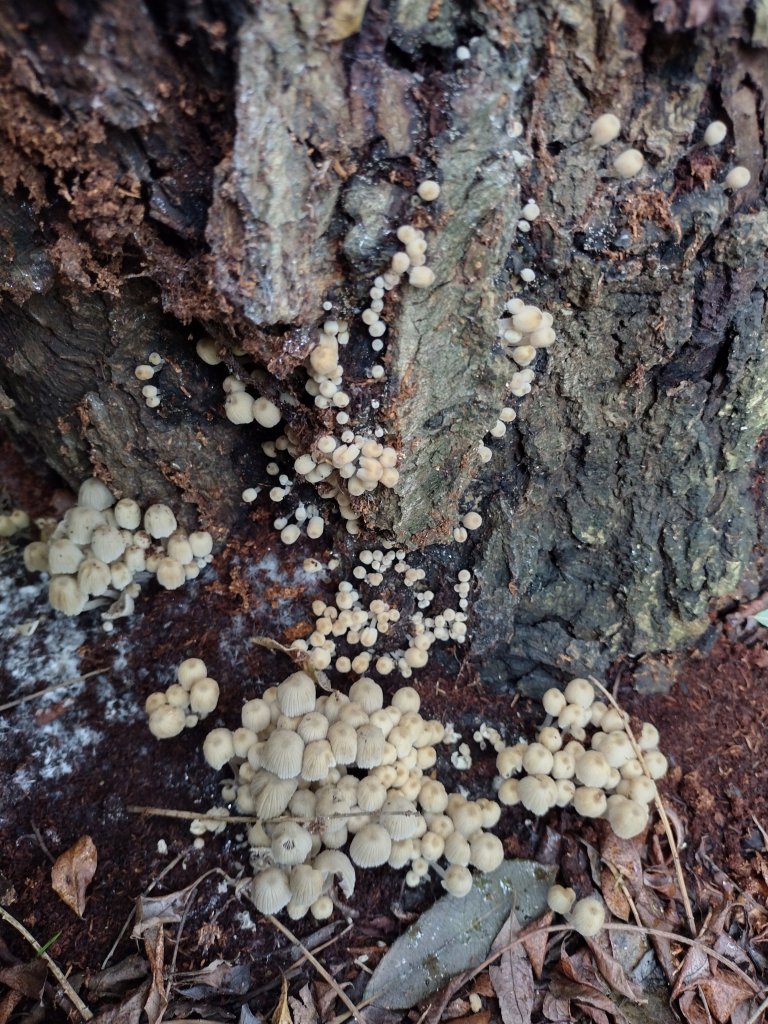
Since the Equinox on the 23rd September, there have been a few misty mornings and the leaves are beginning to loose their green colouring. Autumn cyclamen (Cyclamen hederifolium) and Crocuses (Colchicum autumnale) have been blooming for a few weeks now and even mushrooms are beginning to emerge. A few I have found recently include;
Ruby Bolete (Hortiboletus rubellus). Found amongst Lambs-ear (Stachys byzantina) in a garden near a Beech (Fagus sylvatica) hedge. Possibly a group of Fairy inkcap (Coprinellus disseminatus)? Found at the base of a tree.
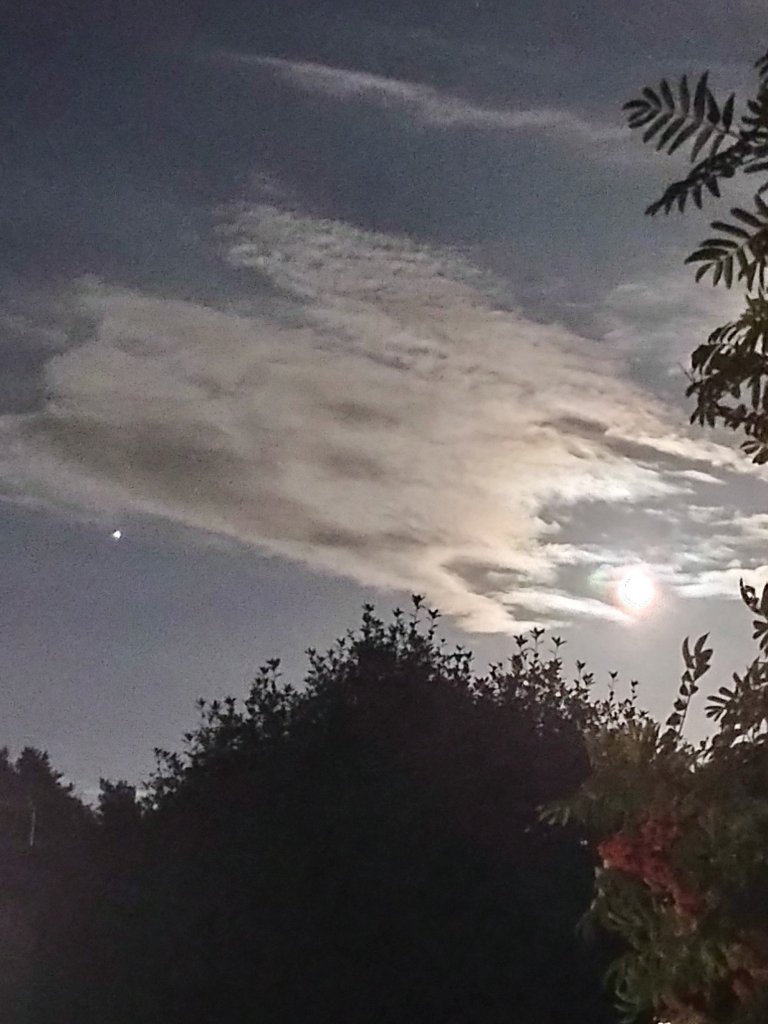
Evenings are noticebly drawing in earlier these days. Saturn is still visible with the naked eye at this time, as is Jupiter. The latter can be seen very clearly, in fact only the moon is brighter in the night sky at the moment. I managed to capture an image on the 10th September which can be seen below.
The tiny dot of Jupiter (left) in the early evening alongside the full ‘Hunters’ moon before being obscured by cloud.
Also in September my partner and I went on a break for a few days to the north east of England. We stayed in a lovely vintage caravan near Durham. On the first day we spent the morning exploring the city, after which we walked alongside the River Wear; there was lots of Himalayan balsam (Impatiens glandulifera) in flower (both along the river bank as well as beside the pathway). We walked to Durham University’s Botanic Garden to have lunch. While we were there we witnessed a Stoat (Mustela erminea) under aerial attack from a Magpie (Pica pica) as we sat in the North American Arboretum (no photo evidence unfortunately). This was our first encounter with a Stoat. Similar to Weasels (Mustela nivalis) Stoats can be easily distinguished from them due to the black tip on their longer tail. The Woodland trust has an article about how to differentiate them on their website.
Then in the afternoon we went to Seaham beach to search for seaglass. A well known area for seaglass searchers, Seaham beaches are noted on maps as being glass beaches due to the huge amount of glass pebbles (of various colours) that can be found there. The glass was discarded into the sea from the Seaham Bottle Works which used to be in the area (between 1853 and 1921. It is known that 20,000,000 hand-blown bottles a year were produced at the height of manufacturing at the factory). It was a quiet sunny day when we visited the area and the sound of the waves crashing against the beach was mesmerising.
We found lots of seaglass including some rare red pieces as well as some that were made up of two colours.
While we stopped for a coffee at the local cafe, we saw a Purple sandpiper (Calidris maritima) with a large group of Gulls (Larinae). Similar in appearance to Gulls, the Sandpiper was larger, speckled and greyer as shown in the following image (taken from the visitor notice board next to the cafe).
This wading bird is a winter visitor in the north east of England. It’s numbers are at a vulnerable level, therefore it is red on the UK conservation status list. They will eat Winkles (Littorina littorea), insects, spiders, crustaceans and also plants.
On the Wednesday, we drove up to Northumberland to visit Lindisfarne. As we drove to the village we got to see the location of Vera’s house (from the ITV detective series Vera). This dwelling is privately owned but it’s possible to park nearby and view it from a distance.
The Snook Tower and stable (left) next to Snook House (right) is Grade ll listed and thought to have been a windmill or watchtower. Both buildings date from the early to mid 1800s.
There was lots of wildlife to see on the journey towards and around the village too. On the way across the causeway, we noticed a Curlew (Numenius arquata) amongst other wading birds. As with the Sandpiper, the Curlew is also red on the UK conservation status list. Approximately 30% of Western Europe’s flocks will overwinter in the UK, unfortunately there was a sign warning of Bird (Avian) flu on the island. Bird flu has been rampant in the UK this year which doesn’t bode well for lots of birds but it is particularly foreboding for many waders and seabird populations. The Curlew’s down curved bill was the give away to its identification. They search for worms, shellfish and shrimps in the nature reserve along the causeway. The RSPB gives a description of Curlew’s here.
It was amazing to witness lots of European grey seals (Halichoerus grypus) as we wondered down by the islands beaches, searching for more seaglass. It is possible to witness them swimming nearby, next to the sandbanks and nature reserve beaches which they inhabit. It is also possible to hear them, unfortunately I was unable to obtain a great video of this; however I found a recording online here, of Grey Seals Singing on the Mewstone in South Devon which gives you an idea of what they sounded like on our visit to Lindisfarne.
The three markings in the sea (top) are actually the best image (on full zoom) of the Seals I could obtain. However you could visibly identify their bobbing heads looking from side to side as well as them diving and resurfacing.
Pups start to be born in September so perhaps we could hear the young with the females, or maybe the adults were singing to one another. Whatever the reason for their beautiful vocalisations, it was absolutely amazing to listen to the haunting sound.
As well as these creatures, we got to see some flora as we investigated the island too. There was;
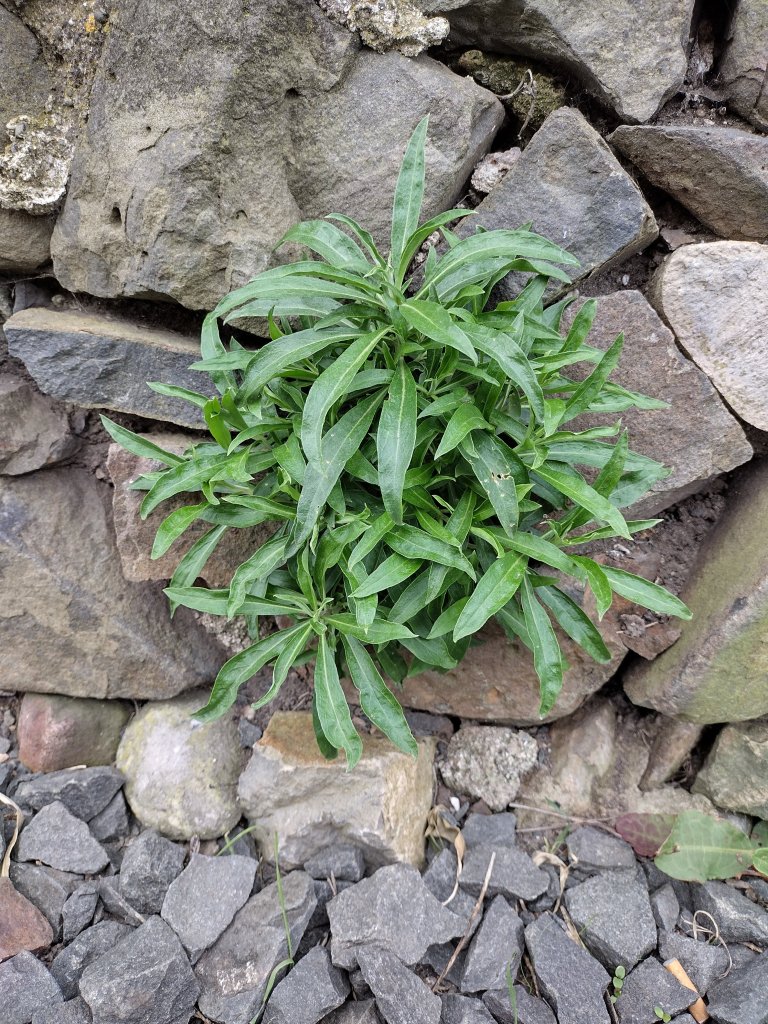
Sea thrift (Armeria maritima)Sea campion (Silene uniflora)Wallflower (Erysimon cheiri), not in flowerSea mayweed (Tripleurospermum maritimu) and Sea spleenwort (Asplenium marinum) alongside some Common orange lichen (Xanthoria parietina).
It was lovely to get away for a couple of days while witnessing wildlife that I had never seen before. Relaxing by the sea, especially on Lindisfarne was so rejuvenating. Obviously two full days with travelling time either side wasn’t long enough, but there’s always next years adventure.
I have been watching a wild flower grow, in the small garden that I look after in front of my flat. Initially unable to identify it (as I didn’t recognise the foliage) I patiently waited throughout autumn and winter to see what emerged. Then in late spring it developed stalks and flowerheads enabling me to see it was a Field scabious- (Knautia arvensis).
This perennial is blooming now. Bees are loving the flowers.
Field scabious is usually found in places such as grassland, meadows, grassy verges and hedgerows. This self set is obviously enjoying similar conditions in my little plot; thriving in an area against a brick wall with dry, partially shady conditions. It is wonderful to see it attract so many beneficial insects so am happy for it to remain where it is.
The allotment is coming on leaps and bounds. The strawberries (which rarely make it home) were a sweet reward as I watered daily through the recent heatwave and continue to ripen. The Blackflies on the Broad beans were eventually joined by seven spot (Coccinella septempunctata) and Harlequin (Harmonia axyridis) ladybirds, together with lots of their larvae; proof that if you leave pests, predators will appear to deal with them; nature really is wonderful.
The recent higher temperatures have encouraged butterflies to fly around. Lately I have seen Small tortoishells (Aglais urticae), Peacocks (Aglais io), Marbled whites (Melanargia galathea) and Speckled woods (Pararge aegeria).
Also on one sunny day last week, while eating lunch outside, I heard a bird song that I didn’t recognise. I recorded it on the Chirp-o-matic app (the name makes me think of Wallace and Gromit) to discover that it was a Yellowhammer (Emberiza citrinella). The rhythm and length of notes makes it sound like they’re saying ‘a little bit of bread and no cheese’. In fact this phrase is used by birders to identify it by the song alone and can be heard on the RSPB website.
Unfortunately I couldn’t see the bird which was a shame as I would have loved to see its yellow plumage. Part of the bunting family, both males and females have yellow colouring mixed with some brown (the males can be distinguished as they are more vibrant). These birds are currently on the red list for UK conservation status and therefore Protected by The Wildlife and Countryside Act 1981. Found on farmland, they eat seeds, insects, worms, caterpillars, spiders and snails and weigh in at about 25-36g weight (a similar size to a sparrow).
To encourage yellowhammer numbers, the RSPB has produced information for farmers so they can take action to help these birds; However the actions can be applied by anyone living near farmland, and can be found here.
On the eve of the Summer solstice I love to go to sleep early with my curtains open so I can wake up naturally and see the sunrise; it helps me align with the seasons and appreciate nature in a different way. This year I awoke at 3:50am and immediately opened the window so I could enjoy the dawn chorus. Initially the predominant birdsong was that of Blackbirds (Turdusmerula), occasionally punctuated by the calls from a Wood pigeon (Columba palumbus), a murder of very vocal Carrion crows (Corvus corone), along with a male Pheasant (Phasianus colchicus) in the distance too. The crescendo came around 4:10am but it wasn’t until finally at 4:42am, when things had quietened, that I heard a few more birds singing. There was a lone Dunnock (Prunella modularis) and then a Greenfinch (Chloris chloris) at about 4:50am; followed much later by Blue tits (Cyanistes caeruleus) which I observed in the Rowan (Sorbus) tree nearby.
It’s interesting to notice an order to the bird song. Blackbirds are the first to be heard, almost like they are an alarm call for the other songbirds; clearly eager to catch the worms.
I also learnt another birdsong last week, heard around midday on Thursday. Hidden somewhere amongst the treeline next to a field, was a Common Whitethroat (Curruca communis); the song can be heard here on the RSPB website.
This warbler visits the UK from Southern Africa (from countries south of the Sahara) between April and October. Once the males arrive on these shores, they will establish territories and build nests for prospective partners (approximately ten to fourteen days before the females arrive).
These birds are about the same size as Great tits (Parus major) and named after the white plumage on their throats. Males can be differentiated from female due to their grey heads. They feed on insects as well as fruit and berries later in the year.
After being concerned that I wasn’t seeing many butterflies and ladybirds the previous week, last week it finally became warm and sunny enough for them to venture out once again. It was lovely to witness a couple of Small tortoisehell butterflies (Aglais urticae) along with some bumblebees visit a Scabious plant in one garden.
Plus there was a loveliness of Seven-spot ladybirds (Coccinella septempunctata) at the allotment, hunting down on all the aphids which also appeared.
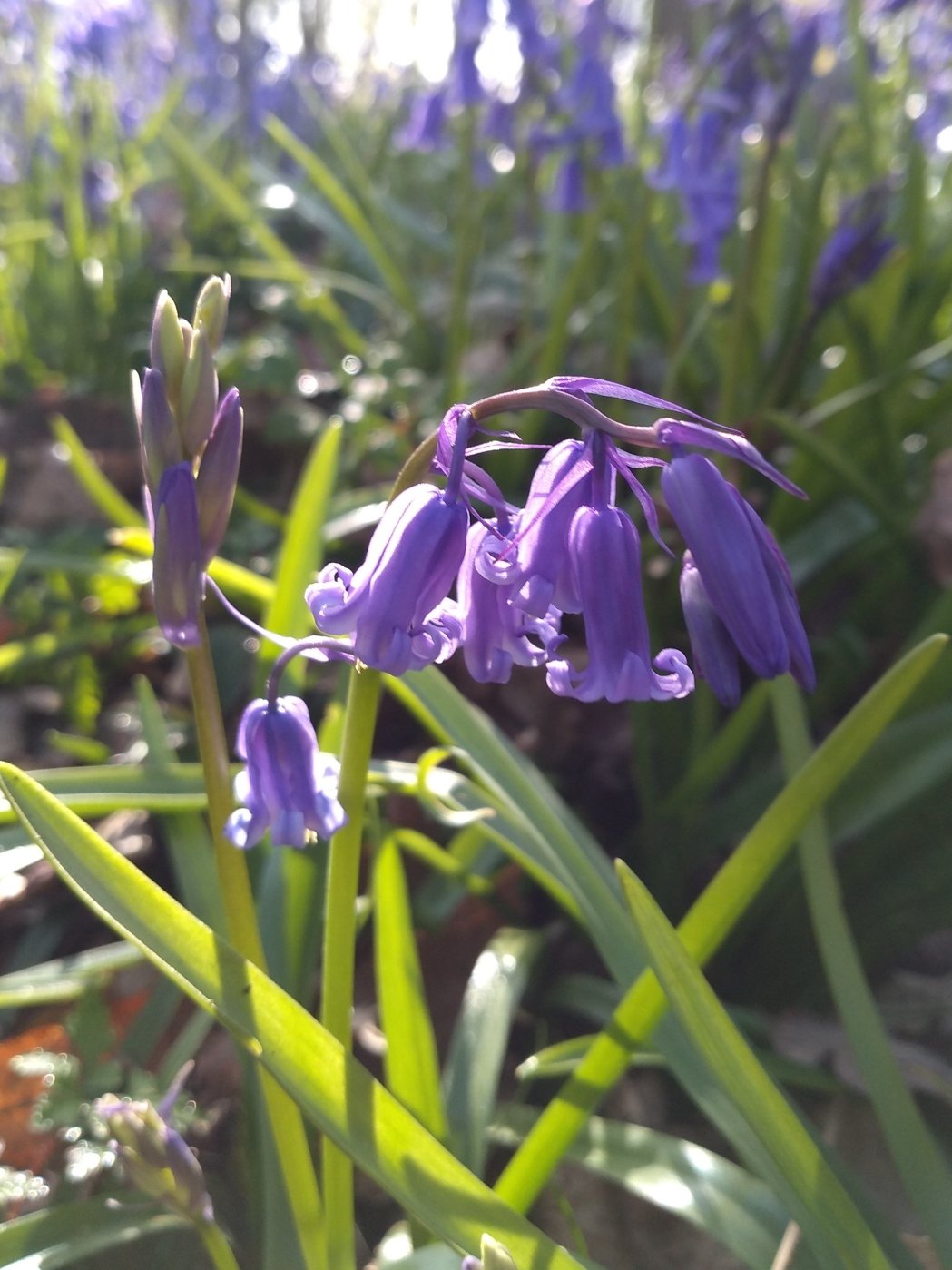
Last week the Bluebells (Hyacinthoides non-scripta) were just beginning to open. I always look forward to seeing these delicate flowers appear; it brings such joy to see their destinctive shade of blue on mass. Although not yet in full bloom, as I knelt down to take photographs I caught their delicate aroma.
Then later the same day, I got my first sighting of a Common carder (Bombus pascuorum) bee of the year, as it took advantage of the apple tree blosom.
I will never tire of hearing birdsong, it’s a wonderful soundtrack to have as I work. Not only is birdsong relaxing to me but it gives me the opportunity to keep learning too. The bird I became most aware of last Tuesday was the Nuthatch (Sitta europaea). Amongst all the birds I could here on that day, this was the clearest (it can be heard here on the RSPB website).
Unfortunately I didn’t get to see it. Having never seen one before I would have loved to see it’s mostly bluish grey and chestnut plumage (with hints white along with a black stripe across the eyes).
Similar in size to a Great tit (Parus major) these birds resemble a small Woodpecker as they climb trees. Nuthatches can be seen clinging to trunks or branches, as they climb up or down headfirst (the only British bird to descend trees in this way). They forage for insects and invertebrates, as well as feast on seeds and nuts (including beechmasts, hazel nuts and acorns) using tree crevices to store food for later. They also bury food and hide it beneath stones.
Nuthatches are found in mixed broadleaf woodlands, parkland or urban gardens which have sufficient tree cover; occasionally eating from bird feeders. They particularly like areas with mature Oak (Quercus) trees. There was an established Oak nearby where I worked, so perhaps that’s where it was singing from.
They remain close to the nesting site where they fledged and are mostly seen in England and Wales; although their range is expanding into Scotland. Nests are holes in trees such as old Woodpecker nests.
Last week had very mixed weather. Easter Sunday was sunny and warm (a hint that summer isn’t far away) replaced by snow showers and frost on Monday and Tuesday; eventually cold days with occasional sunny spells remained.
I took advantage of the glorious weather last Sunday and went for a walk around my local woodland park. More Brimstone (Gonepteryxrhamni) butterflies were flitting about, along with one Comma (Polygonia c-album) and several Peacock (Aglaisio) butterflies too. Blackthorn was still blossoming in earnest, attracting these butterflies as well as bees and hoverflies.
A Peacock butterfly feeding in the sun.
Pollinators weren’t the only wildlife noticeable; lots of Squirrels (Sciurus carolinensis) were running between and up the surrounding trees while birds were singing.
I even noticed a couple of Blackcaps (Sylvi atricapilla). I’m not sure if these birds are resident to the woodland or migrated from Europe or northern Africa. Since the 1960’s records of these Warblers remaining in the UK all year round exhist and since then numbers have increased. Those not living the UK full time visit from April or May and remain until September or October.
It is the first time I have ever seen Blackcaps (presumably a pair given how they were interacting with each other). As they were so high up in the tree, completely unaware I was watching from below, I was unable to actually see their caps (males have black caps while females have a chestnut colouration to the top of their head) however I was able to identify them from their bird song. An example of this can be heard on the RSPB website.
This wasn’t the only amazing experience I had with a bird last week. On the following Tuesday I was privileged to witness a Wren (Troglodytes troglodytes) flying around me as I worked, singing as it did so. At one point it landed on a shrub within a few feet from me; I remained as still as I possibly could, watching this amazing spectacle. Usually remaining near cover Wrens are usually heard but not seen so this was lovely to see; plus I managed to obtain footage.







 Bee in the Moment