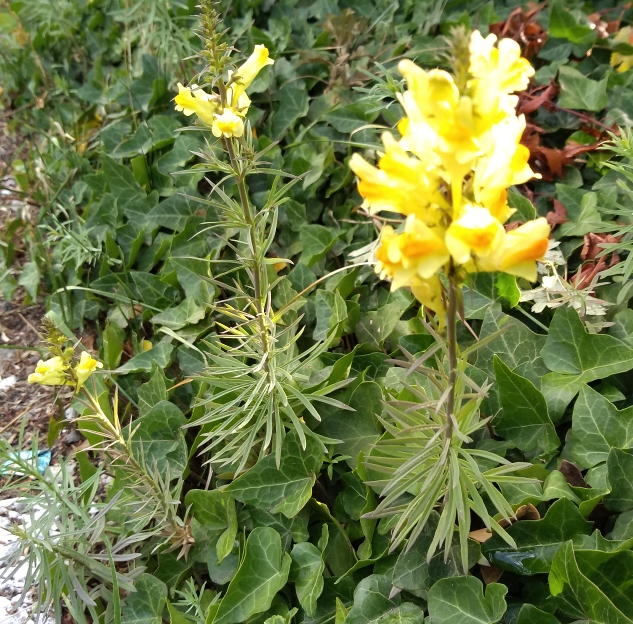
Some fields along my journey to and from work contain a lovely combination of pink Rosebay Willowherb (Chamaenerion angustifolium), purple Buddleia and white Wild carrot (Daucus carota) flowers. Not only do they compliment one another visually but they are all loved by pollinators too. Yellow toadflax (Linaria vulgaris) has started to bloom along the roadside as well.
One special moment occurred on the Monday. As I worked within a border I noticed a Buff-tailed bumblebee (Bombus terrestris) queen flying around a patch of grass. Eventually she began to settle and after a few more large sweeping flights began making a nest in the lawn.
It didn’t take her long to dig into the soil beneath the grass.
She will remain under ground until spring when she will start her own colony.
It was also great to finally get some photos of insects that have have alluded my photographic capture so far this year.
– The first is the Red admiral (Vanessa atalanta),
– Some Hoverflies, including a Hornet mimic (Volucellazonaria) hoverfly,
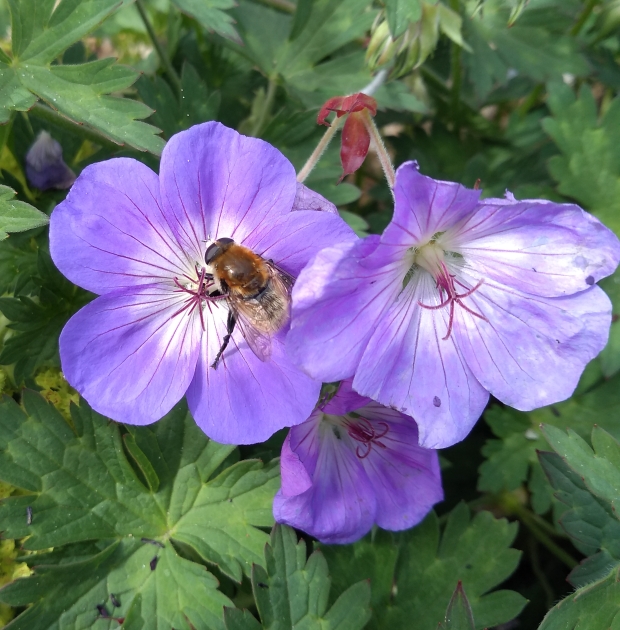
Hornet mimic Hoverfly pollinating Wisteria flowers that were still blooming.Hoverfly pollinating Geranium flowers.
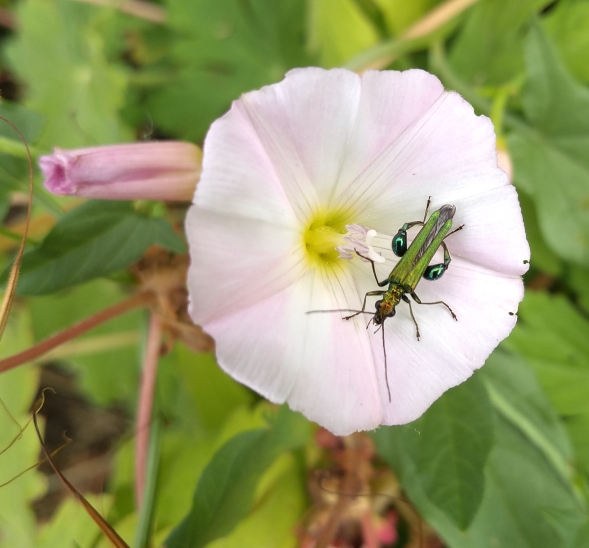
– as well as a Male False oil beetle (Oedemera nobilis), to compliment the female one seen on a walk earlier in the year.
A False oil beetle pollinating a Field bindweed (Convolvulus arvensis) flower.
The males are easily identified due to their large metallic thighs, explaining the reason behind the other common name for this insect the Swollen-thighed beetle.
If I create a wildlife friendly allotment nature will come. My allotment is really filling up and blooming now even though I’ve only had it since February. Most of the plants are from seed, cuttings or rescued from other gardens. For the first year I plan to let the plants develop before harvesting properly.
We’ve had so much rain in recent days that I didn’t need to visit the allotment to water during the week. So last Saturday was the first time in seven days that I visited my plot to undertake major garden tasks. It was the summer solstice and the weather was glorious.
As I walked around to check how things were, I noticed a large number of wildlife; nature had come.
The first things I saw were two Small tortoiseshell Butterflies (Aglais urticae) pollinating the Thyme ‘Lemon curd’ (Thymus ‘Lemon curd’)
whilst Oedemera beetles were taking advantage of the Dandelions (Taraxacum officinale) left on the grassy walkways.
Several Buff-tailed bumblebees (Bombus terrestris) busily flew between the flowers on a neighbouring allotment’s Hebe and flowers on my patch, including the Lacy Phacelia (Phacelia tanacetifolia)
as well as the Borage (Borago officinalis).
A Honey bee (Apis mellifera) also visited the Borage.
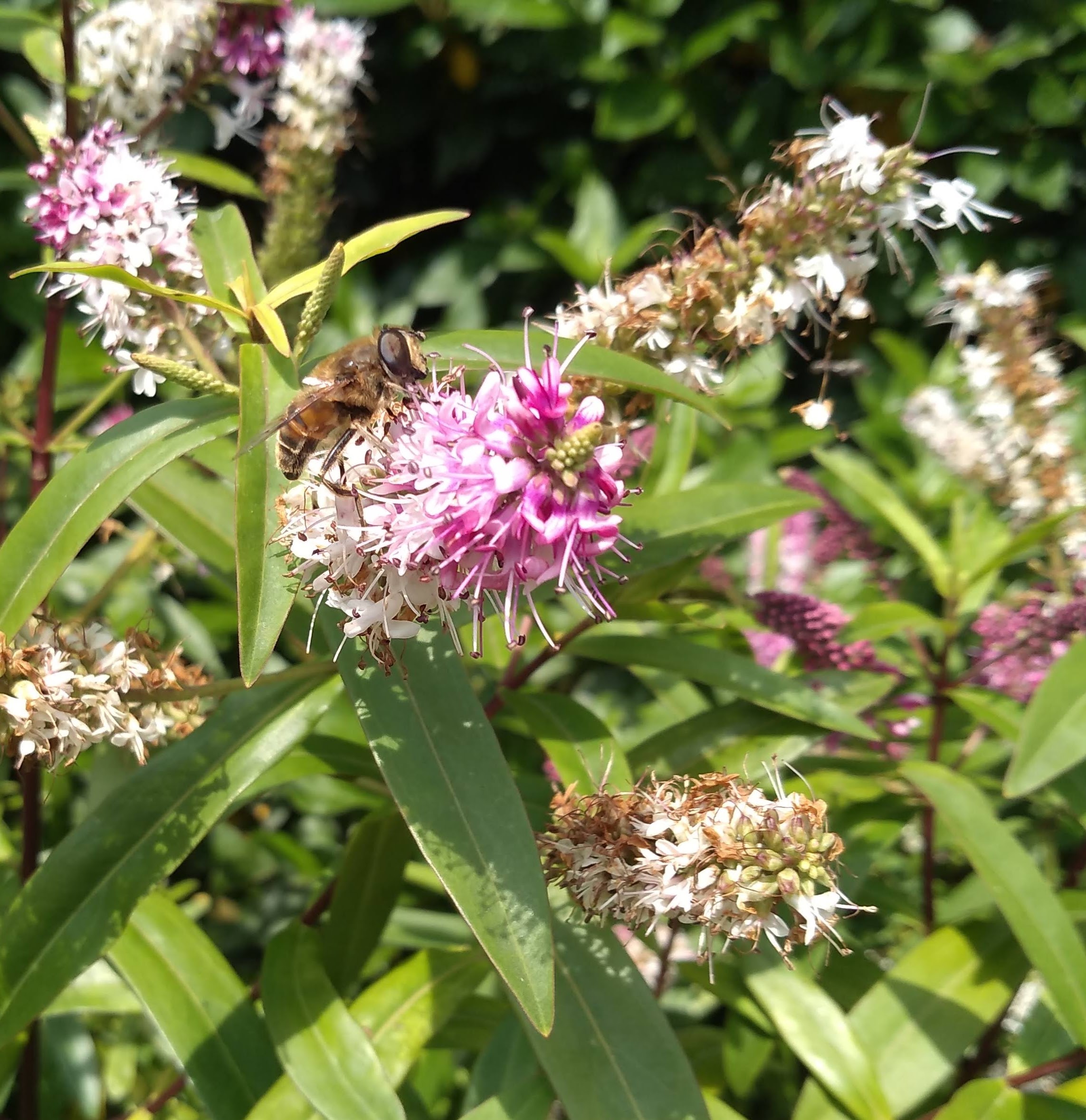
There was even a solitary bee buzzing about; an Ashy mining bee (Andrena cineraria) pollinating the Hebe.
Most likely this is the bee that was accidentally unearthed the previous weekend while getting rid of bindweed from around the potatoes (see photo below).
I had contacted the Bumblebee Conservation Trust to see if they could identify this silvery bee, if indeed it was a bee. Stephanie Miles answered my query explaining; ‘This is indeed a bee! It’s a male solitary bee of the genus Andrena. When these bees first hatch from the pupa they’re completely silver-haired, like this – over a day or so they dry out, lay down pigmentation, and the normal colour appears. Once the normal colour appears they can be identified to species level. You disturbed this one before it was quite ready to be seen in public!’ Therefore the Ashy mining bee seen on the Hebe seems a likely candidate.
Seven-spot ladybirds (Coccinella septempunctata) in different stages of development were resting on potato, Calendula (Calendula officinalis) and Borage foliage. There were newly formed adults along with the larvae.
A young Seven-spot ladybird before the recognisable red and black beetle develops fully.
Outside of my allotment wildflowers that are beginning to bloom included;
I have begun to notice a chill in the mornings as the nights grow colder. I love the promise of Autumn. It doesn’t quite feel autumnal yet (especially as the weather has warmed up again this weekend) but some changes are occurring. Conkers and beech masts have started dropping and fungi are appearing in some lawns. A couple of times I have come across fairy rings; in both instances the Marasmius oreades fungi was the cause (sadly no magical elvish, fairy or pixie dancing).
The week continued with more observations of Painted lady (Vanessa cardui) butterflies. On Monday there were two visiting a Buddleja bush along with a Small tortoiseshell (Aglais urticae) and a Large white (Pieris brassicae).
Then on Friday, in different gardens, more were flitting about. On one occasion, during the morning, I saw a Painted lady on a Ceratostigma willmottianum.
In the second half of the week I noticed more butterflies including a Green-veined white (Pieris napi) on Verbena bonariensis
and a Small tortoiseshell visiting an Erysimum ‘Bowles’s Mauve’.
Throughout last week I saw lots of pollinators busily collecting nectar and pollen.
On Monday I noticed lots of small flies and Buff-tailed bumblebees (Bombus terrestris) pollinating Marigold (Tagetes) flowers. Perhaps they are enticed by their overwhelming aroma which even I found hard to ignore.
Then on Wednesday there was a Common carder (Bombus pascuorum) bee flying between Nandina domesticas and several Agapanthus africanus.
On Friday while working near some Hebe ‘Great Orme’ there were lots of honey bees (Apis mellifera) as well as a Hornet mimic hoverfly (Volucella zonaria).
Another interesting thing I noticed last week was a Red campion (Silene dioica) plant growing on an old moss covered log.
With no soil surrounding its roots clearly it was receiving sufficient moisture and nutrients from this unusual source. It has been flowering healthily all summer but I hadn’t realised it had been relying on the log for its growth until then. I found this plants ability for survival amazing and will closely watch its development.
Lastly I have been aware of how wonderful hardy Fuchsias (Fuchsia magellanica) are currently looking. Although I don’t see pollinators visiting the flowers, there have been a couple of times, in the past, when I have seen Elephant Hawk-moth (Deilephila elpenor) caterpillars feeding on Fushia plants. (See Elephant Hawk-moth).
These caterpillars also eat Himalayan balsam (Impatiens glandulifera) and Willowherbs including Enchanter’s nightshade (Circaea lutetiana) and Rosebay willowherb (Epilobium angustifolium). This beautiful pink and olive green moth flies at night and therefore feeds on Honeysuckle (Lonicera).
Across the way from this hardy Fushia there was a Honeysuckle growing along the wall so it would have been a fantastic place for these moths to inhabit. Unfortunately I didn’t come across any Elephant Hawk-moths this year but hopefully I will in years to come (and I am sure it will feel magical).
I am watching Wimbledon while eating lovely sweet strawberries. The window is open so I can hear the birds singing outside; thankfully the temperature has dropped and it is feeling fresher now. It is a lovely summers day to reflect upon the things I saw last week. More flowers blooming along the roadside include Hedge bindweed (Calystegiasepium) Creeping thistles (Cirsiumarvense), Spear thistle (Cirsium vulgare), Field Scabious (Knautia arvensis), Ragwort (Seneciojacobaea) and Rosebay willowherb (Chamerionangustifolium). Creeping thistle seeds are a great food source for birds that make their home on farmland, while Spear thistle seeds are good for Goldfinch (Cardueliscarduelis) and the nectar enjoyed by the Small copper (Lycaenaphlaeas) butterfly. Ragwort (considered harmful to horses and livestock) is great for bees and the Cinnabar moth (Tyriajacobaeae) caterpillars. Even the Field Scabious is a useful food source for bees and butterflies.
Now that July has arrived, my butterfly and moth observations have increased. I have seen,
– A couple of Double-striped Pug (Gymnoscelisrufifasciata) moths
– Two Large yellow underwing (Noctuapronuba) moths
– Along with several that were photo shy including a White Plume (Pterophoruspentadactyla) moth and a couple of Large white (Pierisbrassicae) butterflies, three female and one male Meadow brown (Maniolajurtina) butterflies, a Comma (Polygoniac-album) butterfly near a patch of nettles (which are great food for their caterpillars) as well as two Large tortoisehell (Nymphalispolychloros) butterflies. Other butterflies I saw were,
– A Ringlet (Aphantopushyperantus) butterfly
– Small tortoisehell (Aglaisurticae) butterfly on Verbenabonariensis
– Red admiral (Vanessaatalanta) butterfly on wall by Climbing Hydrangea (Hydrangeaanomalasubsp. petiolaris)
These weren’t the only insects I noticed throughout the past week as I also saw,
– Two immature male Large red damselflies (Pyrrhosomanymphula)
– Two Azure damselflies (Coenagrionpuella) on Water lily (Nymphaeaceae)
– One Harlequin ladybird (Harmoniaaxyridis) on a Red valerian (Centranthusruber) leaf.
– Honey bees (Apismellifera) on an Eryngium bourgatii
-Lots of Honey bees and hoverflies (Syrphidae) on lavender (Lavandula) which is in full bloom.
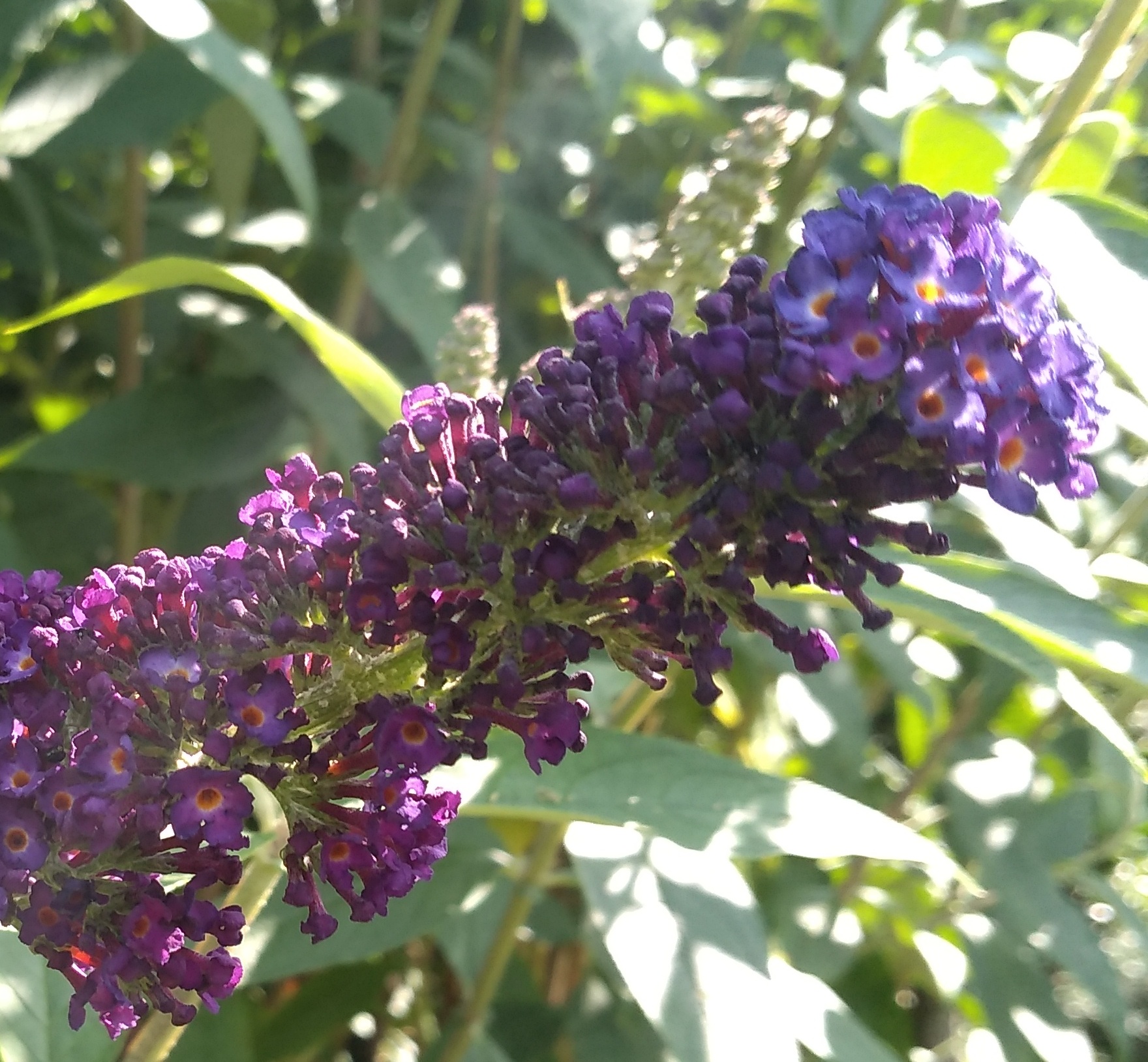
I am keeping my eye on a large mature Butterfly bush Buddlejadavidii ‘Black Knight’ that is starting to flower. A few years ago I took some cuttings from this Buddleja and successfully grew one of my own. My Buddleja is only about a foot tall but it will be flowering soon. I look forward to seeing visitors arrive on both shrubs.
Lastly I couldn’t resist adding a few photos of some Cornflower (Centaurea cyanus) someone had planted in their vegetable patch. While I didn’t see any insects visiting it my attention was drawn to the cheery vivid blue flowers, they were so beautiful.












 Bee in the Moment