Posted in nature

Springing Forward

Spring is in full swing now. The Spring equinox has passed, clocks have been changed to welcome in British summer time, april showers often appear (and disappear just as quickly) and the Bluebell (Hyacinthoides non-scripta) season has begun. It has been a while since my last post and a lot has happened since then.
Back in early march, I noticed lots of frogspawn appear, they have since developed into tadpoles and some now resemble small versions of the adults. Male Smooth newts (also called Common newts- Lissotriton vulgaris) were undertaking courtship displays, swishing their tails to waft pheromones towards the females. The video below shows this courtship display; I managed to capture it back on the 7th of march.


Newt eggs are laid individually wrapped in the foliage of aquatic plants and therefore not as obvious as frogspawn. I haven’t noticed any Efts (young newts) yet though but hopefully I will soon.

Hawthorn (Crataegus) blossom has replaced those of Blackthorn (Prunus spinosa) now. Plus alongside the flowering Bluebells, many more spring flowers are currently blooming including, Cuckoo flower (Cardamine pratensis), Lesser stitchwort (Stellaria graminea) and Cow parsley (Anthriscus sylvestris).

Butterflies are more noticeable these days. Recently I have seen Holly blue (Celastrina argiolus), Speckled wood (Pararge aegeria) and Small tortoiseshell (Aglais urticae) butterflies, as well as plenty more Brimstone (Gonepteryx rhamni).

More bee species have emerged over the past month; even the Leafcutter (Megachilidae) bees from the bee hotel on the allotment. Together with Red tailed bumblebees (Bombus lapidarius), Buff tailed bumblebees (Bombus terrestris), a Common carder bumblebee (Bombus pascuorum), and an Ashy mining bee (Andrena cineraria) I also noticed a Tawny Mining Bee (Andrena fulva)- The latter (shown below) was seen carefully exiting a hole on the side of the Wrekin.

I visited the Wrekin in Shropshire last weekend. A woodland surrounds the base of the hill which is quite a contrast from the more open areas at the top. Here Wood sorrel (Oxalis acetosella), an ancient forest indicator, could be seen blooming alongside ferns and moss. It was lovely to see patches of bluebells while listening to water trickling down the hillside (from the previous nights downpour).

Wood sorrel


At the summit of the igneous bedrock, Common heather (Calluna vulgaris) and Bilberry (Vaccinium myrtillus) are seen growing. Both plants grow on nutrient poor acidic soil. The Bilberries (also called Whinberry or Wimberry in Shropshire) were flowering but the edible fruit will be ripe in the summer.

Bilberry shrubs in flower.


It was also wonderful to see a couple of Buzzards (Buteo buteo) soaring and hovering around, ignoring us humans that had completed the ascent.

Lastly, since the Spring equinox, I have been watching the Peregrine falcons (Falco peregrinus) at St Albans cathedral on the live webcam here. Once again the pair have three eggs, the same as last year. Currently we are all waiting to see if they all successfully hatch and fledge. It is far more entertaining than any tv drama.

Posted in nature

🎵The Heat Is On. 🎤 🎹🎷🎶


“Tell me can you feel it, tell me can you feel it, tell me can you feel it, the heat is on…”

The 80’s song from the Beverly Hills Cop soundtrack with Glenn Frey’s voice, synthesizer and saxophone was my earworm as the temperature soared last week. The temperature increased to around 27°C mid week, which meant lots more insects ventured out as it felt like summer.

I was happy to see my first Red admiral (Vanessa atalanta) butterfly of the year, however my main observations were bees including the Red-tailed bumblebee (Bombus lapidarius) and Honey bees (Apis mellifera).

A Red-tailed bumblebee pollinating some geranium.
Honey bees visited Nepeta.

Another bee I started seeing last week was the Tree bumblebee (Bombus hypnorum). I noticed a nest inside a compost bin as I emptied grass clippings from the mower bag.

I have seen Tree bumblebees nest in bird houses before but not under compost. I made sure I avoided tipping grass onto their home and used the next bin along. I couldn’t help watching them for a little while as I stopped for a breather on the very hot Wednesday.

Moths were prominent throughout the week too. Unfortunately Box tree moth (Cydalima perspectalis) caterpillars and the signs of heavy infestation (foliage that had been eaten and covered with webbing) was noticeably present in several gardens. Therefore, I spent lots of time picking them off buxus topiary and informing clients to keep an eye out for them as well. For more information on this pest see the RHS website.

I discovered this years first sighting of a Silver Y (Autographa gamma) moth.

A Silver Y moth resting on a Heuchera leaf.

This immigrant is one of the few brown moths I can identify easily, mostly due to the clear y markings on it’s forewings but also because of their size and shape. This is a day and night flying moth which can be observed visiting flowers to obtain nectar.

However my most exciting moth sighting was the Lime hawk-moth (Mimas tiliae).

This spectacular large moth is night flying. It’s wingspan is 4.6-7.8cms and it can be found in broadleaf woodland, parks and gardens between May and July. I accidentally disturbed it as I pruned some shrubs under a Lime (Tilia sp.) tree. Thankfully it didn’t seem bothered by the disruption and it was carefully placed back near the lime tree. While adult moths of this species don’t feed, the caterpillars do. Once they have emerged from overwintering pupa, the caterpillars will eat Lime, elms (Ulmus sp.), Alder (Alnus glutinosa), Downy Birch (Betula pubescens) and Silver Birch (Betula pendula), Plane (Platanus x hispanica) along with some Cherry cultivars. This was the first Hawk-moth I have ever seen. There are a few that exist in the UK. The nearest I came to seeing one before was observing caterpillars of the Elephant hawk-moth (Deilephila elpenor) eating away at some Fuchsia. For more information on these Hawk-moths see the Butterfly Conservation website (Lime hawk-moth and Elephant hawk-moth)

I also saw hoverflies. I am still learning about these insects and learnt another one last week.

The photo above shows a Narcissus bulb fly (Merodon equestris). The maggots eat away at the centre of bulbs from the Amaryllidaceae family. However even though the maggots are a pest, the adult hoverflies are pollinators.

Posted in nature

Even Nature Turned Blue for the NHS.

While flowers dominated my thoughts last week, there were moments when I enjoyed observing bees and butterflies too. I saw my first male Orange-tip butterfly (Anthocharis cardamines) and female Red-tailed bumblebee (Bombus lapidarius) of the season; both visiting Dandelions (Taraxacum officinale). Other butterflies I noticed were more Speckled woods (Pararge aegeria) and Peacocks (Aglais io). All were too busy making the most of the sun to remain still long enough for me to photograph them.

After threatening to rain last Sunday, with distant thunder in the afternoon and evening, wet weather eventually arrived the following weekend. On Friday it rained late in the day through to Saturday afternoon. The ground loved that sustained soaking and together with all the sunshine we’ve had recently the grass is beginning to flourish. Thankfully lots of wild flowers bloom despite the lack of water, including;

– Ivy-leaved toadflax which is also called Kenilworth ivy (Cymbalaria muralis),

– Lords and ladies, otherwise known as Cuckoo-pint (Arum maculatum),

– Ribwort plantain (Plantago lanceolata),

The seedheads are great for feeding birds in winter.

– Dog’s mercury (Mercurialis perennis),

The tiny flowers are easy to miss amongst the leaves.

– Ox-eye daisy (Leucanthemum vulgare) and

– Cuckoo flower (Cardamine pratensis).

The name for this comes from the belief that this plant blooms at the same time the first Cuckoo arrives in the UK.

The main spring spectacle of the English countryside however are English Bluebell (Hyacinthoides non-scripta) woods in full bloom. Photos of these have filled social media over the past week. I am lucky enough to live near to several woods where English bluebells flower, however due to the lockdown this year I have to make do with spotting the ones amongst the headgerow, on my way to the allotment. Thankfully even small scale sightings of these flowers makes my heart soar. Swathes of these beauties are an indicator of ancient woodland (they are slow growers with seeds taking five years to become bulbs, which then flower). 

English bluebells continue to be under threat from the Spanish bluebell (Hyacinthoides hispanica) escaping from gardens, brought to these shores by the Victorians, which readily hybridise with English ones to produce the Hybrid bluebell (Hyacinthoides x massartiana). However, this isn’t the only threat to our native Bluebell. Habitat destruction is another reason for their decline. Simply walking on them can prevent them from flourishing for years afterwards as photosynthesis is prevented and the plant is weakened. They are a protected species under the ‘Wildlife and Countryside Act (1981)’. This means that people can be prosecuted for removing the plants and bulbs from their habitat and/ or selling them. 

It is possible to tell the English and Spanish Bluebells apart.
English Bluebells are a deep violet shade of blue with creamy-white pollen. The leaves are narrow (1-1.5mm wide) as are the flowers. The tips of each petal (six in total) curl up and inwards. The scented flowers grow on one side of the stem causing it to arch over to the one side (referred to as inflorescence).

Spanish bluebell flowers are pale blue (but can be pink or white), have a wider open bell shape with flared petal tips and bloom all around the stem, which therefore remains upright. The leaves are also wider (by 3cms) than its English counterpart and the flowers have no scent. 

Unsurprisingly the hybrids possess characteristics of both parents, however their appearance tends to be more like the English Bluebell meaning distinguishing the two can sometimes be difficult. 

Last week I saw both English and Spanish Bluebells on my daily exercise.

English Bluebells are great for long-tongued bumblebees. However previously I have seen evidence of short-tongued bumblebees visiting Bluebells. Unable to reach the nectar in the traditional method, I noticed a hole in the base of the flower where a bee had obtained the nectar without pollinating it. This is referred to as ‘nectar robbing’.
Spanish bluebells found in a garden.

Bluebells are interwoven into our culture. In the past the sap was used to glue feathers to arrows and in book binding. Plus the Elizabethans used the bulbs to starch collar and sleeve ruffs.

In folklore they are associated with fairies while in the language of flowers (popular in the Victorian era) they represent humility, constancy, gratitude and everlasting love. What better flower to have bloom during this difficult time when we are showing our appreciation for the NHS and other frontline workers. It seems even nature has turned blue in solidarity.

Posted in nature

The Ladies Arrived

I finally got to see a some Painted lady (Vanessa cardui) butterflies, in fact there were three visiting a Buddleia I was working near. I thought I caught a glimpse of one last week (but couldn’t be sure) however this was a definite sighting.

I got to see them again on Tuesday together with a Large white (Pieris brassicae), Small tortoiseshell (Aglais urticae) and a Red admiral (Vanessa atalanta) on the same Buddleia.

Plus earlier on Tuesday I got to see two Small white (Pieris rapae) butterflies, a Holly blue (Celastrina argiolus) along with a Meadow brown (Maniola jurtina) butterfly.

Also on Tuesday I got to feast on my first blackberries (Rubus) of the season and see an Oak bush (Meconema thalassinum) cricket in the hallway upon my return from work.

Wednesday was a washout and Thursday quiet too therefore it was nice to have some wildlife sightings on Friday morning before the rain returned.

While I ate breakfast, I observed the young Bluetits (Cyanistes caeruleus) visit the Rowan (Sorbus) tree. I noticed that their plumage was more like the adults, no longer predominantly green.

Then just before lunch, I noticed a Red-tailed (Bombus lapidarius) bumblebee and a Heath bumblebee (Bombus jonellus) visiting some Thyme (Thymus).

The Heath bumblebee visiting some Thyme.
Posted in nature

Amphibians and Insects

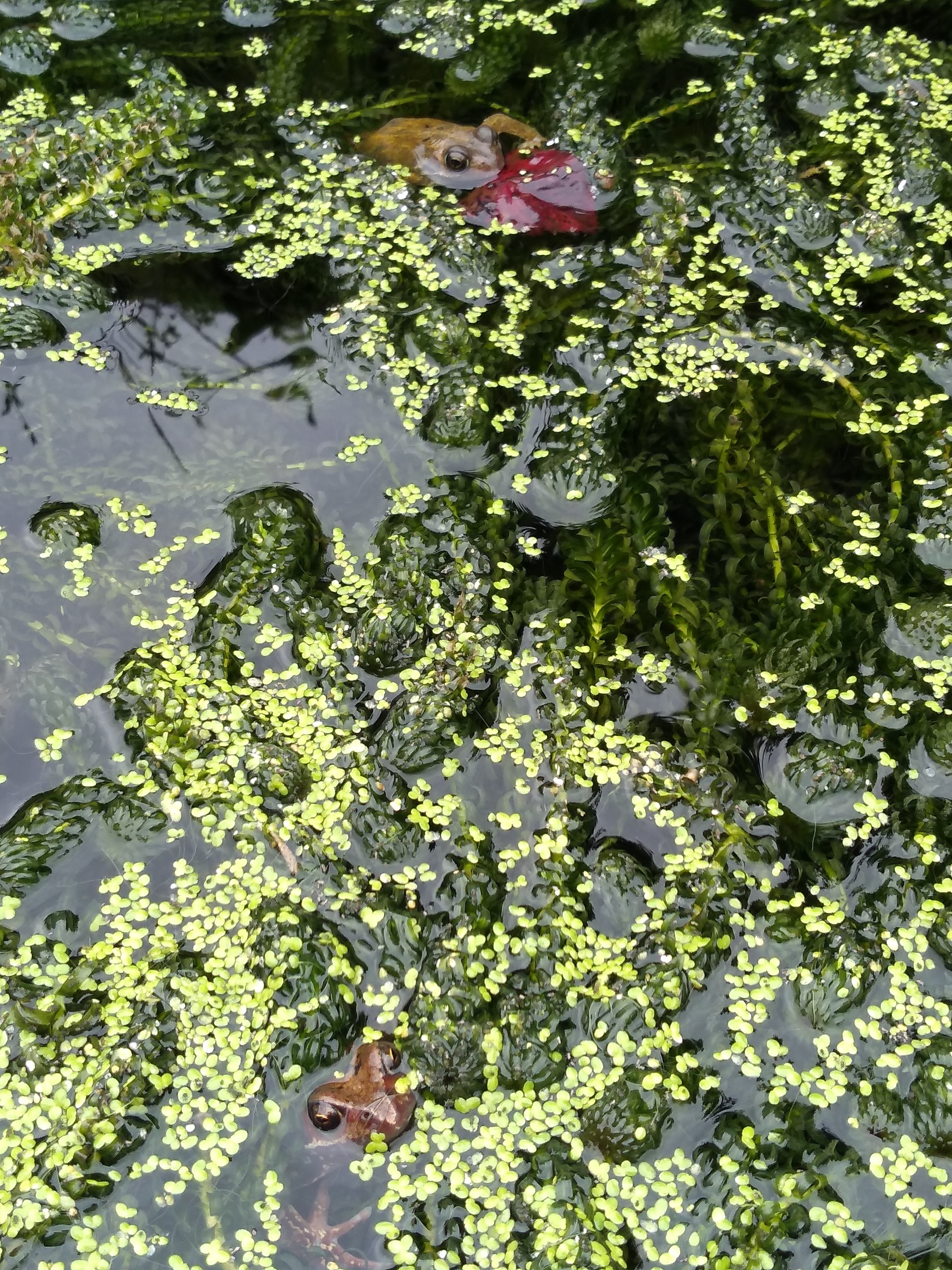
My week started and ended working next to ponds. The first was a small natural pond with a couple of frogs (Rana temporaria) sitting in it.

The other was a large disused outdoor swimming pool. In its neglected state rainwater collects within the concrete walls and nature is taking over. Given the murkiness of the water I was unable to obtain decent photos of my findings; however I saw another frog, (surrounded by lots and lots of tadpoles) along with a dragonfly nymph and a newt. It should be interesting to discover how many tadpoles survive to adulthood.

For the rest of the week insects were centre stage, especially on Wednesday when flying ants took to the sky. Flying ant season really tests my resolve to work through my dislike of ants (which originated in childhood). Thankfully I now find them more fascinating than loathsome, mostly.

The other insects I saw that day were;
– A (Chrysotoxum cautum) hoverfly on some Pyracantha.

– Honey bees (Apis mellifera) and a Red-tailed bumblebee (Bombus lapidarius) visiting a Geranium ‘Rozanne’ plant.

– Lavender (Lavandula) full of bees and butterflies, including more Honey bees as well as Buff-tailed bumblebees (Bombus terrestris), Meadow browns (Maniola jurtina) and a Ringlet (Aphantopus hyperantus) butterfly.

The Meadow brown butterflies also enjoyed visiting the Echinops bannaticus flowers too.

Even as I returned home I noticed a Willow Beauty (Peribatodes rhomboidaria) moth on the hall window.

The adults feed on Creeping thistle (Cirsium arvense) and Ragwort (Senecio jacobaea) both of these plants are common around this area. The caterpillars feed on various trees, shrubs as well as climbers ranging from Yew (Taxus baccata), Birch (Betula), ivy (Hedera helix), honeysuckle (Lonicera) and the wild Clematis, Traveller’s joy (Clematis vitalba).

The previous day I came across more insects that I was previously unaware of.

The first one was the Common red soldier beetle (Rhagonycha fulva).

It is a beneficial insect as adults eat aphids and are pollinators (feeding on nectar and pollen from open flat flowers such daisies and hogweed) while the larvae feed on slugs and snails along with other ground dwelling invertebrates.

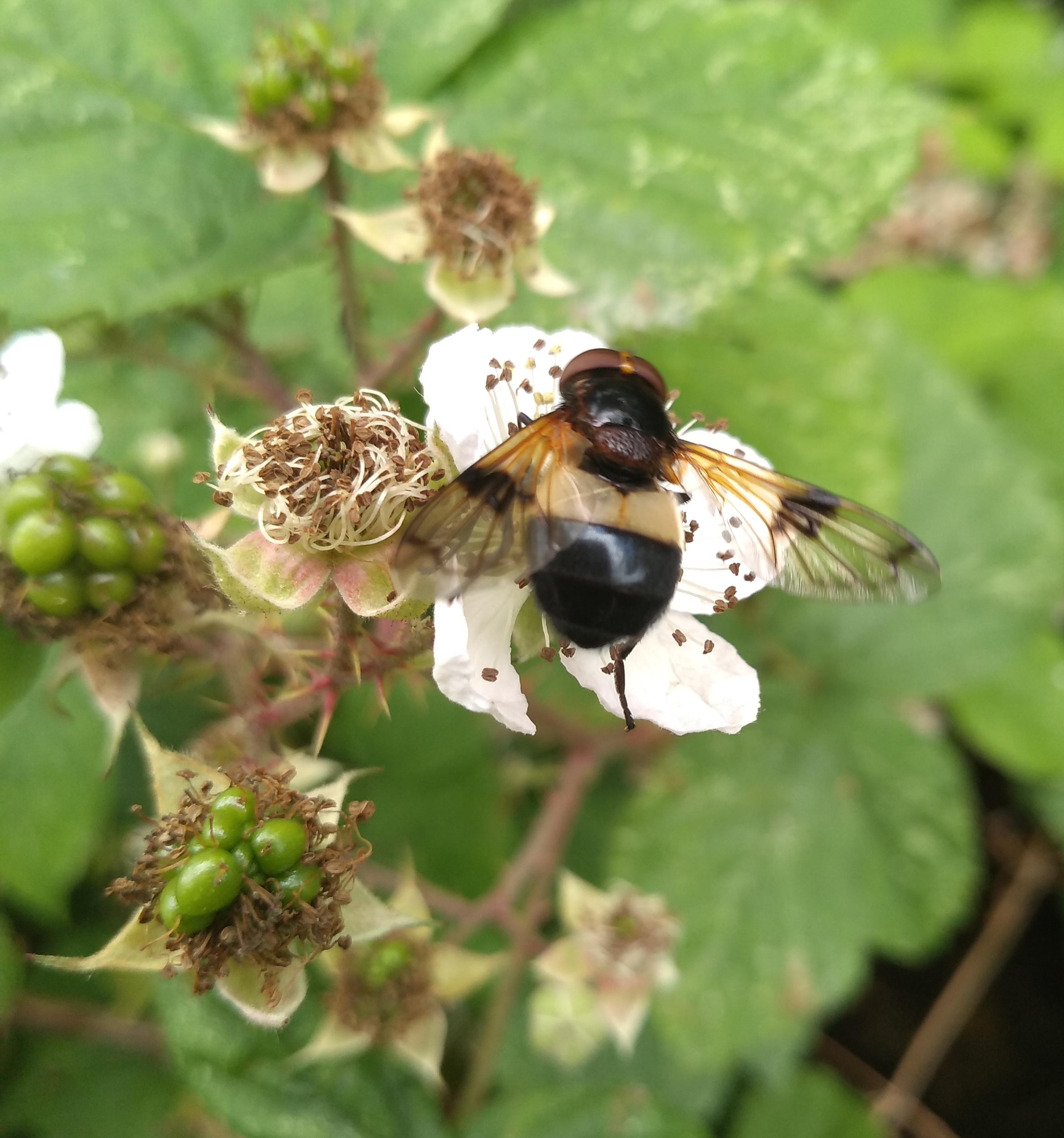
The other insect I saw on Tuesday was a female Volucella pellucens hoverfly feeding on nectar and pollen from Bramble (Rubus fruticosus).

These hoverflies also pollinate umbellifers; However as larvae they inhabit Bumblebee and wasp nests eating any waste produced along with their hosts larvae.

Posted in nature

Working with Insects can be Frustrating

More colour is showing up along the road as the purple of the Common mallow (Malva sylvestris) blooms amongst Common Poppies (Papaver rhoeas) and Ox-eye daisies (Leucanthemum vulgare); a lovely sight as I travel on the bus.

Another plant that is flowering on the verges and lawns now is White Clover (Trifolium repens).

I first saw it on Monday, at the bus stop, as I listened to a Goldfinch (Carduelis carduelis).

The Goldfinch can just be heard singing above the drone of the traffic.

A group of Goldfinches is a ‘Charm’ from the old English word c’irm, referring to their singing.

Last monday was the day for noticing Goldfinch as later in the morning I watched a couple of Goldfinch on a nest in a Buddleia (Buddleja davidii).

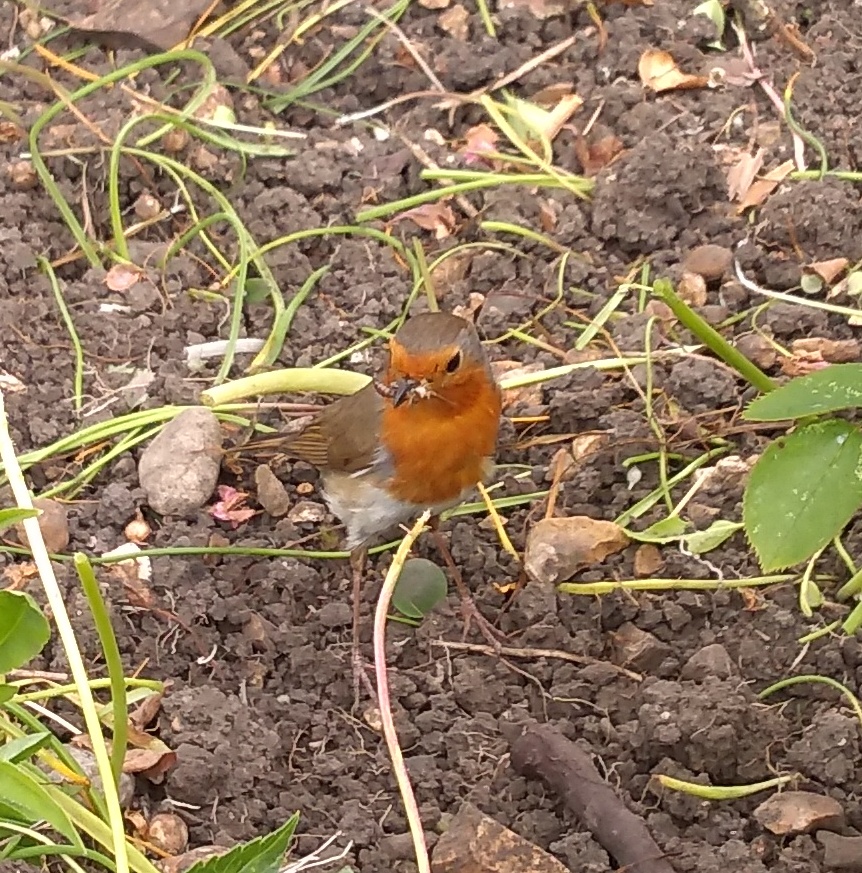
They weren’t the only birds I noticed that day. In the afternoon a Robin (Erithacus rubecula) kept me company as I weeded. It was quite fearless, frequently getting close to me to collect food as I worked.

I noticed some Scarlet Pimpernel (Anagallis arvensis) flowering too. Other common names for it include Poor man’s Barometer or Shepherd’s clock because the flowers open in sunny weather and close when it is dull.

As it was a a warm sunny day lots of bees were out. On the Catmint (Nepeta) there were Early Bumblebees (Bombus pratorum), White-tailed Bumblebees (Bombus lucorum), Tree Bumblebees (Bombus hypnorum) and Honey Bees (Apis mellifera).

A White-tailed bumblebee busy working.

As the week went on I continued to notice a greater variety of bees visiting the garden;

– Tree Bumblebees, Early Bumblebees, White-tailed Bumblebees as well as female Red tailed bumblebees (Bombus lapidarius) on a weigela.

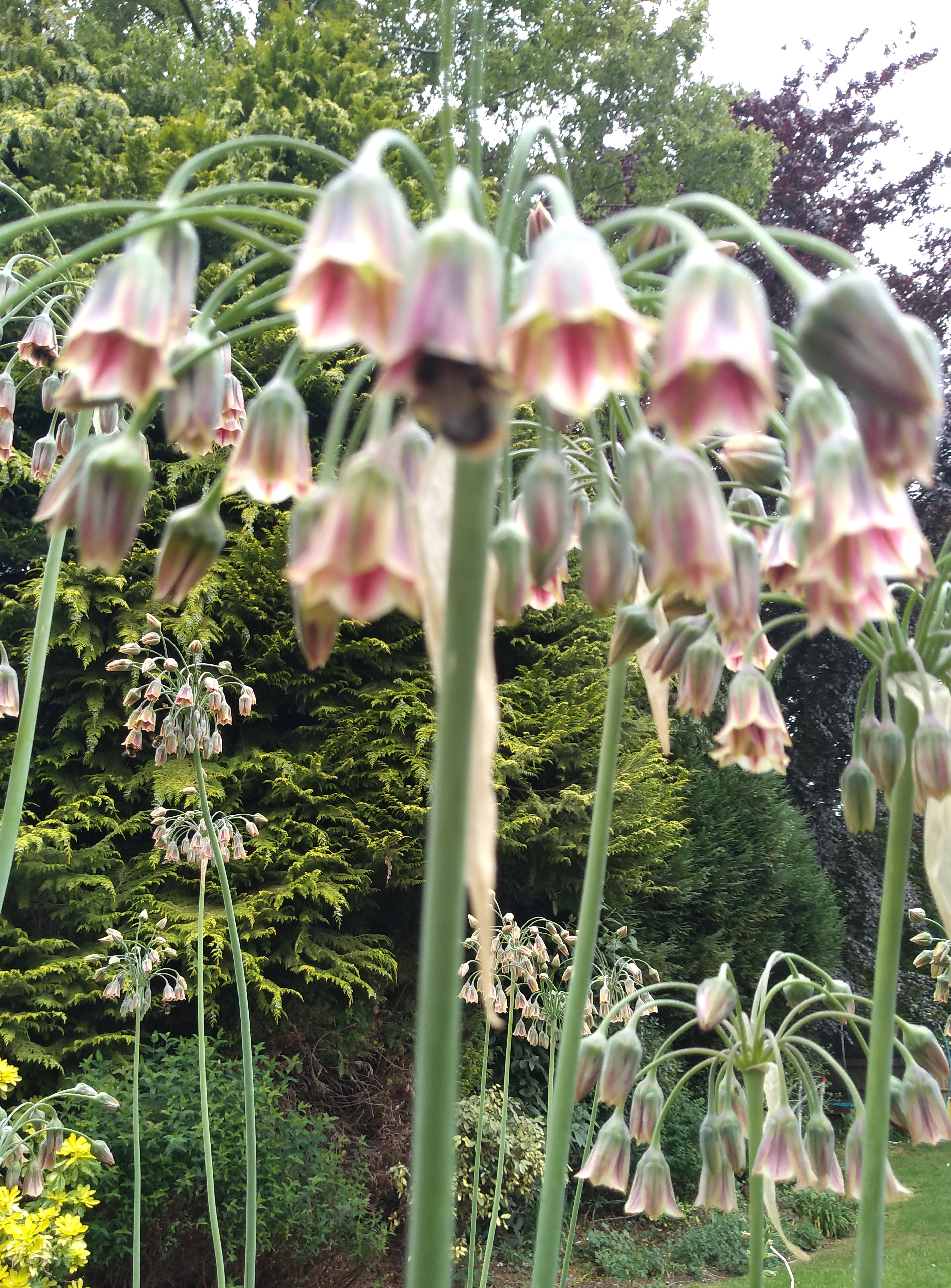
-Early Bumblebees and White-tailed Bumblebees on some Pale Garlic (Allium paniculatum).

This is the best photo I managed to obtain. The saying about not working with children or animals (or in this case insects) came to mind on Tuesday and Wednesday; descent photos were severely lacking midweek.

On Thursday, as I undertook more weeding, I unfortunately disturbed a beautiful White plume moth (Pterophorus pentadactyla) in the border. The caterpillars, which are green and yellow, feed on bindweed so this was a welcome sighting.

Posted in nature

World Bee Day 🐝🐝🐝🐝🐝🐝🐝🐝🐝🐝

Today is World Bee Day; a day that publicises the decline in bee numbers, the affect that has in the world as well as what we can do to reverse this problem ( BBC Newsround).

I was keeping a special lookout for bees today. Two species of bees that I noticed were;

-Red-tailed Bumblebees (Bombus lapidarius) on a group of Alliums.

– White-tailed Bumblebees (Bombus lucornum) on some Dusky Cranesbill (Geranium phaeum)

Posted in nature

Bee friendly plant

Along with male Orange-tip (Anthocharis cardamines) and Holly Blue (Celastrina argiolus) butterflies, I have now seen a Peacock butterfly (Aglais io) flitting around as I garden. Yet while butterflies have been camera shy I have managed to capture bees so far his week.

Comfrey has started to flower. It is a great plant for organic gardening; used as a compost activator or to make a liquid fertilizer containing nitrogen, phosphorus and potassium. Comfrey is also loved by bees, as proved by the following photos.

Photo 1; Red-tailed bumblebee (Bombus lapidarius) on Creeping Comfrey (Symphytum grandiflorum)

Photos 2 and 3; a Buff-tailed bumblebee
(Bombus terrestris) enjoying Common Comfrey (Symphytum orientale).

Posted in nature

🌞Sunny weather brings many sightings

Birdsong filled the air throughout the day. The calls I could identify were of Robins, Blackbirds and a Long-tailed tit. I also heard a Great Spotted Woodpecker (Dendrocopus major) drumming against a tree and a couple of Tawny owl (Strix aluco) calls in the morning. Once the sun broke through the cloud lots of insects started flying around too.

In the morning I noticed another Harlequin ladybird, this one was sheltering on a Cornus sanguinea ‘Midwinter Fire’. Unlike Seven spot ladybirds I only find Harlequins one at a time.

During the afternoon a female Red-tailed Bumblebee was enjoying the flowers blooming on a Berberis darwinii shrub. Pollen sacks can be seen as well as her proboscis as she collects pollen and nectar.

Lastly, I saw a Small White butterfly warming up on some ivy.

Posted in nature

Natural therapy

Nature enables me to be mindful, focus my attention on the present moment and help combat my anxiety. I am lucky that I work outdoors (no, I don’t mind the rain and cold weather) it enables me to dose up on serotonin and vitamin D as well as get plenty of exercise. Also, I can observe nature as I work which is great therapy.
Last week was busy but I still managed to take time out of my schedule to focus on nature.
The week started joyfully with a Red-tailed bumblebee flying around me while I was working. It was a male drone, identified by its yellow markings, along with the black and red colouring. I love hearing bees buzzing, especially when it is amplified by a trumpet shaped flower or there is a chorus of them, it is so relaxing.
Then on Tuesday, while retrieving a ladder from the shed, I noticed an adult Robin trying to fly in through the shed door. Realising it probably had a nest in there I left the door ajar and walked away. After a few moments I was glad to see it fly into the shed and reappear with a fledged youngster. It was beautiful to witness this.
On my way to work, the next day, I came across a male Pheasant dining out with some sparrows and two squirrels. The pheasant and sparrows were eating some bread and birdseed (left on the lawn by one of my neighbours). The squirrels were attacking the bird feeders. I have heard the pheasant for a few weeks now but this was the first time I had seen him. The sparrows and squirrels were unfazed by him, obviously realising he was no threat. I love the colours of a male pheasant’s plumage. They are so rich and great inspiration for craftwork. I can just imagine knitting a jumper in those colours, now there’s a thought…
During Thursdays lunchtime I watched a Magpie washing its feathers in a puddle. It was splashing around for about 5 minutes, flew into the nearby conifer only to return to the same puddle for another long cleaning and preening session. Watching it made me smile.
The working week ended with a lovely lullaby. I fell asleep listening to the beautiful song of a male Blackbird. He started singing around 10:20pm. He hasn’t sung at that hour since; perhaps he was only visiting the Rowan tree outside. It is also possible that something disturbed his slumber and the lit streetlights confused his body clock. Whatever the reason for his singing at that time of night it was a lovely way to fall asleep.