Posted in nature

Every Day is a School Day

No doubt due to the recent weather, I have noticed more flowers blooming earlier than their traditional start time of June. One example is the Common nipplewort (Lapsana communis).

The Common nipplewort is part of the sunflower family.

Other plants flowering at the moment are Greater celandine (Chelidonium majus),

This isn’t a relative of the Lesser celandine (Ficaria verna) despite its name. It is part of the poppy rather than buttercup family.

– Three-cornered garlic (Allium triquetrum),

Ants spread the seeds of this wild flower.

– Red campion (Silene dioica),

A dioecious plant, male flowers bloom on separate plants to the female flowers.

– White campion (Silene latifolia),

White campion is pollinated by moths because it is night scented

– Cleavers (Galium aparine),

The flowers of Cleavers are tiny. This photograph has been enlarged so they can be seen more clearly.

– Common honeysuckle (Lonicera periclymenum),

I noticed the sweet scent first. This plant is beneficial for a variety of butterflies, like the White admiral (Limenitis camilla), bumblebees and moths. Birds such as Thrushes (Turdidae), Warblers (Sylvidae) and Bullfinches (Pyrrhula pyrrhula) also eat its berries. Plus Dormice (Muscardinus avellanarius) inhabit and feed on this plant.

– A sow thistle (Sonchus),

– A Hawkweed (Hieracium),

– Mouse-ear Hawkweed (Hieracium pilosella)

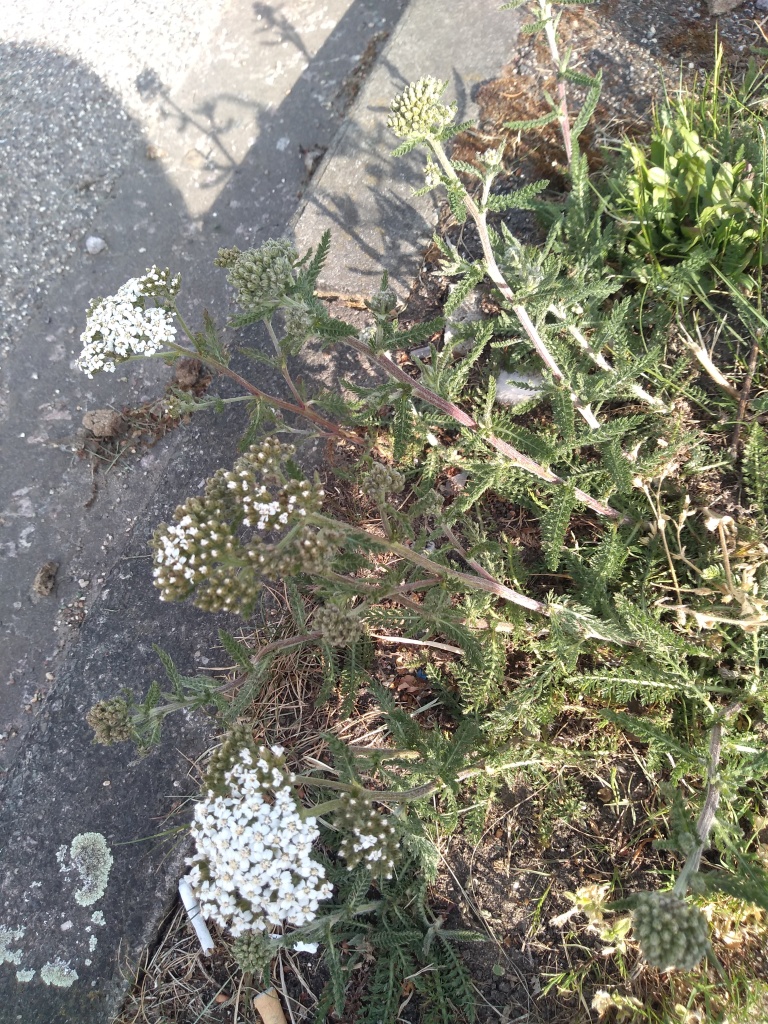
– and Yarrow (Achillea millefolium).
A plant that was new to me was Common knapweed (Centaurea nigra).

Along with all the wild flowers I noticed last week, the warm weather continued to encourage lots of insects out. There were more Holly blue (Celastrina argiolus) and Orange-tip (Anthocharis cardamines) butterflies along with bumblebees.

I also saw a Cinnabar moth (Tyria jacobaeae) at the allotment, amongst the long grass.

This moth flies flies during the day as well as at night time.

The most interesting insect I observed last week was a Pine ladybird (Exochomus qadripustulatus).

I have never seen this species of ladybird before. It dropped onto my sunglasses as I worked. Due to its small size (3mm in length), to begin with I thought it was a bit of dirt. As the name suggests, this beetle inhabits Pine (Pinus) trees. However they can also be found around other trees and shrubs especially Hawthorn (Crataegus monogyna).

Posted in nature

A Magical Week

I have begun to notice a chill in the mornings as the nights grow colder. I love the promise of Autumn. It doesn’t quite feel autumnal yet (especially as the weather has warmed up again this weekend) but some changes are occurring. Conkers and beech masts have started dropping and fungi are appearing in some lawns. A couple of times I have come across fairy rings; in both instances the Marasmius oreades fungi was the cause (sadly no magical elvish, fairy or pixie dancing).

The week continued with more observations of Painted lady (Vanessa cardui) butterflies. On Monday there were two visiting a Buddleja bush along with a Small tortoiseshell (Aglais urticae) and a Large white (Pieris brassicae).
Then on Friday, in different gardens, more were flitting about. On one occasion, during the morning, I saw a Painted lady on a Ceratostigma willmottianum.

In the second half of the week I noticed more butterflies including a Green-veined white (Pieris napi) on Verbena bonariensis

and a Small tortoiseshell visiting an Erysimum ‘Bowles’s Mauve’.

Throughout last week I saw lots of pollinators busily collecting nectar and pollen.
On Monday I noticed lots of small flies and Buff-tailed bumblebees (Bombus terrestris) pollinating Marigold (Tagetes) flowers. Perhaps they are enticed by their overwhelming aroma which even I found hard to ignore.

Then on Wednesday there was a Common carder (Bombus pascuorum) bee flying between Nandina domesticas and several Agapanthus africanus.

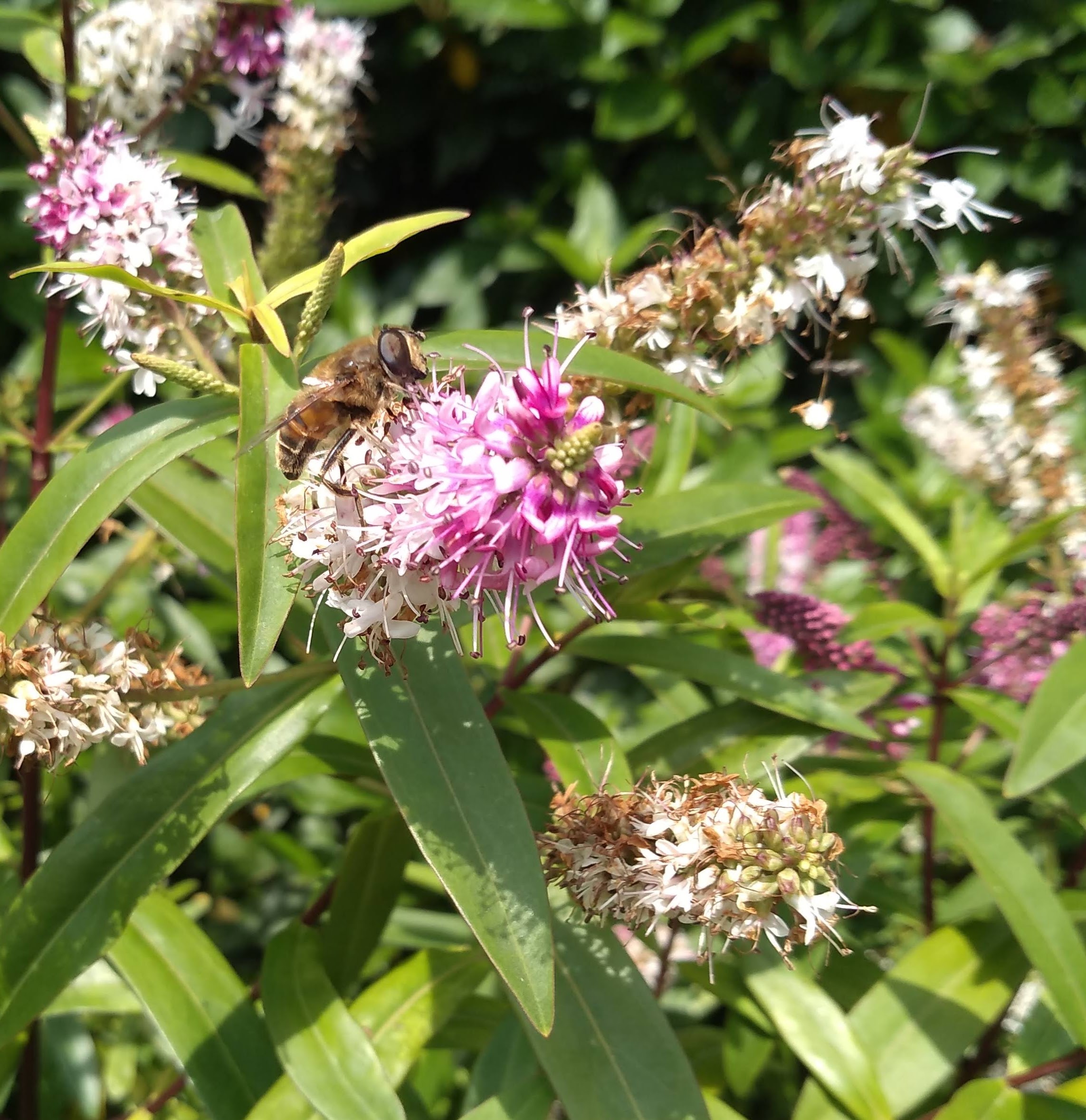
On Friday while working near some Hebe ‘Great Orme’ there were lots of honey bees (Apis mellifera) as well as a Hornet mimic hoverfly (Volucella zonaria).

Another interesting thing I noticed last week was a Red campion (Silene dioica) plant growing on an old moss covered log.

With no soil surrounding its roots clearly it was receiving sufficient moisture and nutrients from this unusual source. It has been flowering healthily all summer but I hadn’t realised it had been relying on the log for its growth until then. I found this plants ability for survival amazing and will closely watch its development.

Lastly I have been aware of how wonderful hardy Fuchsias (Fuchsia magellanica) are currently looking. Although I don’t see pollinators visiting the flowers, there have been a couple of times, in the past, when I have seen Elephant Hawk-moth (Deilephila elpenor) caterpillars feeding on Fushia plants. (See Elephant Hawk-moth).

These caterpillars also eat Himalayan balsam (Impatiens glandulifera) and Willowherbs including Enchanter’s nightshade (Circaea lutetiana) and Rosebay willowherb (Epilobium angustifolium). This beautiful pink and olive green moth flies at night and therefore feeds on Honeysuckle (Lonicera).

Across the way from this hardy Fushia there was a Honeysuckle growing along the wall so it would have been a fantastic place for these moths to inhabit. Unfortunately I didn’t come across any Elephant Hawk-moths this year but hopefully I will in years to come (and I am sure it will feel magical).

Posted in nature

The Very Hungry Caterpillar

The weather at the beginning of last week started nicely. Early on a sunny Monday morning I spotted seven Large white (Pieris brassicae) butterfly caterpillars on a Nasturtium (Tropaeolum) plant.
Used as a companion plant near brassicas this plant has been sacrificed to prevent the butterfly eggs being laid on the cabbages.

Unknown to me at the time, I also photographed some caterpillar faeces as well as an undeveloped egg on the leaf. I don’t remember the loved childhood picture book, The Very Hungry Caterpillar mention poo (although I’m sure children would have loved that addition to the story).

As with elsewhere in the country, the weather continued to be unsettled throughout the week. Tuesday was mostly overcast but the bees were still out foraging. As the lavender (Lavandula) was over lots of Honeybees (Apis mellifera) started visiting the Echinops bannaticus.

Later the same day I managed to see another Male Gatekeeper (Pyronia tithonus) butterfly too, this time visiting a Geranium.

Plus on Thursday I noticed a Holly blue (Celastrina argiolus) butterfly on some Verbena bonariensis. I haven’t seen Holly blue butterflies since spring, so that was nice.

Unfortunately on Wednesday I managed to disturb a Silver Y (Autographa gamma) moth.

Although this isn’t a great photo, it is clear enough to be able to identify the moth. I managed to identify it because of the shape and light colouring along with the unbroken y shaped silver marking on each forewing. This moth is a migrant, visiting from the continent. It can be seen here with the wings vibrating to warm up it’s flight muscles before flying off.

The week ended with a visit to the Royal Botanical Gardens, Kew on Saturday. There were some insects braving the stronger winds and the afternoon rain.

Amongst the Wildflower meadow surrounding The Hive experience the flowers still blooming were; Red Campion (Silene dioica), Red clover (Trifolium pratense), Ragwort (Senecio jacobaea), Yellow toadflax (Linaria vulgaris), Creeping buttercup (Ranunculus repens), Yarrow (Achillea millefolium), Flatweed (Hypochaeris radicata) and Wild marjoram (Origanum vulgare).

Yarrow and Yellow toadflax along the path.

A Volucella inanis Hoverfly visiting the Wild marjoram.

In the Agius Evolution Garden there were lots of bees visiting the Salvias as well as a Buff-tailed bumblebee (Bombus terrestris) on a hollyhock (Alcea)

and a Honey bee (Apis mellifera) visiting a Wallflower (Erysimum).