Since my last post, Amazing Insects. I took part in the Butterfly Count; my results, from an allotment full of herbs, Verbena boriensis, Lavender and Buddleia were;
The overall results for 2025 have just been published. While the year seemed particularly good for butterflies and moths, especially after 2024, when compared to the last decade, it has been an average year.
August disappeared quickly and September is zooming by, even the Autumn equinox has been and gone. Apart from the heatwave a few weeks ago (with the highest temperatures of the year being reached) it is beginning to feel autumnal. Fungi has appeared, leaves have started turning, plus nights are drawing in and cooler misty mornings have returned highlighting once hidden spiders and their cobwebs.
Foraging blackberries had begun early this year but the extreme heat meant that the remaining flowers and berries dried up; the same is true of elderberries, although sloes, haws, rosehips and rowan berries are abundant. Unlike last year, apple and pear trees, that I see regularly, have struggled with the weather this year as well. Thankfully harvesting on the allotment is still going strong; potatoes, kale, beetroot, radishes, chillies, courgettes and rhubarb have been keeping us fed. The popping corn will soon be ready too. I have also been harvesting calendula, lavender and other herbs recently.
There has been a few changes on my plot. I had finally collected enough items to be able to construct ‘the bug snug’.
It is an addition to the wildlife section containing wildflowers and long grass (which also links to a pond on the adjoining plot). I know we have a couple of frogs visiting us so hopefully it encourages more to inhabit our allotment (to help keep slug and snail population down). I still hear the grasshopper when we are nearby too. There has also been evidence of a fox visitor; random toys get left near the water I leave out, along with poo on the grassy paths between plots.
Last week I also noticed that the Bee house, at the opposite end of the plot, was finally being used.
I found it hard to contain my excitement as it has been there for a few years and I was beginning to think it would never be used. There is evidence that it has been used by a Leaf-cutter bee and Mason bees too. Although it is difficult to know which ones specifically, the most commonly found in gardens are the Patchwork leaf-cutter bees (Megachile centuncularis) and Red mason bees (Osmia bicornis). As the name suggests Leaf-cutter bees used leaf particles to plug one piece of bamboo while those used by the Mason bees were plugged with soil. Each cell contains larvae as well as some pollen and nectar for the developing young. Male bees fly out before the females as they are near the entrance. The developing bees will remain there over winter and emerge as adults next spring, at the around April.
In other news… While clearing a gravel footpath of wildflowers at work, I accidentally disturbed a Devil’s coach-horse beetle (Staphylinus olens). I stopped weeding that section to enable it to hide for the rest of the day.
Devil’s coach-horse beetle
These beetles can raise their abdomens (resembling a scorpion), release an odour and even bite when they need to defend themselves (thankfully it didn’t feel threatened by my presence). They grow up to 2cms 8mm in length and are commonly found in gardens from April till October (when accidentally disturbed as they are active at night). The young overwinter in the soil as pupae until the following spring when they emerge as adults. The adults can fly but usually quickly run away from danger or to catch prey eating larvae, insects, spiders and slugs.
The Big butterfly count results came out this month. The long term trend of many species of butterfly and daytime flying moths recorded continue to fall, although the numbers were the highest since 2022 (with an average of 12 butterflies being spotted compared to 9 back then). The most commonly recorded were Red admiral (Vanessa atalanta), Gatekeeper (Pyronia tithonus), Small and Large whites (Pieris rapae and Pieris brassicae) as well as Holly blue (Celastrina argiolus). While those which are in significant decline are Ringlet (Aphantopus hyperantus), Common blue (Polyommatus icarus) and Speckled wood (Pararge aegeria). Over the last few days I have seen several Red admirals and even one Speckled wood making the most of the Autumn sun.
Upon visiting the Chiltern Open Air museum on the last bank holiday weekend, we walked through the meadow and woodland that is there. In the woodland, a couple of Silver-washed fritillary (Argynnis paphia) butterflies fluttered in amongst the brambles (the flowers of which give nectar for these fritillaries along with thistle blooms.
Silver-washed Fritillary
There were lots of Dog violets (Viola riviniana) on the woodland floor too, which is the food source for their caterpillars. The wingspan of this butterfly is between 7.2cms and 7cms 6mm. They are found in most areas of the UK (apart from Scotland) and often in oak woodland.
The meadow was full of wildflowers, but it was particularly lovely to see Harebell (Campanula rotundifolia) and Wild basil (Clinopodium vulgare) amongst them.
Harebell
The delicate looking Harebells bloom from late summer into autumn. They can be used as an indicator of dry nutrient poor chalky limestone soil which they require to thrive. Along with dry undisturbed grassland and heathland Harebells will flower in walls, cliffs and even on sand dunes.
Wild basil
Wild basil is a mound forming perennial which also likes the same soil conditions as the Harebell. This wildflower can be seen blooming in July, August and September.
It was lovely to see Tansy (Tanacetum vulgare) growing in the wild too; found in a few areas including near the iron age roundhouse located on the museum grounds.
Tansy
It starts flowering in July through to October. While used as an insect repellent to keep ants and flies away, some insects, especially the Tansy beetle (Chrysolina graminis) are resistant to the toxins produced by the plant. Tansy beetles are endangered in the UK; only found in two places in York along the River Ouse and in Cambridgeshire at the Woodwalton Fen nature reserve. We are at risk of losing this once common beetle due to habitat loss (wetlands), where their entire lifecycle occurs, and loss of suitable food source (mainly Tansy); however in the Fens its been seen eating Water mint (Mentha aquatica) and Gypsywort (Lycopus europaeus) too. It’s conservation status is known to be Nationally Scarce and is a UK BAP priority species that is Protected in the UK under the Wildlife and Countryside Act, 1981. More can be found on this beautiful beetle on the Buglife website (see web pages below), including how to help with its conservation.
I can’t believe March has arrived already. Blackthorn (Prunus spinosa), Sweet violet (Viola odorata) and Daffodils are in full bloom.
It wasn’t so long ago that we had the stormy weather and Snowdrops were at their best; the year seems to be advancing in leaps and bounds now.
The temperature last Thursday reached 16°C which encouraged butterflies to flutter about. I noticed several Brimstones (Gonepteryx rhamni) as well as the Red admiral (Vanessa atalanta) below.
A Red admiral feeding from a Daphne, a delight for the senses, both visual and aroma.
Along with these beautiful sightings, there were a couple of amazing nature experiences that particularly stood out over the past few weeks.
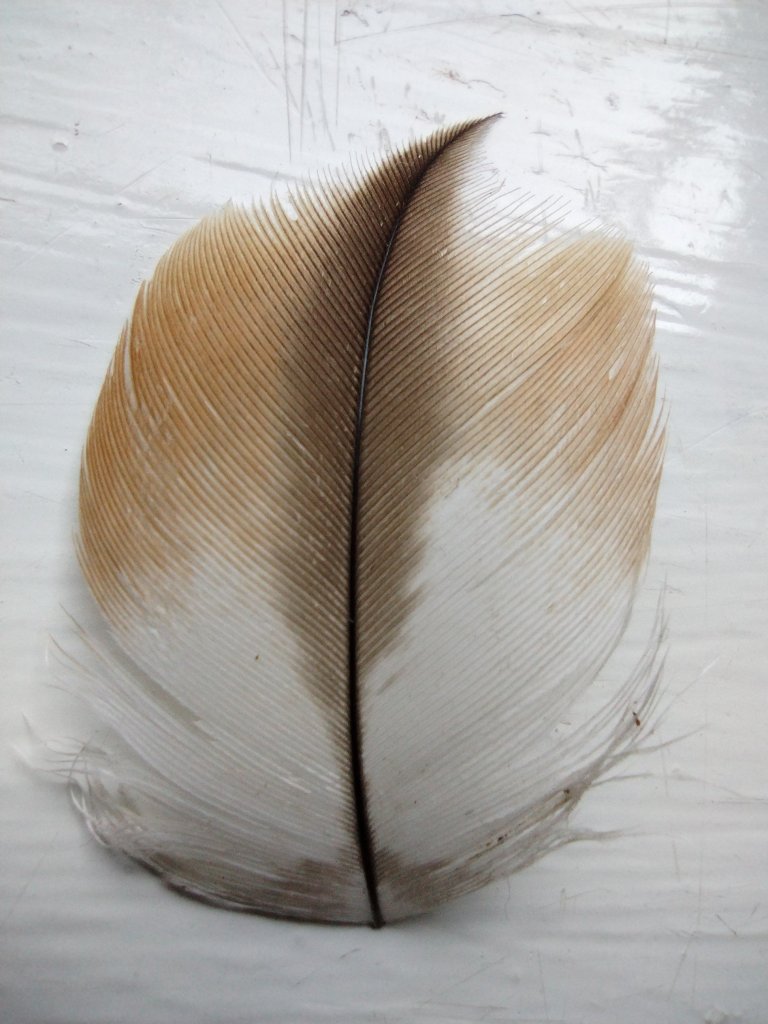
The first was due to the recent storms. While clearing up tree debris a few days later, I found a Red kite (Milvus milvus) feather which had blown to the ground. I have since added it to my version of a nature table (a vintage printing tray) along with my other treasure finds.
I love the shape, colour and pattern of this Red kite feather.
The second took place last Wednesday. While carefully tidying up another garden, to allow for the new spring growth which is already appearing, I noticed a young male Blackbird (Turdus merula) following and closely foraging next to me, just like Robins (Erithacus rubecula) often do in gardens. At one point, it appeared to watch me as I worked (seemingly unphased as I kept my movements to a minimum, so as to not alarm him). Eventually it moved further away but started to make a low repetitive ‘pok pok’ call, at both me and my colleague who was a short distance away (presumably thinking we were predators). This interactive experience was particularly moving; I am used to Robins being close by and making themselves known but never a Blackbird before. The call I heard the blackbird make can be heard on the Sussex Wildlife Trust website.
As another month rolls on, an initial glance may suggest that nothing is changing. Bare trees and quiet gardens with cold weather still nipping at fingertips and noses still persist, while sunny days bring glorious colourful skies.
A stripey sunset.
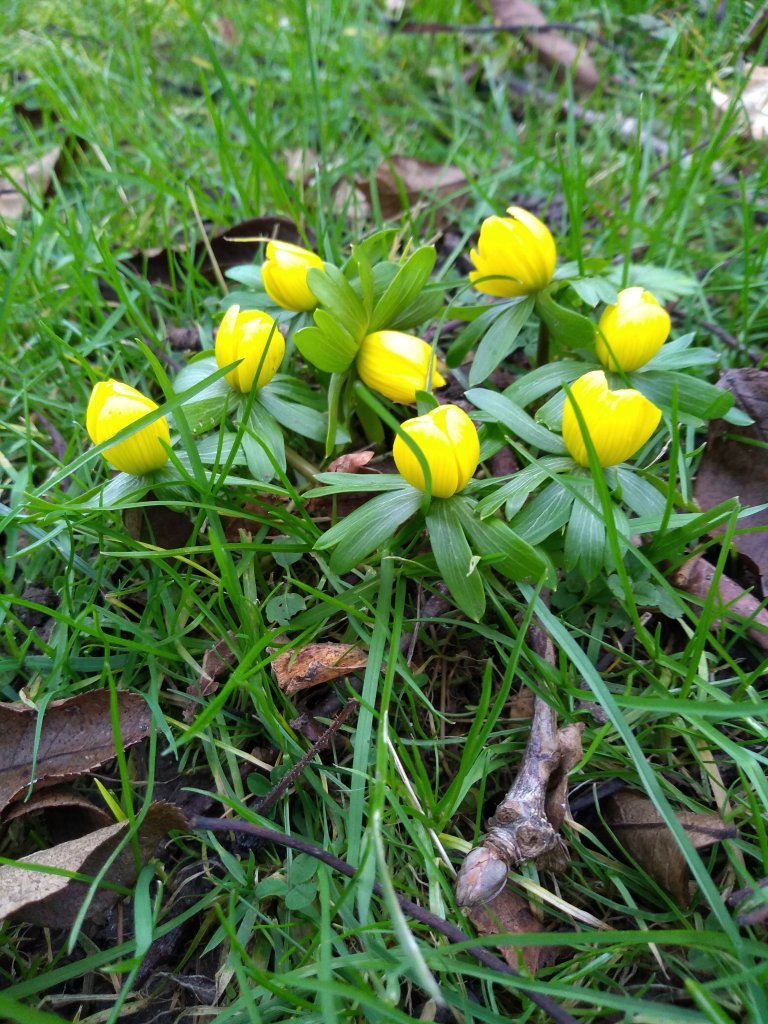
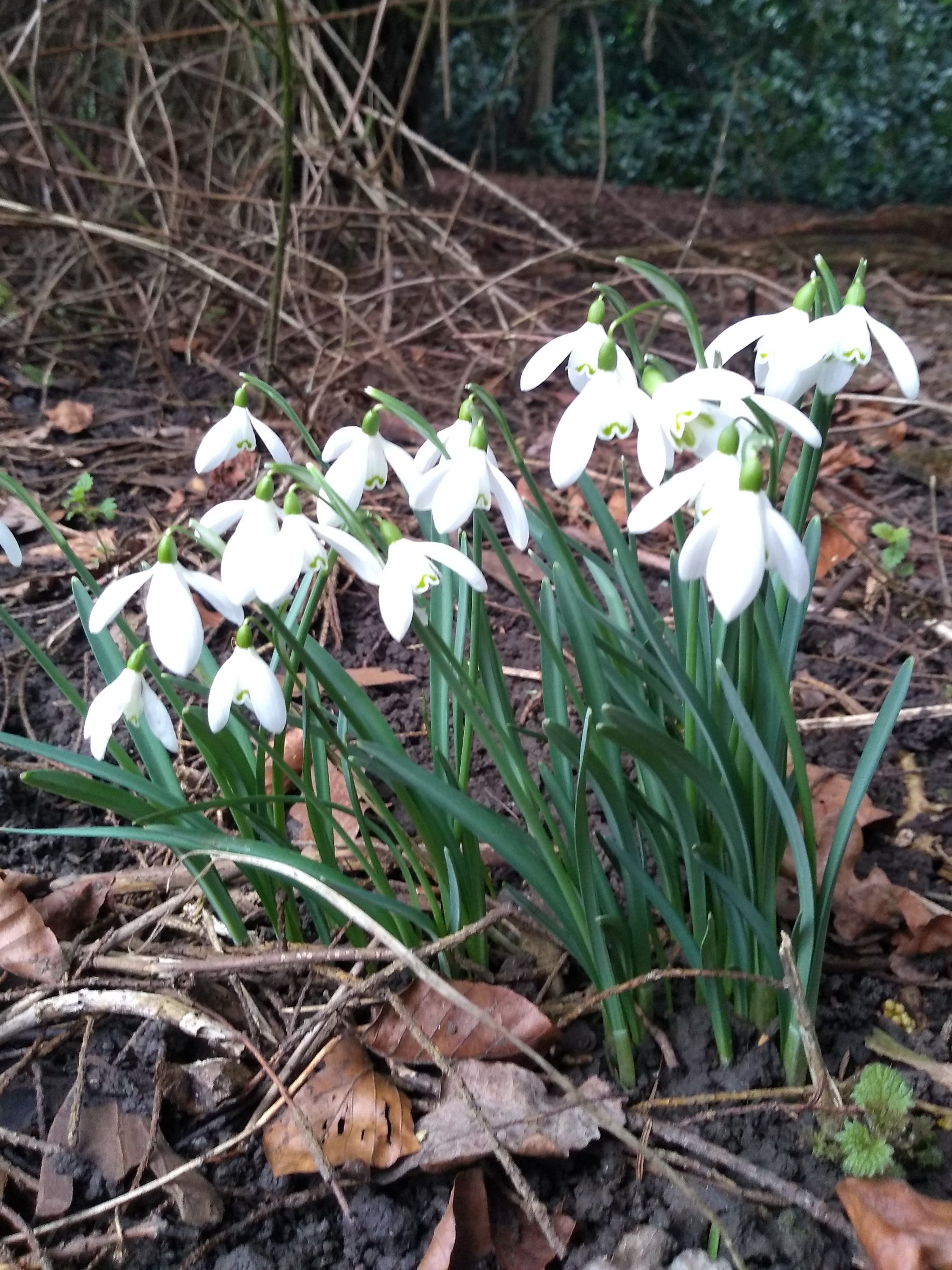
However, upon closer inspection small changes can be seen. The striking yellow of Winter aconites (Eranthis hyemalis) as well as delicate Early crocuses (Crocus tommasinianus) are beginning to bloom alongside the snowdrops (Galanthus).
The tiny red female flowers of Hazels (Corylus) have opened joining the male catkins. Plus, Blackthorn (Prunus spinosa) buds are ready to burst open (in fact on one walk, I saw a single flower already blooming).
I even witnessed a Red admiral (Vanessa atalanta) visit a flowering Mahonia on one sunny day; clearly making use of the milder weather before sheltering once again.
However the main focus of my attention, over the past few weeks, have been birds.
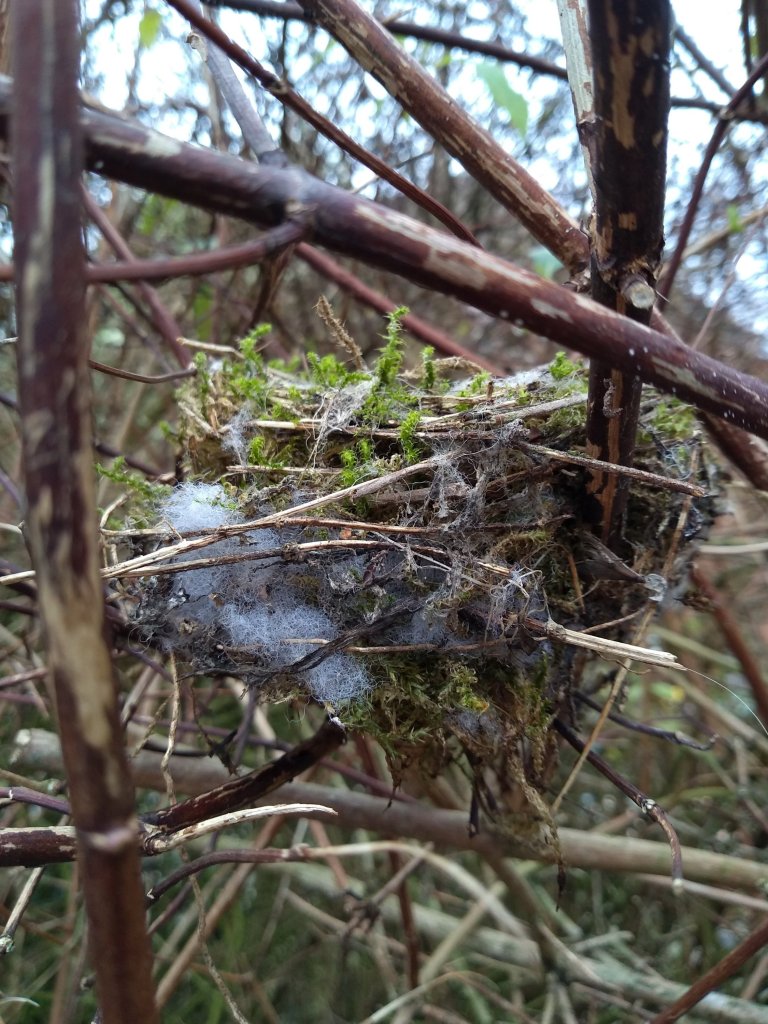
In one garden, I discovered a lovely little nest, from the previous year, in a shrub. Upon investigation I discovered it was either a Goldfinch (Carduelis carduelis) or Greenfinch (Chloris chloris) nest (most likely the former); it can be seen below.
I also saw a Lesser spotted woodpecker (Dendrocopos minor) perched on a tall tree in the distance. I was able to follow the sound of the drumming to watch it move around the trunk before flying off. Given the length of drumming and location of the red on it’s crown I was able to identify it as a male Lesser spotted woodpecker.
Then later in the week, while pruning roses, I watched a Wren (Troglodytes troglodytes) forage around the base of a hedge; I managed to film it briefly before it disappeared fully into the undergrowth.
I am currently reading ‘The Wren: A biography’ by Stephen Moss.
This charity shop find is a fascinating read. Chapters are set out month by month, each concentating on an aspect of a Wrens life. Included alongside facts about the Wren, are their involvement in human history, culture, literature, art and folklore together with beautiful illustrations. The chapter entitled February, for example, focuses on courtship and population. As with other books written by this author, such as ‘The Robin’, this book is definitely worth emmersing yourself in.
Lastly, once again I partook in the Big Garden Birdwatch. My results this year were- 7 Starlings (Sturnus vulgaris), 4 Magpies (Pica pica), 2 Bluetits (Cyanistes caeruleus), 2 Blackbirds (Turdus merula)- a male and female, 2 Wood pigeons (Columba palumbus), 1 Dunnock (Prunella modularis) as well as a Carrion crow (Corvus corone).
Although there weren’t any major surprises in what I saw, it was lovely that the Dunnock made an appearance (usually I only get to hear them). However the Red Kite (Milvus milvus), Ring-necked parakeets (Psittacula krameri), Great tit (Parus major) and Robin (Erithacus rubecula), that I regularly observe, all decided to have a lie in the previous weekend, most only making an appearance once my chosen hour had ended.





 Bee in the Moment