Posted in nature

Daffodils in Snow

Daffodils (Narcissus) began to bloom at the beginning of March, in time for St David’s day, together with Hellebores.  Since then wildflowers including Red dead nettle (Lamium purpureum), Speedwell (Veronica), Celandine (Ficaria verna), Dandelions (Taraxacum), Primroses, Cowslips (Primula veris), Daisies (Bellis perennis), Dog violets (Viola riviniana) and Winter aconites (Eranthis hyemalis) have joined them. It’s lovely to see all the colour developing, taking over from the Snowdrops (Galanthus nivalis) and early flowering Crocuses that have started to whither. I have even noticed Bluebell (Hyacinthoides non-scripta) leaves showing now too, it wont be long before they flower.

Blackthorn (Prunus spinosa), the first trees of the year to bloom are putting on a show, their blossom resembling white clouds lining the roads. Willow (Salix) aren’t far behind, their buds ready to burst open. Even Magnolias, Camelias and Forsythia (in gardens) are beginning to flower as well. The male catkins on Poplar trees are noticeable now too.

Red male Poplar catkins on a twig fallen in the strong winds.

I have also witnessed the first queen Buff-tailed (Bombus terrestris) bumblebees venturing out on the few warmer sunnier days that we have had. Seeking energy sources as the venture out from hibernation. I also noticed a Brimstone (Gonepteryx rhamni) butterfly flutter passed me last week while the previous Friday a Peacock (Aglais io) butterfly flew passed as I worked. It was also lovely to see lots of Smooth newt (Lissotriton vulgaris) in a garden pond last Wednesday. The newts were almost full sized and looked fully developed already.

Although 20th of March was the Spring equinox we experienced a cold northerly blast of weather a few weeks ago. The wintery showers that arrived brought snow. During this transitional time, March weather can be very mixed. Although spring has sprung, winters grasp still holds on; It was strange to see Daffodils poking above snow for a day.

During a few of the snowy days, I witnessed a wonderful sight of a female Sparrowhawk (Accipiter nisus) perched on top of a tree and later in flight as it swooped towards a smaller bird in a more wooded area of town. Presumably the weather had forced it out into the open to search for food. It’s size, together with its dark brown head back, tail and wings together with a pale breast made it clear to identify. Males are a bluey grey colouring with pale breasts and orange highlights. Males are about 25% smaller than the females, the size of a Collared dove (Streptopelia decaocto).

These birds are protected under the Wildlife and Countryside Act 1981 because they are Amber Under the Red List, Birds of Conservation Concern 5: (2021).

Often found in woodlands or open ground nearby, as well as gardens in urban settings, Sparrowhawks are the most commonly seen bird of prey in the UK. They can be seen throughout the year eating smaller birds, rodents and also rabbits when their regular food is scarce. In fact many years ago I witnessed a male Sparrowhawk take down a city pigeon (Columba livia). Although similar in size, and although the feral pigeon was doing its best to escape the Sparrowhawks clutches it didn’t win the fight.

Sparrowhawk breeding will occur between May and the end of July, laying 4-5 eggs.

Although mostly silent, these birds do have a call which can be heard on the RSPB website here.

Posted in nature

Bees in Winter

Honey bees (Apis mellifera) overwinter in hives, huddling round the queen to keep warm, occasionally venturing out on warmer days. Bumblebees (Bombus) on the other hand have an annual lifespan with new queens, having mated during the summer and autumn months, hibernating underground until spring when they can begin a new colony; also sometimes waking up too early on warm days and foraging.

However over the past 10 years, in urban areas of Southern England, a trend has been seen with certain bumblebee species.
Initially Buff-tailed bumblebees (Bombus terrestris), but since then Early bumblebees (Bombus pratorum) and Tree bumblebees (Bombus hypnorum) have begun to nest in winter rather than hibernate. Consequently winter flowering plants such as Mahonia and Winter Heathers (Erica), Winter honeysuckle (Lonicera fragrantissima), Winter aconite (Eranthis hyemalis), Hellebores (Helleborus) and Snowdrops (Galanthus) are garden essentials; enabling these bees to access pollen and nectar during the colder months.

Solitary bees on the other hand will survive throughout winter in burrows or cavities as eggs, with their own supply of nectar and pollen close to hand (as the adults don’t survive winter). These include Mining and Mason bees which emerge early in spring taking advantage of Willow (Salix), Blackthorn (Prunus spinosa) and Hawthorn (Crataegus monogyna) in bloom. Leafcutter and Carder bees emerge later still. The one exception are Furrow bees; like Bumblebees, the female will hibernate during winter and lay eggs in spring.

I have noticed lots of Mahonias blooming over the last few weeks, their bright yellow flowers and perfume is wonderful to experience during dull days. Somehow the colour shines more vividly against grey skies.

Mahonia x media

Another shrub that has been blooming recently is Viburnum farreri, it’s lovely scent wafting through the air too.

Posted in nature

New House Build. 🐝

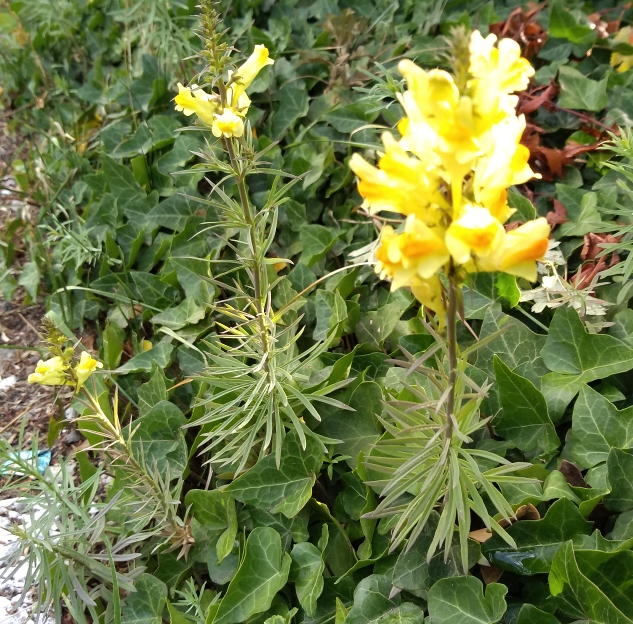
Some fields along my journey to and from work contain a lovely combination of pink Rosebay Willowherb (Chamaenerion angustifolium), purple Buddleia and white Wild carrot (Daucus carota) flowers. Not only do they compliment one another visually but they are all loved by pollinators too. Yellow toadflax (Linaria vulgaris) has started to bloom along the roadside as well.

One special moment occurred on the Monday. As I worked within a border I noticed a Buff-tailed bumblebee (Bombus terrestris) queen flying around a patch of grass. Eventually she began to settle and after a few more large sweeping flights began making a nest in the lawn.

It didn’t take her long to dig into the soil beneath the grass.

She will remain under ground until spring when she will start her own colony.

It was also great to finally get some photos of insects that have have alluded my photographic capture so far this year.

– The first is the Red admiral (Vanessa atalanta),

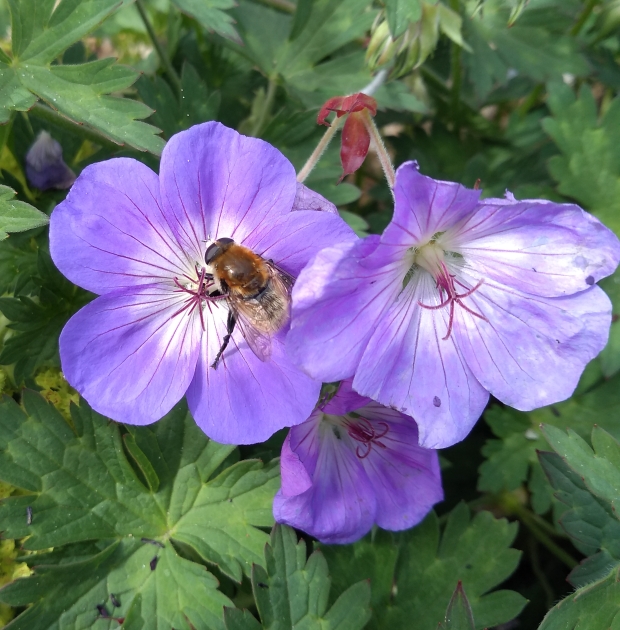
– Some Hoverflies, including a Hornet mimic (Volucella zonaria) hoverfly,

Hornet mimic Hoverfly pollinating Wisteria flowers that were still blooming.
Hoverfly pollinating Geranium flowers.

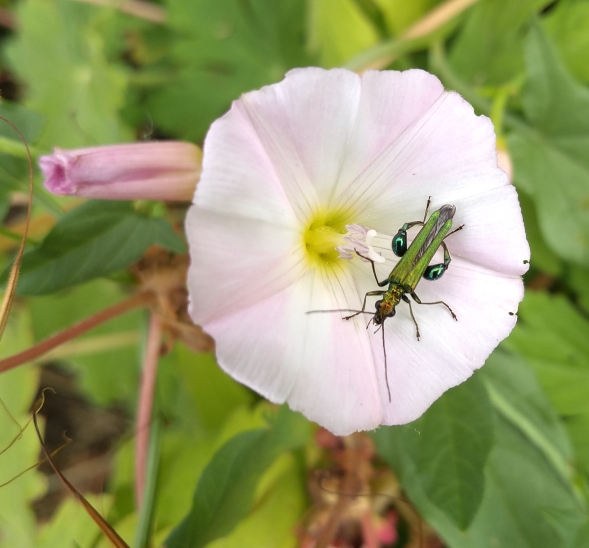
– as well as a Male False oil beetle (Oedemera nobilis), to compliment the female one seen on a walk earlier in the year.

A False oil beetle pollinating a Field bindweed (Convolvulus arvensis) flower.

The males are easily identified due to their large metallic thighs, explaining the reason behind the other common name for this insect the Swollen-thighed beetle.

Posted in nature

Crisp Autumn Mornings

The clear cold nights and frosty mornings have arrived. I don’t mind crisp starts to the day because eventually the sunshine appears.

As more trees become leafless I find other means of identifying them. I learnt two new trees last week; the first was a Strawberry tree (Arbutus unedo) and the second was an American sweetgum (Liquidambar styraciflua). In both instances the first things I noticed on each was their fruit.
The unripe fruit of the Strawberry tree can be seen below alongside the delicate flowers. The common name, Strawberry tree, comes from the ripe red fruit which look similar to strawberries. The fruit of this evergreen tree will be eaten by birds. It seemed strange to see the fruit, from the pollination of last year’s flowers, appearing at the same time as this years flowers.

The American sweetgum tree also gives interest to gardens at this time of year. The leaves turn a rich mixture of yellow through to orange and red and even purple in autumn.

The spiky looking fruit dangle from the branches at the same time as the leaves turn and fall.

I have started noticing more Robins (Erithacus rubecula) hanging around lately; always eager to gobble up insects and worms that I unwittingly uncover as I work.

Moments after taking this photo another Robin swooped down and a fight over winter territory began.

It is fascinating to observe Robins, who can be relatively social towards humans, eagerly defend their patch of garden against other Robins. It is quite a contrast to the other bird which became more noticeable last week; Ring-necked parakeets (Psittacula krameri) flock together. I saw groups of this social parrot flying overhead throughout the week. They have been breeding in the area for a long time and I often see them but not usually every day.

I still notice the occasional bee and on Wednesday I saw a Buff-tailed (Bombus terrestris) bumblebee (the buff coloured tail enabled me to Identify it as a queen). I observed her walking amongst leaf litter. She could have been a new queen, going into hibernation before starting a nest next spring, or an old queen who will soon die.

More fungi are appearing as autumn continues to take hold.

*Once again, please do not use this post as a guide to edible mushrooms. I have managed to identify some but have placed question marks next to those I am unsure of.*

Those I saw last week are;

-The Bitter oyster (Panellus stipticus) fungus

-Collared earthstar (Geastrum triplex) fungus.

-Grey Spotted Amanita
(Amanita excelsa var. spissa)?

-The prince (Agaricus augustus)?

This is the largest fungus I have seen this autumn; the diameter was almost as long as my size 5 boot. It also had a slightly sweet aroma.