Posted in Allotment, nature

Slugs and Snails

What a mixed bag of weather we’ve had in the UK recently. It seems strange experiencing the current dry, warm weather given the snow, frost and april showers we had during the previous weeks.

Deciduous trees are turning green, as leaves unfurl and wildflowers continue to bloom. Snake’s-head fritillary (Fritillaria meleagris), Speedwells (Veronica), White Dead-nettle (Lamium album), Red Dead-nettle (Lamium purpureum), Yellow archangel (Lamium galeobdolon), Forget-me-nots (Myosotis) and Cowslips (Primula veris) are all flowering at the moment, with English Blubells (Hyacinthoides non-scripta) beginning to open up too.

Dainty Cowslips found on a verge.

Last week I caught a glimpse of a blue butterfly, my first sighting of the year, most likely a Holly blue (Celastrina argiolus). I also found another Red kite (Milvus milvus) feather as I worked last Tuesday (see below).

Even Tadpoles have begun to emerge, including in the pond we have near our plot on the allotment; hopefully they will help keep the slug and snail numbers down this year.

Slugs and snails have been in the news a lot this month because the Metaldehyde slug pellets ban has finally come into force in the UK. Perhaps we could view these creatures in a different way, after all they do good in nature; we can’t blame them going for an easy meal of soft tender leaves which just happen to be our prized plants. Interestingly only a small number of the 44 species in the UK are responsible for the damage we experience in gardens while the others feed on dead organic matter. I read an interesting article by Dr Andrew Salisbury, from the RHS, in The Guardian on this subject.

On my allotment I find wool pellets, copper barriers and cloches are helpful; along with growing seedlings on in pots before planting them out. Transplanting larger, stronger plants is better as they are able to withstand any damage, I also spend time collecting slugs and snails from hidden damp dark places and moving them to an area far away where they will cause less damage to crops. Encouraging predators (frogs, toads, hedgehogs, birds, slow worms (Anguis fragilis) and ground beetles) is always a great idea too, along with not having areas for them to hide near vulnerable plants.

A biological control that can be used, for slugs only, are Nematodes (Phasmarhabditis hermaphrodita). Watered into the ground these eventually kill the slugs as they infect them with bacteria once they’ve entered the slugs body. I have never gone for this option as I find the other measures suffice.

The other option is to grow plants which slugs and snails do not eat. Ones I’ve noticed they avoid include Ajuga, Aquilegia, Digitalis, Fuchsia, Geum Penstemon and Pulmonaria (further examples can be found on the internet).


Posted in nature

Patience is a Virtue

February has a duality to it; on one hand plants have begun to bloom (bringing the excitement of Spring around the corner) while on the other, the weather reminds us that it’s still Winter and we must be patient for a little longer. Last week three storms arrived, including Eunice with high strength winds leading to rare red weather warnings for wind and floods in the Bristol channel area and South East (with the after effects still being experienced in other areas of the UK). Bad weather usually arrives in February, in fact last year we had snow.

However, while nature continues at its own pace, Spring activities still occur earlier as decades pass. I read an article by Miranda Bryant in the Guardian recently regarding indicators of Spring, flowering and bird activities, occuring earlier since 1987. Pre 1987 plants flowered a month later than they did between that year and 2019 (In fact this was particularly evident in 2019 and yet again in 2020). The Woodland Trust’s Natures calender also shows this trend. The article can be accessed in the following link- The Guardian .

It is too early to notice any indication of patterns in this blog yet, although one thing I have witnessed this year, not seen before are daisies appearing in lawns already.

Other cultivated plants that have begun to bloom in gardens, as usual at this time of year are:

Helleborus
Anemone blanda
Pulmonaria
Cyclamen and
Iris reticulata
Posted in nature

A Snowy Adventure

The previous Sunday brought a little light relief as snow covered most of the UK. My childhood excitement of seeing the snow returned, so the days exercise was a walk through the local woodland park.

As I wondered past trees I began to notice odd glimpses of colour amongst the white and greys. Upon closer inspection I could see catkins already dangling along with female flowers ready to bloom on the Hazel (Corylus avellana) trees.

The male catkins are more showy than the tiny female flowers (which appear at the end of buds and harder to spot).
A very enlarged photo showing the red styles of the female flowers.

I also saw female flowers and cones on several Scots pine (Pinus sylvestris).

A closer view of the female flowers at the end of new shoots.

Surprisingly, given it was still snowing at the time, lots of birds were about too. I saw Redwing (Turdus iliacus), Blue tits (Cyanistes caeruleus), a small group of noisy Long tailed tits (Aegithalos caudatus) as well as a male Chaffinch (Fringilla coelebs) amongst the trees.

Redwings are migratory birds, from Iceland, Scandinavia and even Russia. Named after the red area under the wings, they can be seen in the UK between October and spring.

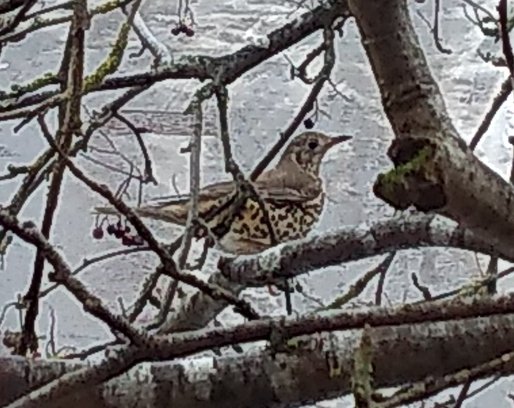
Throughout the week, as the snow slowly disappeared, I saw different birds visiting my Rowan (Sorbus) tree. I had never seen a Mistle thrush (Turdus viscivorus)

or male Chaffinch (Fringilla coelebs) visit the tree before.

Perhaps the reduced availability of food, during the snowy weather, made them search further afield than usual. Thankfully they found the remaining, mostly dried, berries on the Rowan tree outside my window.

Mistle thrush, so named because of their love of eating mistletoe (and guarding trees where it grows) also visit Rowan and Holly (Ilex) trees for their berries as well as eat worms, slugs and insects. They are larger and duller in colour than Song thrush (Turdus philomelos). Their spots are darker and rounder plus they have white tips to their tails. In fact they are larger than Blackbirds (unlike Song thrushes).

Wonderfully, there were even more flowers blooming in the garden too. I saw

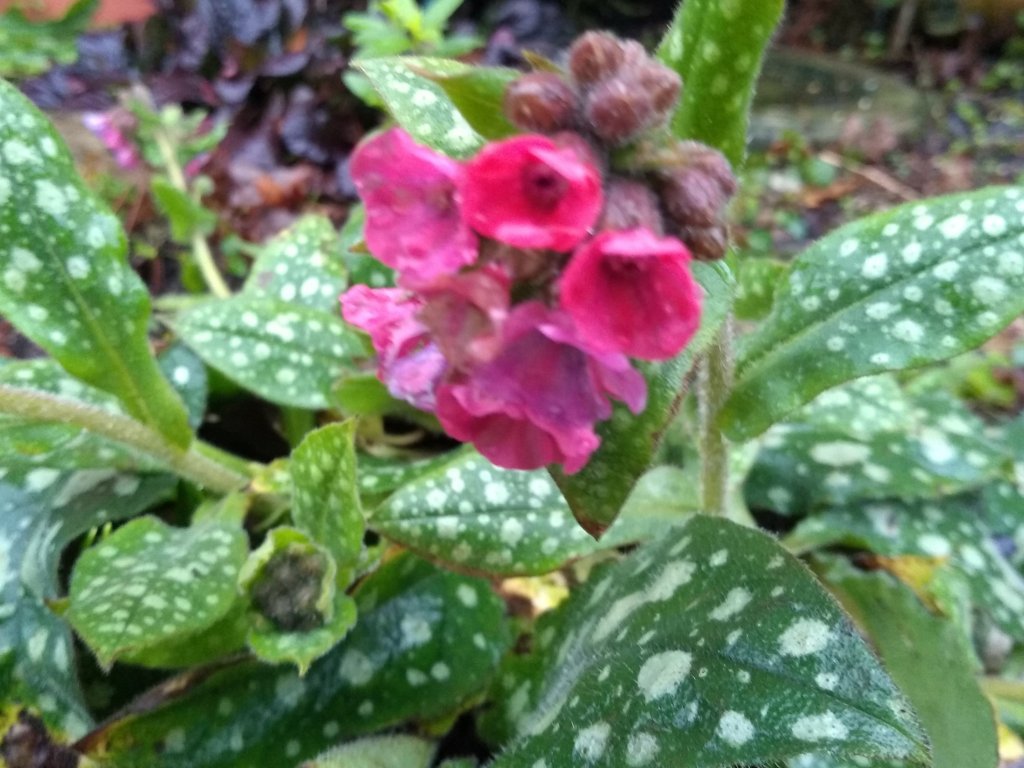
Lungwort (Pulmonaria officinalis),

Crocus and

lots of Cyclamen.

Posted in nature

Increased Sunshine to Lift the Spirits.

With an increase in sunnier moments last week the more life is seemed to come out to enjoy the sun’s rays. Amidst these strange times I am especially glad I can enjoy nature therapy. In particular seeing Bumblebees flying around makes me smile. Along with several Buff-tailed Bumblebees (Bombus terrestris), I also saw a Hairy-footed flower bee (Anthophora plumipes) last Wednesday.

A Hairy-footed flower bee visiting Lungwort (Pulmonaria officinalis).
A Buff-tailed Bumblebee (Bombus terrestris) pollinating Winter heath (Erica Carnea).

In fact Wednesday was a very productive day for sightings. I saw my first lacewing (Neuroptera) of the season, which was hitching a ride in the van. I also saw a couple of 7-spot ladybirds (Coccinella septempunctata) amongst some Heuchera

Last week was great for counting frogs (Rana temporaria) too. On Wednesday there were seven attempting to remain shaded by a pile of scaffolding boards in a garden attached to a new build development. Consequently the frogs were moved to a quieter area so that access could be gained to the garden. Even on Thursday, as I worked next to a pond, I observed tadpoles emerge; It was fascinating to see the process unfold. I couldn’t count the total number of tadpoles but the pond was full of them as well as frogspawn; as it had been the previous year. Plus I even found a frog on the allotment.

As well as amphibians and insect sightings, further flowers blooming were,
Glory of the snow (Chionodoxa luciliae)

Anemone apennina and

Two-leaf squill, also called Alpine squill (Scilla bifolia)