Posted in nature

Common Insects but an Uncommon Viewing Experience

It was great to still witness pollinators flying around last week. Even though, due to the colder weather numbers have greatly reduced, some insects are still foraging. I noticed the odd hardy Buff-tailed bumblebee (Bombus terrestris) as well as a few Honey bees (Apis mellifera) visiting autumn flowering perennials and shrubs. Currently the most wonderful spectacle is Common Ivy (Hedera helix) in full bloom. Loved by pollinators including butterflies, bees and hoverflies, ivy is a useful plant to have in flower at this time of year. It supports up to fifty species altogether, such as providing food for Holly blue Butterflies (Celastrina argiolus), along with the Small dusty wave (Idaea seriata), Angle shades (Phlogophora meticulosa)
and Swallow-tailed (Ourapteryx sambucaria) moths. Mature Ivy plants flower in September and October on clustered umbels. Eventually, pollinated flowers develop into fruit that provides food for Thrushes (Turdidae), Blackbirds (Turdus merula), Blackcaps (Sylvia atricapilla) and Wood pigeons (Columba palumbus). Ivy also provides shelter for hibernating insects over winter.

However the most prevalent insects I witnessed covering the ivy flowers last week were the Common wasp (Vespula vulgaris). They weren’t nesting amongst it but feeding on the abundant nectar. My confidence in their complete focus on the ivy flowers, and not being bothered by my presence, enabled me to unusually observe them up close. Each time I came across ivy covered with wasps, I would take a few moments to watch and listen. Unlike bees, their buzzing was very faint; you had to listen carefully to hear it. I had never been close enough to appreciate the wonderful pattern on their abdomen before or watch their activity as they hurriedly switched from one flower to another.

I would have been observing male and worker wasps obtain nectar from the ivy (which also visit other umbellifier flowers). Queens are active in spring, collecting nectar from Cotoneaster and other spring flowering shrubs.

These much hated creatures are useful pollinators (as the photo below proves) when not pestering us as we eat outdoors. We can’t really blame them trying to access an easy source of food or protecting nests when we stumble upon them.

Wasps also help keep insect numbers down which once captured, are chewed up and fed to the larvae.

Although I haven’t seen any yet, I am ever hopeful that I will see Ivy bees (Colletes hederae) as I look at ivy. Recorded for the first time in southern Britain as far back as 2001, these solitary bees feed on ivy nectar and are therefore only seen when ivy flowers. Since they were first noted in Britain the species has been spreading northwards, nesting in sandy soil. For further information see (Wildlife Trust).

More fungi started to appear last week too; I saw
– Common bonnets (Mycena galericulata)

– Shaggy ink caps (Xylaria hypoxylon) and

– Candlesnuff (also referred to as candlestick or stag’s horn) fungus (Xylaria hypoxylon).

You have to look closely to identify this minute fungi, found on decaying wood, it has a blackened base.

Lastly I was utterly surprised to witness a Fox (Vulpes vulpes) run across my allotment as I worked early on Saturday afternoon. It looked healthy so presumably had been disturbed with all the activity from allotmenteers tidying their plots.

Posted in nature

Garden Treasures

It feels like spiderweb season, the time when they become more prevalent, has arrived. I often get a face full of web when I accidentally walk into hidden ones as I work.

The spider’s web I come across most often is created by the European garden spider (Araneus diadematus). Also called the Diadem spider, Garden cross spider or Crowned orb weaver, due to the pattern on their abdomen and large circular webs they weave.

Males are 9mm in length, smaller than females (which grow to 15mm). Colouration can vary from light to dark brown and even burnt orange.

They are often found in gardens but also inhabit woodlands and meadows. The large orb webs (up to 40cms diameter) become more noticeable at this time of year in strong sunlight, due to the position of the sun, especially when glistening with dew in the mornings.

Those spiders which have survived summer will be mature adults now and start mating when autumn arrives. Males pluck the threads of the female’s web before he approaches, so he isn’t mistaken for food. However this tactic isn’t 100% successful as they can still become prey, even after mating. In late autumn a pregnant female will lay her eggs and spend every second protecting them until she eventually dies. Any adult spider still alive by November will succumb to cold weather.

The young spiderlings will survive winter inside a protective egg sac made of silk, to hatch in May the following year. Repeating the process of feeding on insects caught in webs (after being given a paralysing bite and wrapped in silk for later). They may not be the nation’s favourite garden helpers but they reduce pests and therefore should be treasured just like Ladybirds.

I also learnt a new plant last week. Standing out like a jewel amongst the other perennials was the beautiful Bog sage (Salvia uliginosa).

A Buff-tailed bumblebee (Bombus terrestris) visiting some Bog sage.

As it’s common name suggests this plant grows in damp areas. The one I saw was planted in a herbaceous border that used to be a pond which never completely dries out.

Originally from South American waterways (between Brazil to Argentina) this tall hardy perennial also requires a sunny position to survive. The beautiful blue flowers, loved by bees, bloom between August and October so this plant is a wonderful addition to gardens for extending the pollinating season.

Posted in nature

Pretty in Pink

Some late summer flowering plants such as Lavender, Buddleia and Nepeta have begun to wane;Β however others were starting to look their best. One which started performing last week was Hylotelephium spectabile (‘Brilliant’ series), also referred to as Sedums, Stonecrop or Ice plants.

Loved by pollinators (especially bees) Sedum are great plants to grow in gardens to extend the nectar and pollen season.

These hardy perennials die back to ground level over winter; however until then the seedheads can be left for structural interest allowing hiding places for hibernating insects. They are succulents and therefore like well drained soil in full sun or partial shade. Once established they can cope with dry conditions, continuing to flower until November.

Mature plants can begin to flop, so to prevent this the Chelsea Chop can be carried out. This technique of cutting every stem by a third enables the plant to grow with a bushier habit as well as prolong the flowering period. It is called the Chelsea Chop because this job is done in the last week of May, when the RHS Chelsea flower show takes place. This technique can be used with other perennials that bloom later in the year too. Further information on this can be found on the RHS website.

These Sedums look wonderful in herbaceous borders alongside other fantastic pollinator plants which flower at this time of year.

Hylotelephium spectabile (‘Brilliant’ series) alongside Asters and Echinacea
Hylotelephium spectabile (‘Brilliant’ series) planted with Geranium ‘Rozanne’
and Ceratostigma willmottianum.
Geranium ‘Rozanne’
Ceratostigma willmottianum
Posted in nature

🎡”It’s a Beautiful Da(hlia)…” 🎢

Actually there were lots of beautiful Dahlias at the Autumn festival I went to last Saturday. In fact even the weather was beautiful during the afternoon.

The Dahlia originates from Mexico (where its the national flower) and Central America. A perennial that grows from tubers, it is part of the Asteraceae family which also includes Daisies, Zinnias, Sunflowers and Chrysanthemums.

Because they’re not hardy and prefer light, free draining Soil, Dahlias are often lifted and stored somewhere dry over winter in the UK.

However, in southern counties, where gardens contain favourable conditions (with no heavy, soggy soils in colder climates) I have known people keep them in the ground. Sure enough the following year they reappear without fail. The lack of harsh winters in recent years no doubt enabling their survival.

Apparently Dahlia tubers can be eaten in the same way as Sweet potatoes (originally they were grown as a food source by the Aztecs). They can also flavour drinks when roasted. See Alys Fowler’s piece for the Guardian newspaper)

Over the past few years the popularity of Dahlias has increased; I must confess I am one if their fans.

I love the flowers vibrant colours but prefer the plants with single flowers, which are great for pollinators too (although I have caught sleepy bees having a nap amongst petals of other Dahlias as well; see below).

Unnamed variety from my Allotment with a Buff-tailed bumblebee snuggly sleeping inside a petal.
Formby Art: Bee seen relaxing on this Dahlia at the festival.

Some of my favourites on display last Saturday were:

Honka: Apparently popular with butterflies.
Pooh
Blueberry Hill
Carstone Firebox
Preston Park

I was also impressed by the wonderful bug hotel within the Celebration garden at the garden centre.

Posted in nature

New House Build. πŸ

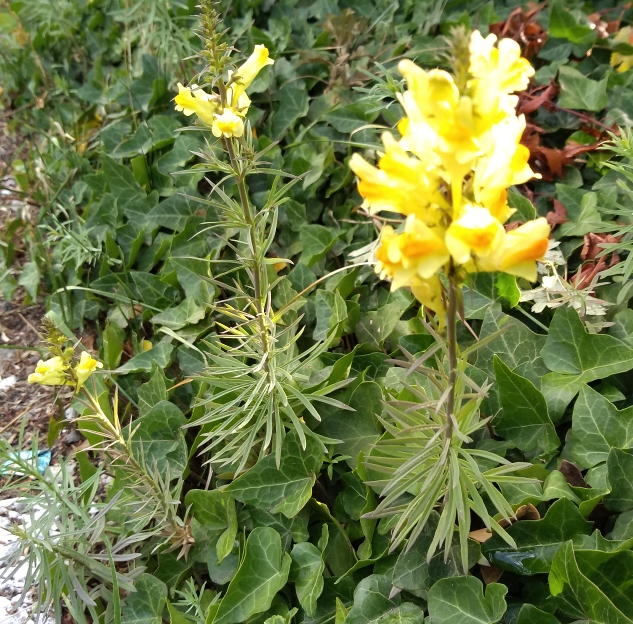
Some fields along my journey to and from work contain a lovely combination of pink Rosebay Willowherb (Chamaenerion angustifolium), purple Buddleia and white Wild carrot (Daucus carota) flowers. Not only do they compliment one another visually but they are all loved by pollinators too. Yellow toadflax (Linaria vulgaris) has started to bloom along the roadside as well.

One special moment occurred on the Monday. As I worked within a border I noticed a Buff-tailed bumblebee (Bombus terrestris) queen flying around a patch of grass. Eventually she began to settle and after a few more large sweeping flights began making a nest in the lawn.

It didn’t take her long to dig into the soil beneath the grass.

She will remain under ground until spring when she will start her own colony.

It was also great to finally get some photos of insects that have have alluded my photographic capture so far this year.

– The first is the Red admiral (Vanessa atalanta),

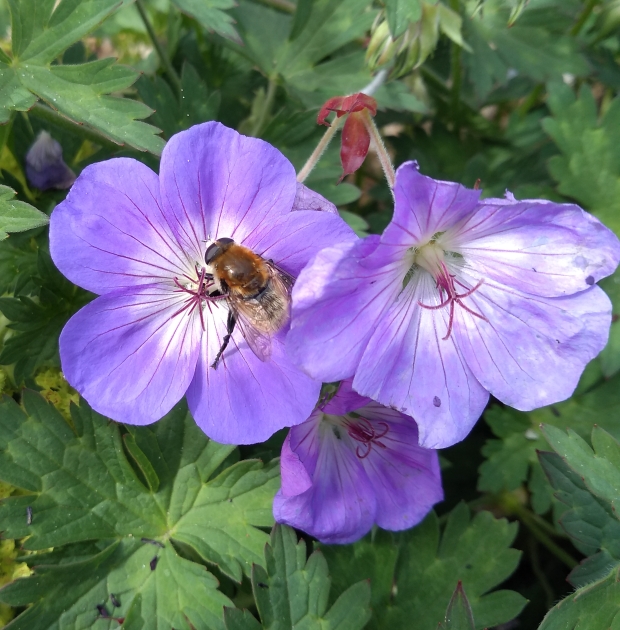
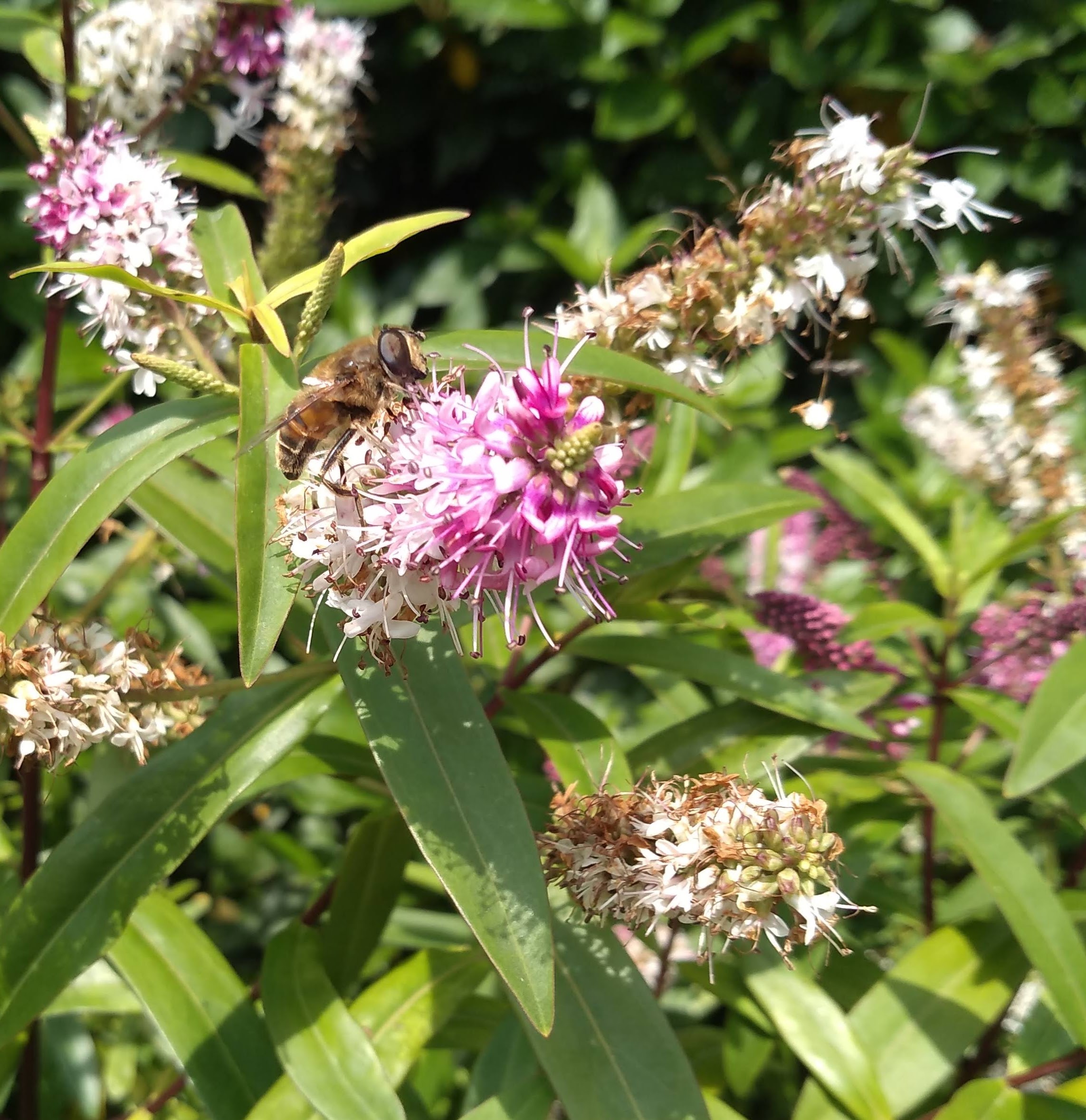
– Some Hoverflies, including a Hornet mimic (Volucella zonaria) hoverfly,

Hornet mimic Hoverfly pollinating Wisteria flowers that were still blooming.
Hoverfly pollinating Geranium flowers.

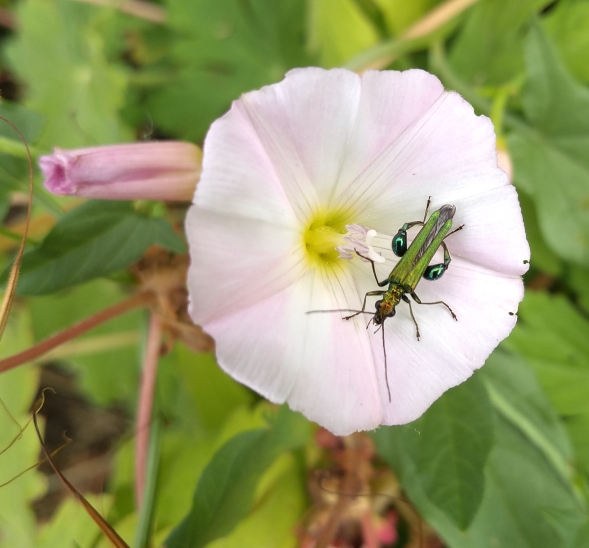
– as well as a Male False oil beetle (Oedemera nobilis), to compliment the female one seen on a walk earlier in the year.

A False oil beetle pollinating a Field bindweed (Convolvulus arvensis) flower.

The males are easily identified due to their large metallic thighs, explaining the reason behind the other common name for this insect the Swollen-thighed beetle.

Posted in nature

A Little Love on Valentine’s Day

Over the last few weeks I have noticed several bees motionless on the ground. Thankfully they were just resting so each time I carefully moved them to a nectar source. It is so lovely to see them hungrily lap it up, getting covered in pollen as they go. Just shows how important it is to growΒ late winter flowering plants for bees to visit. Yesterday I found another Buff-tailed Bumblebee in the same predicament. Showing love to that bee made my Valentine’s day. β™₯️ 🐝🌸

Posted in nature

A Magical Week

I have begun to notice a chill in the mornings as the nights grow colder. I love the promise of Autumn. It doesn’t quite feel autumnal yet (especially as the weather has warmed up again this weekend) but some changes are occurring. Conkers and beech masts have started dropping and fungi are appearing in some lawns. A couple of times I have come across fairy rings; in both instances the Marasmius oreades fungi was the cause (sadly no magical elvish, fairy or pixie dancing).

The week continued with more observations of Painted lady (Vanessa cardui) butterflies. On Monday there were two visiting a Buddleja bush along with a Small tortoiseshell (Aglais urticae) and a Large white (Pieris brassicae).
Then on Friday, in different gardens, more were flitting about. On one occasion, during the morning, I saw a Painted lady on a Ceratostigma willmottianum.

In the second half of the week I noticed more butterflies including a Green-veined white (Pieris napi) on Verbena bonariensis

and a Small tortoiseshell visiting an Erysimum ‘Bowles’s Mauve’.

Throughout last week I saw lots of pollinators busily collecting nectar and pollen.
On Monday I noticed lots of small flies and Buff-tailed bumblebees (Bombus terrestris) pollinating Marigold (Tagetes) flowers. Perhaps they are enticed by their overwhelming aroma which even I found hard to ignore.

Then on Wednesday there was a Common carder (Bombus pascuorum) bee flying between Nandina domesticas and several Agapanthus africanus.

On Friday while working near some Hebe ‘Great Orme’ there were lots of honey bees (Apis mellifera) as well as a Hornet mimic hoverfly (Volucella zonaria).

Another interesting thing I noticed last week was a Red campion (Silene dioica) plant growing on an old moss covered log.

With no soil surrounding its roots clearly it was receiving sufficient moisture and nutrients from this unusual source. It has been flowering healthily all summer but I hadn’t realised it had been relying on the log for its growth until then. I found this plants ability for survival amazing and will closely watch its development.

Lastly I have been aware of how wonderful hardy Fuchsias (Fuchsia magellanica) are currently looking. Although I don’t see pollinators visiting the flowers, there have been a couple of times, in the past, when I have seen Elephant Hawk-moth (Deilephila elpenor) caterpillars feeding on Fushia plants. (See Elephant Hawk-moth).

These caterpillars also eat Himalayan balsam (Impatiens glandulifera) and Willowherbs including Enchanter’s nightshade (Circaea lutetiana) and Rosebay willowherb (Epilobium angustifolium). This beautiful pink and olive green moth flies at night and therefore feeds on Honeysuckle (Lonicera).

Across the way from this hardy Fushia there was a Honeysuckle growing along the wall so it would have been a fantastic place for these moths to inhabit. Unfortunately I didn’t come across any Elephant Hawk-moths this year but hopefully I will in years to come (and I am sure it will feel magical).

Posted in nature

National Growing for Wellbeing Week (3rd-9th June) πŸ…πŸŒ»πŸ₯¦πŸŒΌπŸ₯•πŸŒ±πŸ“

National Growing for Wellbeing Week is a celebration of how gardening aids good health. Gardening certainly helps me mentally and physically. Plus if you encourage wildlife into your garden you will get health benefits from seeing nature on your doorstep too (as well as help wildlife). Small steps can be incorporated into a garden, whatever its size, maybe;

-Help hedgehogs

Hedgehog street

RSPCA

-Add plants that benefit pollinators

RHS

-Garden organically

BBC- Organic gardening

Garden Organic

-Feed and leave some water out for birds

RSPB