Posted in Allotment, nature

What’s up Buttercup?

With May finally here, spring is now in full swing. Lots of things are growing on the allotment from seedlings to fruit, even the Rhubarb is almost ready to pick.

During a woodland walk, on the Easter weekend, I observed the first Speckled wood (Pararge aegeria) butterfly of the year. Plus local ornamental Cherry trees (Prunus) began their spectacular show at the same time; later joined by the flowers of the Hawthorn (Crataegus) , Rowan (Sorbus) and Horse chestnut (Aesculus hippocastanum).

Over the last few weeks, more wildflowers have started to bloom, including Buttercups (Ranunculus), Stitchwort (Stellaria), Ground-ivy (Glechoma hederacea) Honesty (Lunaria annua) and Hedge garlic (Alliaria petiolata) along with Cuckoo flower (Cardamine pratensis).

Ground-ivy
Cuckoo flower

Another butterfly that began to emerge recently is the Orange-tip (Anthocharis cardamines). Hedge garlic and Cuckoo flower are important food sources for Orange-tip caterpillars, so it is lovely to think these butterflies will be laying eggs on the plants I’ve noticed to ensure future generations; the verge not being mown, allowing both plants to develop, enabling this.

The ‘No mow May’ campaign is back this year. Encouraging us to avoid mowing lawns in order to encourage a wide variety of wildflowers to bloom (including rare ones), thus increasing the availability of pollen and nectar for pollinators as they start to emerge (along with helping butterfly populations, as discussed above). After several years of this campaign together with the every flower counts survey, improvements in wildflower growth have been recorded, as people report their sightings taken at this time.
An article from the Plantlife charity discusses their findings in more detail here.

Even leaving the humblest of flowers to flower on lawns, like Dandelions (Taraxacum), Daisies (Bellis perennis) and Buttercups helps.

Posted in nature

Bees in Winter

Honey bees (Apis mellifera) overwinter in hives, huddling round the queen to keep warm, occasionally venturing out on warmer days. Bumblebees (Bombus) on the other hand have an annual lifespan with new queens, having mated during the summer and autumn months, hibernating underground until spring when they can begin a new colony; also sometimes waking up too early on warm days and foraging.

However over the past 10 years, in urban areas of Southern England, a trend has been seen with certain bumblebee species.
Initially Buff-tailed bumblebees (Bombus terrestris), but since then Early bumblebees (Bombus pratorum) and Tree bumblebees (Bombus hypnorum) have begun to nest in winter rather than hibernate. Consequently winter flowering plants such as Mahonia and Winter Heathers (Erica), Winter honeysuckle (Lonicera fragrantissima), Winter aconite (Eranthis hyemalis), Hellebores (Helleborus) and Snowdrops (Galanthus) are garden essentials; enabling these bees to access pollen and nectar during the colder months.

Solitary bees on the other hand will survive throughout winter in burrows or cavities as eggs, with their own supply of nectar and pollen close to hand (as the adults don’t survive winter). These include Mining and Mason bees which emerge early in spring taking advantage of Willow (Salix), Blackthorn (Prunus spinosa) and Hawthorn (Crataegus monogyna) in bloom. Leafcutter and Carder bees emerge later still. The one exception are Furrow bees; like Bumblebees, the female will hibernate during winter and lay eggs in spring.

I have noticed lots of Mahonias blooming over the last few weeks, their bright yellow flowers and perfume is wonderful to experience during dull days. Somehow the colour shines more vividly against grey skies.

Mahonia x media

Another shrub that has been blooming recently is Viburnum farreri, it’s lovely scent wafting through the air too.

Posted in nature

Amazing Auburn Beauty Spotted

Annual honesty (Lunaria annua), Shepherd’s purse (Capsella bursa-pastoris) and Hedge garlic (Alliara petiolata) were all blooming last week, which is great for the increasing numbers of pollinators I saw flying around.

Some flowers began to open up on a Crab apple (Malus spectabilis) I saw in in one garden too.

As alluded to above, more insects were prominent throughout last week compared to earlier in the month. I saw my first male Orange-tip butterfly (Anthocharis cardamines) and undisturbed Seven-spot ladybirds (Coccinella septempunctata) of the year.
Yet more species of bee were buzzing about too; I observed female Early bumblebees (Bombus pratorum) one Hairy-footed flower (Anthophora plumipes) bee queen, along with several female Red-tailed (Bombus lapidarius) bumblebees.
A great Bumblebee ID guide can be viewed at Blooms for Bees; this website also includes ways to encourage bees into your garden.

Then on Thursday, as I was clearing wildflower seedlings from a path, I noticed a beautiful redhead resting next to me.

This photo doesn’t do the vibrant colouration of this bee justice.

I recognized it was a bee but was initially unsure of the species. Upon further investigation, via Google lens, I discovered it was a female Tawny mining bee (Andrena fulva).

Given the place I saw the bee, I was unable to locate it’s nest, in fact it may have flown in from another garden anyway. Their burrow is usually located in lawns (sometimes flower beds); identifiable from a mound of earth with a hole at the top for the entrance. Often described as having a volcano like appearance it can be differentiated from ants nests which are flatter and have no distinguishable hole at the summit. After several weeks these mounds are no where to be found, so they can be left undisturbed without any worry of damage to lawns.

These solitary bees (which do not sting) can be seen between April and June in gardens and parkland as well as along the edges of fields and orchards.

The appearance of these beautiful bees coincides with the flowing of Cherry (Prunus), Pear (Pyrus), Hawthorn (Crataegus), Blackthorn (Prunus spinosa), Maple (Acer), Willow (Sallows) and Apple (Malus) trees, along with other plants such as Buttercups (Ranunculus) and Dandelions (Taraxacum). Nectar and Pollen from these blooms is collected for the bee larvae that develop in the nest beneath the ground. Once the young become pupa, they continue to hibernate through winter to eventually emerge the following spring.

Males are smaller than the female Tawny bees and are a dull brown colour. They do not take any part in creating nests or rearing the young, the females will undertake these jobs alone.

Posted in nature

Pretty in Pink

Some late summer flowering plants such as Lavender, Buddleia and Nepeta have begun to wane; however others were starting to look their best. One which started performing last week was Hylotelephium spectabile (‘Brilliant’ series), also referred to as Sedums, Stonecrop or Ice plants.

Loved by pollinators (especially bees) Sedum are great plants to grow in gardens to extend the nectar and pollen season.

These hardy perennials die back to ground level over winter; however until then the seedheads can be left for structural interest allowing hiding places for hibernating insects. They are succulents and therefore like well drained soil in full sun or partial shade. Once established they can cope with dry conditions, continuing to flower until November.

Mature plants can begin to flop, so to prevent this the Chelsea Chop can be carried out. This technique of cutting every stem by a third enables the plant to grow with a bushier habit as well as prolong the flowering period. It is called the Chelsea Chop because this job is done in the last week of May, when the RHS Chelsea flower show takes place. This technique can be used with other perennials that bloom later in the year too. Further information on this can be found on the RHS website.

These Sedums look wonderful in herbaceous borders alongside other fantastic pollinator plants which flower at this time of year.

Hylotelephium spectabile (‘Brilliant’ series) alongside Asters and Echinacea
Hylotelephium spectabile (‘Brilliant’ series) planted with Geranium ‘Rozanne’
and Ceratostigma willmottianum.
Geranium ‘Rozanne’
Ceratostigma willmottianum
Posted in nature

Song Finally Identified.

For several weeks I have heard lots of male Grasshoppers in the long grass next to my allotment plot. I have been hoping to see one so I can identify them. Finally last Saturday the opportunity arrived. Sitting on some carpet used as a weed suppressor, a Field Grasshopper (Chorthippus brunneus) was seen basking in the sun.

A Common Field Grasshopper (unsuccessfully) attempting to hide behind a stone.

At last I knew which grasshoppers were repeating that soft short chirruping ‘song’. The sound made as the hind legs are rubbed against their wings attracts females. With successful mating approximately 15 eggs are laid and remain in the soil until next year. The nymphs hatch from March onwards and after shedding their skins three or four times become adults in the subsequent summer. This common UK grasshopper feeds on grasses so they won’t go hungry living amongst the overgrown plot.

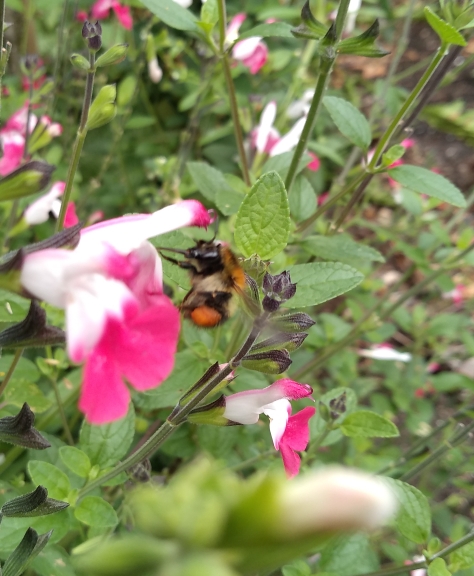
The other amazing thing I saw last week was another bee with spectacular coloured pollen baskets. A Common carder bee (Bombus pascuorum) with orange pollen baskets was visiting a Salvia flower.

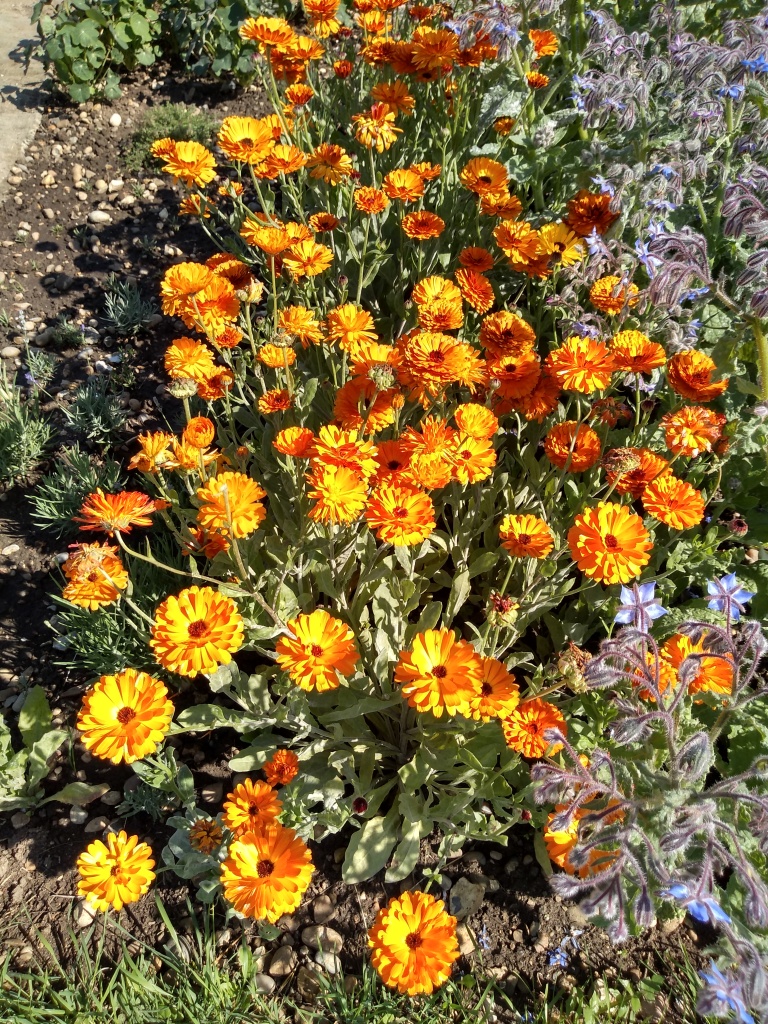
After checking a pollen colour chart, the source of the pollen it had collected was most likely from Calendula officinalis which are in full bloom at the moment (especially on my allotment).

Given the vibrant petals of Calendula I am not surprised that it’s pollen is deep orange. My Calendula is growing next to Borage which has been blooming for a while too. Loved by bees, Borage nectaries refresh every few minutes and the pollen is greyish blue in colour. I look forward to seeing bees with their pollen baskets full of Borage pollen.
Posted in nature

Further Easing into Summer

I am constantly amazed by the natural world. Last week I saw something that, as a gardener, I’m surprised I’ve never noticed before. A few White-tailed bumblebees (Bombus lucorum) flew to and from a nest in a wall, via the damp proofing brickwork, of an old house. What I wasn’t expecting to see were the blue pollen baskets.

I had never thought of pollen as anything other than varying shades of yellow. After researching this I found that different coloured pollen often shows up in nests and hives. Charts have been produced enabling beekeepers to identify which flowers their bees have visited by the colour and shade of the pollen found. The most likely candidates in this instance, given the time of year and dark blue shade, is Purple tansy (Phacelia tanacetifolia), see the North Shropshire Bee Keepers Association website.

Phacelia is loved by bees. These photos are from a neighbouring allotment plot.

As well as Phacelia other flowers currently blooming include;

– Hedge woundwort (Stachys sylvatica),

– Pineappleweed (Matricaria discoidea),

A close up view of Pineappleweed. When crushed, the flowers have a refreshing pineapple scent.

– Stinking iris also called Roast-beef plant (Iris foetidissima),

This plant has two colour variations. It thrives in shady areas.

– Scarlet pimpernel (Anagallis arvensis) and

– Pyramidal orchid (Anacamptis pyramidalis)

This orchid is attractive to butterflies and moths.

Birds are particularly noticeable at this time of year as they feed youngsters and defend territories. Last week I was able to listen to Song thrush (Turdus philomelos), Chiff chaff (Phylloscopus collybita), Robin (Erithacus rubecula) Great spotted woodpecker (Dendrocopos major) and Swifts (Apus apus).  I saw the Swifts’ arial display as they soared and dived in the distance while I ate lunch last Wednesday. They were too high and quick for me to identify visually but their vocalisations gave them away. The Swifts’ call can be heard on the RSPB website.

Ladybirds continued to show up last week, but mostly the Seven-spot ladybird (Coccinella septempunctata).

Eventually, the weather turned and rain finally arrived by Friday. It has been much needed and continued throughout the weekend. It was fantastic to watch thunder and lightening from the comfort of my sofa on Saturday afternoon.

Posted in nature

A Little Love on Valentine’s Day

Over the last few weeks I have noticed several bees motionless on the ground. Thankfully they were just resting so each time I carefully moved them to a nectar source. It is so lovely to see them hungrily lap it up, getting covered in pollen as they go. Just shows how important it is to grow late winter flowering plants for bees to visit. Yesterday I found another Buff-tailed Bumblebee in the same predicament. Showing love to that bee made my Valentine’s day. ♥️ 🐝🌸