Posted in nature

Silver Beauties

The Silver birch (Betula pendula) is from the Betulaceae family, just like Hazel (Corylus) and Alder (Alnus), which also have flowers in the form of catkins (see my previous two posts A Snowy Adventure and The Birds and the Trees).

At the moment only the immature male catkins are visible (as they have been since autumn) dangling at the end of tree shoots.

Silhouette of male catkins on the ends of high branches.

Female Catkins develop after the leaves unfurl in spring. They face upwards, are bright green and smaller than the male ones; flowering between April and May. Unlike the fertilized Alder catkins these do not become woody and remain on the tree for seeds to disperse from there. Instead seed dispersal occurs as the female catkins disintegrate and are carried away by the wind as they fall from the tree.

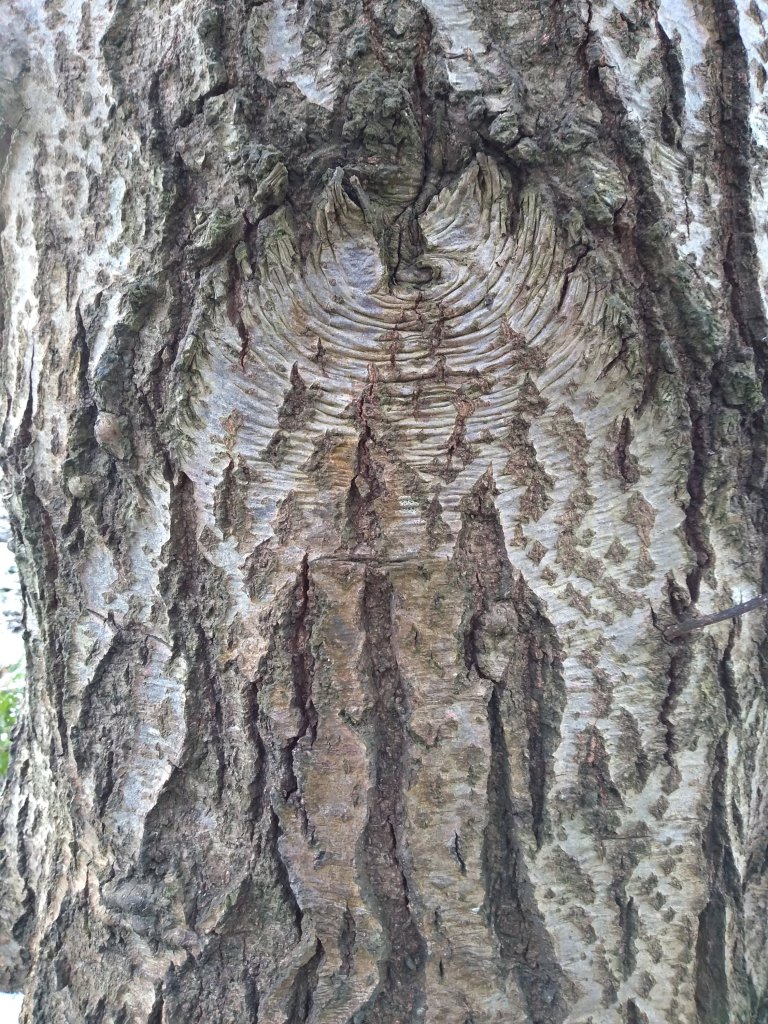
The paper like white bark of the Birch sheds to uncover newer, cleaner bark underneath; plus dark diamond shaped fissures develop as the tree ages.

Fissures developing on the trunk of a Silver birch from my local woodland park.

Two birch trees are native to the UK, the other is the Downy birch (Betula pubescens). It is possible for these to hybridize with one another however individually they can be differentiated. The Downy birch has hairy, single-toothed leaves and hairy shoots (which is how it gets its name); plus the leaf base is rounder. The leaves of the Silver birch are more angular, double toothed around the edges and hairless (the shoots are also hairless). The Downy birch also prefers damper soil than the Silver birch but both are naturally found in woodlands.

The Silver and Downy Birches have open canopies allowing flowers such as violets (Viola), Primrose (Primula vulgaris), Bluebells (Hyacinthoides non-scripta) and Wood anemone (Anemone nemorosa) to florish beneath them. Several fungi are linked with Birch trees too, such as Fly agaric (Amanita muscaria), Woolly milk cap (Lactarius torminosus), Birch milk cap (Lactarius tabidus), Birch brittlegill (Russula betularum), Birch knight (Tricholoma fulvum) and the Birch polypore (Fomitopsis betulina).

These trees can support over 300 insect species. They are a good food source for the caterpillars of Angle-shades (Phlogophora meticulosa), Buff tip (Phalera bucephala), Pebble hook-tip (Drepana falcataria), and Kentish glory (Endromis versicolora) moths. Several Bird species make use of these trees including woodpeckers (Picidae), which nest in the trunks, along with Siskins (Spinus spinus), Greenfinch (Chloris chloris) and Redpolls (Acanthis) that feed on the seeds.

Uses for Birch trees include the manufacture of furniture, handles and toys as well as the process of tanning leather.

In times gone by it was used to make bobbins, spools and reels for the Lancashire cotton industry as well. To the Celts Birches symbolised purity, renewal and love. Later on brooms were made using birch twigs in order to clean rooms. In Finland they are the national tree.

There are several threats to Birch trees, two fungal pathogens (Marssonina betulae and Anisogramma virgultorum) which can cause Birch dieback and eventual death. Bronze birch borer (Agrilus anxius) can also attack native trees.
More information on both can be found on the Forest research website, see the links Birch dieback and Bronze birch borer.

Posted in nature

The Birds and the Trees

On the 31st January, I undertook the RSPBs Big Garden bird watch. Most birds, I’d normally see, were clearly hiding but I did notice some within the hour. Those birds I saw were; 1 Carrion crow (Corvus corone), 2 Robins (Erithacus rubecula), 1 Coal tit (Periparus ater), 1 Blackbird (Turdus merula) and 2 Mistle thrush (Turdus viscivorus). I enjoy taking part in this citizen science project each year; it’s interesting to see how the results differ each time.

Due to the frozen ground last week, I was still able to go for my regular exercise in the local woodland park. Various tree species were waking up from their winter sleep. Beech (Fagus) and Oak (Quercus) had started budding while others were developing catkins.

Last years leaves and new buds on a Beech tree.
Old Oak leaves alongside new buds.

As well as the Hazel (Corylus avellana) other trees had catkins hanging from them too. Hazel catkins are the earliest to flower in the year, from January to March (see my previous post A Snowy Adventure).

Then the Alder (Alnus glutinosa) is the next tree to bloom with both male and female catkins. The male catkins are longer than the female ones which flower from February to March. Also hanging from the Alder trees were some small dark brown shapes. These woody cone-like fruit develop from the previous seasons fertilised female catkins; these can remain on the tree (even when the seeds have been shed) well into the following year alongside the newly formed catkins. I also noticed leaf buds growing on the trees last week too. When the buds burst, I shall update the Woodland trust Nature’s calendar with my findings.

Unfortunately I was unable to capture decent photos on location so I collected part of a fallen branch to take home.

One small female catkin above a group of larger male catkins. On the tree (before fertilisation when they develop into the rounder, woody fruit) the female catkins point upwards while the male ones hang down.
A magnified view of two unfertilised female catkins.
A leaf bud with one of last years fertilised female catkins.
A magnified view of the Alder tree seeds that had remained in last seasons female catkin.

I find Alder trees fascinating and the rough, fissured bark beautiful.

Alder are native to Britain and found on wet land, next to water or in marshes and woodlands. They naturally thrive in moist conditions although can also grow in drier areas such as the edges of mixed woodland. Alder wood is durable when wet and actually becomes stronger rather than rot when submerged in water; a characteristic that makes them useful in flood mitigation, boat building, sluice gates, and even the construction of Venice which is mostly built on Alder piles. Alder wood is also used in the creation of charcoal, gunpowder and making clogs.

The pale wood turns a deep orange colour at the point at which it’s cut (while the rest of the wood remains pale); leading to a superstition, in Ireland, that it was bad luck to walk past an Alder tree on your travels. However, traditionally alder branches were also taken into houses to prevent Woodworm. Alder wood is particularly liked by various species of beetle larvae (collectively referred to as Woodworm). It is hoped that the beetles will lay eggs in the Alder rather than the furniture or fixtures; the branches once infested can then be removed.

There is also a traditional use for Alder flowers as a green dye; believed to be used as camouflage by outlaws like Robin hood and fairies.

For fun, I looked up Alder wands used in the Harry potter series. Only one is mentioned, that owned by Quirinus Quirrell. The wands qualities are described on the Wizarding world website.

The roots of Alder are nitrogen fixers. Nitrogen from the air is fixed into the soil, replenishing the levels and aiding soil fertility, through the bacterium Frankia alni.

As well as improving soil, Alder are great for wildlife too. The seeds are eaten by Redpoll (Acanthis flammea), Siskin (Spinus spinus) and Goldfinch (Carduelis carduelis). The leaves are food for the caterpillars of the Alder kitten (Furcula bicuspis), Pebble hook-tip (Drepana falcataria), Autumn green carpet (Chloroclysta miata) and Blue-bordered carpet (Plemyria rubiginata) moths. Bees visit the catkins for an early source of nectar plus Alders provide habitats for the Checkered skipper (Carterocephalus palaemon) butterfly, Small pearl-bordered fritillary (Boloria selene) butterfly, some species of Crane fly, Otters (which create nests amongst the roots) along with mosses, lichens and fungi that like damp conditions.

However, these trees are also threatened through infection by the Phytophthora fungus (together with some other broadleaf tree species). In Alder this disease is referred to as Alder dieback and eventually causes the death of any infected tree. For more information see the Forest research website. There aren’t many Alders in my local woodland park compared to other tree species so it would be sad to see them disappear. Given my newly acquired knowledge I will keep a special lookout for any ill health in these trees; thankfully no infection is being exhibited at the moment.