How is it nearly July? The passage of time has certainly flown by, for me, but then the growing season is in full swing and has kept me busy.
In April, a few weeks of unusually warm weather for the time of year ended with April showers. Since then there have been occasional periods of heavy rain, however it remained largely dry here in southern England. A couple of weeks ago (as well as this coming Monday) we had another very hot period of high temperatures. The weather remains warm, so colder mornings are refreshing. It was the sunniest spring on record and continues to be incredibly dry here in the south.
Early warm spring weather has meant that fruit picking this year has been very good. So far the strawberry, currants, gooseberry and raspberry harvests have been great. There are plenty of apples and plums developing too.
The allotment is coming along, we had to hold out planting for a while due to the drought we had early spring. I took advantage of that to add another wildlife area. The shed casts a shadow so I have been unsure what to do with it; now there is a dead hedge, stumpery, log pile and hedgehog house along with nettles and a few other plants to encourage insects, beetles and other invertebrates.
I have noticed a variety of insects this year. Lots of Brimstones (Gonepteryx rhamni) in spring have now been replaced by Commas (Polygonia c-album), Speckled woods (Pararge aegeria), Large whites (Pieris brassicae) and Peacock (Aglais io) butterflies.
Bees have been evident too; Ashy mining bees (Andrena cineraria) in particular. I saw a group of about 20 in one garden.
A buff tailed bee (Bombus terrestris) snoozing in a foxglove.
Juvenile ladybirds have also been evident, arriving soon after aphids show up, now becoming adults.
Mullein Moth (Cucullia verbasci) caterpillars were around one week in April and then disappeared in early June, presumably eaten by birds.
These vibrant caterpillars turn into a brown coloured moth.
Although the caterpillars had eaten a lot of the leaves, the plant survived and has begun to bloom now. It never ceases to fascinate me how the moths found the plant in the first place and how the birds found the caterpillars with no need for chemicals to control so-called pests. The adult Mullien moths are nocturnal, flying in April and May.
I have also learnt about another spider, the Cucumber spider (Araniella cucurbitina); named because of their vibrant green abdomens they are commonly found in the UK, especially in woodlands and hedgerows.
Larger than actual size. Males are about 3.5- 4mm while the larger females are between 4- 6mm.
In May, we met friends at Black park in Slough. It was wonderful to see the emergence of adult dragonflies from their nymph form, species unknown.
It might be the start of meteorological autumn but it’s still too early for leaves to start falling from trees; yet over the past few weeks this has been occurring. Referred to as false autumn, this leaf (and acorn) drop is occurring as a result of the extreme temperatures and drought we’ve experienced this year. It is a sign of stress as trees attempt to conserve water and energy. Current lower morning temperatures have also lead to an autumnal feeling. Thankfully we are now experiencing rainfall so perhaps this will prevent trees from showing further signs of stress even though it doesn’t stop us being in drought. Hopefully autumnal colour won’t be affected too much and we will still witness the spectacular seasonal colours this year.
A couple of weeks ago my partner and I went for a walk to spot Saturn ascending in the sky at dusk; we visited the local woodland park. At nine o’clock, on one of the hottest days of the year, the temperature was quite pleasant. As we walked through the woodland to an open area, where we could view the planet, we got to experience bats flying close by (the following videos is of some footage I managed to obtain).
Without a Bat detector, I have no way of correctly identifying the species out of the 18 that roost in the UK. According to the information I found on the Hertfordshire and Middlesex Bat Group website, the ones we most likely encountered in the area are either the Common Pipistrelle (Pipistrellus pipistrellus) or Soprano Pipistrelle (Pipistrellus pygmaeus). Regardless of the species, just experiencing the creatures flying nearby to capture insects was amazing. I haven’t witnessed bats in fight since I was a child.
It’s still possible to see some butterflies and bees at this time of year so late year flowering plants are essential.
A Common carder bee visiting a group of Aster flowers.
White tailed bumblebees (Bombus lucorum), Buff tailed bumblebees (Bombus terrestris), Red tailed bumblebees (Bombus lapidarius), Common carder bees (Bombus pascuorum) and even some Honey bees (Apis mellifera) still forage in September. The Butterfly Conservation charity produced a photo (see below) of common butterflies and moths to see at this time of year.
During the previous week I was still noticing several Hummingbird hawk moths (Macroglossum stellatarum) too. These moths have been quite prevalent this year.
On one occasion I managed to get a video of a Hummingbird hawk moth visiting a Buddleia.
Within the past month the temperature has reached the highest on record in the UK at 40.2 Celsius. Here in the south, rain still evades us leading to hosepipe bans in some counties. Plus as I write this blog another heatwave begins. While the parched grass will recover once rain eventually falls, and some insects may benefit from these conditions, this drought is not good for nature in general (including humans due to amber and red heat warnings for health issues and fires). We need to use resources more thoughtfully and manage the land better so that nature (to me humans are part of nature not separate from it) isn’t placed under unnecessary pressure due to extreme weather conditions anymore.
Most wildlife isn’t adapted to this current weather and certainly has no chance against wild fires, especially Badgers (Meles meles) and Hedgehogs (Erinaceus europaeus– whose numbers have been in decline for many years for other reasons too). Even birds with second broods will be finding these times difficult; that is why it’s so important to place water sources at both ground level and higher up for birds and Hedgehogs at this time. Plus insects like Butterflies and Bees suffer when flowers start to whither early due to water shortage. Nature can recover from the odd hot dry year but unfortunately this is a trend, year on year, due to climate change so we need to be concerned and act now. Stephen Moss has written a wonderful article regarding this issue recently, it can be read here.
Given the information from the article mentioned above, it will be interesting to see how this prolonged drought will affect the results of the Big Butterfly Count this year (which took place from the 15th July to the 7th August) and consequently next years results too.
I have undertaken a few counts this year. The first time I looked out for Butterflies was on a warm afternoon, in a garden containing a Buddleia along with some Lavender (Lavandula) and Mint (Mentha) that was flowering. During that time, I identified; 5 Red admirals (Vanessa atalanta) 5 Commas (Polygonia c-album) 2 Peacock (Aglais io) 5 Gate keepers (Pyronia tithonus) 1 Meadow brown (Maniola jurtina) 2 Small tortoishell (Aglais urticae) together with 1 Hummingbird Hawkmoth (Macroglossum stellatarum). The Hummingbird Hawkmoth is fascinating. I have observed two individuals visiting Buddleia this year in different gardens that I work at. It is so amazing to watch it collect nectar as it hovers next to flowers.
On separate occasions (at the previously mentioned garden) I also noticed a Large skipper (Ochlodes sylvanus) and a Ringlet (Aphantopus hyperantus) too. That garden also has an allotment attached to it where I got to observe the full lifecycle of a ladybird on one bean plant (thanks to the Blackfly being present). On this occasion it was the Harlequin (Harmonia axyridis) ladybird.
Larvae (on the right, looking for Blackfly to munch on) and on the left a pupae (from which the adult emerges).An adult Harlequin ladybird.
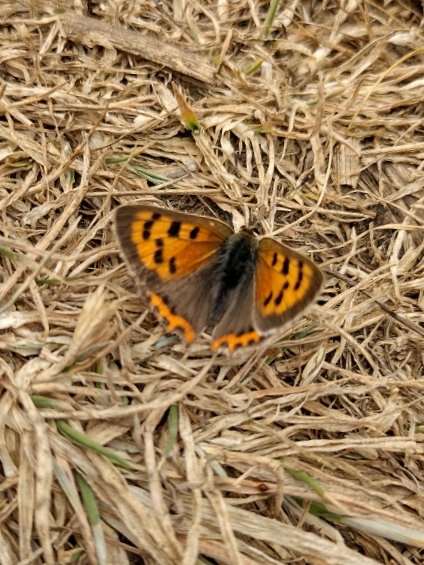
My second Butterfly Count was during a morning as I picked Blackberries (Rubus) at the local woodland park, where I saw 5 Gatekeepers, 1 Speckled wood (Pararge aegeria) and 1 Small copper (Lycaena phlaeas).
Speckled woodSmall copper
The Small copper is one I had never seen before. It is a small butterfly with a wingspan of 32-35mm. The caterpillars feed on Common Sorrel (Rumex acetosa), Sheep’s Sorrel (R. acetosella) and sometimes the Broad-leaved Dock (R. obtusifolius). They can be found in heath, moor and grassland together with woodland clearings or on waste ground.
At my allotment I have seen lots of Cabbage whites, along with the odd Peacock and Small tortoishell as well as a small blue Butterfly (that never settled so I was unable to identify it properly but was most likely a Holly blue- Celastrina argiolus). Thankfully I have also noticed plenty of bees during my butterfly observations, including honey, bumblebees and solitary bees.
Lughnasadh (also known as Lammas) a time when harvests begin to be ready for picking, occurred at the beginning of August. During this time I love to wander through natural environments, spending time observing the changes of the seasons. On my walk the previous weekend I observed Sloes (from Blackthorn- Prunus spinosa) and Elderberries (from Elder- Sambucus) already ripening alongside the Blackberries.
I must confess that I often struggle to enjoy the hottest days of summer. To me extremely hot temperatures are often overwhelming and I would love nothing better than to hibernate underground during the hottest times. I find the days exhausting and uncomfortable (due to the constant itchiness and sore skin). At these moments I rely on my mental strength to keep in mind that ‘this too shall pass’. I also try to remind myself that I love the changing seasons, including summer, and all they bring with them. Gratitude helps as each day I look for the little things that bring me joy such as the shining sun, the amazingly beautiful wildlife around me and the cooler night time temperatures. So until the heat reduces significantly I will keep taking things slowly, keep hydrated, take plenty of rest and be kind to myself. I am under no pressure to get things done at this time which is why this post took so long to complete.
For the last couple of weeks conkers and sweet chestnuts have begun to fall, there isn’t a big harvest, neither are there lots of acorns or beech masts. However 2020 was a mast year (where trees produce bumper crops) so reduced harvests this time isn’t too surprising; Mast years only happen every five to ten years. However the low numbers could also be due to this years cold damp spring impacting bud development and fertilization, especially with wind pollinated trees. This issue is discussed further in an article by the Woodland Trust see Nature’s Calendar.
It has been lovely to notice Boston ivy (Parthenocissus tricuspidata), along with Virginia creeper (Parthenocissus quinquefolia) develop their bright red autumnal colour. They are so vibrant in the low autumn sunshine. I’ve also noticed the small beginnings of autumn leaf colour in many trees too.
Boston ivy growing up a wall of an old building.Virginia creeper winding its way through some shrubs.
Now that October has arrived, Cyclamen (Cyclamen hederifolium) and Crocuses (Crocus speciosus) have sprung up alongside Fungi in a few lawns. I noticed a waxcap commonly called the Witches hat (Hygrocybe conica) as well as Lilac fibrecaps (Inocybe geophylla var. lilacina); both resembling Gemstones standing out amongst the grass.
Witches hat waxcaps are so called because they look like witches hats when they blacken with age.A Lilac fibrecap
I also saw another fungi in one lawn, possibly a Blusher (Amanita rubescens), although the identification was difficult so I’m not entirely sure.
Plantlife run Waxcap watch from the 13th September. The charity want to discover previously unknown waxcap grassland sites, uncover habitat conditions and give better protection for them in the future. More information about this survey can be found here.
Something else I observed while weeding a gravel path at work was a Lunar underwing moth (Omphaloscelis lunosa).
This night flying noth had been hiding under some dandelion leaves.
Lunar underwing moths fly between August and October and their pupae overwinter in long grass which they will feed on when they become caterpillars. I managed to re-home this one under a nearby shrub.
During the previous week there were the few days of unusually high temperatures for the time of year; a final flourish for late summer?
The heat encouraged lots of bees, especially Honey bees (Apis mellifera) to visit Hylotelephium (once called Sedums) which began to bloom. The sound was amazing and it was so relaxing to work near them; you could almost feel the buzz it was so intense.
How many bees can you spot?
Things have been ticking over nicely on the allotment for the past month. Corn and Squash are developing nicely while the supply of Sweetpeas and Beetroot keep coming. Plus the Potatoes have been dug up and Apples are ready to pick too.
Time spent planning next years harvest is in full swing, while changes to the allotment occur. I began to create a space for a wild flower area next to a patch of long grass, where a resident frog is no doubt loving the huge supply of slugs this year. Plus work has begun on transforming the veg patches into raised beds.
Away from the allotment, on Friday 10th September, I noticed a rather large moth in the hallway. It was an Old lady/ black underwing (Mormo maura) moth. The wingspan of the Mormo maura is between 55 and 65mm.
The common name of Old Lady is due to the colouration and pattern on the forewings, which resemble the shawls of old Victorian ladies. There is only one generation per year and adults fly between July and August; as I noticed this one in September it must be near the end of its lifespan. A nocturnal moth it is attracted to light (and sugar if you place feeding stations for moths). Clearly the open window had encouraged it into the building. The main habitat for this moth are gardens and waste ground, particularly in damp locations. In spring, after overwintering, the caterpillars will feed on various trees and shrubs, such as Blackthorn (Prunus spinosa).
Then last Friday, another moth found its way to the hall. Also a nocturnal moth attracted by light, the Snout moth (Hypena proboscidalis), so called for obvious reasons.
There are two generations per year of the Hypenaproboscidalis, adults initially fly between June and August and again later in autumn. The wingspan of the Snout moth is approximately 30 to 38mm. Like the Old lady moth it also frequents gardens and wasteland, along with woodlands; essentially it can be found anywhere nettles (Urtica dioica) are found, which the caterpillars feed on.
While I mostly witness nature in amphibian, insect or plant form, just occasionally I get to see mammals too.
Last week I briefly observed two adult Hares (Lepus europaeus) as I traveled from a job; a garden at a house surrounded by farmland.
They were out in an open field some distance away from the driveway, yet close enough to be able to appreciate their size as well as distinguish the black tips on their long ears along with their distinctive hind legs.
As Hares are usually seen alone, I’m guessing these two were a pair. Perhaps aware of the movement of the electric vehicle, one suddenly crouched down as the other sat bolt upright alongside it. It was lovely to witness these two together in this way. Previously, I’ve only ever seen one Hare far in the distance running across an open field, presumably after being disturbed.
Hares are the UK’s fastest mammal, when disturbed they have a top speed of 45 mph and move in a zig zag formation.
While mostly solitary, these mammals occasionally live apart from one another in loosely connected groups. This explains why, in early spring, when two Hares are seen ‘boxing’ they’re not two males fighting for dominance but actually a female fighting off a male.
Their preferred habitat is a combination of farmland or undisturbed grassland surrounded by woods; enabling easy access to grass and crops for food while giving some protection.
Rather than burrows, Hares live in a form (an exposed depression on the ground). They remain close to their form during the daytime, becoming more active and feeding at night. The two I saw must have been in their form. I wonder if they had a litter? Hares can have three to four litters within a year (between March and July) giving birth to two- four leverets each time. Hares can live for up to four years.
There was one other prominent sighting from last week, that of a Angle shades Moth (Phlogophora meticulosa). I noticed it on Thursday, resting on the milk bottle carrier as I collected my milk delivery.
This is the moths I see more than any other, perhaps because I am surrounded by the perfect habitat for them; a mixture of gardens, parks, woodland and hedgerows containing an abundant food source for their caterpillars. Angle shades caterpillars will feed upon Common Nettle (Urtica dioica), Red Valerian (Centranthus ruber), Broad-leaved Dock (Rumex obtusifolius), Bramble (Rubus fruiticosus) and Hazel (Corylus avellana). As this is a night flying moth, I carefully transferred it to the nearby wall where it could gain shelter from the daylight.
On the 31st January, I undertook the RSPBs Big Garden bird watch. Most birds, I’d normally see, were clearly hiding but I did notice some within the hour. Those birds I saw were; 1 Carrion crow (Corvuscorone), 2 Robins (Erithacusrubecula), 1 Coal tit (Periparusater), 1 Blackbird (Turdusmerula) and 2 Mistle thrush (Turdus viscivorus). I enjoy taking part in this citizen science project each year; it’s interesting to see how the results differ each time.
Due to the frozen ground last week, I was still able to go for my regular exercise in the local woodland park. Various tree species were waking up from their winter sleep. Beech (Fagus) and Oak (Quercus) had started budding while others were developing catkins.
Last years leaves and new buds on a Beech tree.Old Oak leaves alongside new buds.
As well as the Hazel (Corylus avellana) other trees had catkins hanging from them too. Hazel catkins are the earliest to flower in the year, from January to March (see my previous post A Snowy Adventure).
Then the Alder (Alnus glutinosa) is the next tree to bloom with both male and female catkins. The male catkins are longer than the female ones which flower from February to March. Also hanging from the Alder trees were some small dark brown shapes. These woody cone-like fruit develop from the previous seasons fertilised female catkins; these can remain on the tree (even when the seeds have been shed) well into the following year alongside the newly formed catkins. I also noticed leaf buds growing on the trees last week too. When the buds burst, I shall update the Woodland trust Nature’s calendar with my findings.
Unfortunately I was unable to capture decent photos on location so I collected part of a fallen branch to take home.
One small female catkin above a group of larger male catkins. On the tree (before fertilisation when they develop into the rounder, woody fruit) the female catkins point upwards while the male ones hang down. A magnified view of two unfertilised female catkins.A leaf bud with one of last years fertilised female catkins.A magnified view of the Alder tree seeds that had remained in last seasons female catkin.
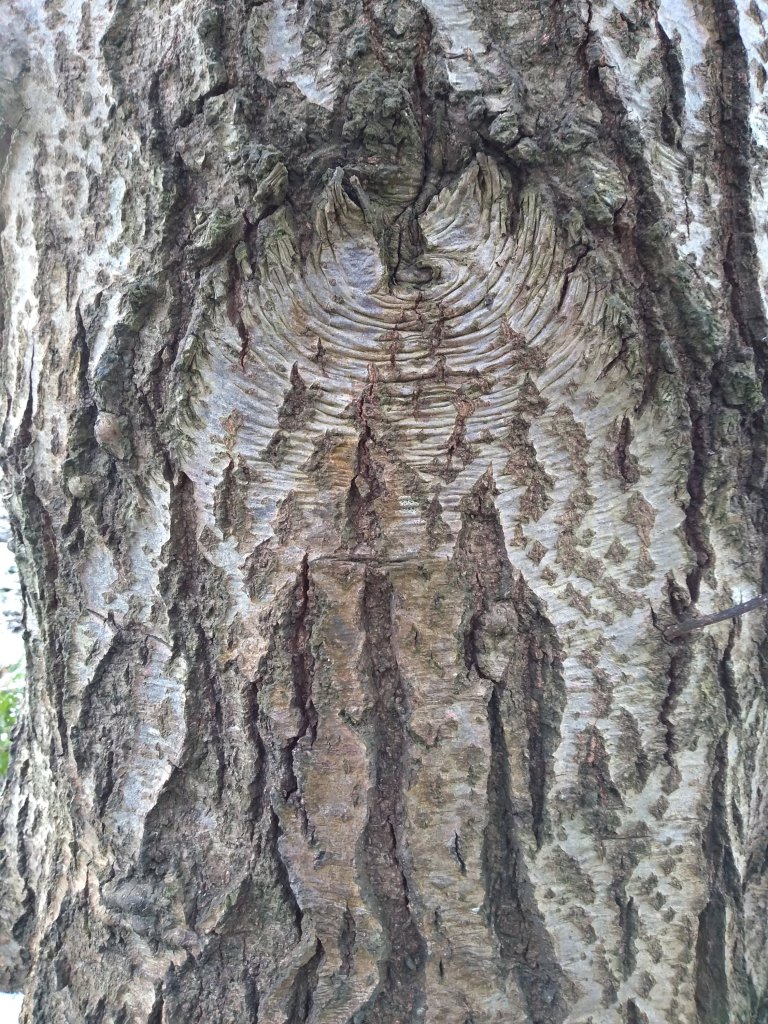
I find Alder trees fascinating and the rough, fissured bark beautiful.
Alder are native to Britain and found on wet land, next to water or in marshes and woodlands. They naturally thrive in moist conditions although can also grow in drier areas such as the edges of mixed woodland. Alder wood is durable when wet and actually becomes stronger rather than rot when submerged in water; a characteristic that makes them useful in flood mitigation, boat building, sluice gates, and even the construction of Venice which is mostly built on Alder piles. Alder wood is also used in the creation of charcoal, gunpowder and making clogs.
The pale wood turns a deep orange colour at the point at which it’s cut (while the rest of the wood remains pale); leading to a superstition, in Ireland, that it was bad luck to walk past an Alder tree on your travels. However, traditionally alder branches were also taken into houses to prevent Woodworm. Alder wood is particularly liked by various species of beetle larvae (collectively referred to as Woodworm). It is hoped that the beetles will lay eggs in the Alder rather than the furniture or fixtures; the branches once infested can then be removed.
There is also a traditional use for Alder flowers as a green dye; believed to be used as camouflage by outlaws like Robin hood and fairies.
For fun, I looked up Alder wands used in the Harry potter series. Only one is mentioned, that owned by Quirinus Quirrell. The wands qualities are described on the Wizarding world website.
The roots of Alder are nitrogen fixers. Nitrogen from the air is fixed into the soil, replenishing the levels and aiding soil fertility, through the bacterium Frankia alni.
As well as improving soil, Alder are great for wildlife too. The seeds are eaten by Redpoll (Acanthis flammea), Siskin (Spinus spinus) and Goldfinch (Carduelis carduelis). The leaves are food for the caterpillars of the Alder kitten (Furcula bicuspis), Pebble hook-tip (Drepana falcataria), Autumn green carpet (Chloroclysta miata) and Blue-bordered carpet (Plemyria rubiginata) moths. Bees visit the catkins for an early source of nectar plus Alders provide habitats for the Checkered skipper (Carterocephalus palaemon) butterfly, Small pearl-bordered fritillary (Boloria selene) butterfly, some species of Crane fly, Otters (which create nests amongst the roots) along with mosses, lichens and fungi that like damp conditions.
However, these trees are also threatened through infection by the Phytophthora fungus (together with some other broadleaf tree species). In Alder this disease is referred to as Alder dieback and eventually causes the death of any infected tree. For more information see the Forest research website. There aren’t many Alders in my local woodland park compared to other tree species so it would be sad to see them disappear. Given my newly acquired knowledge I will keep a special lookout for any ill health in these trees; thankfully no infection is being exhibited at the moment.
Last week I began hearing the male Tawny owls (Strix aluco) territorial call as I fell asleep and again when I awoke. Usually this starts from late autumn and continues throughout winter (see BTO). Whatever the reason for him asserting his territory early, it was lovely to hear that sound return from last winter. Yet this wasn’t the only spectacle I noticed last week.
Last Wednesday, as I cut back spent Lavender, I became aware of something flying past me. I continued to watch until the insect stopped to gain nectar from some Red Valerian (Centranthus ruber); It was a Humming-bird Hawk-moth (Macroglossum stellatarum). As this was my first sighting of this superb moth, I found it impossible to maintain my composure as I hurriedly fumbled for my phone. Unfortunately it was too quick for me to photograph as it flitted between flowers, not resting as it fed. It did return momentarily but I was still unable to gain photographic evidence before it flew away once again. A visual guide can be seen on the Butterfly Conservation website. For further information on Red Valerian see the RHS website.
Apparently it is possible to hear it buzz as it flies, due to the quick movement of it’s wings; sadly all I could hear were builders working nearby.
Occasionally this daytime flying moth can be observed at other times of the year but traditionally it is seen between June and September. It usually migrates to the UK from the continent but in milder winters can overwinter in this country; in sheltered areas such as crevices, holes within trees and outbuildings.
It obtains nectar from a variety of plants in gardens, woodland edges as well as heathland on very warm sunny days. Along with the Red Valerian I noticed this one visit these moths can be seen amongst Honeysuckle (Lonicera), Jasmine (Jasminum), Buddleja, lilac (Syringa), Escallonia, Petunia and Phlox. While the caterpillars only feed on Wild Madder (Rubia peregrina) and Red Valerian along with Lady’s (Galium verum) and Hedge Bedstraw (Galium album).
So much has happened in the world over the last fortnight. Changes are moving so quickly, that I have felt overwhelmed and struggled with my mental health, like a lot of people right now. Consequently I nearly didn’t write this latest post. However I remembered why this blog is so important to me. During my darkest hours nature helps me overcome depression and anxiety; so here it is, better late than never.
Lots of plants were starting to bloom last week.
– Forget-me-not (Myosotis),
– Green alkanet (Pentaglottissempervirens),
– White dead-nettle (Lamiumalbum,
– Red dead-nettle (Lamiumpurpureum),
– Brunnera macrophylla,
– Aubrieta deltoidea
– and Vinca minor were all flowering.
Bindweed (Calystegia sepium) is growing too.
When I found it on the allotment, initially my heart sank slightly; it means lots of work to control it organically. Yet I decided to see if it has a good side, after all it is a wild flower. Look up Bindweed on the internet and you find countless references to it being a horrible weed in gardens together with how to exterminate it (both traditionally and organically). I must admit I find it hard to like the plant but I wanted to challenge my views (gained from years of trying to get rid of it from people’s gardens). The Gatekeeper (Pyronia tithonus) or Hedge Brown butterfly, Bees along with Hoverflies pollinate its large white bell shaped flowers. Moths too visit the flowers because they are also open at night-time. Bindweed is also food for the Convolvulus Hawk Moth (Agrius convolvuli) larvae.
Something else I discovered last week was the Bumblebee mite (Parasitus fucorum).
A Buff-tailed bumblebee visiting some Aubretia. Bumblebee mites can be seen clinging onto the bee.
They hitch a ride on the queen so that they’re taken to a new nest; once there it feeds on wax, pollen, nest debris as well as other small insects. They do not feed on the bees themselves. It is the first time I have noticed mites on a bee. I clearly saw four in total (two either side) just behind the head, on the thorax. It looked like the bee, which remained in the same spot for at least an hour, was attempting to groom itself so presumably the mites were irritating it even though they doesn’t harm the bee itself.
The weather last week was a mixed bag. Sunshine with the temperature rising into the thirties, fantastic storms and then dull days of rain. Thankfully it is a little cooler now; while I enjoy the sun, I wilt in muggy heat.
Given the weather there were still lots of butterflies around, mostly Peacock (Aglaisio), Red admiral (Vanessaatalanta) and Small white (Pierisrapae). Unfortunately I haven’t managed to capture photos of any of these as they didn’t remain in situ for long. I see many white butterflies flit past me. It can be difficult to say if they are Large white (Pierisbrassicae), Small white or female Orange tip (Anthochariscardamines) butterflies because they disappear before I can identify them.
Happily I was able to photograph one butterfly on a Buddleia on Wednesday. The combination of the pattern in the underside, orange colouring I saw on the upper wings, together with the wing outline means the butterfly in the photo below is a Comma (Polygoniac-album).
Their Caterpillars usually feed on the Common nettles (Urticadioica) but also Elms (Ulmus), Hops (Humuluslupulus) as well as Willows (Salix). Peacocks often visit Buddleia too. The Common Nettle is also the favoured food of Peacock Caterpillars; although they have been recorded feeding on hops and small nettle (Urticaurens) as well. As the common nettle is the favourite food of both Comma and Peacock caterpillars, what better reason is there for allowing some nettles to grow in a garden?
There were other observations last week too;
– a Harlequin ladybird (Harmoniaaxyridis) on some Lesser Burdock (Arctiumminus),
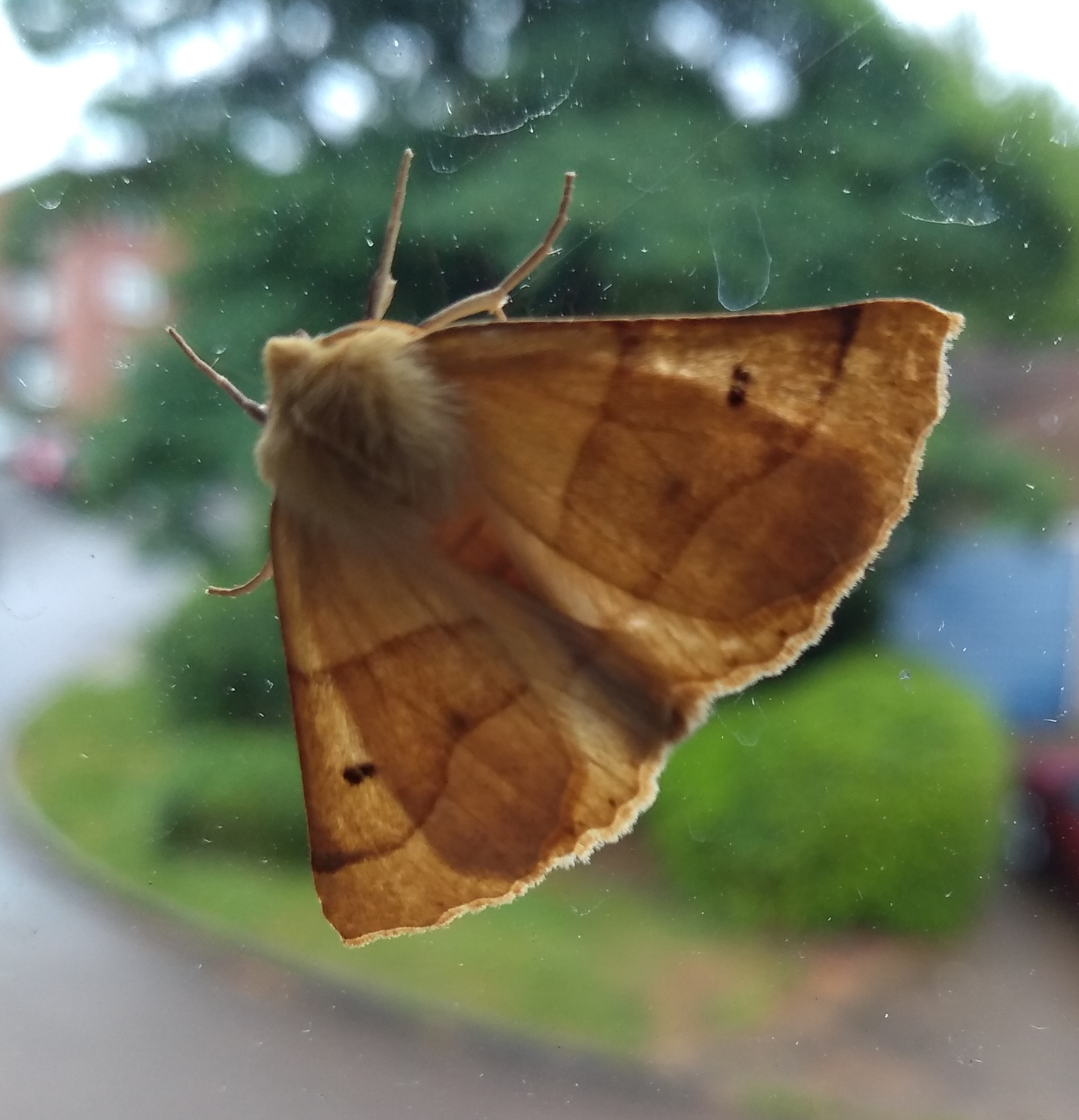
– a Scalloped oak (Crocalliselinguaria) moth,
The caterpillars of these moths feed on honeysuckle (Lonicera), heather (Calluna vulgaris) and broadleaf trees like Oak (Quercus) and Birch (Betula).
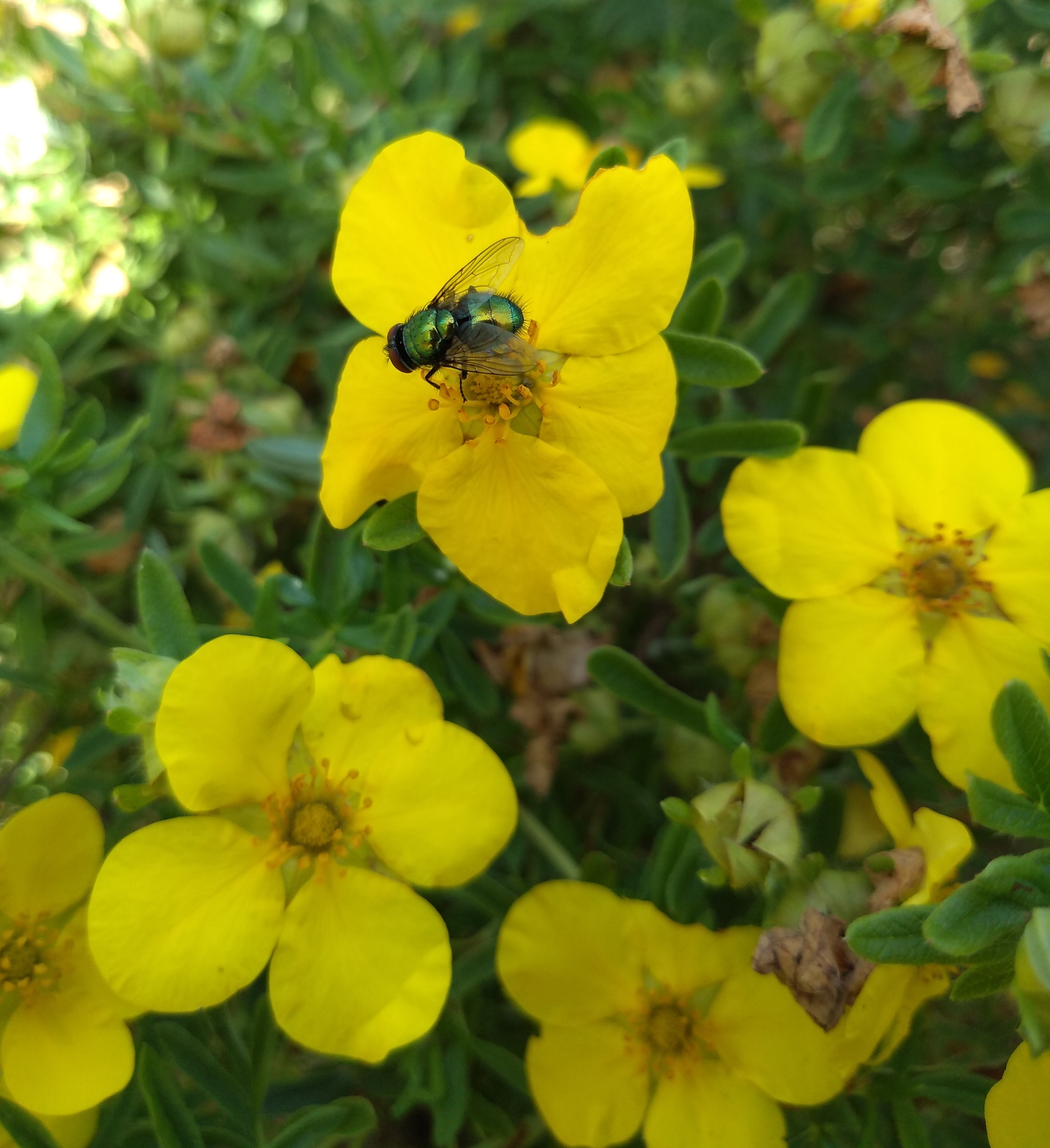
– plus a Long hoverfly (Sphaerophoriascripta), whose larvae feed on aphids, and a Common green bottle fly (Luciliasericata) on a Potentilla plant.
Capturing the Common green bottle fly was accidental but it worked out really well. In the sun its glistening metallic colouring is highlighted against the yellow Potentilla flowers. Their maggots feed on dead tissue so their appearance is used to accurately determine time of death. Adult Common green bottle flies on the other hand are useful pollinators, as the last photo proves. Fascinating how different stages of this fly species exists alongside both death and life.







 Bee in the Moment