Posted in nature

Garden Treasures

It feels like spiderweb season, the time when they become more prevalent, has arrived. I often get a face full of web when I accidentally walk into hidden ones as I work.

The spider’s web I come across most often is created by the European garden spider (Araneus diadematus). Also called the Diadem spider, Garden cross spider or Crowned orb weaver, due to the pattern on their abdomen and large circular webs they weave.

Males are 9mm in length, smaller than females (which grow to 15mm). Colouration can vary from light to dark brown and even burnt orange.

They are often found in gardens but also inhabit woodlands and meadows. The large orb webs (up to 40cms diameter) become more noticeable at this time of year in strong sunlight, due to the position of the sun, especially when glistening with dew in the mornings.

Those spiders which have survived summer will be mature adults now and start mating when autumn arrives. Males pluck the threads of the female’s web before he approaches, so he isn’t mistaken for food. However this tactic isn’t 100% successful as they can still become prey, even after mating. In late autumn a pregnant female will lay her eggs and spend every second protecting them until she eventually dies. Any adult spider still alive by November will succumb to cold weather.

The young spiderlings will survive winter inside a protective egg sac made of silk, to hatch in May the following year. Repeating the process of feeding on insects caught in webs (after being given a paralysing bite and wrapped in silk for later). They may not be the nation’s favourite garden helpers but they reduce pests and therefore should be treasured just like Ladybirds.

I also learnt a new plant last week. Standing out like a jewel amongst the other perennials was the beautiful Bog sage (Salvia uliginosa).

A Buff-tailed bumblebee (Bombus terrestris) visiting some Bog sage.

As it’s common name suggests this plant grows in damp areas. The one I saw was planted in a herbaceous border that used to be a pond which never completely dries out.

Originally from South American waterways (between Brazil to Argentina) this tall hardy perennial also requires a sunny position to survive. The beautiful blue flowers, loved by bees, bloom between August and October so this plant is a wonderful addition to gardens for extending the pollinating season.

Posted in nature

Every Day is a School Day

No doubt due to the recent weather, I have noticed more flowers blooming earlier than their traditional start time of June. One example is the Common nipplewort (Lapsana communis).

The Common nipplewort is part of the sunflower family.

Other plants flowering at the moment are Greater celandine (Chelidonium majus),

This isn’t a relative of the Lesser celandine (Ficaria verna) despite its name. It is part of the poppy rather than buttercup family.

– Three-cornered garlic (Allium triquetrum),

Ants spread the seeds of this wild flower.

– Red campion (Silene dioica),

A dioecious plant, male flowers bloom on separate plants to the female flowers.

– White campion (Silene latifolia),

White campion is pollinated by moths because it is night scented

– Cleavers (Galium aparine),

The flowers of Cleavers are tiny. This photograph has been enlarged so they can be seen more clearly.

– Common honeysuckle (Lonicera periclymenum),

I noticed the sweet scent first. This plant is beneficial for a variety of butterflies, like the White admiral (Limenitis camilla), bumblebees and moths. Birds such as Thrushes (Turdidae), Warblers (Sylvidae) and Bullfinches (Pyrrhula pyrrhula) also eat its berries. Plus Dormice (Muscardinus avellanarius) inhabit and feed on this plant.

– A sow thistle (Sonchus),

– A Hawkweed (Hieracium),

– Mouse-ear Hawkweed (Hieracium pilosella)

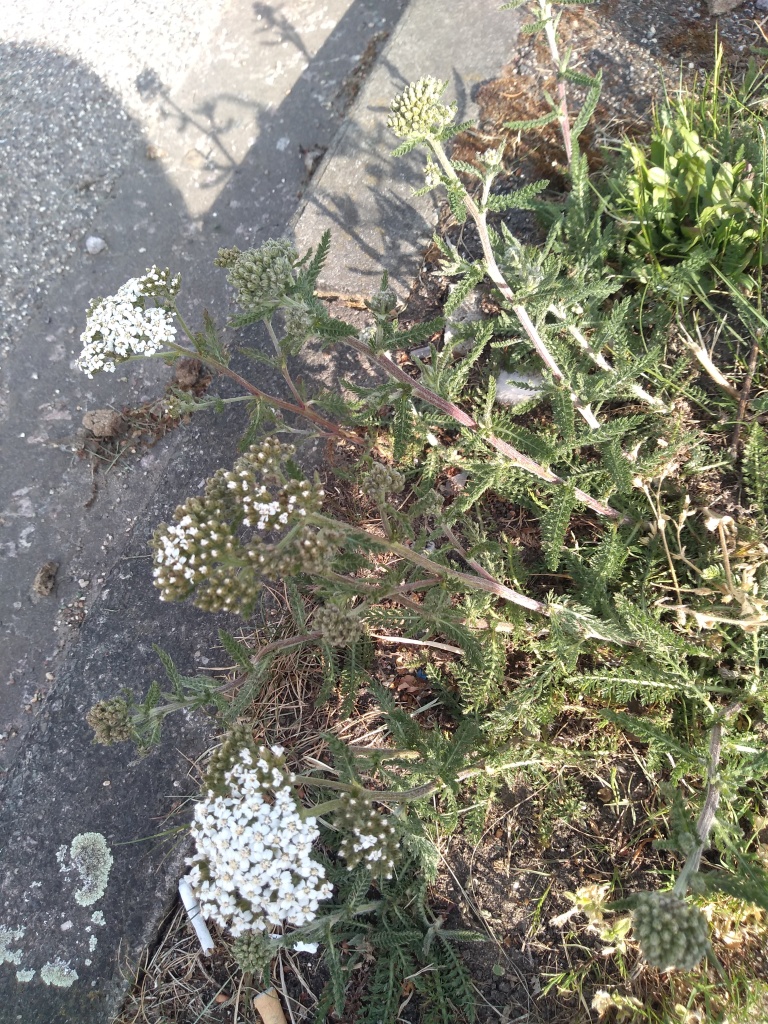
– and Yarrow (Achillea millefolium).

A plant that was new to me was Common knapweed (Centaurea nigra).

Along with all the wild flowers I noticed last week, the warm weather continued to encourage lots of insects out. There were more Holly blue (Celastrina argiolus) and Orange-tip (Anthocharis cardamines) butterflies along with bumblebees.

I also saw a Cinnabar moth (Tyria jacobaeae) at the allotment, amongst the long grass.

This moth flies flies during the day as well as at night time.

The most interesting insect I observed last week was a Pine ladybird (Exochomus qadripustulatus).

I have never seen this species of ladybird before. It dropped onto my sunglasses as I worked. Due to its small size (3mm in length), to begin with I thought it was a bit of dirt. As the name suggests, this beetle inhabits Pine (Pinus) trees. However they can also be found around other trees and shrubs especially Hawthorn (Crataegus monogyna).