Posted in nature

Common Insects but an Uncommon Viewing Experience

It was great to still witness pollinators flying around last week. Even though, due to the colder weather numbers have greatly reduced, some insects are still foraging. I noticed the odd hardy Buff-tailed bumblebee (Bombus terrestris) as well as a few Honey bees (Apis mellifera) visiting autumn flowering perennials and shrubs. Currently the most wonderful spectacle is Common Ivy (Hedera helix) in full bloom. Loved by pollinators including butterflies, bees and hoverflies, ivy is a useful plant to have in flower at this time of year. It supports up to fifty species altogether, such as providing food for Holly blue Butterflies (Celastrina argiolus), along with the Small dusty wave (Idaea seriata), Angle shades (Phlogophora meticulosa)
and Swallow-tailed (Ourapteryx sambucaria) moths. Mature Ivy plants flower in September and October on clustered umbels. Eventually, pollinated flowers develop into fruit that provides food for Thrushes (Turdidae), Blackbirds (Turdus merula), Blackcaps (Sylvia atricapilla) and Wood pigeons (Columba palumbus). Ivy also provides shelter for hibernating insects over winter.

However the most prevalent insects I witnessed covering the ivy flowers last week were the Common wasp (Vespula vulgaris). They weren’t nesting amongst it but feeding on the abundant nectar. My confidence in their complete focus on the ivy flowers, and not being bothered by my presence, enabled me to unusually observe them up close. Each time I came across ivy covered with wasps, I would take a few moments to watch and listen. Unlike bees, their buzzing was very faint; you had to listen carefully to hear it. I had never been close enough to appreciate the wonderful pattern on their abdomen before or watch their activity as they hurriedly switched from one flower to another.

I would have been observing male and worker wasps obtain nectar from the ivy (which also visit other umbellifier flowers). Queens are active in spring, collecting nectar from Cotoneaster and other spring flowering shrubs.

These much hated creatures are useful pollinators (as the photo below proves) when not pestering us as we eat outdoors. We can’t really blame them trying to access an easy source of food or protecting nests when we stumble upon them.

Wasps also help keep insect numbers down which once captured, are chewed up and fed to the larvae.

Although I haven’t seen any yet, I am ever hopeful that I will see Ivy bees (Colletes hederae) as I look at ivy. Recorded for the first time in southern Britain as far back as 2001, these solitary bees feed on ivy nectar and are therefore only seen when ivy flowers. Since they were first noted in Britain the species has been spreading northwards, nesting in sandy soil. For further information see (Wildlife Trust).

More fungi started to appear last week too; I saw
– Common bonnets (Mycena galericulata)

– Shaggy ink caps (Xylaria hypoxylon) and

– Candlesnuff (also referred to as candlestick or stag’s horn) fungus (Xylaria hypoxylon).

You have to look closely to identify this minute fungi, found on decaying wood, it has a blackened base.

Lastly I was utterly surprised to witness a Fox (Vulpes vulpes) run across my allotment as I worked early on Saturday afternoon. It looked healthy so presumably had been disturbed with all the activity from allotmenteers tidying their plots.

Posted in nature

October Arrives

The results from the UK’s Big Butterfly Count 2020 were released last week. This summer, between 17th July to 9th August over 1.4 million butterflies were counted. However, while the amount of people taking part increased, overall the average numbers of butterflies were down 34% from the previous year (and were the lowest average since 2009 when the first count took place).

One difference from the 2019 results was the amount of Painted Lady (Vanessa cardui) butterflies. Last year was great for this species as a huge migration of Painted Ladies arrived to the UK from the continent; this spectacle wasn’t repeated this summer. Whatever other reasons for the results this year, it does show the fragility of nature and how quickly things can change.

Yet there are things we can do to improve this situation in the future; for example, growing food for caterpillars as well as providing shelter and nectar. The Butterfly Conservation website provides helpful tips on how we can help butterflies within our gardens.

More information on the results, including the breakdown of the individual species, can be seen on the Butterfly Conservation website too (see here).

It is still possible to see Butterflies on sunny days, along with moths, even in this month as shown on the picture below (also provided by the Butterfly Conservation charity).

Posted in nature

Pretty in Pink

Some late summer flowering plants such as Lavender, Buddleia and Nepeta have begun to wane; however others were starting to look their best. One which started performing last week was Hylotelephium spectabile (‘Brilliant’ series), also referred to as Sedums, Stonecrop or Ice plants.

Loved by pollinators (especially bees) Sedum are great plants to grow in gardens to extend the nectar and pollen season.

These hardy perennials die back to ground level over winter; however until then the seedheads can be left for structural interest allowing hiding places for hibernating insects. They are succulents and therefore like well drained soil in full sun or partial shade. Once established they can cope with dry conditions, continuing to flower until November.

Mature plants can begin to flop, so to prevent this the Chelsea Chop can be carried out. This technique of cutting every stem by a third enables the plant to grow with a bushier habit as well as prolong the flowering period. It is called the Chelsea Chop because this job is done in the last week of May, when the RHS Chelsea flower show takes place. This technique can be used with other perennials that bloom later in the year too. Further information on this can be found on the RHS website.

These Sedums look wonderful in herbaceous borders alongside other fantastic pollinator plants which flower at this time of year.

Hylotelephium spectabile (‘Brilliant’ series) alongside Asters and Echinacea
Hylotelephium spectabile (‘Brilliant’ series) planted with Geranium ‘Rozanne’
and Ceratostigma willmottianum.
Geranium ‘Rozanne’
Ceratostigma willmottianum
Posted in nature

New House Build. 🐝

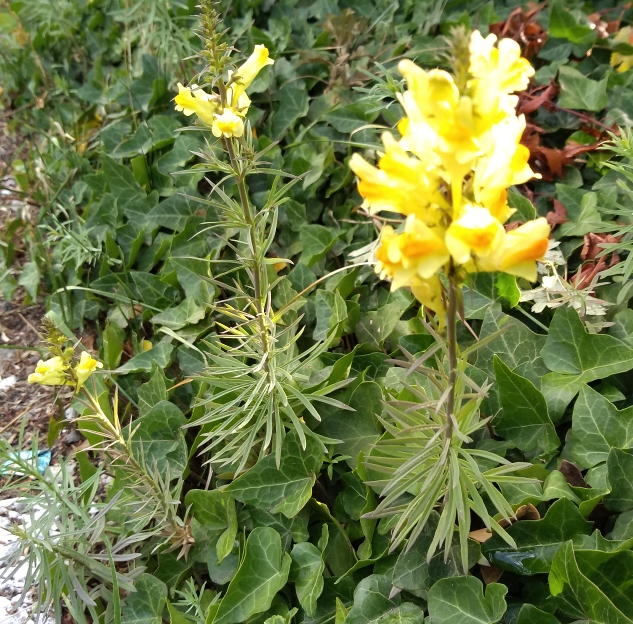
Some fields along my journey to and from work contain a lovely combination of pink Rosebay Willowherb (Chamaenerion angustifolium), purple Buddleia and white Wild carrot (Daucus carota) flowers. Not only do they compliment one another visually but they are all loved by pollinators too. Yellow toadflax (Linaria vulgaris) has started to bloom along the roadside as well.

One special moment occurred on the Monday. As I worked within a border I noticed a Buff-tailed bumblebee (Bombus terrestris) queen flying around a patch of grass. Eventually she began to settle and after a few more large sweeping flights began making a nest in the lawn.

It didn’t take her long to dig into the soil beneath the grass.

She will remain under ground until spring when she will start her own colony.

It was also great to finally get some photos of insects that have have alluded my photographic capture so far this year.

– The first is the Red admiral (Vanessa atalanta),

– Some Hoverflies, including a Hornet mimic (Volucella zonaria) hoverfly,

Hornet mimic Hoverfly pollinating Wisteria flowers that were still blooming.
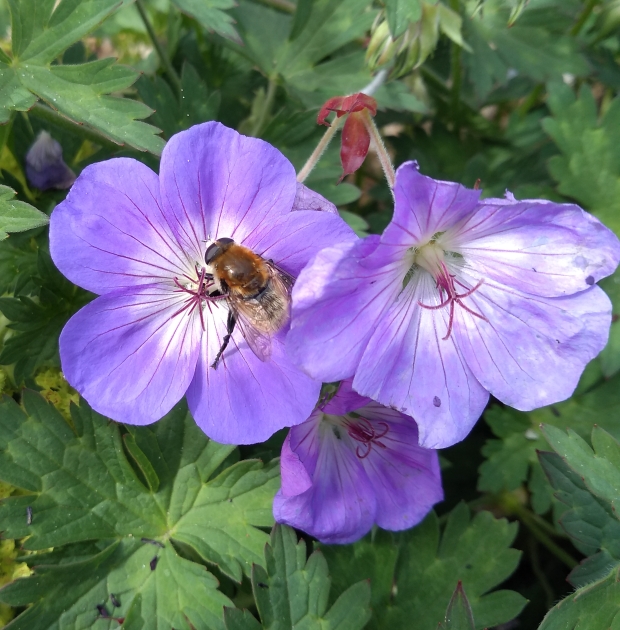
Hoverfly pollinating Geranium flowers.

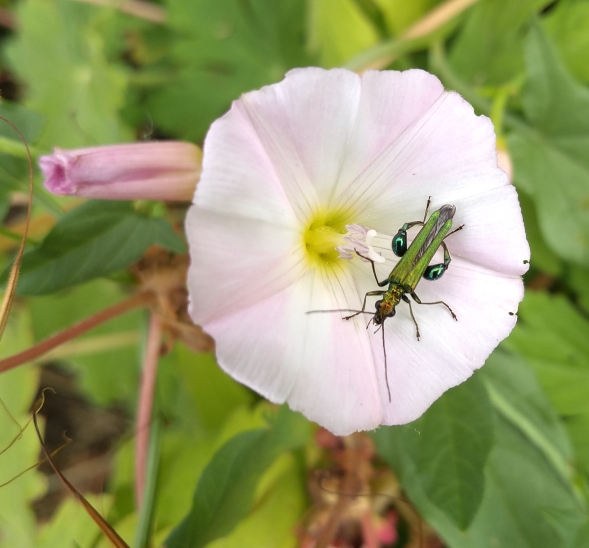
– as well as a Male False oil beetle (Oedemera nobilis), to compliment the female one seen on a walk earlier in the year.

A False oil beetle pollinating a Field bindweed (Convolvulus arvensis) flower.

The males are easily identified due to their large metallic thighs, explaining the reason behind the other common name for this insect the Swollen-thighed beetle.

Posted in nature

Allotment of Dreams

If I create a wildlife friendly allotment nature will come. My allotment is really filling up and blooming now even though I’ve only had it since February. Most of the plants are from seed, cuttings or rescued from other gardens. For the first year I plan to let the plants develop before harvesting properly.

We’ve had so much rain in recent days that I didn’t need to visit the allotment to water during the week. So last Saturday was the first time in seven days that I visited my plot to undertake major garden tasks. It was the summer solstice and the weather was glorious.

As I walked around to check how things were, I noticed a large number of wildlife; nature had come.

The first things I saw were two Small tortoiseshell Butterflies (Aglais urticae) pollinating the Thyme ‘Lemon curd’ (Thymus ‘Lemon curd’)

whilst Oedemera beetles were taking advantage of the Dandelions (Taraxacum officinale) left on the grassy walkways.

Several Buff-tailed bumblebees (Bombus terrestris) busily flew between the flowers on a neighbouring allotment’s Hebe and flowers on my patch, including the Lacy Phacelia (Phacelia tanacetifolia)

as well as the Borage (Borago officinalis).

A Honey bee (Apis mellifera) also visited the Borage.

There was even a solitary bee buzzing about; an Ashy mining bee (Andrena cineraria) pollinating the Hebe.

Most likely this is the bee that was accidentally unearthed the previous weekend while getting rid of bindweed from around the potatoes (see photo below).

I had contacted the Bumblebee Conservation Trust to see if they could identify this silvery bee, if indeed it was a bee. Stephanie Miles answered my query explaining; ‘This is indeed a bee! It’s a male solitary bee of the genus Andrena. When these bees first hatch from the pupa they’re completely silver-haired, like this – over a day or so they dry out, lay down pigmentation, and the normal colour appears. Once the normal colour appears they can be identified to species level. You disturbed this one before it was quite ready to be seen in public!’ Therefore the Ashy mining bee seen on the Hebe seems a likely candidate.

Seven-spot ladybirds (Coccinella septempunctata) in different stages of development were resting on potato, Calendula (Calendula officinalis) and Borage foliage. There were newly formed adults along with the larvae.

A young Seven-spot ladybird before the recognisable red and black beetle develops fully.

Outside of my allotment wildflowers that are beginning to bloom included;

– Ladies bedstraw (Galium verum),

– Rosebay Willowherb (Chamaenerion angustifolium),

– Spear-leaved Willowherb (Epilobium lanceolatum),

– Creeping thistle (Cirsium arvense),

– Spear thistle (Cirsium vulgare),


– Hedge bindweed (Calystegia sepium)

– and Self-heal (Prunella vulgaris).

Posted in nature

Increased Sunshine to Lift the Spirits.

With an increase in sunnier moments last week the more life is seemed to come out to enjoy the sun’s rays. Amidst these strange times I am especially glad I can enjoy nature therapy. In particular seeing Bumblebees flying around makes me smile. Along with several Buff-tailed Bumblebees (Bombus terrestris), I also saw a Hairy-footed flower bee (Anthophora plumipes) last Wednesday.

A Hairy-footed flower bee visiting Lungwort (Pulmonaria officinalis).
A Buff-tailed Bumblebee (Bombus terrestris) pollinating Winter heath (Erica Carnea).

In fact Wednesday was a very productive day for sightings. I saw my first lacewing (Neuroptera) of the season, which was hitching a ride in the van. I also saw a couple of 7-spot ladybirds (Coccinella septempunctata) amongst some Heuchera

Last week was great for counting frogs (Rana temporaria) too. On Wednesday there were seven attempting to remain shaded by a pile of scaffolding boards in a garden attached to a new build development. Consequently the frogs were moved to a quieter area so that access could be gained to the garden. Even on Thursday, as I worked next to a pond, I observed tadpoles emerge; It was fascinating to see the process unfold. I couldn’t count the total number of tadpoles but the pond was full of them as well as frogspawn; as it had been the previous year. Plus I even found a frog on the allotment.

As well as amphibians and insect sightings, further flowers blooming were,
Glory of the snow (Chionodoxa luciliae)

Anemone apennina and

Two-leaf squill, also called Alpine squill (Scilla bifolia)

Posted in Bookworm review, nature

Bookworm Review- The Wild Remedy (How Nature Mends Us~ A Diary) by Emma Mitchell

I have wanted to read this book for a while. As somebody who seeks solace in nature, especially when my depression and anxiety worsen, I am always interested in reading about other peoples experiences.

A long time sufferer of depression Emma describes her ‘Grey Slug’ through the seasons and she uses nature to improve her mental well-being along with conventional help. She lives in the Cambridgeshire fens and sees a variety of wildlife from insects to mammals and wild flowers such as the Bee Orchid as she explores her local area.

Even during her darkest days, when she is unable to go out of the house to emerse herself in nature, she relies on watching birds in her garden.

This lovely book is soothing and inspirational. Her writing transports you to the world around her, while her beautiful illustrations and photographs are a joy to look at. This book is proof that nature can help mend us.

Posted in nature

Growing Food for Birds

I saw contrasting images last week which made me think of feeding birds with plants from the garden.
I first observed the Rowan (Sorbus) tree outside, now stripped bare of it’s berries, before noticing some Cotoneaster

and Ivy (Hedera) full of berries. Clearly the pollinators had been busy during the Summer and Autumn months.

Along with supplementary food, on the ground and bird feeders, birds can also rely on trees and other plants in the garden for food in winter. Along with the examples already mentioned there are other berries, fruit, seeds and nuts which are enjoyed by birds.

Some other plants providing fruit and berries are;
Hawthorn (Crataegus)
Honeysuckle (Lonicera)
Guelder rose (Viburnum opulus)
Dog rose (Rosa canina)
Berberis
Bird cherry (Prunus padus)
Crab apple (Malus sylvestris)
Blackthorn (Prunus spinosa)
Pyracantha
Sarcococca hookeriana
Mahonia

Plants providing seeds and nuts include;
Oak (Quercus)
Beech (Fagus)
Hazel (Corylus)
Spindle (Euonymus europaeus)
Teasel (Dipsacus)
Sunflower (Helianthus)
Miscanthus
Bergamot (Monarda)
Verbena bonariensis
Lavender (Lavandula)
Yarrow (Achillea millefolium)
Asters

Leaving seedheads on perennials not only provides food for birds, they also give shelter to beneficial insects. In fact a little bit of leaf litter also has this affect which in turn helps feed birds who eat the insects.

Common birds to see in winter include;
Redwings (Turdus iliacus)
Waxwings (Bombycilla)
Starlings (Sturnidae
Blackbirds (Turdus merula
Robins (Erithacus rubecula
Chaffinches (Fringilla coelebs)
Bramblings (Fringilla)
Goldfinches (Carduelis carduelis)
Bullfinches (Pyrrhula pyrrhula)
Dunnocks (Prunella modularis)
Goldcrests (Regulus regulus)
Blue tits (Cyanistes caeruleus)
Long-tailed tits (Aegithalos caudatus)
Coal tits (Periparus ater)
Great tits (Parus major)
Fieldfares (Turdus pilaris)

The RSPB Big Garden Birdwatch, which takes place on the 25-27th Jan 2020, has been going for over 40 years. Surveying birds visiting your Garden or local park for one hour is calming and enjoyable. This citizen science continues to give the charity useful information on the numbers of birds in the UK.

Further information on feeding birds can be found in the book, ‘RSPB Pocket Bird Feeder Guide’ by Robert Burton (published by Dorking Kindersley) or on the Gardeners World website.

Posted in nature

National Tree Week (23/11/19-01/12/19)

Meteorological winter has begun. Rather appropriately Autumn turned wintery yesterday as we had a very cold and frosty start to the morning. Apparently it was the coldest night since February.

National tree week ends today too. Started by the Tree Council in 1975 it’s a time to focus on the importance of tree planting along with celebrate these amazing plants. The week coincides with the best time of year to plant trees. This time round there has been a specific emphasis on promoting the usefulness of trees in combating climate change (by pollution and carbon dioxide absorption).

I have planted many trees in the past, however last week the main job continued to be leaf collection.

A little momento of some beautiful leaves.

While most trees shed leaves consistently over a period of time, in my experience, leaf drop of English/ Pedunculate Oak (Quercus robur) and European Beech (Fagus sylvatica) tends to occur in one go at the end of Autumn. This has certainly been true this year, as we collected huge amounts of leaves from large Oak and Beech trees in many gardens; their beautiful rich autumnal colours like carpets on the ground.

Both these deciduous trees are from the Fagaceae family which explains their similarities. Both grow to great heights, have dense canopies and can exhibit marcescence (where some dead leaves are retained on the trees throughout winter).

Both trees are great for wildlife too. Beech nuts are eaten by Deer, Badgers (Meles meles), Grey squirrels (Sciurus carolinensis), Mice, Chaffinches (Fringilla coelebs) and Brambling (Fringilla montifringilla). Even the foliage is food for caterpillars of several species of moth like the Barred hook-tip (Drepana cultraria) and Olive crescent (Trisateles emortualis). Beech trees create a vital habitat for butterflies along woodland edges as well; including Orange-tip (Anthocharis cardamines) and Gatekeepers (Pyronia tithonus). Plus ectomycorrhizal truffle fungi grow beneath them. Turned into hedges, Beech can also create a habitat for birds.

As with the European Beech, the Pedunculate Oak supports a variety of fungi, animals, birds- particularly Jays (Garrulus glandarius) and insects such as Stag beetles (Lucanus cervus)
and the Purple hairstreak (Neozephyrus quercus) and Purple emperor (Apatura iris) butterflies. In fact of all the native British trees the Pedunculate Oak supports more wildlife than any other tree. Even its leaf litter and dead wood is full of life. I love these wonderful trees, especially ancient oaks. I enjoy thinking of all the hidden life existing alongside me as I work in the gardens. Also they are wonderful trees to hug. 🌳🤗

Posted in nature

Quieter Days Ahead

We finally have some rain today, the start of some wetter weather this week. It looks very autumnal and very different from the weather of late. Although last week was still sunny and dry the amount of butterflies have reduced. However I do still see some Small white butterflies (Pieris rapae) flitting about. Wednesday was the best day for seeing these butterflies along with bees.

In a few gardens many late flowering plants are blooming nicely; this is especially important for pollinators that are still around in Autumn. Extending the season at the beginning of the year is just as helpful too. Early flowering bulbs, shrubs, wildflowers (including dandelions) Hellebores and Pulmonaria are great for the bees that forage in early spring. The first bees of spring are various solitary bees and the queens of some bumblebees (see Wildlife Trusts).

On Wednesday I saw;

– a Buff-tailed bumblebee (Nimbus terrestris) and Tree bumblebee (Bombus hypnorum) on Helianthus ‘Lemon queen’ flowers,

Buff-tailed bumblebee

Tree bumblebee

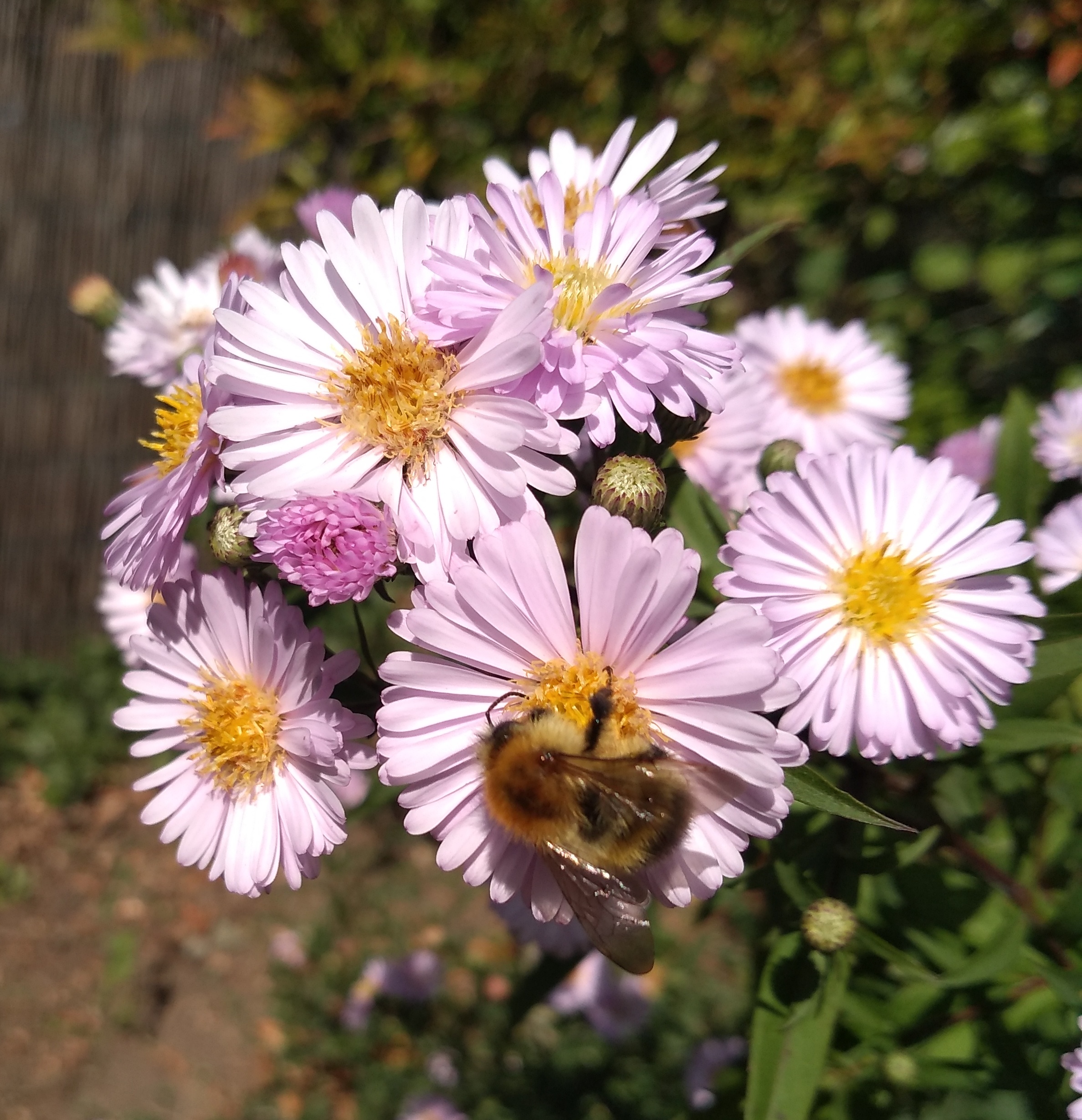
-Common carder bees (Bombus pascuorum) visiting Aster, Verbena bonariensis and Rudbeckia,

Aster

Verbena bonariensis

Rudbeckia

– and a Small white butterfly on Aster flowers.

On Friday I noticed more Common carder bees as they visited a hardy Fushia. This was the first time I noticed bees visit a Fushia so it was lovely to see it happen. These bees have long tongues and because they are small can collect nectar easily from Fushia flowers. However the two bumblebees I saw this week are larger and have short tongues which explains why I saw them visiting the Helianthus. Interestingly though Buff-tailed bumblebees are able to ‘rob’ nectar from bell shaped flowers by cutting a hole in the side of the flower to access the nectar. White-tailed bumblebees (Bombus lucorum) can also undertake nectar robbing. Even so single flowers, together with a variety of flower shapes are important for bees and other pollinators. Plus night scented flowers are beneficial for moths.

Another sighting from Wednesday was watching a Red Kite (Milvus milvus) soaring in circles above where I worked. I love hearing Red kites repeatedly call as they fly; it is a beautiful sound.

As well as insects and birds, occasionally I get to see wild mammals as I work too. There was an instance of this last Monday. I noticed a Fox (Vulpes vulpes) exiting a hedge and run into the neighbouring garden while I ate my lunch.