There have been really cold moments this January, with temperatures barely reaching positive numbers here in the UK and some areas experiencing more snow; however nature has started to emerge once again.
On a walk a few weeks ago, I noticed Blackthorn (Prunus spinosa) buds ready to burst open and the tiny red female Hazel (Corylus avellana) flowers open alongside male catkins.
Blackthorn budsHazel flower and catkins
Cyclamen and Snowdrops (Galanthus) are also blooming now and even Daffodils (Narcissus) and Crocus are beginning to push through the now defrosted ground.
Last weekend was the annual RSPB’s Big Garden Birdwatch. My results this year were; 3 Wood pigeon (Columba palumbus) 5 Starlings (Sturnus vulgaris) 2 Blackbirds (Turdus merula)- 1 female and 1 male 2 Great tits (Parus major) 1 Magpie (Pica pica) 1 Robin (Erithacus rubecula) 3 Bluetits (Cyanistes caeruleus) 2 House sparrows (Passer domesticus)- 1 male and 1 female 2 Goldfinch (Carduelis carduelis) along with 2 Carrion crows (Corvus corone)
It’s hard to believe it’s now February. As usual during January I slowed and hunkered down, reflecting nature at this time. Yet the wild flowers are beginning to stir and birds pairing up. It isn’t long before spring arrives and I am already starting to plan what I shall grow on the allotment this year.
Last week began with Spring bank holiday monday. I went for a socially distant walk around the village with my partner. Thankfully he was very patient as I constantly stopped to take photos with my phone.
There were lots of sights and sounds to observe and it really felt like a summers day (which aren’t far off). Some I have noticed for a while like Orange-tip Butterflies (Anthochariscardamines), Red-tailed bumblebees (Bombuslapidarius), Skylarks (Alaudaarvensis), Red kites (Milvusmilvus) and House sparrows (Passerdomesticus).
Yet amongst the Elderflowers (Sambucus nigra) and Brambles (Rubus fruticosus), which are blooming at this time of year,
These flowers are great for making Elderflower cordial.Looks like there will be lots of Blackberries this year.
were many more plants flowering too. The explosion of colour within our countryside is fantastic for pollinators. One insect I saw on Mondays walk, in a field busily pollinating Buttercups (Ranunculus), was the False oil beetle (Oedemeranobilis). This very small beetle is a vibrant metallic green colour. When it’s wings glistened in the sun, they changed from mid to light green.
Unfortunately this is the best photo I managed to get of this tiny beetle.
Upon my return to work, I noticed other insects flying about. Several small tortoiseshell Butterflies (Aglaisurticae) were too quick for me to photograph, however I did capture Common carder bees (Bombuspascuorum) on Common comfrey (Symphytumofficinale) and
a Cream Spot Ladybird (Calviaquattuordecimguttata)
Once again, another ladybird determined to get my attention by falling on my sunglasses while I wore them.
The Cream Spot ladybird has fourteen spots and survives winter in tree bark and Beech masts. Although it is usually found amongst hedgerows rather than gardens.
Wildflowers that were in full bloom last week were;
-Purple toadflax (Linariapurpurea),
-Field scabious (Knautiaarvensis),
– Common stork’s-bill (Erodiumcicutarium),
This plant is a good food source for Brown argus Butterfly (Aricia agestis) caterpillars, along with Meadow and Dove’s-foot Crane’s-bills (mentioned below). This butterfly is often found in southern chalk and limestone grassland but it can also inhabit places with disturbed soil like verges and coastal areas. In fact this plant was found on disturbed soil edging a field.
-Meadow crane’s-bill (Geraniumpratense),
-Creeping cinquefoil (Potentillareptans),
-Common poppy (Papaverrhoeas),
-Dove’s-foot Crane’s-bill (Geraniummolle),
-Field bindweed (Convolvulusarvensis),
-Common mallow (Malvasylvestris),
-Creeping woodsorrel (Oxaliscorniculata),
-Birds-foot trefoil (Lotuscorniculatus) and
-White clover (Trifoliumrepens).
Found amongst lawns, this is a wonderful food source for the Common blue butterfly (Polyommatusicarus) and some bumblebees
Recent weather conditions have caused dryness within nature that normally exists during summertime. Water is already required and talk of conserving water has already begun to help prevent restrictions later in the year. I shall be interested to see how nature deals with this early warm dry weather, especially with less human disturbance due to lockdown. Will it be another great year for butterflies? I look forward to discovering more as we spring into summer.
On Saturday night I woke up to a beautiful duet. A pair of Tawny owls (Strix aluco) were calling to one another, reinforcing their territory. The male call sounds like ‘hooo, hu, huhuhuhooo’ while the female gives a ‘keewik’ sound (see BTO).
Tawny owls pair for life and remain in their territory (initially established in winter) throughout the year. Deciduous broadleaf woodland is their traditional habitat but sometimes they live in large gardens and parkland. They nest within tree cavities or nest boxes. Occasionally eggs are laid in February but more often between March and April. While the female is slightly larger than the male, these owls are the same size as a wood pigeon. They feed on small mammals, birds, rodents, fish, frogs, insects and worms. Their UK Conservation Status is Amber as their numbers are declining.
Another bird which caught my eye last week was a male House sparrow (PasserDomesticus). I was leaving the allotment when I observed him collecting nest material before flying off. As with the Tawny owl, House sparrows pair for life and their numbers have also been declining for a while; House sparrows are Red in the UK Conservation Status list. I grew up seeing lots of them but since moving down south, I haven’t seen one for years so this was a wonderful sight. I love these little birds, especially hearing their chattering and chirping in their colonies. Hopefully I will see him and more Sparrows soon.
As the week went on I noticed more flowers blooming in the hedgerows. Wild strawberry, also called Alpine strawberry (Fragariavesca), was the first one I saw.
The fruit of this strawberry can be eaten.
Others I saw were; Bugle (Ajuga reptans),
These flowers are visited by White-tailed bumblebees (Bombus lucorum), Common carder bees (Bombuspascuorum), Silver Y moths (Autographa gamma) alongwith Green-veined white butterflies (Pieris napi).
– Herb bennet/Wood avens (Geum urbanum) and
Grizzled skipper butterfly (Pyrgusmalvae) caterpillars feed on this plant.
– Bush vetch (Vicia sepium).
Bees and other pollinators enjoy these flowers.
I got to see a female Orange- tip (Anthocharis cardamines) butterfly, having seen a male one the other week. Males have the orange tips while the tips on the female’s forewings are black (both have the black spots). The female can be identified apart from other white butterflies by the mottled green and white underwings (also exhibited by the males). Caterpillars of this butterfly feed on Garlic mustard (Alliaria petiolata) and Cuckoo flower (Cardamine pratensis).
While my colleagues listen to their music via headphones I prefer to listen to nature as I work; especially birdsong which I find uplifting. Recently I have started to really tune in and distinguish different songs and calls as I attempt to identify particular birds. By teaching myself I now recognise Great tit (Parusmajor) song, Coal Tit (Parusater) song and Tawny Owl (Strixaluco) call. However I still find it difficult to pick out certain sounds which is why last Sunday I went to an ‘Introduction to bird calls and songs’ nature talk and walk at a local park. We were introduced to 12 birds that we would most likely hear during our afternoon stroll. Most were already familiar to me however I did learn the songs of Chiffchaff (Phylloscopuscollybita) and Greenfinch (Carduelischloris).
The birds we ended up hearing (above the wind and sirens) were;
-Woodpigeon (ColumbaLivia)
-Carion crow (Corvuscorone)
-Magpie (Picapica)
-Wren (Troglodytidae)
-Chiffchaff
-Blackbird (Turdusmerula)
-Great Spotted Woodpecker (Dendrocopus major)
-Blackcap warbler (Sylviaatricapilla)
– and Song thrush (Turdusphilomelos).
We also saw a (quiet) Jay (Garrulusglandarius) along with a Speckled wood butterfly (Parargeaegeria), Red admiral butterfly (Vanessaatalanta) and some White-tailed bumblebees (Bombuslucorum).
Last week I combined what I learned at this event with my previous knowledge; the birds I was confident I identified correctly were;
-Woodpigeons
-Magpies
-Blackbirds
-Robin (Erithacusrubecula)
-Ring necked parakeets (Psittaculakrameri)
-Blue Tits (Paruscaeruleus).
-Chiffchaffs
-Mallard (Anasplatyrhynchos)
-Red kite (Milvusmilvus)
-and House sparrows (Passerdomesticus)
On several mornings I also watched the family of Blue tits on the Rowan tree as I ate breakfast. The parents had nested in the eaves around Easter (see Different sort of Easter Chicks) so it was great to discover they had a successfully reared a brood. I counted 6 fledged youngsters return to the tree and feed on insects together.
Blue Tit acrobatics- One of the youngsters feeding itself.
These weren’t the only sightings last week as I also saw;
-another Red Admiral butterfly
I have been away for a few days, emersed in beautiful countryside. Below are a few special highlights from last week.
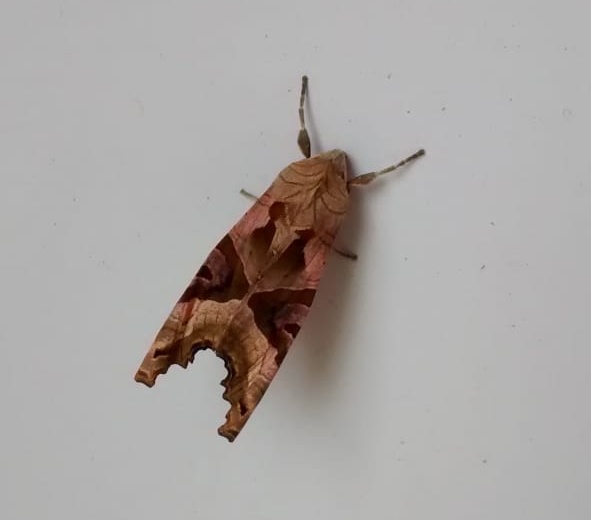
Firstly this Angle Shades Moth (Phlogophorameticulosa) was resting on the door, early Wednesday morning, as I set off on holiday.
Then, on Thursday, I visited Chirk Castle. While looking around the old Laundry building I noticed something swoop from the ceiling and land on a beam.
This juvenile Swallow (Hirundorustica) wasn’t too far from the nest, which was therefore easy to locate. The hint of a red throat was present but not easy to spot in this photo due to distance and low lighting.
The swallow nest in the rafters.
Lastly I awoke early on Sunday, relaxed with a cup of tea and listened to the dawn chorus. The 5th was International Dawn Chorus Day (celebrated on the first Sunday in May each year). The change of scenery brought with it a change in bird song to listen to. I heard a Collard dove (Steptopeliadecaocto), Goldfinch (Cardueliscarduelis) and House Sparrows (Passerdomesticus) along with the Blackbirds (Turdusmerula) and Bluetits (Paruscaeruleus) that I usually hear.




 Bee in the Moment