Posted in nature

September Changes

September brought in a change of weather; stormy wetter conditions set in along with cooler mornings. Earlier in the month, I was lucky enough to witness a mini murmuration of Starlings (Sturnus vulgaris) as they flew away from a storm that was rolling in. The commotion they produced made me look up; there were about 30 to 40 of them grouped together before they eventually headed off.

Hedgerow foraging has been mixed due to the dryness earlier on in the year.
There are fewer conkers but the Horse chestnuts (Aesculus hippocastanum) showed signs of stress as the leaves began to brown off at the end of August. While there have been plenty of blackberries this year, most were smaller and dried up. Plus elderberries ripened a month earlier than usual. There have been plenty of walnuts and acorns though.

Fungi has begun to appear lately. One I spotted on an Ash tree (Fraxinus) was the Shaggy bracket (Inonotus hispidus).


Commonly found on deciduous trees, mostly Ash but also Planes (Platanus), Walnut (Juglans regia) and Apple (malus), it is inedible; attacking the trees heartwood, entering through a wound. It starts off with a velvety look (as seen in the photo) but eventually becomes brittle and black.

Posted in nature

Garden Gems

For the last couple of weeks conkers and sweet chestnuts have begun to fall, there isn’t a big harvest, neither are there lots of acorns or beech masts. However 2020 was a mast year (where trees produce bumper crops) so reduced harvests this time isn’t too surprising; Mast years only happen every five to ten years. However the low numbers could also be due to this years cold damp spring impacting bud development and fertilization, especially with wind pollinated trees. This issue is discussed further in an article by the Woodland Trust see Nature’s Calendar.

It has been lovely to notice Boston ivy (Parthenocissus tricuspidata), along with Virginia creeper (Parthenocissus quinquefolia) develop their bright red autumnal colour. They are so vibrant in the low autumn sunshine. I’ve also noticed the small beginnings of autumn leaf colour in many trees too.

Boston ivy growing up a wall of an old building.
Virginia creeper winding its way through some shrubs.

Now that October has arrived, Cyclamen (Cyclamen hederifolium) and Crocuses (Crocus speciosus) have sprung up alongside Fungi in a few lawns. I noticed a waxcap commonly called the Witches hat (Hygrocybe conica) as well as Lilac fibrecaps (Inocybe geophylla var. lilacina); both resembling Gemstones standing out amongst the grass.

Witches hat waxcaps are so called because they look like witches hats when they blacken with age.
A Lilac fibrecap

I also saw another fungi in one lawn, possibly a Blusher (Amanita rubescens), although the identification was difficult so I’m not entirely sure.

A Blusher?

Plantlife run Waxcap watch from the 13th September. The charity want to discover previously unknown waxcap grassland sites, uncover habitat conditions and give better protection for them in the future. More information about this survey can be found here

Something else I observed while weeding a gravel path at work was a Lunar underwing moth (Omphaloscelis lunosa).

This night flying noth had been hiding under some dandelion leaves.

Lunar underwing moths fly between August and October and their pupae overwinter in long grass which they will feed on when they become caterpillars. I managed to re-home this one under a nearby shrub.

Posted in Allotment, nature

Blossom Watching

Warm sunny weather has finally replaced the wet conditions we seemed to be stuck in all May.

As I write this, meteorological summer has begun so the change in weather is rather fitting.

It has been fascinating to follow the seasons so far this year; paying particular attention to the timing of tree blossom arrival. After the Blackthorn (Prunus spinosa), the ornamental Cherries (Prunus) took over alongside the Crab apples (Malus). Then for the last few weeks Rowan (Sorbus), Horse chestnuts (Aesculus hippocastanum) and Hawthorn (Crataegus) have been blooming and continue to do so.

More wild flowers are joining in the visual performance as Red clover (Trifolium pratense) and Common vetch (Vicia sativa) started putting on a show too.

Even on the allotment, the Lacy Phacelia (Phacelia tanacetifolia) has begun to bloom alongside the vibrant Geums, which is a great combination.

The bees have been enjoying their nectar and pollen, along with a Hairy shield bug (Dolycoris baccarum) who came to visit on them Saturday (see photo below).

We do have blackthorn hedges nearby so I guess it had been overwintering on those.

I’ve noticed that the Chive flowers are particularly loved by worker Red tailed bumblebees (Bombus lapidarius); this isn’t too much of a surprise as I know they have short tongues, plus once they have found a good food source they will repeatedly visit the same plant.

Seven-spot ladybirds (Coccinella septempunctata) numbers are increasing on allotment too. Plus one Female Wolf spider (Pardosa amentata) carrying a blue egg sac was spotted.

It is always a joy to share my plot with beneficial insects, as I don’t use insecticides.

It was nice to have a long weekend, it gave me a chance to walk through the local woodland park which I hadn’t done for a few weeks. Lots of butterflies were flitting about, including one Speckled wood butterfly (Pararge aegeria).

Posted in nature

Things Come in Threes

At least in several gardens last week, things with three leaves appeared as several Trefoils began to flower.

In some lawns the yellow flowering Slender hop clover (Trifolium micranthum) has shown itself along with Red clover (Trifolium pratense).

Slender hop clover
Red clover

Red clover is also called Bee-bread (along with White clover- Trifolium repens) due to its popularity with bees. It’s nectar is especially loved by Common carder bees (Bombus pascuorum), Honeybees (Apis mellifera) and Red-tailed bumblebees (Bombus lapidarius). Red clover, which is less commonly found in nature than White clover, is used for livestock feed and crop rotation (due to its nitrogen fixation abilities). It is also used in herbal medicine to treat respiratory and skin ailments,along with menopausal and PMS symptoms because the flower contains isoflavones. When taken internally, isoflavones become phytoestrogens which has similar affects in the body as estrogen (see Plantlife)

I will have to wait a little longer to see White clover flowering as it blooms from June. However White clover is commonly found in verges and grassland so I’m sure to see some eventually.

Unfortunately I have never spotted a four leaf clover (or five leaved). I am ever hopeful, just for the challenge because they are so hard to spot in the wild.

Several trees are blooming at the moment. Along with Hawthorn (Crataegus monogyna- the May tree flowers referred to in the rhyme ‘Cast ne’er a clout ere May is out’) the Horse chestnut (Aesculus hippocastanum) is also in flower; they have white flowers with a pink tinge.

I also see the Red horse chestnut tree (Aesculus x carnea Briotii) on my travels, both trees have very showy flowers.

It was great to see lots of bees about last week and various species too.

The first type of bee I saw was a Hairy-footed flower bee (Anthophora plumipes) around some forget me nots (Myosotis).

I also noticed lots of Buff-tailed bumblebees (Bombus terrestris),
Honey bees and Early bumblebees (Bombus pratorum) throughout the week too.

This Cotoneaster hedge was alive with Honey bees. Make sure the sound is on to listen to their relaxing buzzing.
The Early bumblebees were also visiting the Cotoneaster flowers.
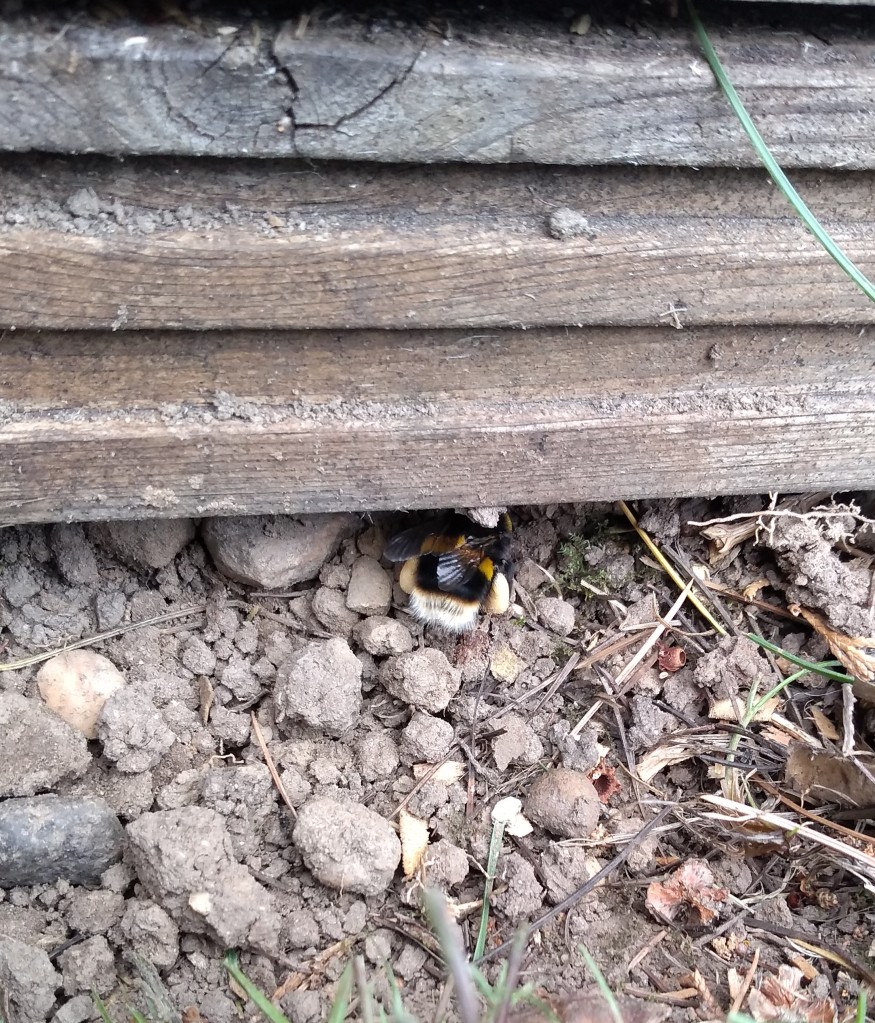
I noticed five Buff-tailed bumblebees coming and going from a nest under some decking in one garden.