Posted in Allotment, nature

Latest on the Allotment

After a slow start, due to the weather, things are growing nicely on the organic, no dig, wildlife friendly allotment.

The view of the allotment from the Buddleia shrub.
The view of the allotment from the apple tree.

While most of the soft fruit season has come to an end (apart from the autumn raspberries), the plums and apples continue to develop and are something to look forward to later in the season.

Thankfully the rhubarb has recovered a bit after a disappointing harvest. Rhubarb doesn’t like growing in waterlogged soil and although we have sandy free draining soil, I think it ended up being too wet over the winter. The rhubarb was on the plot when we took it over four years ago and had grown very large. Every five years Rhubarb can be divided when the growth has become weaker or leaves are overcrowded so I will do this around November and hopefully this will invigorate its growth next year.

The slightly depleted Rhubarb patch.

The vegetables remain on a three yearly rotation to maintain soil health and keep viruses at bay. Main crop potatoes, kale (Cottagers and Cavolo Nero), beetroot, radishes and courgettes are doing well as usual. This years addition are carrots. I always like to try something different each year and It’s been a while since I tried growing these; so far they are surviving. They are in a raised bed and were sown later and sparsely to help avoid detection by carrot fly (Psila rosae). They are also in a mixed raised bed which also helps. 

Along with covering vulnerable plants and growing sacrificial plants such as nasturtium (Tropaeolum majus) and marigolds (Tagetes), I intersperse herbs and other flowers in between the vegetables to help prevent too much loss from pests. I usually find beneficial insects soon appear when needed; there are lots of ladybirds on the plot at the moment. I also find the best way to deal with slugs and snails is to collect them and place them elsewhere; plus any plants with soft young growth are protected by copper tape on old pots and thorny material. I do allow some slugs to remain on the allotment however. The Leopard slug (Limax maximus) is one beneficial slug to have in a garden as they don’t eat living plant matter. They are great for the compost and also eat the eggs of other slugs.

Thorny material protecting new growth from slug and snail damage. Also a plastic bottle (with the bottom cut off) to allow water to be directed to the roots.
Copper tape around an old pot (with the bottom cut off) used as a guard around the base of an annual while it establishes itself.

We have a lot of wildlife visiting the allotment. There is often evidence of a fox (Vulpes vulpes) visitor (which we have seen on other plots). Plus we often see grasshoppers and Common blue Damselflies (Enallagma
cyathigerum) and frogs (at the moment we regularly notice one adult and one youngster hopping around). Last saturday, the sun was out and there was an abundance of bees on the Catmint (Nepeta), Red clover (Trifolium pratense), Lavender and Buddleia.

The wild area on the plot contains a bug hotel and is located near to a neighbouring pond. This is where the red clover grows.

This year, I decided to undertake the Big Butterfly Count at the allotment. The butterflies seen were;

2 Small skippers (Thymelicus sylvestris),
1 Comma (Polygonia c-album),
2 Gatekeepers (Pyronia tithonus),
1 Peacock (Aglais io) and 2 Large whites (Pieris brassicae)

Given the abundance of Cabbage whites (Pieris brassicae) nearby I have made sure my kale is covered up.

The perennial kale mixed in with the cut flower patch.

I find it reassuring to have seen so many butterflies and bees at the weekend, especially as overall there seems to be a reduction in numbers this year; partly due to the frequency of wet days.

I have noticed lots of moths this year too. Perhaps the most exotic looking one I have seen so far is the Scarlet tiger moth (Callimorpha dominula).

The creamy coloured spots on the top of the forewings can sometimes have a more vivid yellow tint.
The red underwings can be seen here. I also managed to capture some of the shimmering blues and greens of the forewings when the sun shone on the moth.

This moth is medium sized, at 23- 27mm (across the wings). It flies during the day and night through May and June; often noticed while resting on plants. The caterpillars of this moth feed on Comfrey (Symphytum), Hemp Agrimony (Eupatorium cannabinum),  Common Nettle (Urtica dioica), Bramble (Rubus fruticosus), Honeysuckle (Lonicera), Meadowsweet (Filipendula ulmaria) and Green alkanet (Pentaglottis sempervirens); they can be seen from August until May, overwintering into the following year. The habitats where the Scarlet tiger moth will be found are in areas of wetland, riverbanks, woodlands, gardens as well as coastal areas.

One sound and aerial display of summer which I enjoy is the return of Swifts (Apus apus). I have even been lucky enough to see them catching insects as they swoop over a pond (sometimes just skimming the water) along with another flock soaring high up the sky. I always treasure seeing these amazing birds as they are on the red list for Birds of Conservation Concern 5: (2021). A few things we can do to help them is to put up appropriate nest boxes, as well as adding swift bricks to new builds, giving them somewhere to raise their young. The RSPB also have a citizen science project where you can record their presence. Further information on how you can take part, can be found here.
Having arrived in Britain in April and May, it won’t be long before they return to Africa as they only remain here until August. Most of their time is spent on the wing, only stopping to nest in roofs especially of old buildings such as churches. If this isn’t incredible enough when feeding the young they regurgitate a bolus, (a pellet formed in the back of the birds throat) containing between three hundred to one thousand insects mixed with saliva. More information on swifts, including how to identify them can be found on the RSPB website, where you can also hear a recording of their distinctive call.

Swifts are not the only thing I have noticed around ponds lately. I recently learnt about another pond invertebrate, the Common backswimmer (Notonecta glauca). So called because they swim on their back just beneath the surface of the water. Not only do they feed on insects, but also tadpoles and small fish. They suck out the contents of their prey’s body after injecting it with toxic saliva. Found all year round they moult a few times before reaching their final length of one and half centimetres. It was quite fascinating to observe them swimming around.

Posted in nature

“It’s a Bird!” “It’s a Plane!” “It’s a Superperb Moth!”

Last week I began hearing the male Tawny owls (Strix aluco) territorial call as I fell asleep and again when I awoke. Usually this starts from late autumn and continues throughout winter (see BTO). Whatever the reason for him asserting his territory early, it was lovely to hear that sound return from last winter. Yet this wasn’t the only spectacle I noticed last week.

Last Wednesday, as I cut back spent Lavender, I became aware of something flying past me. I continued to watch until the insect stopped to gain nectar from some Red Valerian (Centranthus ruber); It was a Humming-bird Hawk-moth (Macroglossum stellatarum). As this was my first sighting of this superb moth, I found it impossible to maintain my composure as I hurriedly fumbled for my phone. Unfortunately it was too quick for me to photograph as it flitted between flowers, not resting as it fed. It did return momentarily but I was still unable to gain photographic evidence before it flew away once again. A visual guide can be seen on the Butterfly Conservation website. For further information on Red Valerian see the RHS website.

Apparently it is possible to hear it buzz as it flies, due to the quick movement of it’s wings; sadly all I could hear were builders working nearby.

Occasionally this daytime flying moth can be observed at other times of the year but traditionally it is seen between June and September. It usually migrates to the UK from the continent but in milder winters can overwinter in this country; in sheltered areas such as crevices, holes within trees and outbuildings.

It obtains nectar from a variety of plants in gardens, woodland edges as well as heathland on very warm sunny days. Along with the Red Valerian I noticed this one visit these moths can be seen amongst Honeysuckle (Lonicera), Jasmine (Jasminum), Buddleja, lilac (Syringa), Escallonia, Petunia and Phlox. While the caterpillars only feed on Wild Madder (Rubia peregrina) and Red Valerian along with Lady’s (Galium verum) and Hedge Bedstraw (Galium album).

Posted in nature

The Birds and the Bees

Two creatures were evident last week even though I didn’t actually see them.

Firstly Wrens (Troglodytes troglodytes) sung loudly in different areas, including near my home. It was a joy to hear them throughout the mornings.

These brown, diminutive birds with upturned tails, weigh about 7-10 grams; only Goldcrests (Regulus regulus)
are smaller. Wrens are rarely seen as their nests (made from moss and twigs) are positioned beneath shrubs or in rock crevices. Plus they mostly feed on insects and spiders and therefore remain hidden for a large amount of time. However they make their presence known due to their powerful song which can be heard at some distance. Their distinctive song contains a trill at the end, often discribed as sounding like a machine gun (see RSPB).

Secondly, on Thursday, I discovered that female Leaf-cutter bee(s) had visited one of the gardens I help look after. The evidence was semi-circular shapes cut around the edges of Broad-leaved enchanter’s nightshade (Circaea lutetiana) leaves.

The Broad-leaved enchanter’s nightshade is part of the Willowherb family.

The bits of leaf will have been carried to a nest, chewed and mixed with saliva to form walls to create the cells if the bees nest. Commonly Bee hotels are used by these solitary bees with lots of cells within each piece of bamboo or hole. Each cell contains an egg and pollen so that the larvae has a food source when it hatches. Although they become adults in autumn, the newly formed bees hibernate during winter, emerging in spring when the new generation repeats the process.

The most common Leaf-cutter bee found in gardens is the Patchwork leaf-cutter bee (Megachile centuncularis); for more information see The Bumblebee Conservation Trust.

Common plant leaves used for this purpose by Leaf-cutter bees are those from Roses, Wisteria, honeysuckle, several tree species and Willowherbs. As at least one bee was clearly using these plants for it’s nest, patches of these wild flowers were left at the back of the borders and the client was informed. Thankfully they are a fellow bee lover and happy to allow them to remain. I feel it’s important to point out, that no lasting damage is done to the plants. Therefore if you find such holes cut in your roses, please don’t panic.

I have yet to see a Leaf cutter bee, especially one ‘surfing’ with a leaf. I would love to see one of these bees so I got incredibly excited to see this evidence. Unfortunately my search was in vain but I am one step closer.

Posted in nature

Growing Food for Birds

I saw contrasting images last week which made me think of feeding birds with plants from the garden.
I first observed the Rowan (Sorbus) tree outside, now stripped bare of it’s berries, before noticing some Cotoneaster

and Ivy (Hedera) full of berries. Clearly the pollinators had been busy during the Summer and Autumn months.

Along with supplementary food, on the ground and bird feeders, birds can also rely on trees and other plants in the garden for food in winter. Along with the examples already mentioned there are other berries, fruit, seeds and nuts which are enjoyed by birds.

Some other plants providing fruit and berries are;
Hawthorn (Crataegus)
Honeysuckle (Lonicera)
Guelder rose (Viburnum opulus)
Dog rose (Rosa canina)
Berberis
Bird cherry (Prunus padus)
Crab apple (Malus sylvestris)
Blackthorn (Prunus spinosa)
Pyracantha
Sarcococca hookeriana
Mahonia

Plants providing seeds and nuts include;
Oak (Quercus)
Beech (Fagus)
Hazel (Corylus)
Spindle (Euonymus europaeus)
Teasel (Dipsacus)
Sunflower (Helianthus)
Miscanthus
Bergamot (Monarda)
Verbena bonariensis
Lavender (Lavandula)
Yarrow (Achillea millefolium)
Asters

Leaving seedheads on perennials not only provides food for birds, they also give shelter to beneficial insects. In fact a little bit of leaf litter also has this affect which in turn helps feed birds who eat the insects.

Common birds to see in winter include;
Redwings (Turdus iliacus)
Waxwings (Bombycilla)
Starlings (Sturnidae
Blackbirds (Turdus merula
Robins (Erithacus rubecula
Chaffinches (Fringilla coelebs)
Bramblings (Fringilla)
Goldfinches (Carduelis carduelis)
Bullfinches (Pyrrhula pyrrhula)
Dunnocks (Prunella modularis)
Goldcrests (Regulus regulus)
Blue tits (Cyanistes caeruleus)
Long-tailed tits (Aegithalos caudatus)
Coal tits (Periparus ater)
Great tits (Parus major)
Fieldfares (Turdus pilaris)

The RSPB Big Garden Birdwatch, which takes place on the 25-27th Jan 2020, has been going for over 40 years. Surveying birds visiting your Garden or local park for one hour is calming and enjoyable. This citizen science continues to give the charity useful information on the numbers of birds in the UK.

Further information on feeding birds can be found in the book, ‘RSPB Pocket Bird Feeder Guide’ by Robert Burton (published by Dorking Kindersley) or on the Gardeners World website.

Posted in nature

A Magical Week

I have begun to notice a chill in the mornings as the nights grow colder. I love the promise of Autumn. It doesn’t quite feel autumnal yet (especially as the weather has warmed up again this weekend) but some changes are occurring. Conkers and beech masts have started dropping and fungi are appearing in some lawns. A couple of times I have come across fairy rings; in both instances the Marasmius oreades fungi was the cause (sadly no magical elvish, fairy or pixie dancing).

The week continued with more observations of Painted lady (Vanessa cardui) butterflies. On Monday there were two visiting a Buddleja bush along with a Small tortoiseshell (Aglais urticae) and a Large white (Pieris brassicae).
Then on Friday, in different gardens, more were flitting about. On one occasion, during the morning, I saw a Painted lady on a Ceratostigma willmottianum.

In the second half of the week I noticed more butterflies including a Green-veined white (Pieris napi) on Verbena bonariensis

and a Small tortoiseshell visiting an Erysimum ‘Bowles’s Mauve’.

Throughout last week I saw lots of pollinators busily collecting nectar and pollen.
On Monday I noticed lots of small flies and Buff-tailed bumblebees (Bombus terrestris) pollinating Marigold (Tagetes) flowers. Perhaps they are enticed by their overwhelming aroma which even I found hard to ignore.

Then on Wednesday there was a Common carder (Bombus pascuorum) bee flying between Nandina domesticas and several Agapanthus africanus.

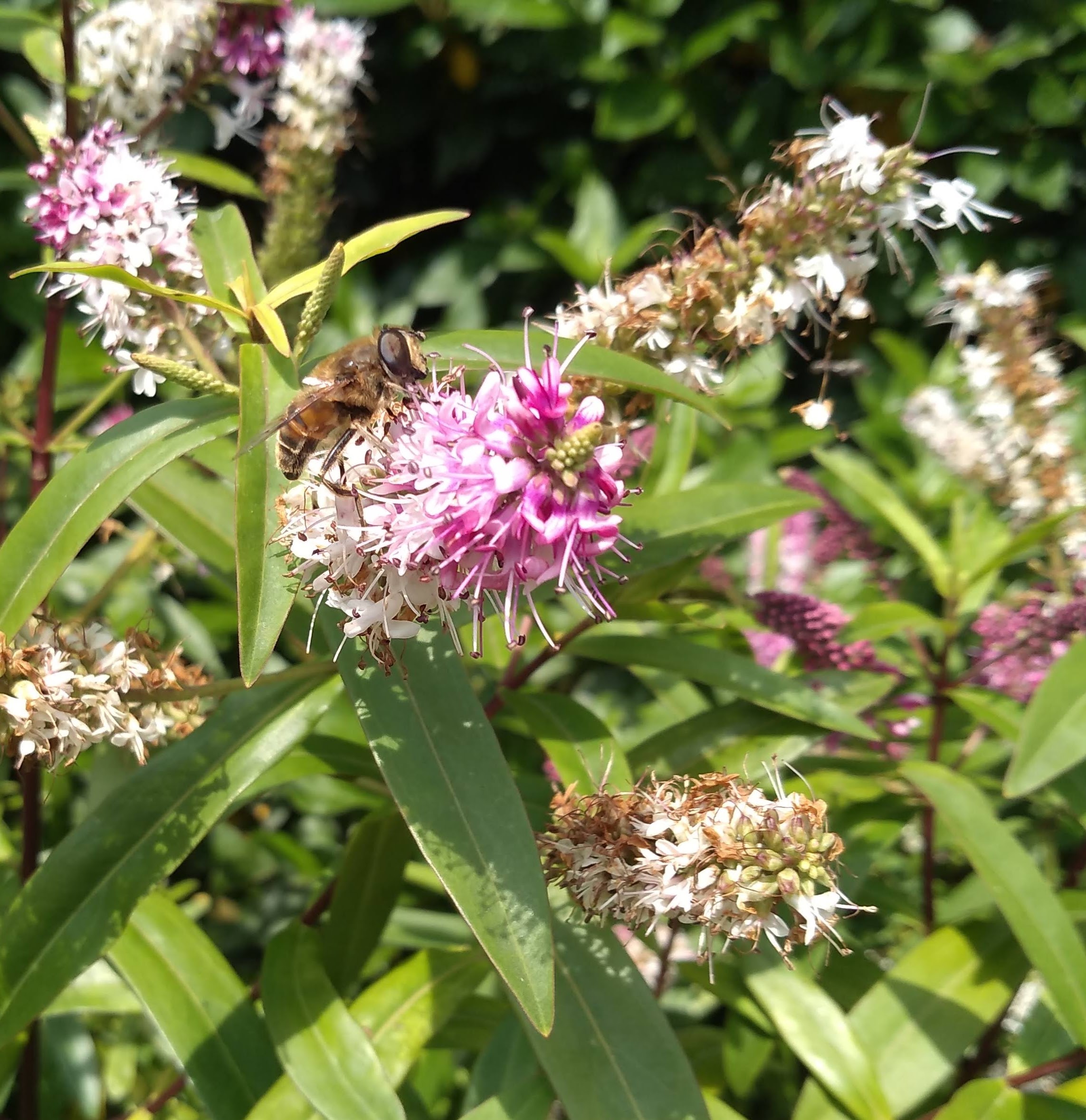
On Friday while working near some Hebe ‘Great Orme’ there were lots of honey bees (Apis mellifera) as well as a Hornet mimic hoverfly (Volucella zonaria).

Another interesting thing I noticed last week was a Red campion (Silene dioica) plant growing on an old moss covered log.

With no soil surrounding its roots clearly it was receiving sufficient moisture and nutrients from this unusual source. It has been flowering healthily all summer but I hadn’t realised it had been relying on the log for its growth until then. I found this plants ability for survival amazing and will closely watch its development.

Lastly I have been aware of how wonderful hardy Fuchsias (Fuchsia magellanica) are currently looking. Although I don’t see pollinators visiting the flowers, there have been a couple of times, in the past, when I have seen Elephant Hawk-moth (Deilephila elpenor) caterpillars feeding on Fushia plants. (See Elephant Hawk-moth).

These caterpillars also eat Himalayan balsam (Impatiens glandulifera) and Willowherbs including Enchanter’s nightshade (Circaea lutetiana) and Rosebay willowherb (Epilobium angustifolium). This beautiful pink and olive green moth flies at night and therefore feeds on Honeysuckle (Lonicera).

Across the way from this hardy Fushia there was a Honeysuckle growing along the wall so it would have been a fantastic place for these moths to inhabit. Unfortunately I didn’t come across any Elephant Hawk-moths this year but hopefully I will in years to come (and I am sure it will feel magical).

Posted in nature

The Heat Is On. 🔆🌡️⛈️☔

The weather last week was a mixed bag. Sunshine with the temperature rising into the thirties, fantastic storms and then dull days of rain. Thankfully it is a little cooler now; while I enjoy the sun, I wilt in muggy heat.

Given the weather there were still lots of butterflies around, mostly Peacock (Aglais io), Red admiral (Vanessa atalanta) and Small white (Pieris rapae). Unfortunately I haven’t managed to capture photos of any of these as they didn’t remain in situ for long. I see many white butterflies flit past me. It can be difficult to say if they are Large white (Pieris brassicae), Small white or female Orange tip (Anthocharis cardamines) butterflies because they disappear before I can identify them.

Happily I was able to photograph one butterfly on a Buddleia on Wednesday. The combination of the pattern in the underside, orange colouring I saw on the upper wings, together with the wing outline means the butterfly in the photo below is a Comma (Polygonia c-album).

Their Caterpillars usually feed on the Common nettles (Urtica dioica) but also Elms (Ulmus), Hops (Humulus lupulus) as well as Willows (Salix). Peacocks often visit Buddleia too. The Common Nettle is also the favoured food of Peacock Caterpillars; although they have been recorded feeding on hops and small nettle (Urtica urens) as well. As the common nettle is the favourite food of both Comma and Peacock caterpillars, what better reason is there for allowing some nettles to grow in a garden?

There were other observations last week too;
– a Harlequin ladybird (Harmonia axyridis) on some Lesser Burdock (Arctium minus),

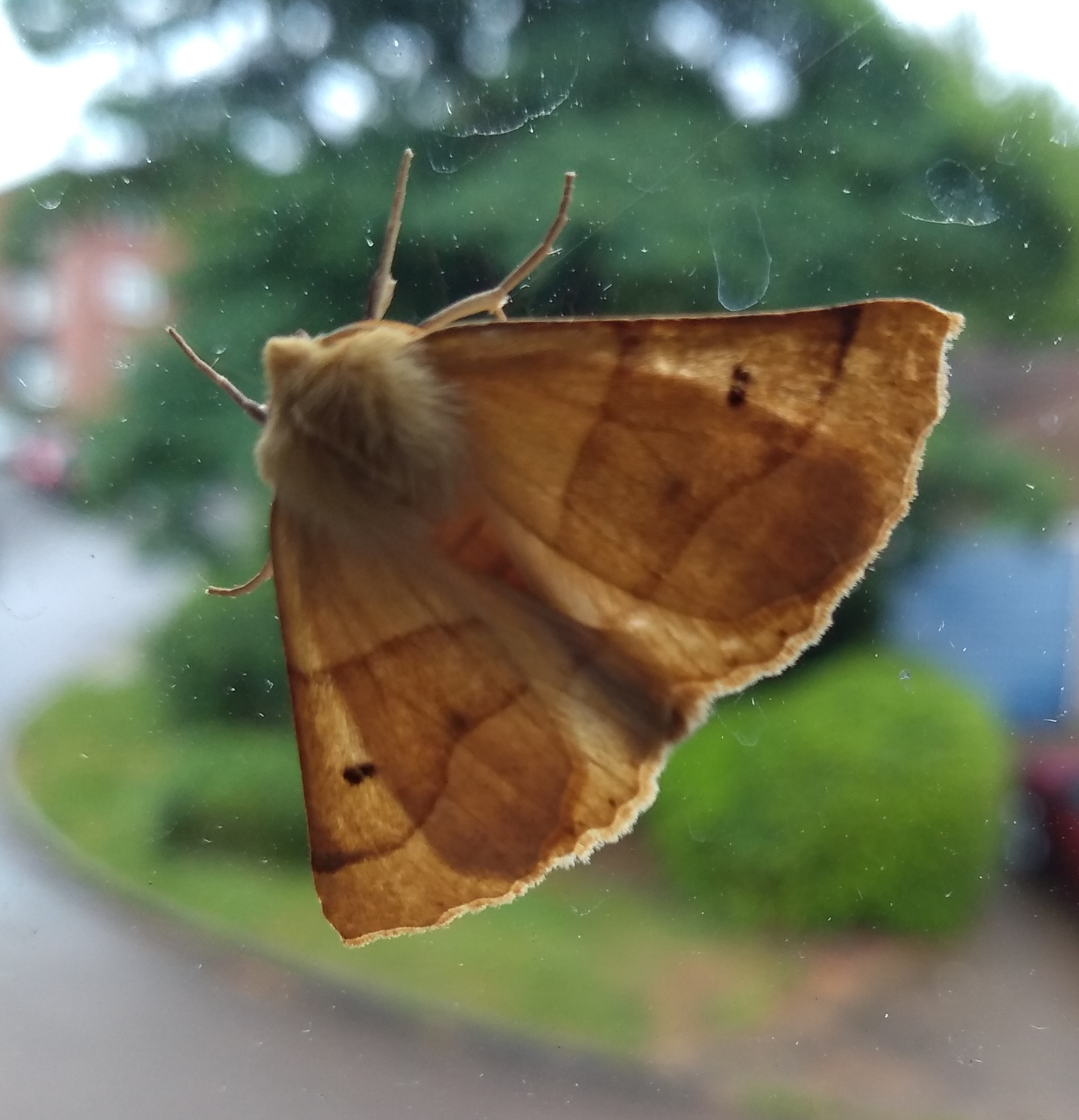
– a Scalloped oak (Crocallis elinguaria) moth,

The caterpillars of these moths feed on honeysuckle (Lonicera), heather (Calluna vulgaris) and broadleaf trees like Oak (Quercus) and Birch (Betula).

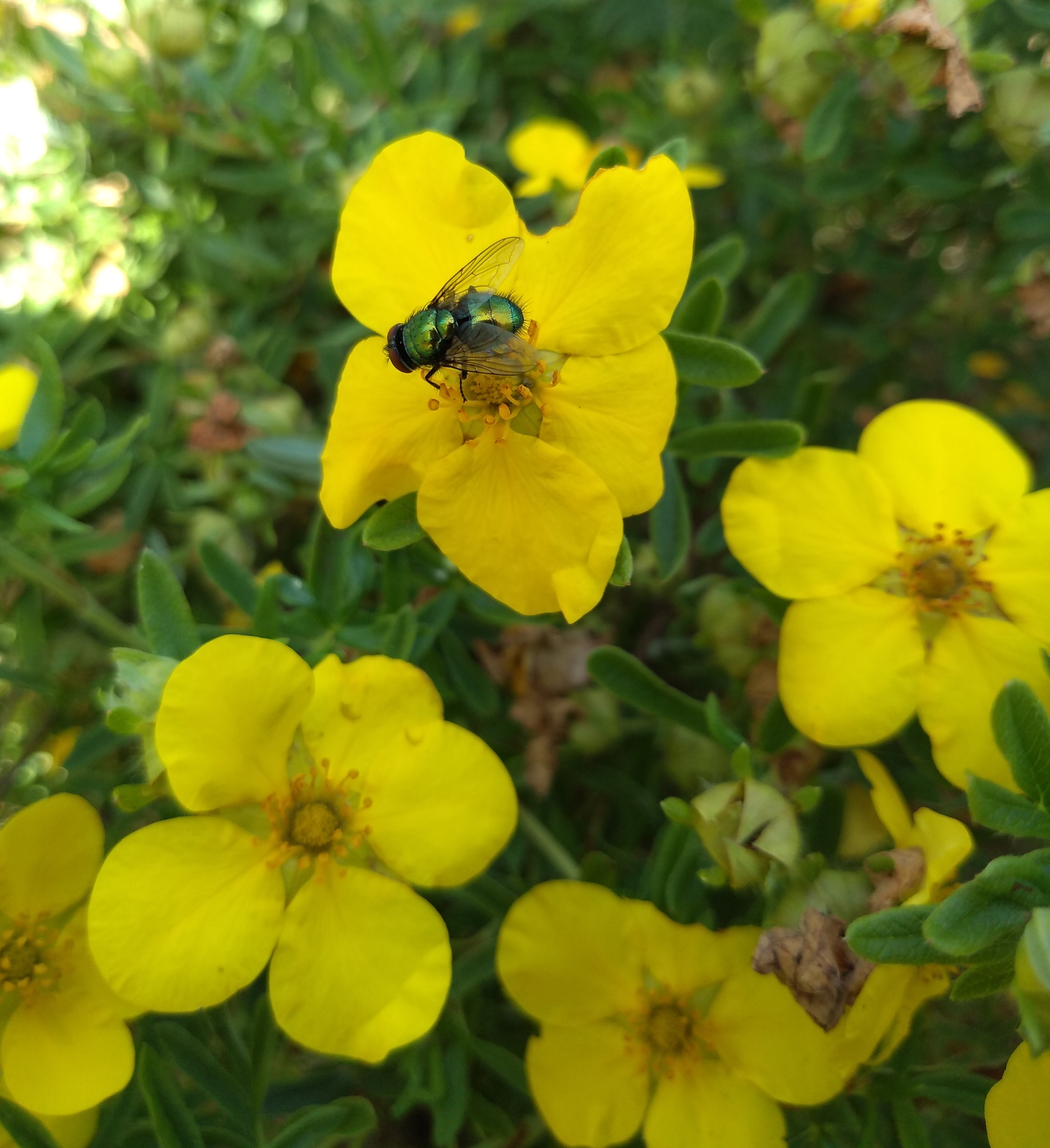
– plus a Long hoverfly (Sphaerophoria scripta), whose larvae feed on aphids, and a Common green bottle fly (Lucilia sericata) on a Potentilla plant.

Capturing the Common green bottle fly was accidental but it worked out really well. In the sun its glistening metallic colouring is highlighted against the yellow Potentilla flowers. Their maggots feed on dead tissue so their appearance is used to accurately determine time of death. Adult Common green bottle flies on the other hand are useful pollinators, as the last photo proves. Fascinating how different stages of this fly species exists alongside both death and life.