Posted in Allotment, nature

Autumns Arrival

Now September has arrived, there is definitely an Autumnal feeling in the air. Similar to March, this month often has a transitional effect on me; especially once the Autumn equinox arrives on the 22nd. The nights are noticeably getting colder and drawing in. Over the past few weeks, some mornings have been misty and there has been a mixture of weather throughout the weeks; humid and stormy one moment and colder and sunny another. Spiders and their webs have become more visible, helped in part by morning dew, plus leaves are beginning to turn on some trees while autumn Cyclamen and crocuses (Colchicum autumnale) are starting to flower. I love September after the intense heat of August I long for a bit of relief.

On the allotment, autumn raspberries (Rubus idaeus) and apples are ready to pick along with pears, damsons (Prunus domestica subsp insititia),

Damsons ready to pick.

elderberries (Sambucus) and blackberries (Rubus). Conkers are falling now too, although the walnut and hazelnut harvests have passed.

Sweet chestnuts are almost ready to fall.

On the last bank holiday of the year (almost a month ago), I visited Minster-on-sea with my partner and his parents. It was an ideal day for walking along the beach searching for treasure, perhaps fossils, sharks teeth, sea glass, pieces of broken pottery and the occasional sea lego.  Washed up along the beach were lots of Slipper limpets (Crepidula fornicata). 

These limpets arrived on these shores from America via ships in the 1800s and thrived in the UK; especially southern England and Wales, where they have become a pest to muscle and oyster beds (competing for food and space). They are edible themselves.

It is usual to see individual empty shells, in fact they are found in huge numbers on beaches in the Solent. The common name of this sea snail refers to the appearance of an individual shell when it is viewed upside down; similarly the latin means small boot. When alive, these gastropod molluscs are rarely found alone (as shown in the photo above). Up to 12 Slipper limpets can be stacked together with the female, the largest and oldest, at the bottom; all the others are male or, in the case of the second from bottom, in the process of transforming into a female. When the one at the bottom dies and falls off, the next one up then becomes female. Further information on these fascinating creatures can be found in an article written by Nick Baker here.

The Slipper limpet isn’t the only snail that I noticed recently. I often get to see land snails but I noticed this beautiful orange coloured Brown lipped snail (Cepaea nemoralis) hanging around after a rainy morning. Snail shells can be very beautiful and I am intrigued by their structure.

Whatever your view on snails it’s hard to look at their shells without admiring the beauty.

I have become more aware of insects lately, mostly when cutting back perennials at work. Although I try to be careful as much as possible, occasionally I disturb a few. I always make a point of replacing or moving them to a safe place. Mostly it is ladybirds but I have also noticed a few other species, such as Common earwigs (Forficula auricularia) and the Rusty tussock (Orgyia antiqua) and Knot grass (Acronicta rumicis) moth caterpillars

Common earwigs feed on organic matter and like to hide away in dark areas of the garden (not in human ears).

Earwigs are useful garden recyclers.

Once eggs are laid, the females diligently clean them and constantly guards the nest only stopping when the young can fend for themselves. While the adults can nip humans and predators, it is only as a warning.


Caterpillars of the medium sized Rusty tussock moth can be seen between May and September.


The males and females of this moth, also called the Vapourer, look different from on another. The males are orangey-brown while the female has a more grey colouration and also lacks any significant wings; therefore it is only the males of this species that are active (mostly flying during the day). The young feed on broadleaf trees and shrubs in gardens and parks, as well as along hedgerows, heaths, moorland and woodland. The adult female and male moths can be seen here .

Knot grass caterpillars (see photo above) can often be found in late summer (and even as late as October in Southern Britain; although these are usually a second generation). Pupa of this moth survive the winter in leaf litter. The grey coloured adults (with a wingspan of 3-3.5 cms) can be seen from May through to September. The caterpillars can be observed on herbaceous or woody plants such as knotgrass (Polygonum aviculare), bramble (Rubus), hawthorn (Crataegus), common sorrel (Rumex acetosa), heather (Calluna), plantains (Plantago), docks (Rumex) and purple loosestrife (Lythrum salicaria). It makes sense therefore that this one was found nibbling on a raspberry leaf on the allotment. The numbers of this moth are declining and while they are still commonly found in gardens, heathland and grassland, it is thought that the  species is becoming vulnerable. I was happy to share my raspberry plant with this caterpillar; raspberries are my favourite fruit but it certainly wouldn’t do any major damage. A photo of the moth can be seen on the UK Moths website.

Sadly the results of the Butterfly count for this year came out last week. They confirmed people’s  suspicion that it hasn’t been good for butterflies and moths (as well as bees). Many butterfly and moth numbers continue to fall, and significantly so from previous years results, due to a variety of factors including the cold wet weather we’ve experienced this year. Further information can be found on the butterfly conservation website here.

Thankfully last Friday, I witnessed a wonderful sight during a warm sunny afternoon. A huge area of ivy in full bloom was covered in so many bees that it stopped me in my tracks. I stood nearby and listened to the wonderful buzzing sound, it was so relaxing. There were so many Ivy bees (Colletes hederae) alongside buff tailed bumblebees (Bombus terrestris) and honey bees (Apis mellifera) visiting the ivy flowers. It was the first time I was able to definitely identify ivy bees which was amazing (see below). 

First recorded in the UK in 2001, Ivy bees are becoming more common. They look very similar to honey bees but can be distinguished by the stripes on their abdomens; the bright yellow stripes are distinctly separate from the black ones than they are with honey bees. Unlike honey bees these are solitary, however there can be lots of nests close to one another and these bees will forage together when opportunity allows. As their name suggests, they feed predominantly on the nectar of ivy flowers and therefore their appearance coincides with this plant flowering (between September and November). I have been searching for a definite sighting of these bees for years and finally I have been rewarded for my patience.

I’ve found more galls, over the last few weeks, this time on the ground surrounding a few Pedunculate Oaks (Quercus robur).

These galls remind me a little of the Facehugger in the Alien film franchise.

They are produced by these trees as a result of the Knopper gall wasp (Andricus quercuscalicis) laying young in the acorns. As with the Oak apple gall wasps (Biorhiza pallida) mentioned in a previous post ‘Relaxing Evening Birdsong’ , they are not detrimental to these majestic trees and don’t appear on many of the fallen acorns.  Interestingly each generation of the wasp will change between sexual and asexual each alternate year.

I also saw my first Goldcrest (Regulus regulus) in a cypress tree near the beginning of the month. Although I could see the silhouette of this tiny bird moving around the top of the tree. I was only able to identify it using the Chirp-o-matic app on my phone, due to its loud singing. The Goldcrests song can be heard on the Woodland trust website here , where you can also see a photo of this diminutive bird. I wish I could have viewed it at closer range, then I would have been able to see the wonderful plumage on the crown (yellow for females and orange for males). The Goldcrest is the smallest bird in Britain, even smaller than the Wren (Troglodytes troglodytes). Hold a 20 pence piece in your hand, and you will have an idea of the birds weight (just 5 grams). They inhabit mixed woodland and conifers along with parks and gardens. The numbers of our resident birds increase with the migration of others from Scandinavian countries during the winter. They feed on insects and other invertebrates. It is always lovely when I am still able to witness new things in nature like this. It gives me a buzz, allowing me to learn through research.

Posted in nature

False Autumn

It might be the start of meteorological autumn but it’s still too early for leaves to start falling from trees; yet over the past few weeks this has been occurring. Referred to as false autumn, this leaf (and acorn) drop is occurring as a result of the extreme temperatures and drought we’ve experienced this year. It is a sign of stress as trees attempt to conserve water and energy. Current lower morning temperatures have also lead to an autumnal feeling. Thankfully we are now experiencing rainfall so perhaps this will prevent trees from showing further signs of stress even though it doesn’t stop us being in drought. Hopefully autumnal colour won’t be affected too much and we will still witness the spectacular seasonal colours this year.

A couple of weeks ago my partner and I went for a walk to spot Saturn ascending in the sky at dusk; we visited the local woodland park. At nine o’clock, on one of the hottest days of the year, the temperature was quite pleasant. As we walked through the woodland to an open area, where we could view the planet, we got to experience bats flying close by (the following videos is of some footage I managed to obtain).

Without a Bat detector, I have no way of correctly identifying the species out of the 18 that roost in the UK. According to the information I found on the Hertfordshire and Middlesex Bat Group website, the ones we most likely encountered in the area are either the Common Pipistrelle (Pipistrellus pipistrellus) or Soprano Pipistrelle (Pipistrellus pygmaeus). Regardless of the species, just experiencing the creatures flying nearby to capture insects was amazing. I haven’t witnessed bats in fight since I was a child.

It’s still possible to see some butterflies and bees at this time of year so late year flowering plants are essential.

A Common carder bee visiting a group of Aster flowers.

White tailed bumblebees (Bombus lucorum), Buff tailed bumblebees (Bombus terrestris), Red tailed bumblebees (Bombus lapidarius), Common carder bees (Bombus pascuorum) and even some Honey bees (Apis mellifera) still forage in September. The Butterfly Conservation charity produced a photo (see below) of common butterflies and moths to see at this time of year.

During the previous week I was still noticing several Hummingbird hawk moths (Macroglossum stellatarum) too. These moths have been quite prevalent this year.

On one occasion I managed to get a video of a Hummingbird hawk moth visiting a Buddleia.
Posted in nature

Bees in Winter

Honey bees (Apis mellifera) overwinter in hives, huddling round the queen to keep warm, occasionally venturing out on warmer days. Bumblebees (Bombus) on the other hand have an annual lifespan with new queens, having mated during the summer and autumn months, hibernating underground until spring when they can begin a new colony; also sometimes waking up too early on warm days and foraging.

However over the past 10 years, in urban areas of Southern England, a trend has been seen with certain bumblebee species.
Initially Buff-tailed bumblebees (Bombus terrestris), but since then Early bumblebees (Bombus pratorum) and Tree bumblebees (Bombus hypnorum) have begun to nest in winter rather than hibernate. Consequently winter flowering plants such as Mahonia and Winter Heathers (Erica), Winter honeysuckle (Lonicera fragrantissima), Winter aconite (Eranthis hyemalis), Hellebores (Helleborus) and Snowdrops (Galanthus) are garden essentials; enabling these bees to access pollen and nectar during the colder months.

Solitary bees on the other hand will survive throughout winter in burrows or cavities as eggs, with their own supply of nectar and pollen close to hand (as the adults don’t survive winter). These include Mining and Mason bees which emerge early in spring taking advantage of Willow (Salix), Blackthorn (Prunus spinosa) and Hawthorn (Crataegus monogyna) in bloom. Leafcutter and Carder bees emerge later still. The one exception are Furrow bees; like Bumblebees, the female will hibernate during winter and lay eggs in spring.

I have noticed lots of Mahonias blooming over the last few weeks, their bright yellow flowers and perfume is wonderful to experience during dull days. Somehow the colour shines more vividly against grey skies.

Mahonia x media

Another shrub that has been blooming recently is Viburnum farreri, it’s lovely scent wafting through the air too.

Posted in Allotment, nature

A Couple of Welcome Visitors

During the previous week there were the few days of unusually high temperatures for the time of year; a final flourish for late summer?

The heat encouraged lots of bees, especially Honey bees (Apis mellifera) to visit Hylotelephium (once called Sedums) which began to bloom. The sound was amazing and it was so relaxing to work near them; you could almost feel the buzz it was so intense.

How many bees can you spot?

Things have been ticking over nicely on the allotment for the past month. Corn and Squash are developing nicely while the supply of Sweetpeas and Beetroot keep coming. Plus the Potatoes have been dug up and Apples are ready to pick too.

Time spent planning next years harvest is in full swing, while changes to the allotment occur. I began to create a space for a wild flower area next to a patch of long grass, where a resident frog is no doubt loving the huge supply of slugs this year. Plus work has begun on transforming the veg patches into raised beds.

Away from the allotment, on Friday 10th September, I noticed a rather large moth in the hallway. It was an Old lady/ black underwing (Mormo maura) moth. The wingspan of the Mormo maura is between 55 and 65mm.

The common name of Old Lady is due to the colouration and pattern on the forewings, which resemble the shawls of old Victorian ladies. There is only one generation per year and adults fly between July and August; as I noticed this one in September it must be near the end of its lifespan. A nocturnal moth it is attracted to light (and sugar if you place feeding stations for moths). Clearly the open window had encouraged it into the building. The main habitat for this moth are gardens and waste ground, particularly in damp locations. In spring, after overwintering, the caterpillars will feed on various trees and shrubs, such as Blackthorn (Prunus spinosa).

Then last Friday, another moth found its way to the hall. Also a nocturnal moth attracted by light, the Snout moth (Hypena proboscidalis), so called for obvious reasons.

There are two generations per year of the Hypena proboscidalis, adults initially fly between June and August and again later in autumn. The wingspan of the Snout moth is approximately 30 to 38mm. Like the Old lady moth it also frequents gardens and wasteland, along with woodlands; essentially it can be found anywhere nettles (Urtica dioica) are found, which the caterpillars feed on.

Posted in nature

Common Insects but an Uncommon Viewing Experience

It was great to still witness pollinators flying around last week. Even though, due to the colder weather numbers have greatly reduced, some insects are still foraging. I noticed the odd hardy Buff-tailed bumblebee (Bombus terrestris) as well as a few Honey bees (Apis mellifera) visiting autumn flowering perennials and shrubs. Currently the most wonderful spectacle is Common Ivy (Hedera helix) in full bloom. Loved by pollinators including butterflies, bees and hoverflies, ivy is a useful plant to have in flower at this time of year. It supports up to fifty species altogether, such as providing food for Holly blue Butterflies (Celastrina argiolus), along with the Small dusty wave (Idaea seriata), Angle shades (Phlogophora meticulosa)
and Swallow-tailed (Ourapteryx sambucaria) moths. Mature Ivy plants flower in September and October on clustered umbels. Eventually, pollinated flowers develop into fruit that provides food for Thrushes (Turdidae), Blackbirds (Turdus merula), Blackcaps (Sylvia atricapilla) and Wood pigeons (Columba palumbus). Ivy also provides shelter for hibernating insects over winter.

However the most prevalent insects I witnessed covering the ivy flowers last week were the Common wasp (Vespula vulgaris). They weren’t nesting amongst it but feeding on the abundant nectar. My confidence in their complete focus on the ivy flowers, and not being bothered by my presence, enabled me to unusually observe them up close. Each time I came across ivy covered with wasps, I would take a few moments to watch and listen. Unlike bees, their buzzing was very faint; you had to listen carefully to hear it. I had never been close enough to appreciate the wonderful pattern on their abdomen before or watch their activity as they hurriedly switched from one flower to another.

I would have been observing male and worker wasps obtain nectar from the ivy (which also visit other umbellifier flowers). Queens are active in spring, collecting nectar from Cotoneaster and other spring flowering shrubs.

These much hated creatures are useful pollinators (as the photo below proves) when not pestering us as we eat outdoors. We can’t really blame them trying to access an easy source of food or protecting nests when we stumble upon them.

Wasps also help keep insect numbers down which once captured, are chewed up and fed to the larvae.

Although I haven’t seen any yet, I am ever hopeful that I will see Ivy bees (Colletes hederae) as I look at ivy. Recorded for the first time in southern Britain as far back as 2001, these solitary bees feed on ivy nectar and are therefore only seen when ivy flowers. Since they were first noted in Britain the species has been spreading northwards, nesting in sandy soil. For further information see (Wildlife Trust).

More fungi started to appear last week too; I saw
– Common bonnets (Mycena galericulata)

– Shaggy ink caps (Xylaria hypoxylon) and

– Candlesnuff (also referred to as candlestick or stag’s horn) fungus (Xylaria hypoxylon).

You have to look closely to identify this minute fungi, found on decaying wood, it has a blackened base.

Lastly I was utterly surprised to witness a Fox (Vulpes vulpes) run across my allotment as I worked early on Saturday afternoon. It looked healthy so presumably had been disturbed with all the activity from allotmenteers tidying their plots.

Posted in nature

🎵”It’s a Beautiful Da(hlia)…” 🎶

Actually there were lots of beautiful Dahlias at the Autumn festival I went to last Saturday. In fact even the weather was beautiful during the afternoon.

The Dahlia originates from Mexico (where its the national flower) and Central America. A perennial that grows from tubers, it is part of the Asteraceae family which also includes Daisies, Zinnias, Sunflowers and Chrysanthemums.

Because they’re not hardy and prefer light, free draining Soil, Dahlias are often lifted and stored somewhere dry over winter in the UK.

However, in southern counties, where gardens contain favourable conditions (with no heavy, soggy soils in colder climates) I have known people keep them in the ground. Sure enough the following year they reappear without fail. The lack of harsh winters in recent years no doubt enabling their survival.

Apparently Dahlia tubers can be eaten in the same way as Sweet potatoes (originally they were grown as a food source by the Aztecs). They can also flavour drinks when roasted. See Alys Fowler’s piece for the Guardian newspaper)

Over the past few years the popularity of Dahlias has increased; I must confess I am one if their fans.

I love the flowers vibrant colours but prefer the plants with single flowers, which are great for pollinators too (although I have caught sleepy bees having a nap amongst petals of other Dahlias as well; see below).

Unnamed variety from my Allotment with a Buff-tailed bumblebee snuggly sleeping inside a petal.
Formby Art: Bee seen relaxing on this Dahlia at the festival.

Some of my favourites on display last Saturday were:

Honka: Apparently popular with butterflies.
Pooh
Blueberry Hill
Carstone Firebox
Preston Park

I was also impressed by the wonderful bug hotel within the Celebration garden at the garden centre.

Posted in nature

🎵The Heat Is On. 🎤 🎹🎷🎶


“Tell me can you feel it, tell me can you feel it, tell me can you feel it, the heat is on…”

The 80’s song from the Beverly Hills Cop soundtrack with Glenn Frey’s voice, synthesizer and saxophone was my earworm as the temperature soared last week. The temperature increased to around 27°C mid week, which meant lots more insects ventured out as it felt like summer.

I was happy to see my first Red admiral (Vanessa atalanta) butterfly of the year, however my main observations were bees including the Red-tailed bumblebee (Bombus lapidarius) and Honey bees (Apis mellifera).

A Red-tailed bumblebee pollinating some geranium.
Honey bees visited Nepeta.

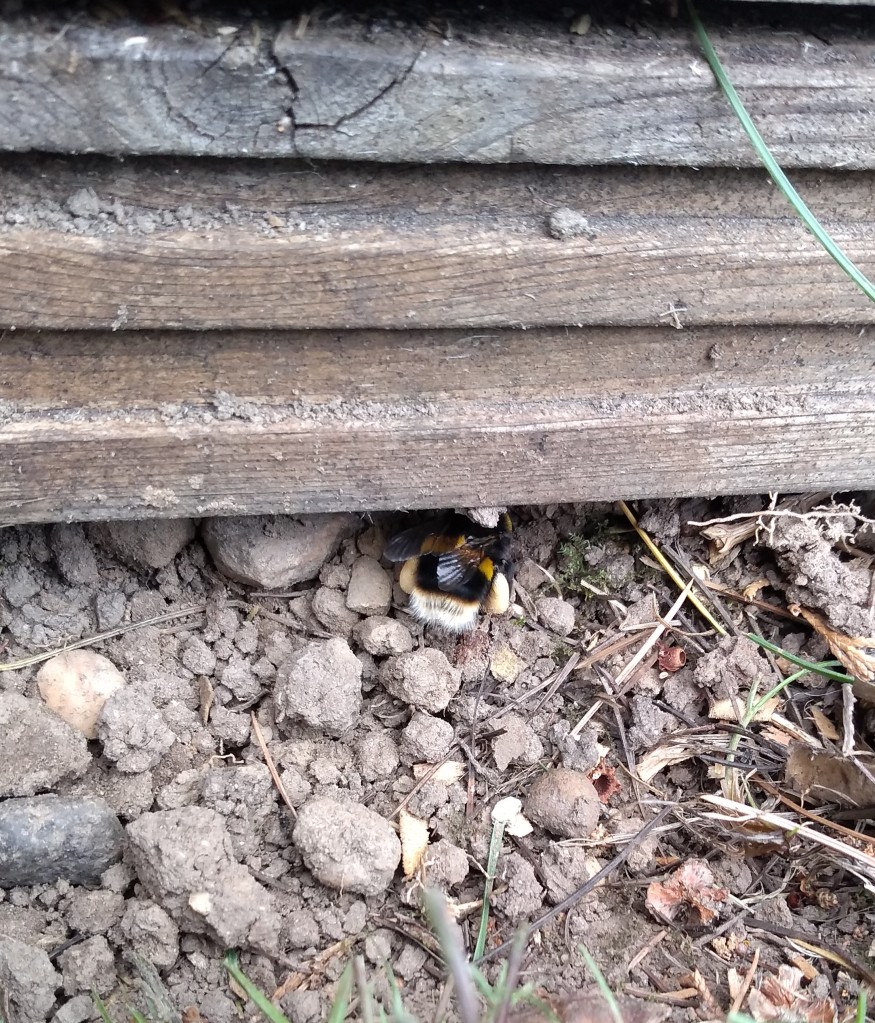
Another bee I started seeing last week was the Tree bumblebee (Bombus hypnorum). I noticed a nest inside a compost bin as I emptied grass clippings from the mower bag.

I have seen Tree bumblebees nest in bird houses before but not under compost. I made sure I avoided tipping grass onto their home and used the next bin along. I couldn’t help watching them for a little while as I stopped for a breather on the very hot Wednesday.

Moths were prominent throughout the week too. Unfortunately Box tree moth (Cydalima perspectalis) caterpillars and the signs of heavy infestation (foliage that had been eaten and covered with webbing) was noticeably present in several gardens. Therefore, I spent lots of time picking them off buxus topiary and informing clients to keep an eye out for them as well. For more information on this pest see the RHS website.

I discovered this years first sighting of a Silver Y (Autographa gamma) moth.

A Silver Y moth resting on a Heuchera leaf.

This immigrant is one of the few brown moths I can identify easily, mostly due to the clear y markings on it’s forewings but also because of their size and shape. This is a day and night flying moth which can be observed visiting flowers to obtain nectar.

However my most exciting moth sighting was the Lime hawk-moth (Mimas tiliae).

This spectacular large moth is night flying. It’s wingspan is 4.6-7.8cms and it can be found in broadleaf woodland, parks and gardens between May and July. I accidentally disturbed it as I pruned some shrubs under a Lime (Tilia sp.) tree. Thankfully it didn’t seem bothered by the disruption and it was carefully placed back near the lime tree. While adult moths of this species don’t feed, the caterpillars do. Once they have emerged from overwintering pupa, the caterpillars will eat Lime, elms (Ulmus sp.), Alder (Alnus glutinosa), Downy Birch (Betula pubescens) and Silver Birch (Betula pendula), Plane (Platanus x hispanica) along with some Cherry cultivars. This was the first Hawk-moth I have ever seen. There are a few that exist in the UK. The nearest I came to seeing one before was observing caterpillars of the Elephant hawk-moth (Deilephila elpenor) eating away at some Fuchsia. For more information on these Hawk-moths see the Butterfly Conservation website (Lime hawk-moth and Elephant hawk-moth)

I also saw hoverflies. I am still learning about these insects and learnt another one last week.

The photo above shows a Narcissus bulb fly (Merodon equestris). The maggots eat away at the centre of bulbs from the Amaryllidaceae family. However even though the maggots are a pest, the adult hoverflies are pollinators.

Posted in nature

Things Come in Threes

At least in several gardens last week, things with three leaves appeared as several Trefoils began to flower.

In some lawns the yellow flowering Slender hop clover (Trifolium micranthum) has shown itself along with Red clover (Trifolium pratense).

Slender hop clover
Red clover

Red clover is also called Bee-bread (along with White clover- Trifolium repens) due to its popularity with bees. It’s nectar is especially loved by Common carder bees (Bombus pascuorum), Honeybees (Apis mellifera) and Red-tailed bumblebees (Bombus lapidarius). Red clover, which is less commonly found in nature than White clover, is used for livestock feed and crop rotation (due to its nitrogen fixation abilities). It is also used in herbal medicine to treat respiratory and skin ailments,along with menopausal and PMS symptoms because the flower contains isoflavones. When taken internally, isoflavones become phytoestrogens which has similar affects in the body as estrogen (see Plantlife)

I will have to wait a little longer to see White clover flowering as it blooms from June. However White clover is commonly found in verges and grassland so I’m sure to see some eventually.

Unfortunately I have never spotted a four leaf clover (or five leaved). I am ever hopeful, just for the challenge because they are so hard to spot in the wild.

Several trees are blooming at the moment. Along with Hawthorn (Crataegus monogyna- the May tree flowers referred to in the rhyme ‘Cast ne’er a clout ere May is out’) the Horse chestnut (Aesculus hippocastanum) is also in flower; they have white flowers with a pink tinge.

I also see the Red horse chestnut tree (Aesculus x carnea Briotii) on my travels, both trees have very showy flowers.

It was great to see lots of bees about last week and various species too.

The first type of bee I saw was a Hairy-footed flower bee (Anthophora plumipes) around some forget me nots (Myosotis).

I also noticed lots of Buff-tailed bumblebees (Bombus terrestris),
Honey bees and Early bumblebees (Bombus pratorum) throughout the week too.

This Cotoneaster hedge was alive with Honey bees. Make sure the sound is on to listen to their relaxing buzzing.
The Early bumblebees were also visiting the Cotoneaster flowers.
I noticed five Buff-tailed bumblebees coming and going from a nest under some decking in one garden.
Posted in nature

I Spy… Something Beginning With B

The mild temperature continued last week. When the sun came out on Wednesday and Friday mornings it almost felt like spring. Bees foraged on both days. Wednesday was the busiest as a [1] Buff-tailed Bumblebee (Bombus terrestris) and about five [2] Honeybees (Apis mellifera) were visiting a Winter honeysuckle (Lonicera fragrantissima).

[1]

[2]

While on Friday another Buff-tailed Bumblebee was collecting nectar from a Mahonia. I found the perfume from these shrubs hard to ignore so I am not surprised that the bees were intoxicated by them too. However I have never seen Honey bees active in January before.

Other things I noticed last week, usually associated with Spring, were lawns full of daisies (Bellis perennis) along with a Great tit (Parus major) loudly singing it’s repetitive two syllable song ‘tea-cher, tea-cher’.

[3]

Should I be concerned that I am noticing lots of spring activity in January? It is lovely to be reminded that Spring isn’t far away but hopefully it won’t be a continuing annual trend.

Posted in nature

What a Difference a Month Makes

A month ago I had a weeks holiday. Signs of autumn were beginning to mingle with late summer. Now October is here autumn has definitely arrived.

As I had another week off I decided to revisit my local park, observing changes from a month ago.

In September Roesel’s bush crickets (Metrioptera roeselii) were chirping everywhere, butterflies were flitting about and some flowers still bloomed amongst the meadow (see Relaxing into Autumn).

Upon my return last Tuesday the only sounds I heard were birds singing and the meadow area had been cut and baled. Cobwebs were visible in the long dew dampened grass around the edges of the woodland too.

Hawkweed, Ragwort (Jacobaea vulgaris), Red clover (Trifolium pratense) and Yarrow (Achillea millefolium) were only just flowering still while the Ivy (Hedera) was in full bloom.

Ivy is fantastic for pollinators at this of year. I saw a few hoverflies flying to and from several flowers but the Honey bees (Apis mellifera), that were still active from the nearby hives would probably visit them too.

It was lovely to see dried seedheads of Wild carrot (Daucus carota)

and Cow parsley (Anthriscus sylvestris)

as I wondered around the park. They look beautiful but they are useful for insects to shelter in as well. In fact I noticed a ladybird snuggling amongst one of the Cow parsley seedheads. I also discovered field mushrooms (Agaricus campestris) growing amongst the grass.

Trees and shrubs were starting to show autumnal colours along with their ripe fruits. I found elderberries, sloe as well as haws on the Hawthorn (Crataegus monogyna) alongside Rosehips. However there were no longer any blackberries left on the brambles.

I noticed the leaves of one Horse chestnut tree (Aesculus hippocastanum) affected by the Horse chestnut leaf miner (Cameraria ohridella) moth.

Similarly there was evidence of caterpillars (most likely another moth) having been on a Silver maple (Acer saccharinum) tree.

The eggs and excrement are still visible on the nibbled leaves.

I ended my weeks holiday with a visit the Horniman museum in London.

On route to the train station I saw a Brown rat (Rattus norvegicus) running across a path. It attempted to cross the road until either the traffic or pedestrians scared it into fleeing towards a nearby hedge. Once I arrived in London I realised that I never see rats in the underground any more. I used to enjoy seeing them scurrying between the tracks. I have owned pet rats for many years so I find wild rats intriguing. I also like to watch Squirrels as rodents tend to act in similar ways to one another. After lunch I observed two Grey Squirrels (Sciurus carolinensis) scamper about.

The nearest squirrel had an acorn in its mouth and appeared to bury it in different places. I once saw a television programme on squirrels in which one was observed ‘pretending’ to bury a nut in several places while in the presence of other squirrels to avoid their stash being taken. Presumably this was occurring with the squirrels I was watching on Friday.

There is a butterfly house and aquarium at the Horniman museum. The butterflies were looking a little aged with their wings rather worn, however they were still beautiful. As soon as I entered the butterfly house a Malachite butterfly (Siproeta stelenes) landed on me which felt wonderfully welcoming.

The photo below shows a selection of the many butterflies I saw.

Feeding on the fruit are one Blue morpho (Morpho peleides), one Brown clipper (Parthenos Sylvia philippinensis), two Blue clipper (Parthenos Sylvia) and three Owl butterflies (Caligo memnon).

There were lots to see in the aquarium as well but my favourites were the White spotted jellyfish (Phyllorhiza punctata); watching them was so relaxing.

Even at the weekend nature was visible. As I ate breakfast on Saturday morning I heard and watched a group of Coal tits (Periparus ater) on the Rowan tree (Sorbus aucuparia) outside. I have never seen Coal tits on this tree before, I hope to see them again.

Another animal I became aware of last week was a Red fox (Vulpes vulpes). I first noticed it on my way home on Wednesday night and again on Sunday morning. It was making itself known on Saturday night too as it was being very vocal.