I have managed to learn more fungi over the past winter months, both at work and during woodland walks. I have seen these, mentioned below, between November 2025 through to mid January 2026.
1) Common stinkhorn (Phallus impudicus).
The common name is very appropriate, as Stinkhorn suggests, it does produce a very strong (foul) odour; in fact you become aware of it well before seeing it. The smell resembles blocked drains or a decaying animal. Flies land on it, spreading the spores as they continue to move around.
2) Wrinkled club (Clavulina rugosa).
This fungi is often found near pathways. These specimens were located on the edge of the lawn.
3) Jelly ear (Auricularia auricula-judae). I have seen this fungi before but I find it fascinating. I noticed a young slug seeking shelter amongst it.
4) False turkey tail (Stereum hirsutum).
False turkey tail is found growing on fallen branches or those dying on hardwood trees (as shown here). It is much smaller than Turkey tail fungi (Trametes versicolor).
5) Leaf Parachute (Marasmius epiphyllus).
These tiny fungi develop on leaf litter of Ash or Poplar trees.
6) White Saddle (Helvella crispa).
These pretty fungi develop near paths amongst Beech (Fagus) and Oak (Quercus) trees.
7) Candle snuff (Xylaria hypoxylon).
Candle snuff grows on moss and the decaying wood of broadleaf trees. Starting off greyish white, it releases spores that turns it black.
8) Oakbug Milkcap (Lactarius quietus), found them beneath Oak trees.
As the name suggests, milkcaps produce a milky substance (latex) when bruised as a form of protection, like putting on a plaster to cover the injured area. They form a cooperative relationship with specific trees, this one is only found under Oak trees.
9) Some Oysterlings, possibly Variable oystering (Crepidotus variabilis). Oysterlings are very small and difficult to distinguish from one another.
Developing on woody debris such as twigs from Broadleaf trees on woodland floors these white fungi are tiny.
Now that we are well into January flowers are starting to show signs of life. Snowdrops are beginning to bud and female Hazel (Corylus) flowers as well as Winter aconites (Eranthis hyemalis) are blooming. Plus I have seen lots of ladybirds sheltering through this harsh season.
7-spot ladybird (Coccinella septempunctata) found on a dead tree trunk.
I’ve slowly started to emerge from hibernation now that Imbolc, the half way point between the Winter solstice and Spring equinox, (meaning ‘In the belly of the mother’- referring to the first stirrings of the years new growth) has passed; mirroring the snowdrops, winter aconites and hazel flowers (the first signs of the transition into the next season).
The scents of Daphne, Mahonia and Sarcococca fill the air alongside the arrival of other spring flowers; daffodils, cyclamen, crocus and hellebores. Willow (Salix) catkins are also opening while Blackthorn (Prunus spinosa) blossoms fill the roadsides with glorious white clouds.
Although it has still been too early for most allotment activities, the rhubarb has been emerging on the plot for the last month. I still haven’t cut back perennials as I want to allow cover for beneficial insects such as sheltering ladybirds (Coccinellidae) until the weather makes their survival easier. Instead February is mainly a month for planning the forthcoming years growing (thinking about chitting potatoes and planning seed sowing). One job I have begun however is the indoor Sweet pea and Chilli seed sowing. This small step gives me hope that I will soon be able to sow other seeds soon.
Although I am beginning to think ahead, I am still fondly holding on to snuggly sofa moments such as reading and partaking in arts and crafts, especially on wet days.
Through the winter I still immersed myself in nature. In January I pruned my apple tree on the allotment, blessing and giving thanks through Wassailing. Although symbolic, it was a nice way to feel deeply connected to the plot. I am grateful to be a guardian over it and receive the abundance of fruit, veg and flowers in return.
I saw quite a few foxes (Vulpes vulpes) over the winter too, including one on the allotment. It was such a beautiful moment to watch it foraging under trees.
Once again, I took part in the RSPB Big Garden Bird Watch in January. The list of birds I saw this time were; 4 Long-tailed tits (Aegithalos caudatus) 5 Starlings (Sturnus vulgaris) 1 Blackbird (Turdus merula) 3 Wood pigeons (Columba palumbus) 5 Sparrows (Passer domesticus) 2 Blue tits (Cyanistes caeruleus) 1 Greenfinch (Chloris chloris) 1 Great tit (Parus major) 6 Magpies (Pica pica) 1 Gull (Larinae) and 1 Red kite (Milvus milvus)
There is a small group of Ring-necked Parakeet (Psittacula krameri) that visit a nearby tree of late but frustratingly they didn’t show up during the observation hour.
During February, bird song continued to fill the skies, growing in frequency and volume. Also occasionally insects have boldly buzzed and fluttered about on the odd sunny days. Butterflies I noticed were a Brimstone (Gonepteryx rhamni) and Peacock (Aglais io); the latter I saved from an abandoned spider web. I have also seen bees visiting mahonia, crocuses and hellebores, especially queen bumblebees.
Last week, I was excited to find some Jelly ear fungus (Auricularia auricula-judae) for the first time. They were growing on a Buddleia bush. Although this fungus is usually associated with elder (Sambucus) it can also be found on other hard woods like sycamore (Acer pseudoplatanus), ash (Fraxinus) and beech (Fagus) in damp shady conditions. Perhaps the fungus was thriving on the Buddleia, in the garden I visited, because of the recent weather as well as it being planted near a beech hedge. Interestingly this fungus can continue to grow on dying wood that has been thawed, once frozen; hence it can survive really cold winters. The common name was given to this fungi because of how it looks and also its jelly-like texture.
Worryingly, it has been a very mild winter overall with lots of flooding occurring in Britain; certainly very different from last winter. So far the wet weather is continuing into March; hopefully the month will exit like a lamb and the roaring weather won’t continue too much in spring, as it will have an affect pollinators. We will have to see what the rest of 2024 has in store.
There have been really cold moments this January, with temperatures barely reaching positive numbers here in the UK and some areas experiencing more snow; however nature has started to emerge once again.
On a walk a few weeks ago, I noticed Blackthorn (Prunus spinosa) buds ready to burst open and the tiny red female Hazel (Corylus avellana) flowers open alongside male catkins.
Blackthorn budsHazel flower and catkins
Cyclamen and Snowdrops (Galanthus) are also blooming now and even Daffodils (Narcissus) and Crocus are beginning to push through the now defrosted ground.
Last weekend was the annual RSPB’s Big Garden Birdwatch. My results this year were; 3 Wood pigeon (Columba palumbus) 5 Starlings (Sturnus vulgaris) 2 Blackbirds (Turdus merula)- 1 female and 1 male 2 Great tits (Parus major) 1 Magpie (Pica pica) 1 Robin (Erithacus rubecula) 3 Bluetits (Cyanistes caeruleus) 2 House sparrows (Passer domesticus)- 1 male and 1 female 2 Goldfinch (Carduelis carduelis) along with 2 Carrion crows (Corvus corone)
It’s hard to believe it’s now February. As usual during January I slowed and hunkered down, reflecting nature at this time. Yet the wild flowers are beginning to stir and birds pairing up. It isn’t long before spring arrives and I am already starting to plan what I shall grow on the allotment this year.
It definitely feels like late summer now. Nights are noticeably drawing in, the sun is lower and my spidey senses have noticed a change in the air too.
The highlights of last week were seeing a Painted Lady (Vanessa cardui) on a Buddleja and noticing the harvests developing.
Autumn, my favourite season, is nearly here. The apples at the allotment are coming along nicely, almost ready to eat, along with the ripening blackberries. Plus hazelnuts and walnuts can be picked soon too.
Rowan berries have ripened now, their beautiful red colour showing through the green foliage. Last Thursday I noticed a female blackbird pick some before flying off with them.
It’s also been lovely to see my resident family of Blue tits on the Rowan tree (Sorbus), as I enjoy breakfast before my days work.
These small moments bring me so much joy and are a fantastic way to begin the day. I am grateful for natures restorative ability. Finding solace in it helps ground me while enabling me to remain in the moment and appreciate the small things. This time of year, when nature starts to slow down, also reminds me to take things more easily too. I do love this time of year. For me, the transition into Autumn, is a time of contemplation and preparation for the future.
While I mostly witness nature in amphibian, insect or plant form, just occasionally I get to see mammals too.
Last week I briefly observed two adult Hares (Lepus europaeus) as I traveled from a job; a garden at a house surrounded by farmland.
They were out in an open field some distance away from the driveway, yet close enough to be able to appreciate their size as well as distinguish the black tips on their long ears along with their distinctive hind legs.
As Hares are usually seen alone, I’m guessing these two were a pair. Perhaps aware of the movement of the electric vehicle, one suddenly crouched down as the other sat bolt upright alongside it. It was lovely to witness these two together in this way. Previously, I’ve only ever seen one Hare far in the distance running across an open field, presumably after being disturbed.
Hares are the UK’s fastest mammal, when disturbed they have a top speed of 45 mph and move in a zig zag formation.
While mostly solitary, these mammals occasionally live apart from one another in loosely connected groups. This explains why, in early spring, when two Hares are seen ‘boxing’ they’re not two males fighting for dominance but actually a female fighting off a male.
Their preferred habitat is a combination of farmland or undisturbed grassland surrounded by woods; enabling easy access to grass and crops for food while giving some protection.
Rather than burrows, Hares live in a form (an exposed depression on the ground). They remain close to their form during the daytime, becoming more active and feeding at night. The two I saw must have been in their form. I wonder if they had a litter? Hares can have three to four litters within a year (between March and July) giving birth to two- four leverets each time. Hares can live for up to four years.
There was one other prominent sighting from last week, that of a Angle shades Moth (Phlogophora meticulosa). I noticed it on Thursday, resting on the milk bottle carrier as I collected my milk delivery.
This is the moths I see more than any other, perhaps because I am surrounded by the perfect habitat for them; a mixture of gardens, parks, woodland and hedgerows containing an abundant food source for their caterpillars. Angle shades caterpillars will feed upon Common Nettle (Urtica dioica), Red Valerian (Centranthus ruber), Broad-leaved Dock (Rumex obtusifolius), Bramble (Rubus fruiticosus) and Hazel (Corylus avellana). As this is a night flying moth, I carefully transferred it to the nearby wall where it could gain shelter from the daylight.
The Silver birch (Betula pendula) is from the Betulaceae family, just like Hazel (Corylus) and Alder (Alnus), which also have flowers in the form of catkins (see my previous two posts A Snowy Adventure and The Birds and the Trees).
At the moment only the immature male catkins are visible (as they have been since autumn) dangling at the end of tree shoots.
Silhouette of male catkins on the ends of high branches.
Female Catkins develop after the leaves unfurl in spring. They face upwards, are bright green and smaller than the male ones; flowering between April and May. Unlike the fertilized Alder catkins these do not become woody and remain on the tree for seeds to disperse from there. Instead seed dispersal occurs as the female catkins disintegrate and are carried away by the wind as they fall from the tree.
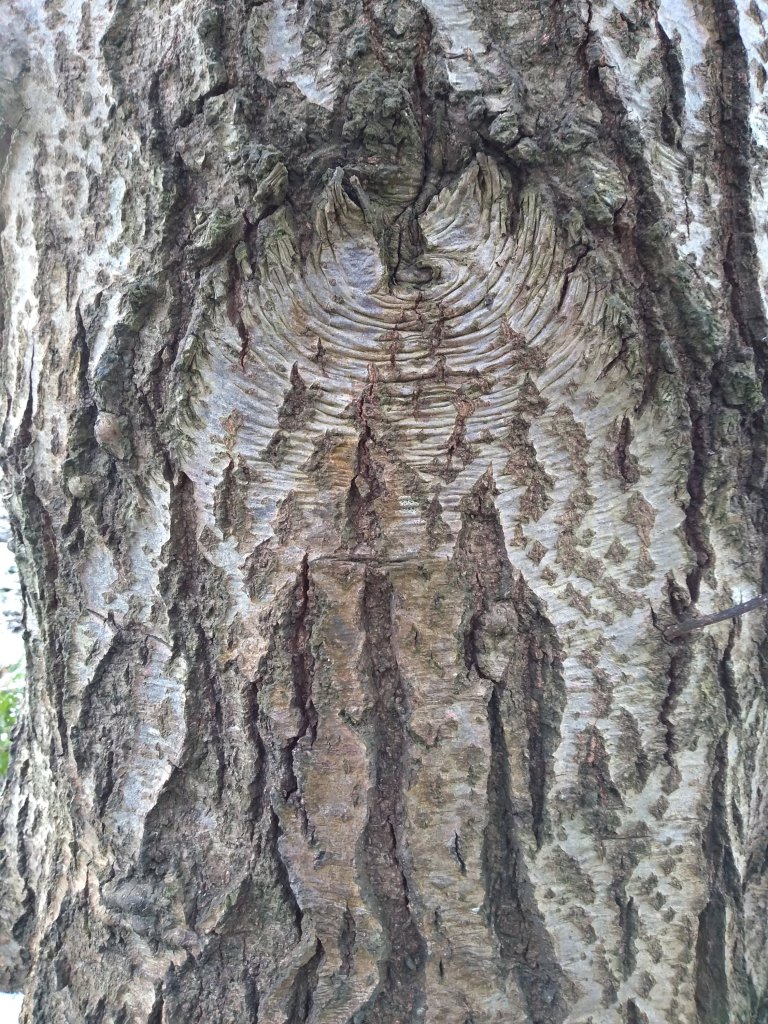
The paper like white bark of the Birch sheds to uncover newer, cleaner bark underneath; plus dark diamond shaped fissures develop as the tree ages.
Fissures developing on the trunk of a Silver birch from my local woodland park.
Two birch trees are native to the UK, the other is the Downy birch (Betula pubescens). It is possible for these to hybridize with one another however individually they can be differentiated. The Downy birch has hairy, single-toothed leaves and hairy shoots (which is how it gets its name); plus the leaf base is rounder. The leaves of the Silver birch are more angular, double toothed around the edges and hairless (the shoots are also hairless). The Downy birch also prefers damper soil than the Silver birch but both are naturally found in woodlands.
The Silver and Downy Birches have open canopies allowing flowers such as violets (Viola), Primrose (Primula vulgaris), Bluebells (Hyacinthoides non-scripta) and Wood anemone (Anemone nemorosa) to florish beneath them. Several fungi are linked with Birch trees too, such as Fly agaric (Amanita muscaria), Woolly milk cap (Lactarius torminosus), Birch milk cap (Lactarius tabidus), Birch brittlegill (Russula betularum), Birch knight (Tricholoma fulvum) and the Birch polypore (Fomitopsis betulina).
These trees can support over 300 insect species. They are a good food source for the caterpillars of Angle-shades (Phlogophora meticulosa), Buff tip (Phalera bucephala), Pebble hook-tip (Drepana falcataria), and Kentish glory (Endromis versicolora) moths. Several Bird species make use of these trees including woodpeckers (Picidae), which nest in the trunks, along with Siskins (Spinus spinus), Greenfinch (Chloris chloris) and Redpolls (Acanthis) that feed on the seeds.
Uses for Birch trees include the manufacture of furniture, handles and toys as well as the process of tanning leather.
In times gone by it was used to make bobbins, spools and reels for the Lancashire cotton industry as well. To the Celts Birches symbolised purity, renewal and love. Later on brooms were made using birch twigs in order to clean rooms. In Finland they are the national tree.
There are several threats to Birch trees, two fungal pathogens (Marssonina betulae and Anisogramma virgultorum) whichcan cause Birch dieback and eventual death. Bronze birch borer (Agrilus anxius) can also attack native trees. More information on both can be found on the Forest research website, see the links Birch dieback and Bronze birch borer.
On the 31st January, I undertook the RSPBs Big Garden bird watch. Most birds, I’d normally see, were clearly hiding but I did notice some within the hour. Those birds I saw were; 1 Carrion crow (Corvuscorone), 2 Robins (Erithacusrubecula), 1 Coal tit (Periparusater), 1 Blackbird (Turdusmerula) and 2 Mistle thrush (Turdus viscivorus). I enjoy taking part in this citizen science project each year; it’s interesting to see how the results differ each time.
Due to the frozen ground last week, I was still able to go for my regular exercise in the local woodland park. Various tree species were waking up from their winter sleep. Beech (Fagus) and Oak (Quercus) had started budding while others were developing catkins.
Last years leaves and new buds on a Beech tree.Old Oak leaves alongside new buds.
As well as the Hazel (Corylus avellana) other trees had catkins hanging from them too. Hazel catkins are the earliest to flower in the year, from January to March (see my previous post A Snowy Adventure).
Then the Alder (Alnus glutinosa) is the next tree to bloom with both male and female catkins. The male catkins are longer than the female ones which flower from February to March. Also hanging from the Alder trees were some small dark brown shapes. These woody cone-like fruit develop from the previous seasons fertilised female catkins; these can remain on the tree (even when the seeds have been shed) well into the following year alongside the newly formed catkins. I also noticed leaf buds growing on the trees last week too. When the buds burst, I shall update the Woodland trust Nature’s calendar with my findings.
Unfortunately I was unable to capture decent photos on location so I collected part of a fallen branch to take home.
One small female catkin above a group of larger male catkins. On the tree (before fertilisation when they develop into the rounder, woody fruit) the female catkins point upwards while the male ones hang down. A magnified view of two unfertilised female catkins.A leaf bud with one of last years fertilised female catkins.A magnified view of the Alder tree seeds that had remained in last seasons female catkin.
I find Alder trees fascinating and the rough, fissured bark beautiful.
Alder are native to Britain and found on wet land, next to water or in marshes and woodlands. They naturally thrive in moist conditions although can also grow in drier areas such as the edges of mixed woodland. Alder wood is durable when wet and actually becomes stronger rather than rot when submerged in water; a characteristic that makes them useful in flood mitigation, boat building, sluice gates, and even the construction of Venice which is mostly built on Alder piles. Alder wood is also used in the creation of charcoal, gunpowder and making clogs.
The pale wood turns a deep orange colour at the point at which it’s cut (while the rest of the wood remains pale); leading to a superstition, in Ireland, that it was bad luck to walk past an Alder tree on your travels. However, traditionally alder branches were also taken into houses to prevent Woodworm. Alder wood is particularly liked by various species of beetle larvae (collectively referred to as Woodworm). It is hoped that the beetles will lay eggs in the Alder rather than the furniture or fixtures; the branches once infested can then be removed.
There is also a traditional use for Alder flowers as a green dye; believed to be used as camouflage by outlaws like Robin hood and fairies.
For fun, I looked up Alder wands used in the Harry potter series. Only one is mentioned, that owned by Quirinus Quirrell. The wands qualities are described on the Wizarding world website.
The roots of Alder are nitrogen fixers. Nitrogen from the air is fixed into the soil, replenishing the levels and aiding soil fertility, through the bacterium Frankia alni.
As well as improving soil, Alder are great for wildlife too. The seeds are eaten by Redpoll (Acanthis flammea), Siskin (Spinus spinus) and Goldfinch (Carduelis carduelis). The leaves are food for the caterpillars of the Alder kitten (Furcula bicuspis), Pebble hook-tip (Drepana falcataria), Autumn green carpet (Chloroclysta miata) and Blue-bordered carpet (Plemyria rubiginata) moths. Bees visit the catkins for an early source of nectar plus Alders provide habitats for the Checkered skipper (Carterocephalus palaemon) butterfly, Small pearl-bordered fritillary (Boloria selene) butterfly, some species of Crane fly, Otters (which create nests amongst the roots) along with mosses, lichens and fungi that like damp conditions.
However, these trees are also threatened through infection by the Phytophthora fungus (together with some other broadleaf tree species). In Alder this disease is referred to as Alder dieback and eventually causes the death of any infected tree. For more information see the Forest research website. There aren’t many Alders in my local woodland park compared to other tree species so it would be sad to see them disappear. Given my newly acquired knowledge I will keep a special lookout for any ill health in these trees; thankfully no infection is being exhibited at the moment.
I saw contrasting images last week which made me think of feeding birds with plants from the garden.
I first observed the Rowan (Sorbus) tree outside, now stripped bare of it’s berries, before noticing some Cotoneaster
and Ivy (Hedera) full of berries. Clearly the pollinators had been busy during the Summer and Autumn months.
Along with supplementary food, on the ground and bird feeders, birds can also rely on trees and other plants in the garden for food in winter. Along with the examples already mentioned there are other berries, fruit, seeds and nuts which are enjoyed by birds.
Some other plants providing fruit and berries are;
Hawthorn (Crataegus)
Honeysuckle (Lonicera)
Guelder rose (Viburnum opulus)
Dog rose (Rosa canina) Berberis
Bird cherry (Prunus padus)
Crab apple (Malus sylvestris)
Blackthorn (Prunus spinosa) Pyracantha
Sarcococca hookeriana Mahonia
Leaving seedheads on perennials not only provides food for birds, they also give shelter to beneficial insects. In fact a little bit of leaf litter also has this affect which in turn helps feed birds who eat the insects.
Common birds to see in winter include;
Redwings (Turdus iliacus)
Waxwings (Bombycilla)
Starlings (Sturnidae
Blackbirds (Turdus merula
Robins (Erithacus rubecula
Chaffinches (Fringillacoelebs)
Bramblings (Fringilla)
Goldfinches (Carduelis carduelis)
Bullfinches (Pyrrhula pyrrhula)
Dunnocks (Prunella modularis)
Goldcrests (Regulus regulus)
Blue tits (Cyanistescaeruleus)
Long-tailed tits (Aegithaloscaudatus)
Coal tits (Periparus ater)
Great tits (Parus major)
Fieldfares (Turdus pilaris)
The RSPB Big Garden Birdwatch, which takes place on the 25-27th Jan 2020, has been going for over 40 years. Surveying birds visiting your Garden or local park for one hour is calming and enjoyable. This citizen science continues to give the charity useful information on the numbers of birds in the UK.
Further information on feeding birds can be found in the book, ‘RSPB Pocket Bird Feeder Guide’ by Robert Burton (published by Dorking Kindersley) or on the Gardeners World website.




 Bee in the Moment