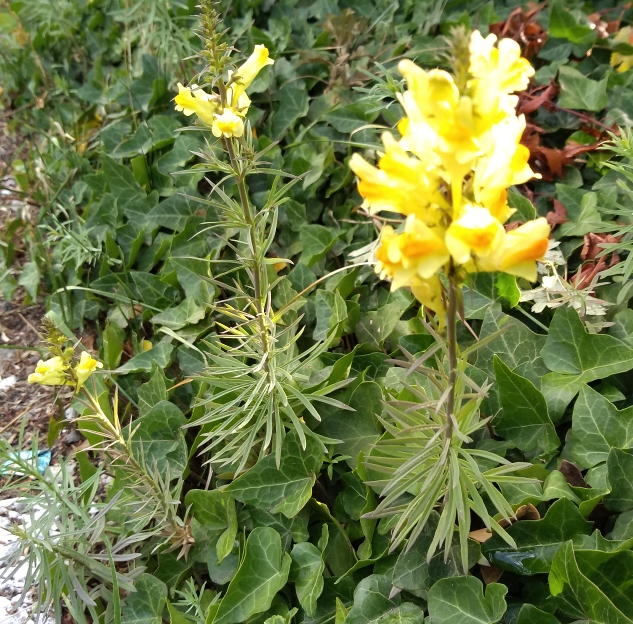
Some fields along my journey to and from work contain a lovely combination of pink Rosebay Willowherb (Chamaenerion angustifolium), purple Buddleia and white Wild carrot (Daucus carota) flowers. Not only do they compliment one another visually but they are all loved by pollinators too. Yellow toadflax (Linaria vulgaris) has started to bloom along the roadside as well.
One special moment occurred on the Monday. As I worked within a border I noticed a Buff-tailed bumblebee (Bombus terrestris) queen flying around a patch of grass. Eventually she began to settle and after a few more large sweeping flights began making a nest in the lawn.
It didn’t take her long to dig into the soil beneath the grass.
She will remain under ground until spring when she will start her own colony.
It was also great to finally get some photos of insects that have have alluded my photographic capture so far this year.
– The first is the Red admiral (Vanessa atalanta),
– Some Hoverflies, including a Hornet mimic (Volucellazonaria) hoverfly,
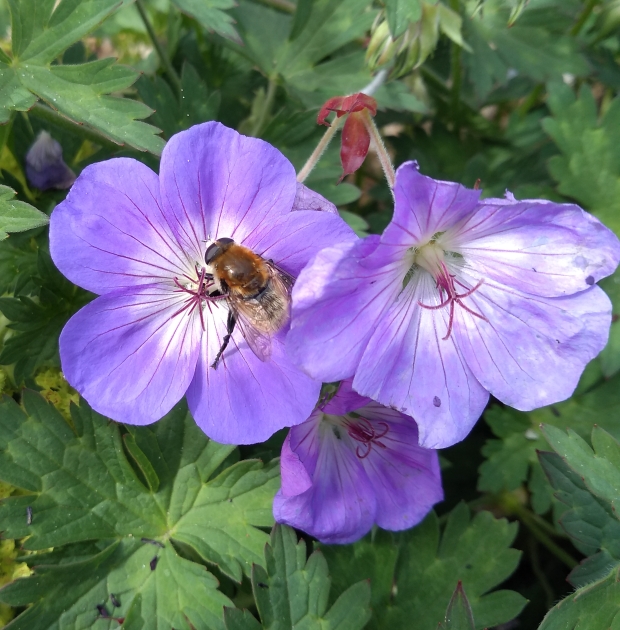
Hornet mimic Hoverfly pollinating Wisteria flowers that were still blooming.Hoverfly pollinating Geranium flowers.
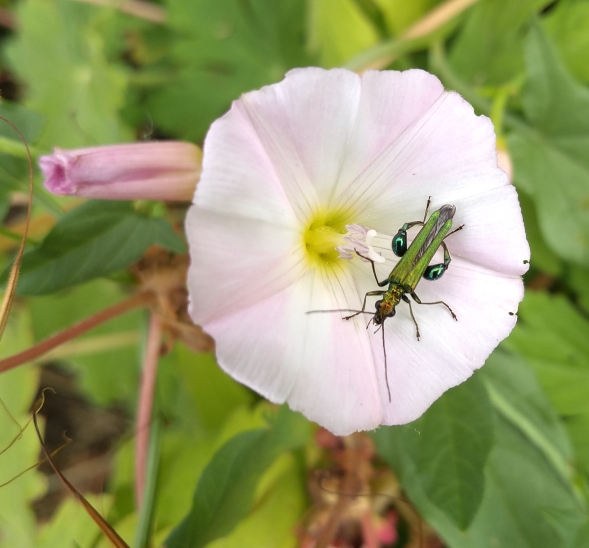
– as well as a Male False oil beetle (Oedemera nobilis), to compliment the female one seen on a walk earlier in the year.
A False oil beetle pollinating a Field bindweed (Convolvulus arvensis) flower.
The males are easily identified due to their large metallic thighs, explaining the reason behind the other common name for this insect the Swollen-thighed beetle.
“Tell me can you feel it, tell me can you feel it, tell me can you feel it, the heat is on…”
The 80’s song from the Beverly Hills Cop soundtrack with Glenn Frey’s voice, synthesizer and saxophone was my earworm as the temperature soared last week. The temperature increased to around 27°C mid week, which meant lots more insects ventured out as it felt like summer.
I was happy to see my first Red admiral (Vanessaatalanta) butterfly of the year, however my main observations were bees including the Red-tailed bumblebee (Bombuslapidarius) and Honey bees (Apismellifera).
A Red-tailed bumblebee pollinating some geranium.Honey bees visited Nepeta.
Another bee I started seeing last week was the Tree bumblebee (Bombushypnorum). I noticed a nest inside a compost bin as I emptied grass clippings from the mower bag.
I have seen Tree bumblebees nest in bird houses before but not under compost. I made sure I avoided tipping grass onto their home and used the next bin along. I couldn’t help watching them for a little while as I stopped for a breather on the very hot Wednesday.
Moths were prominent throughout the week too. Unfortunately Box tree moth (Cydalima perspectalis) caterpillars and the signs of heavy infestation (foliage that had been eaten and covered with webbing) was noticeably present in several gardens. Therefore, I spent lots of time picking them off buxus topiary and informing clients to keep an eye out for them as well. For more information on this pest see the RHS website.
I discovered this years first sighting of a Silver Y (Autographa gamma) moth.
A Silver Y moth resting on a Heuchera leaf.
This immigrant is one of the few brown moths I can identify easily, mostly due to the clear y markings on it’s forewings but also because of their size and shape. This is a day and night flying moth which can be observed visiting flowers to obtain nectar.
However my most exciting moth sighting was the Lime hawk-moth (Mimas tiliae).
This spectacular large moth is night flying. It’s wingspan is 4.6-7.8cms and it can be found in broadleaf woodland, parks and gardens between May and July. I accidentally disturbed it as I pruned some shrubs under a Lime (Tilia sp.) tree. Thankfully it didn’t seem bothered by the disruption and it was carefully placed back near the lime tree. While adult moths of this species don’t feed, the caterpillars do. Once they have emerged from overwintering pupa, the caterpillars will eat Lime, elms (Ulmus sp.), Alder (Alnus glutinosa), Downy Birch (Betula pubescens) and Silver Birch (Betula pendula), Plane (Platanus x hispanica) along with some Cherry cultivars. This was the first Hawk-moth I have ever seen. There are a few that exist in the UK. The nearest I came to seeing one before was observing caterpillars of the Elephant hawk-moth (Deilephilaelpenor) eating away at some Fuchsia. For more information on these Hawk-moths see the Butterfly Conservation website (Lime hawk-moth and Elephant hawk-moth)
I also saw hoverflies. I am still learning about these insects and learnt another one last week.
The photo above shows a Narcissus bulb fly (Merodon equestris). The maggots eat away at the centre of bulbs from the Amaryllidaceae family. However even though the maggots are a pest, the adult hoverflies are pollinators.
The weather at the beginning of last week started nicely. Early on a sunny Monday morning I spotted seven Large white (Pierisbrassicae) butterfly caterpillars on a Nasturtium (Tropaeolum) plant.
Used as a companion plant near brassicas this plant has been sacrificed to prevent the butterfly eggs being laid on the cabbages.
Unknown to me at the time, I also photographed some caterpillar faeces as well as an undeveloped egg on the leaf. I don’t remember the loved childhood picture book, The Very Hungry Caterpillar mention poo (although I’m sure children would have loved that addition to the story).
As with elsewhere in the country, the weather continued to be unsettled throughout the week. Tuesday was mostly overcast but the bees were still out foraging. As the lavender (Lavandula) was over lots of Honeybees (Apismellifera) started visiting the Echinopsbannaticus.
Later the same day I managed to see another Male Gatekeeper (Pyroniatithonus) butterfly too, this time visiting a Geranium.
Plus on Thursday I noticed a Holly blue (Celastrinaargiolus) butterfly on some Verbenabonariensis. I haven’t seen Holly blue butterflies since spring, so that was nice.
Unfortunately on Wednesday I managed to disturb a Silver Y (Autographagamma) moth.
Although this isn’t a great photo, it is clear enough to be able to identify the moth. I managed to identify it because of the shape and light colouring along with the unbroken y shaped silver marking on each forewing. This moth is a migrant, visiting from the continent. It can be seen here with the wings vibrating to warm up it’s flight muscles before flying off.
The week ended with a visit to the Royal Botanical Gardens, Kew on Saturday. There were some insects braving the stronger winds and the afternoon rain.
Amongst the Wildflower meadow surrounding The Hive experience the flowers still blooming were; Red Campion (Silenedioica), Red clover (Trifoliumpratense), Ragwort (Seneciojacobaea), Yellow toadflax (Linariavulgaris), Creeping buttercup (Ranunculusrepens), Yarrow (Achilleamillefolium), Flatweed (Hypochaerisradicata) and Wild marjoram (Origanumvulgare).
Yarrow and Yellow toadflax along the path.
A Volucellainanis Hoverfly visiting the Wild marjoram.
In the Agius Evolution Garden there were lots of bees visiting the Salvias aswell as a Buff-tailed bumblebee (Bombusterrestris) on a hollyhock (Alcea)
and a Honey bee (Apismellifera) visiting a Wallflower (Erysimum).
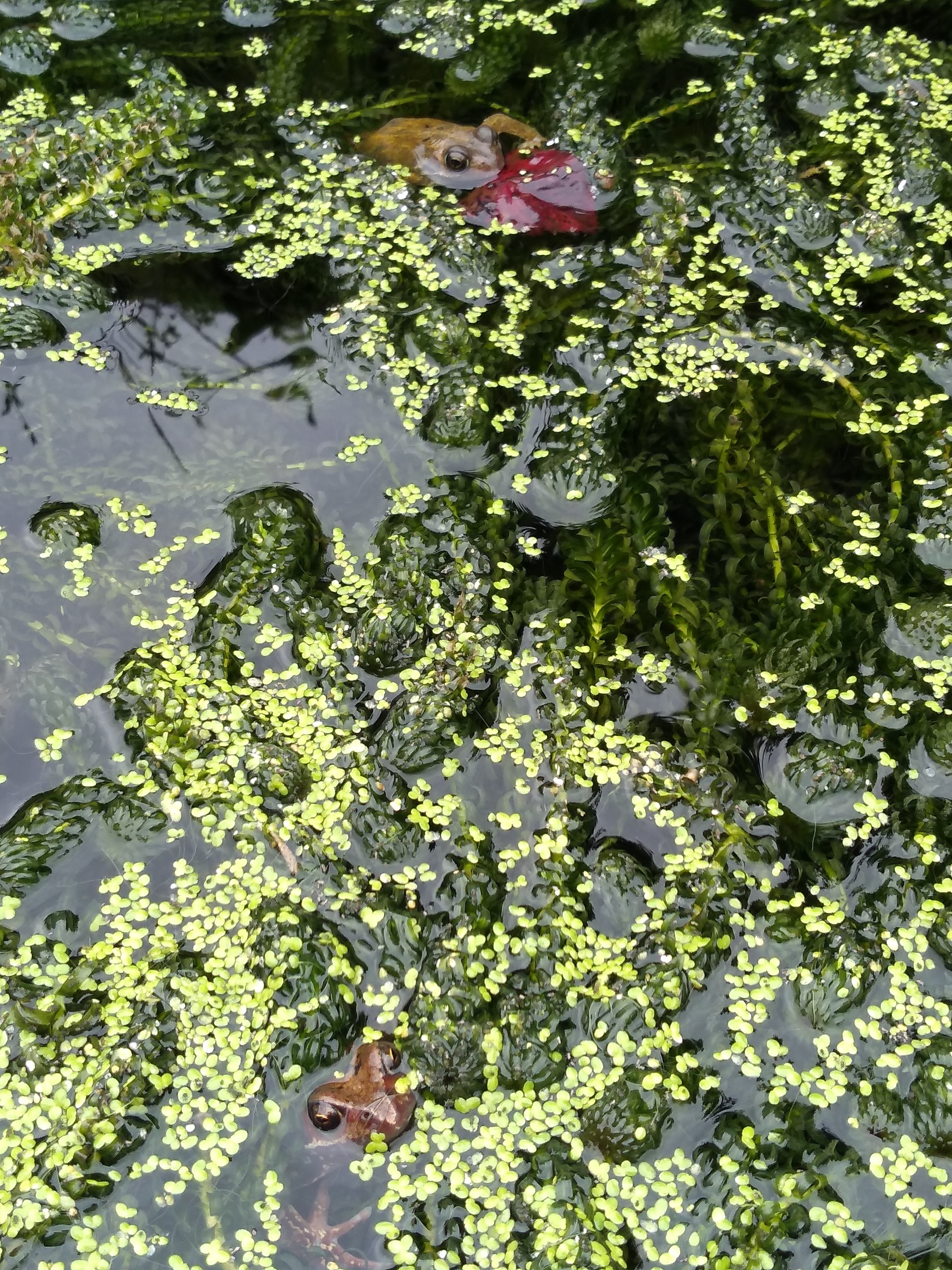
My week started and ended working next to ponds. The first was a small natural pond with a couple of frogs (Rana temporaria) sitting in it.
The other was a large disused outdoor swimming pool. In its neglected state rainwater collects within the concrete walls and nature is taking over. Given the murkiness of the water I was unable to obtain decent photos of my findings; however I saw another frog, (surrounded by lots and lots of tadpoles) along with a dragonfly nymph and a newt. It should be interesting to discover how many tadpoles survive to adulthood.
For the rest of the week insects were centre stage, especially on Wednesday when flying ants took to the sky. Flying ant season really tests my resolve to work through my dislike of ants (which originated in childhood). Thankfully I now find them more fascinating than loathsome, mostly.
The other insects I saw that day were;
– A (Chrysotoxum cautum) hoverfly on some Pyracantha.
– Honey bees (Apis mellifera) and a Red-tailed bumblebee (Bombus lapidarius) visiting a Geranium ‘Rozanne’ plant.
– Lavender (Lavandula) full of bees and butterflies, including more Honey bees as well as Buff-tailed bumblebees (Bombus terrestris), Meadow browns (Maniola jurtina) and a Ringlet (Aphantopus hyperantus) butterfly.
The Meadow brown butterflies also enjoyed visiting the Echinops bannaticus flowers too.
Even as I returned home I noticed a Willow Beauty (Peribatodes rhomboidaria) moth on the hall window.
The adults feed on Creeping thistle (Cirsium arvense) and Ragwort (Senecio jacobaea) both of these plants are common around this area. The caterpillars feed on various trees, shrubs as well as climbers ranging from Yew (Taxus baccata), Birch (Betula), ivy (Hedera helix), honeysuckle (Lonicera) and the wild Clematis, Traveller’s joy (Clematis vitalba).
The previous day I came across more insects that I was previously unaware of.
The first one was the Common red soldier beetle (Rhagonycha fulva).
It is a beneficial insect as adults eat aphids and are pollinators (feeding on nectar and pollen from open flat flowers such daisies and hogweed) while the larvae feed on slugs and snails along with other ground dwelling invertebrates.
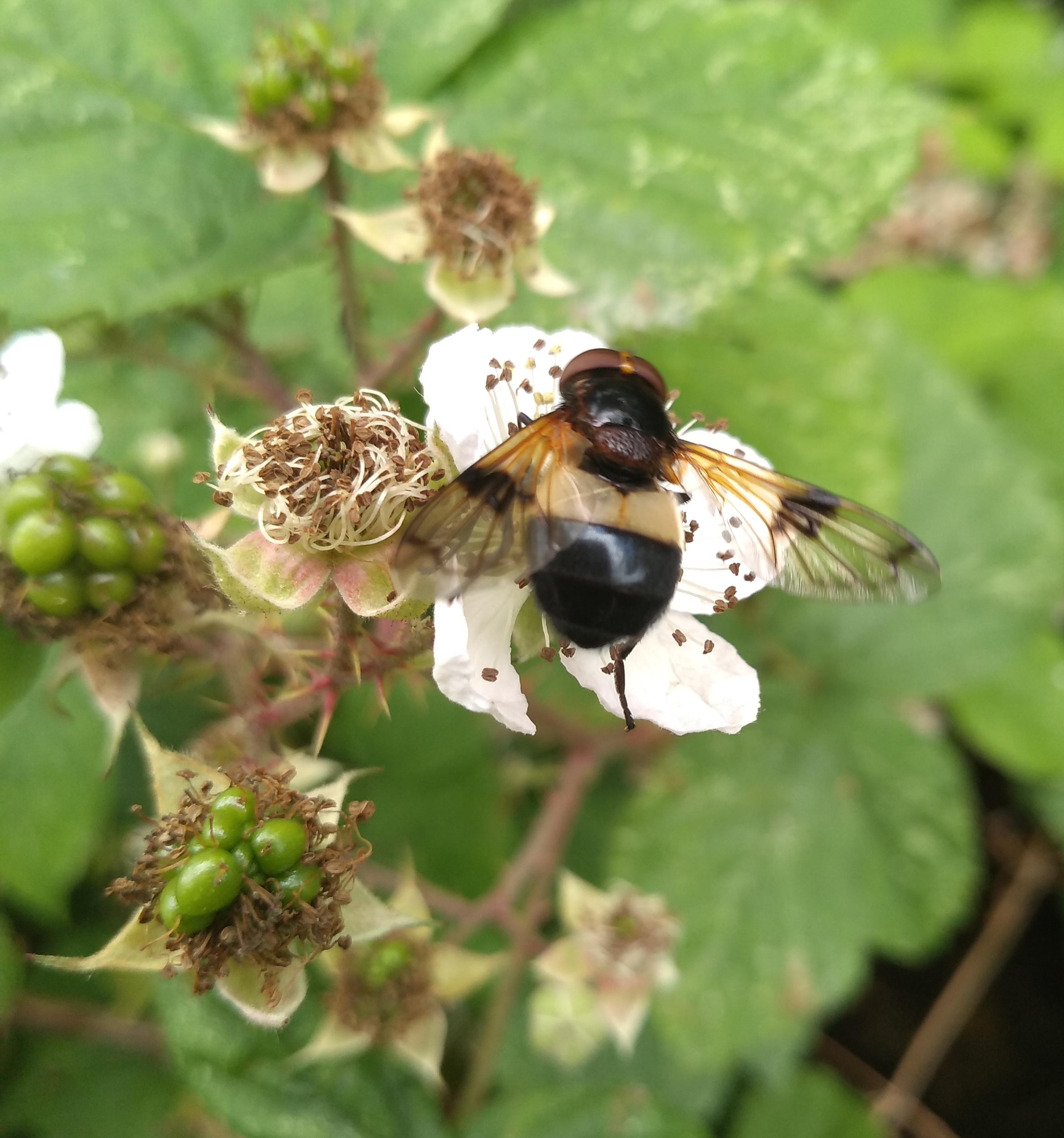
The other insect I saw on Tuesday was a female Volucella pellucens hoverfly feeding on nectar and pollen from Bramble (Rubus fruticosus).
These hoverflies also pollinate umbellifers; However as larvae they inhabit Bumblebee and wasp nests eating any waste produced along with their hosts larvae.
Last Monday lunchtime I got to hear a wonderful song. A Song thrush (Turdusphilomelos) was singing loudly from an Oak (Quercus) tree. It’s repeated phrases made it easy to identify even though I couldn’t locate it visually. Their conservation status in the UK is red (see RSPB) so was nice to hear it. I have also seen one in the past but observations of Song thrushes are rare for me.
I haven’t noticed the young Bluetits (Cyanistescaeruleus) in the Rowan (Sorbus) tree for several days now. However while I ate my breakfast on Wednesday I
briefly saw a young Jay (Garrulusglandarius) instead. It didn’t remain for long, perhaps realising that it hadn’t landed on an Oak tree (a favourite of Jays as they love acorns). It was a great sighting; unfortunately in my sleepy state I wasn’t quick enough to get a photo.
The observations for the rest of the week were of insects. On my way to work I saw a Riband Wave moth (Idaeaaversata).
Plants which their caterpillars feed on are Wood Aven (Geumurbanum), Primrose (Primulavulgaris), dandelions (Taraxacum) and dock (Rumex). I also saw another Cinnabar moth (Tyriajacobaeae) on my travels. Common Ragwort (Jacobaeavulgaris) is the main food source for their caterpillars. I often see these wildflowers around this area. I love to learn about plants that are beneficial for wildlife so I can undertake wildlife-friendly weeding. I allow ‘weeds’ to flower, remove seed heads before they set seed and control them via digging to prevent them from taking over a patch. With the exception of a few (which could remain in wild uncultivated areas of a garden) I find wildflowers can complement a border. I read an interesting article about this subject yesterday (see The Guardian).
I recently discovered that the collective noun for a group of Ladybirds is a loveliness. I saw loveliness of Seven spot ladybirds (Coccinellaseptempunctata) on a geranium on Tuesday afternoon.
They were a bit pale so it is possible they had only recently emerged; their wings not hardened properly or developed from pink to bright red. At one point I counted 10 and eventually noticed a Green shield bug (Palomenaprasina) nymph too.
This wasn’t the only encounter with ladybirds last week. On Thursday a Harlequin ladybird (Harmoniaaxyridis) larvae attached itself to my colleague’s t-shirt.
I have started noticing more moths lately, especially different species. I tried to discover the collective noun for moths. I couldn’t find an official word but one suggestion online was a whisper of moths which I like.
Another moth that I saw was a Large Yellow Underwing (Noctuapronuba).
Unfortunately it had a slightly damaged wing. It must have been disturbed because it isn’t a day flying moth. It soon sought shelter under the Hebe I photographed it resting on.
Apparently there is no such thing as bad weather, just inappropriate clothing. Most of the time I agree with this statement, however when you are outdoors all day and the rain is heavy and constant eventually it breaks through waterproof defenses. Although feeling bedraggled many times this week, being supplied with cups of tea made things seem better.
After days of much needed rain I was beginning to think I would have nothing to write about this week. It has been very quiet with a noticeable lack of birds, mammals and insects visible during the wet weather.
As I drank a much appreciated cup of tea, I observed a rose rambling up the wall. Upon closer inspection I saw the raindrops on the roses which made me think of the song sung by Julie Andrews.
I was told once that my paternal Grandmother liked The Sound of Music. I still remember my paternal grandparents garden vividly; the smell of French Marigolds (which they had in the front garden) immediately takes me back to my childhood with them. My maternal Grandmother also had green fingers, filling the garden with with a variety of plants.
So in dedication to my Grandparents, I took photos of raindrops on roses (and other plants).
This is the climbing rose that was the inspiration for this post.
More roses in the rain…
Other flowers I noticed with raindrops on them are Foxglove (Digitalis) and Geranium.
No piece containing raindrops on plants would be complete without a photo of a Lady’s mantle (Alchemillamollis) leaf.
Rain form beadlike droplets on these leaves because they are covered in hairs which hold the water. Alchemillamollis is also part of the Rosaceae family, so this is a photo of raindrops on Rosaceae.
Lastly, just because I couldn’t resist adding a close up photo of a Hosta leaf; again, raindrops sit on the surface of the Hosta foliage.









 Bee in the Moment