I have managed to learn more fungi over the past winter months, both at work and during woodland walks. I have seen these, mentioned below, between November 2025 through to mid January 2026.
1) Common stinkhorn (Phallus impudicus).
The common name is very appropriate, as Stinkhorn suggests, it does produce a very strong (foul) odour; in fact you become aware of it well before seeing it. The smell resembles blocked drains or a decaying animal. Flies land on it, spreading the spores as they continue to move around.
2) Wrinkled club (Clavulina rugosa).
This fungi is often found near pathways. These specimens were located on the edge of the lawn.
3) Jelly ear (Auricularia auricula-judae). I have seen this fungi before but I find it fascinating. I noticed a young slug seeking shelter amongst it.
4) False turkey tail (Stereum hirsutum).
False turkey tail is found growing on fallen branches or those dying on hardwood trees (as shown here). It is much smaller than Turkey tail fungi (Trametes versicolor).
5) Leaf Parachute (Marasmius epiphyllus).
These tiny fungi develop on leaf litter of Ash or Poplar trees.
6) White Saddle (Helvella crispa).
These pretty fungi develop near paths amongst Beech (Fagus) and Oak (Quercus) trees.
7) Candle snuff (Xylaria hypoxylon).
Candle snuff grows on moss and the decaying wood of broadleaf trees. Starting off greyish white, it releases spores that turns it black.
8) Oakbug Milkcap (Lactarius quietus), found them beneath Oak trees.
As the name suggests, milkcaps produce a milky substance (latex) when bruised as a form of protection, like putting on a plaster to cover the injured area. They form a cooperative relationship with specific trees, this one is only found under Oak trees.
9) Some Oysterlings, possibly Variable oystering (Crepidotus variabilis). Oysterlings are very small and difficult to distinguish from one another.
Developing on woody debris such as twigs from Broadleaf trees on woodland floors these white fungi are tiny.
Now that we are well into January flowers are starting to show signs of life. Snowdrops are beginning to bud and female Hazel (Corylus) flowers as well as Winter aconites (Eranthis hyemalis) are blooming. Plus I have seen lots of ladybirds sheltering through this harsh season.
7-spot ladybird (Coccinella septempunctata) found on a dead tree trunk.
September brought in a change of weather; stormy wetter conditions set in along with cooler mornings. Earlier in the month, I was lucky enough to witness a mini murmuration of Starlings (Sturnus vulgaris) as they flew away from a storm that was rolling in. The commotion they produced made me look up; there were about 30 to 40 of them grouped together before they eventually headed off.
Hedgerow foraging has been mixed due to the dryness earlier on in the year. There are fewer conkers but the Horse chestnuts (Aesculus hippocastanum) showed signs of stress as the leaves began to brown off at the end of August. While there have been plenty of blackberries this year, most were smaller and dried up. Plus elderberries ripened a month earlier than usual. There have been plenty of walnuts and acorns though.
Fungi has begun to appear lately. One I spotted on an Ash tree (Fraxinus) was the Shaggy bracket (Inonotus hispidus).
Commonly found on deciduous trees, mostly Ash but also Planes (Platanus), Walnut (Juglans regia) and Apple (malus), it is inedible; attacking the trees heartwood, entering through a wound. It starts off with a velvety look (as seen in the photo) but eventually becomes brittle and black.
The weather this year continues to be strange. Early October was relatively mild. Buddleias were still flowering and on the 7th, a very sunny day, I saw a Painted lady (Vanessa cardui), a few Red admirals (Vanessa atalanta) and many Comma (Polygonia c-album) butterflies visiting one, together with some Verbena bonariensis. There were lots of bees on these plants as well, along with lots of mining bee activity in lawns too.
Now, a month on, still milder than usual, the clocks have gone back and Samhain/ Halloween has passed. While the autumnal colour has been developing for a short while, leaves have only been falling in great numbers for the passed few weeks. Grass is still being mown although growth is slowing down.
It has been lovely watching the various birds visiting the Rowan tree (Sorbus) outside my flat. Alongside Redwings (Turdus iliacus) there have been a few Blackbirds (Turdus merula), Magpies (Pica pica) and many Starlings (Sturnus vulgaris) eating the berries.
I have also noticed a Winter flowering cherry (Prunus subhirtella Autumnalis) in bloom too.
This small ornamental tree can continue flowering until February if the weather remains mild and gives a wonderful winter interest.
Fungi have been putting on a wonderful show over the past month; some providing a splash of colour to rival the leaves during this transitional period. I noticed Shaggy inkcaps (Coprinus comatus) in late October, followed by many others, including puffballs, Common bonnets (Mycena galericulata) as well as Scarlet waxcap (Hygrocybe coccinea) and Amethyst deceivers (Laccaria amethystina).
This aging Amethyst deceiver has lightened in colour.
The latter, as the common name suggests is a lovely purple colour that fades to lilac as it ages. The caps are typically 1.5 to 5 cm in diameter and height of stem 4-6 cm. This fungi has gills and is commonly found in broadleaf woodlands containing Beech (Fagus) and Oak (Quercus) between June and November. I noticed these under some Copper beech (Fagus sylvatica f. purpurea).
I also found a carpet of Scarlet waxcap on a lawn, unfortunately I didn’t manage to get a good photo of them. However, it was an amazing view, bright red caps with orange gills. Photographs and information on this fungi can be found on the Wild Food UK website here.
I’ve slowly started to emerge from hibernation now that Imbolc, the half way point between the Winter solstice and Spring equinox, (meaning ‘In the belly of the mother’- referring to the first stirrings of the years new growth) has passed; mirroring the snowdrops, winter aconites and hazel flowers (the first signs of the transition into the next season).
The scents of Daphne, Mahonia and Sarcococca fill the air alongside the arrival of other spring flowers; daffodils, cyclamen, crocus and hellebores. Willow (Salix) catkins are also opening while Blackthorn (Prunus spinosa) blossoms fill the roadsides with glorious white clouds.
Although it has still been too early for most allotment activities, the rhubarb has been emerging on the plot for the last month. I still haven’t cut back perennials as I want to allow cover for beneficial insects such as sheltering ladybirds (Coccinellidae) until the weather makes their survival easier. Instead February is mainly a month for planning the forthcoming years growing (thinking about chitting potatoes and planning seed sowing). One job I have begun however is the indoor Sweet pea and Chilli seed sowing. This small step gives me hope that I will soon be able to sow other seeds soon.
Although I am beginning to think ahead, I am still fondly holding on to snuggly sofa moments such as reading and partaking in arts and crafts, especially on wet days.
Through the winter I still immersed myself in nature. In January I pruned my apple tree on the allotment, blessing and giving thanks through Wassailing. Although symbolic, it was a nice way to feel deeply connected to the plot. I am grateful to be a guardian over it and receive the abundance of fruit, veg and flowers in return.
I saw quite a few foxes (Vulpes vulpes) over the winter too, including one on the allotment. It was such a beautiful moment to watch it foraging under trees.
Once again, I took part in the RSPB Big Garden Bird Watch in January. The list of birds I saw this time were; 4 Long-tailed tits (Aegithalos caudatus) 5 Starlings (Sturnus vulgaris) 1 Blackbird (Turdus merula) 3 Wood pigeons (Columba palumbus) 5 Sparrows (Passer domesticus) 2 Blue tits (Cyanistes caeruleus) 1 Greenfinch (Chloris chloris) 1 Great tit (Parus major) 6 Magpies (Pica pica) 1 Gull (Larinae) and 1 Red kite (Milvus milvus)
There is a small group of Ring-necked Parakeet (Psittacula krameri) that visit a nearby tree of late but frustratingly they didn’t show up during the observation hour.
During February, bird song continued to fill the skies, growing in frequency and volume. Also occasionally insects have boldly buzzed and fluttered about on the odd sunny days. Butterflies I noticed were a Brimstone (Gonepteryx rhamni) and Peacock (Aglais io); the latter I saved from an abandoned spider web. I have also seen bees visiting mahonia, crocuses and hellebores, especially queen bumblebees.
Last week, I was excited to find some Jelly ear fungus (Auricularia auricula-judae) for the first time. They were growing on a Buddleia bush. Although this fungus is usually associated with elder (Sambucus) it can also be found on other hard woods like sycamore (Acer pseudoplatanus), ash (Fraxinus) and beech (Fagus) in damp shady conditions. Perhaps the fungus was thriving on the Buddleia, in the garden I visited, because of the recent weather as well as it being planted near a beech hedge. Interestingly this fungus can continue to grow on dying wood that has been thawed, once frozen; hence it can survive really cold winters. The common name was given to this fungi because of how it looks and also its jelly-like texture.
Worryingly, it has been a very mild winter overall with lots of flooding occurring in Britain; certainly very different from last winter. So far the wet weather is continuing into March; hopefully the month will exit like a lamb and the roaring weather won’t continue too much in spring, as it will have an affect pollinators. We will have to see what the rest of 2024 has in store.
August disappeared quickly and September is zooming by, even the Autumn equinox has been and gone. Apart from the heatwave a few weeks ago (with the highest temperatures of the year being reached) it is beginning to feel autumnal. Fungi has appeared, leaves have started turning, plus nights are drawing in and cooler misty mornings have returned highlighting once hidden spiders and their cobwebs.
Foraging blackberries had begun early this year but the extreme heat meant that the remaining flowers and berries dried up; the same is true of elderberries, although sloes, haws, rosehips and rowan berries are abundant. Unlike last year, apple and pear trees, that I see regularly, have struggled with the weather this year as well. Thankfully harvesting on the allotment is still going strong; potatoes, kale, beetroot, radishes, chillies, courgettes and rhubarb have been keeping us fed. The popping corn will soon be ready too. I have also been harvesting calendula, lavender and other herbs recently.
There has been a few changes on my plot. I had finally collected enough items to be able to construct ‘the bug snug’.
It is an addition to the wildlife section containing wildflowers and long grass (which also links to a pond on the adjoining plot). I know we have a couple of frogs visiting us so hopefully it encourages more to inhabit our allotment (to help keep slug and snail population down). I still hear the grasshopper when we are nearby too. There has also been evidence of a fox visitor; random toys get left near the water I leave out, along with poo on the grassy paths between plots.
Last week I also noticed that the Bee house, at the opposite end of the plot, was finally being used.
I found it hard to contain my excitement as it has been there for a few years and I was beginning to think it would never be used. There is evidence that it has been used by a Leaf-cutter bee and Mason bees too. Although it is difficult to know which ones specifically, the most commonly found in gardens are the Patchwork leaf-cutter bees (Megachile centuncularis) and Red mason bees (Osmia bicornis). As the name suggests Leaf-cutter bees used leaf particles to plug one piece of bamboo while those used by the Mason bees were plugged with soil. Each cell contains larvae as well as some pollen and nectar for the developing young. Male bees fly out before the females as they are near the entrance. The developing bees will remain there over winter and emerge as adults next spring, at the around April.
In other news… While clearing a gravel footpath of wildflowers at work, I accidentally disturbed a Devil’s coach-horse beetle (Staphylinus olens). I stopped weeding that section to enable it to hide for the rest of the day.
Devil’s coach-horse beetle
These beetles can raise their abdomens (resembling a scorpion), release an odour and even bite when they need to defend themselves (thankfully it didn’t feel threatened by my presence). They grow up to 2cms 8mm in length and are commonly found in gardens from April till October (when accidentally disturbed as they are active at night). The young overwinter in the soil as pupae until the following spring when they emerge as adults. The adults can fly but usually quickly run away from danger or to catch prey eating larvae, insects, spiders and slugs.
The Big butterfly count results came out this month. The long term trend of many species of butterfly and daytime flying moths recorded continue to fall, although the numbers were the highest since 2022 (with an average of 12 butterflies being spotted compared to 9 back then). The most commonly recorded were Red admiral (Vanessa atalanta), Gatekeeper (Pyronia tithonus), Small and Large whites (Pieris rapae and Pieris brassicae) as well as Holly blue (Celastrina argiolus). While those which are in significant decline are Ringlet (Aphantopus hyperantus), Common blue (Polyommatus icarus) and Speckled wood (Pararge aegeria). Over the last few days I have seen several Red admirals and even one Speckled wood making the most of the Autumn sun.
Upon visiting the Chiltern Open Air museum on the last bank holiday weekend, we walked through the meadow and woodland that is there. In the woodland, a couple of Silver-washed fritillary (Argynnis paphia) butterflies fluttered in amongst the brambles (the flowers of which give nectar for these fritillaries along with thistle blooms.
Silver-washed Fritillary
There were lots of Dog violets (Viola riviniana) on the woodland floor too, which is the food source for their caterpillars. The wingspan of this butterfly is between 7.2cms and 7cms 6mm. They are found in most areas of the UK (apart from Scotland) and often in oak woodland.
The meadow was full of wildflowers, but it was particularly lovely to see Harebell (Campanula rotundifolia) and Wild basil (Clinopodium vulgare) amongst them.
Harebell
The delicate looking Harebells bloom from late summer into autumn. They can be used as an indicator of dry nutrient poor chalky limestone soil which they require to thrive. Along with dry undisturbed grassland and heathland Harebells will flower in walls, cliffs and even on sand dunes.
Wild basil
Wild basil is a mound forming perennial which also likes the same soil conditions as the Harebell. This wildflower can be seen blooming in July, August and September.
It was lovely to see Tansy (Tanacetum vulgare) growing in the wild too; found in a few areas including near the iron age roundhouse located on the museum grounds.
Tansy
It starts flowering in July through to October. While used as an insect repellent to keep ants and flies away, some insects, especially the Tansy beetle (Chrysolina graminis) are resistant to the toxins produced by the plant. Tansy beetles are endangered in the UK; only found in two places in York along the River Ouse and in Cambridgeshire at the Woodwalton Fen nature reserve. We are at risk of losing this once common beetle due to habitat loss (wetlands), where their entire lifecycle occurs, and loss of suitable food source (mainly Tansy); however in the Fens its been seen eating Water mint (Mentha aquatica) and Gypsywort (Lycopus europaeus) too. It’s conservation status is known to be Nationally Scarce and is a UK BAP priority species that is Protected in the UK under the Wildlife and Countryside Act, 1981. More can be found on this beautiful beetle on the Buglife website (see web pages below), including how to help with its conservation.
The shift in seasons is definitely noticeable now. This November is warmer than usual, so we still haven’t had a frost here in southern England; however autumn colours, shorter days, wet weather and fungi have arrived over the past month.
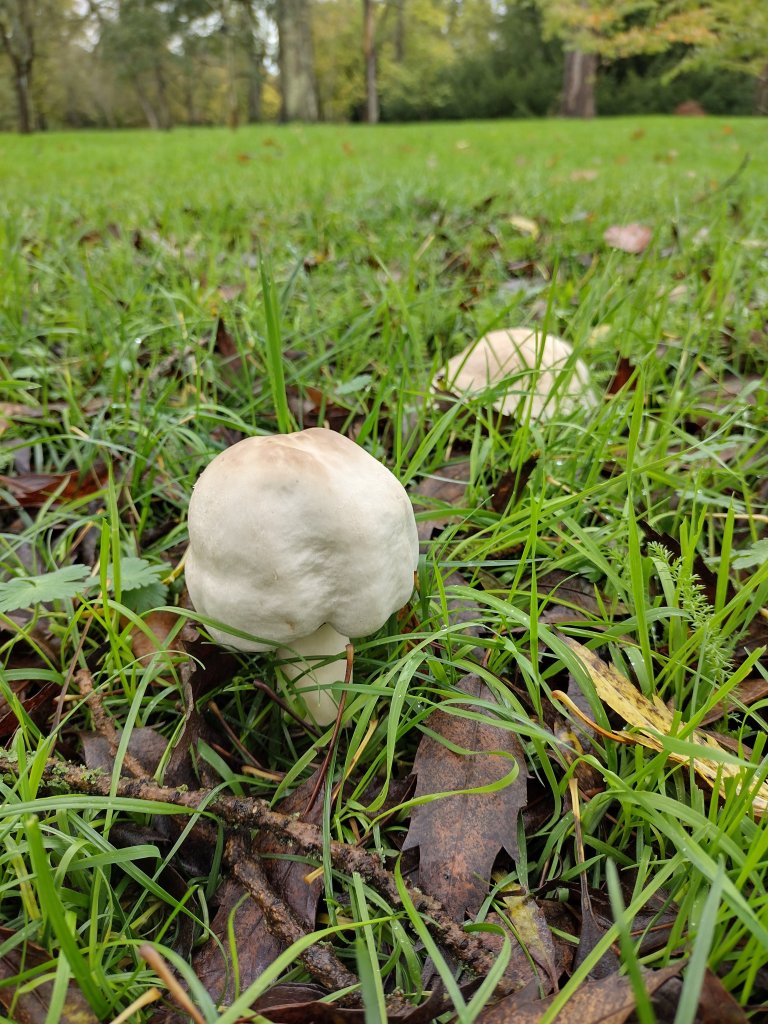
On a recent trip to Kew gardens several fungi including some Horse mushrooms (Agaricus arvensis),
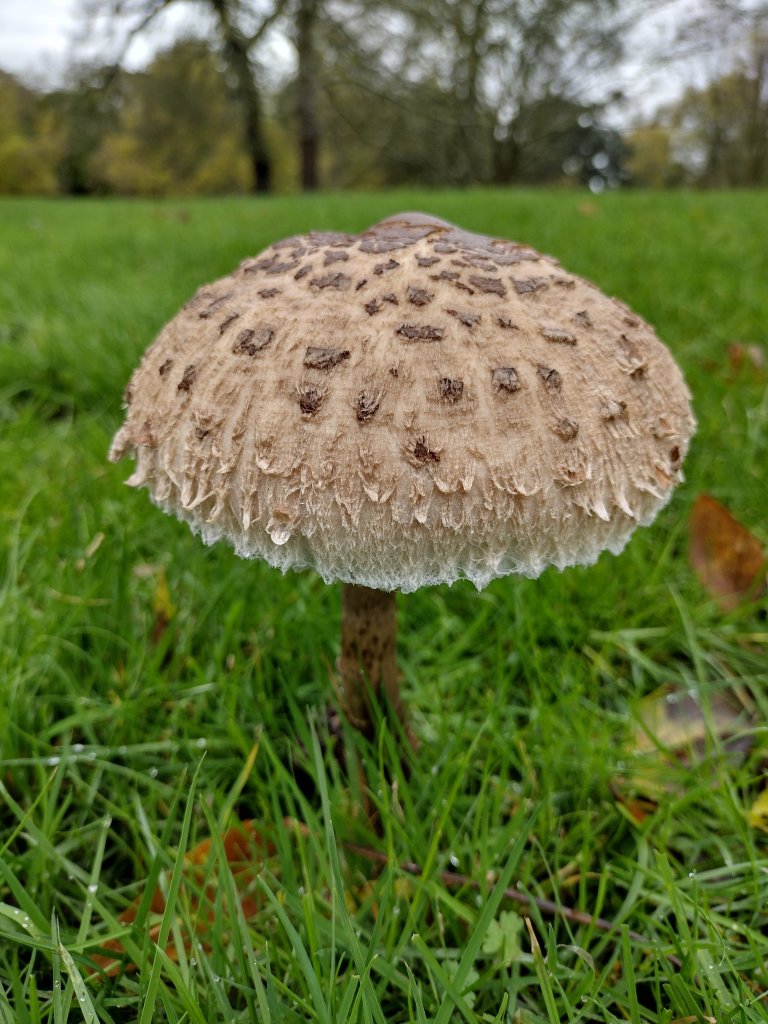
and Parasol mushrooms (Macrolepiota procera)
were dotted around the lawns as well as a group of Glistening inkcap (Coprinellus micaceus) on a decaying tree stump.
I think the weather had put many people off visiting which meant the gardens were fairly quiet. Although the odd heavy rain shower arrived while we were there, most of the day was dry and eventually the sun shone before we left, highlighting the vibrant leaves against a grey sky.
This year, I finally got to see a couple of Fly agaric (Amanita muscaria) fungi for the first time if my life (outside of books).
Fly agaric
I’d hoped to see these iconic fairytale fungi for a long time. Known for being hallucinogenic these incredibly toxic fungi are usually found in Birch (Betula), Pine (Pinus) and Spruce (Picea) woodlands; however I found them in a garden near a single Birch tree. Fly agaric supply nutrients to nearby trees along the underground mycorrhizal network therefore they have a close association with trees. A traditional use for this poisonous fungus is as an insecticide for house flies due to the Ibotenic acid contained within them (hence the common name for this fungi). Added so a saucer of milk, once a fly drinks the substance it becomes drousy and drowns.
These mushrooms weren’t the only exciting thing I got to observe in recent weeks. My Fishbone cactus (Epiphyllum anguliger) which has lived in my bathroom for many years flowerered for the first time. An epiphytic cacti, originally from Mexican rainforests, this plant develops aerial roots in order to attach itself to host trees. It likes humid indirect light and requires more watering than desert cacti. Clearly the conditions in my bathroom are ideal. The unusual looking flowers (which are produced once the plant is mature) were highy scented, similar to TCP but more floral. They take weeks to develop and once opened only last for a few days before dying off.
The temperature has fluctuated during the previous two weeks, with a few light frosts and hotter than average November days. Leaf fall is well under way now too keeping us busy at work. I never cease to be in awe of the beautiful leaf colours as the sun shines; They make fireworks look monochrome in comparison.
Fungi observations were still numerous. Here are some that I have seen over the past few weeks;
The Prince (Agaricus augustus)Golden waxcap (Hygrocybe chlorophana)Russula queletiiFalse saffron milkcap/ Orange milkcap (Lactarius deterrimus)
Amazingly I have still seen the occasional Buff-tailed bumblebee (Bombus terrestris) queen; plus the previous Friday I also noticed a Common carder bee (Bombus pascuorum) near a compost bin in one garden.
Common carder bee
The Rowan (Sorbus) berries on the tree outside my flat are almost gone, mostly due to a local flock of starlings (Sturnus vulgaris); however other visitors enjoying the bounty have been two Song thrushes (Turdus philomelos) and two blackbird (Turdus merula) couples.
I enjoy watching Starlings, seeing their shiny purple and green plumage and listening to their social interactions and mimicry. Starlings have a wide repertoire of calls because they imitate sounds, especially other bird calls (usually 15-20 distinctive sounds); even their murmurations are beautiful to watch.
Other birds visiting the tree, not interested in the berries, were a male and female Chaffinch (Fringilla coelebs), my family of Blue tits (Cyanistes caeruleus) along with a newcomer, a rather vocal Coal tit (Periparus ater). It was lovely to be able to hear a new call coming from the Rowan, it can be heard here (RSPB).
It is Halloween, British Summer Time ended last night and initially today was a stereotypically autumnal day; windy and very wet. However now it’s less blustery and the sun is shining. Throughout the day, I’ve kept hearing Carrion crows (Corvus corone) call too; I love their haunting sound. Autumn has definitely taken hold over the past few weeks and there have been lots of treats to see.
Fungi continued to appear, showing biodiversity in untreated lawns. I managed to spot one of my favourites again this year, the Shaggy mane (Coprinus comatus) in various stages of development.
Also called Shaggy inkcaps or Lawyers mane.Here the gills have turned black and have begun to ‘drip’ onto the lawn, resembling ink.
I also saw Yellow club fungus (Clavulinopsis helvola).
The photo was taken after the grass had been mown so the very tip of the fungi had been cut off.
As with other fungi, Yellow club fungus has no negative affect on lawns. It likes acidic mossy lawns appearing between September and November.
There was one more fungi that I noticed (see below), possibly a Honey waxcap (Hygrocybe reidii) although I am not entirely sure my identification of this one is correct.
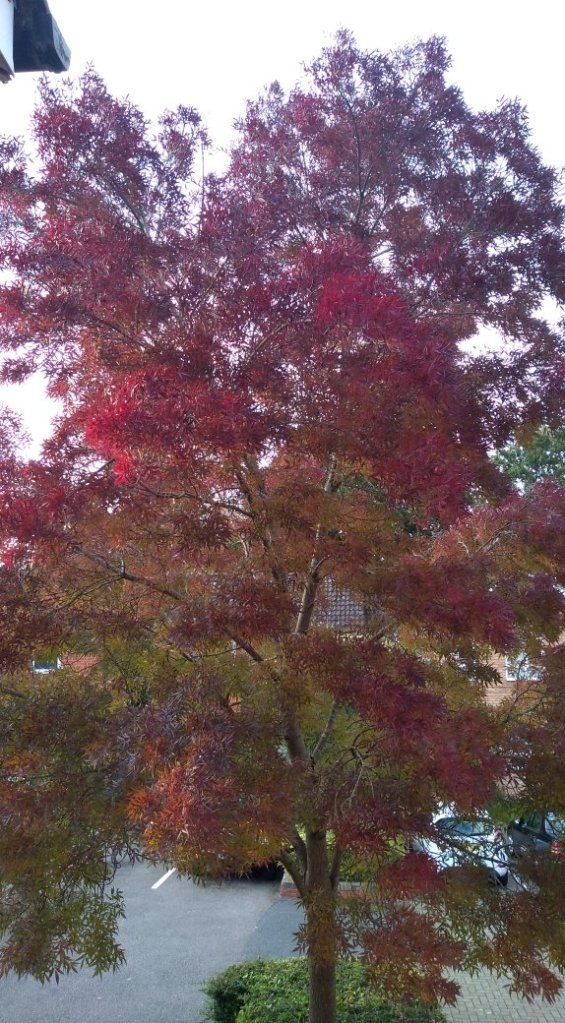
The tree that has already shown it’s autumn colours is the Claret ash or ash ‘Raywood’ (Fraxinus angustifolia ‘Raywood‘). There are a couple in the car park, one of which is now completely bare.
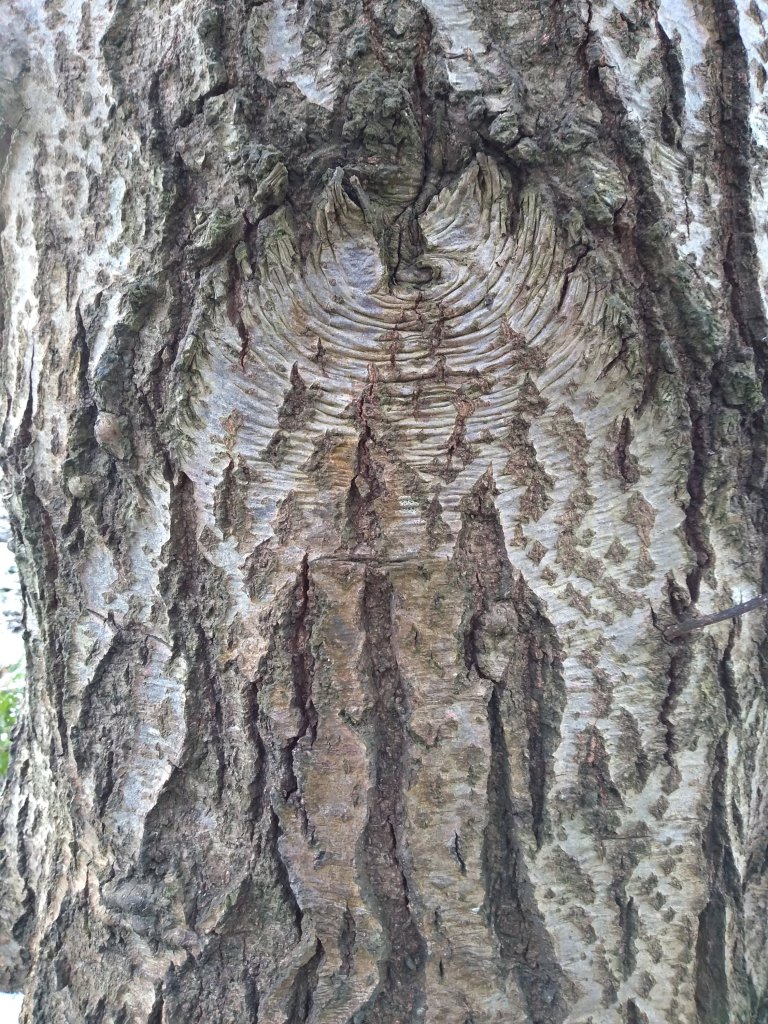
The deep claret coloured leaves glow bright red in the sunlight.The bark of the Claret ash.
I have noticed the occasional pollinator still flying around during the last fortnight. One observation was some Common wasps (Vespula vulgaris) visiting Common ivy (Hedera helix) flowers. Evidence that Ivy is a wonderful source of pollen and nectar late in the year along with that fact that wasps have a purpose.
Along with pollination, there are many wasps that are useful predators of spiders and insects which are fed to their young. Unfortunately the adult wasps need for sugar means they are often disliked by humans, but can we really blame them for having a sweet tooth just like us or trying to get to something that is easily accessible? A fascinating article about wasps and their usefulness in the world, published by the Natural History Museum, can be viewed here.
For the last couple of weeks conkers and sweet chestnuts have begun to fall, there isn’t a big harvest, neither are there lots of acorns or beech masts. However 2020 was a mast year (where trees produce bumper crops) so reduced harvests this time isn’t too surprising; Mast years only happen every five to ten years. However the low numbers could also be due to this years cold damp spring impacting bud development and fertilization, especially with wind pollinated trees. This issue is discussed further in an article by the Woodland Trust see Nature’s Calendar.
It has been lovely to notice Boston ivy (Parthenocissus tricuspidata), along with Virginia creeper (Parthenocissus quinquefolia) develop their bright red autumnal colour. They are so vibrant in the low autumn sunshine. I’ve also noticed the small beginnings of autumn leaf colour in many trees too.
Boston ivy growing up a wall of an old building.Virginia creeper winding its way through some shrubs.
Now that October has arrived, Cyclamen (Cyclamen hederifolium) and Crocuses (Crocus speciosus) have sprung up alongside Fungi in a few lawns. I noticed a waxcap commonly called the Witches hat (Hygrocybe conica) as well as Lilac fibrecaps (Inocybe geophylla var. lilacina); both resembling Gemstones standing out amongst the grass.
Witches hat waxcaps are so called because they look like witches hats when they blacken with age.A Lilac fibrecap
I also saw another fungi in one lawn, possibly a Blusher (Amanita rubescens), although the identification was difficult so I’m not entirely sure.
Plantlife run Waxcap watch from the 13th September. The charity want to discover previously unknown waxcap grassland sites, uncover habitat conditions and give better protection for them in the future. More information about this survey can be found here.
Something else I observed while weeding a gravel path at work was a Lunar underwing moth (Omphaloscelis lunosa).
This night flying noth had been hiding under some dandelion leaves.
Lunar underwing moths fly between August and October and their pupae overwinter in long grass which they will feed on when they become caterpillars. I managed to re-home this one under a nearby shrub.
On the 31st January, I undertook the RSPBs Big Garden bird watch. Most birds, I’d normally see, were clearly hiding but I did notice some within the hour. Those birds I saw were; 1 Carrion crow (Corvuscorone), 2 Robins (Erithacusrubecula), 1 Coal tit (Periparusater), 1 Blackbird (Turdusmerula) and 2 Mistle thrush (Turdus viscivorus). I enjoy taking part in this citizen science project each year; it’s interesting to see how the results differ each time.
Due to the frozen ground last week, I was still able to go for my regular exercise in the local woodland park. Various tree species were waking up from their winter sleep. Beech (Fagus) and Oak (Quercus) had started budding while others were developing catkins.
Last years leaves and new buds on a Beech tree.Old Oak leaves alongside new buds.
As well as the Hazel (Corylus avellana) other trees had catkins hanging from them too. Hazel catkins are the earliest to flower in the year, from January to March (see my previous post A Snowy Adventure).
Then the Alder (Alnus glutinosa) is the next tree to bloom with both male and female catkins. The male catkins are longer than the female ones which flower from February to March. Also hanging from the Alder trees were some small dark brown shapes. These woody cone-like fruit develop from the previous seasons fertilised female catkins; these can remain on the tree (even when the seeds have been shed) well into the following year alongside the newly formed catkins. I also noticed leaf buds growing on the trees last week too. When the buds burst, I shall update the Woodland trust Nature’s calendar with my findings.
Unfortunately I was unable to capture decent photos on location so I collected part of a fallen branch to take home.
One small female catkin above a group of larger male catkins. On the tree (before fertilisation when they develop into the rounder, woody fruit) the female catkins point upwards while the male ones hang down. A magnified view of two unfertilised female catkins.A leaf bud with one of last years fertilised female catkins.A magnified view of the Alder tree seeds that had remained in last seasons female catkin.
I find Alder trees fascinating and the rough, fissured bark beautiful.
Alder are native to Britain and found on wet land, next to water or in marshes and woodlands. They naturally thrive in moist conditions although can also grow in drier areas such as the edges of mixed woodland. Alder wood is durable when wet and actually becomes stronger rather than rot when submerged in water; a characteristic that makes them useful in flood mitigation, boat building, sluice gates, and even the construction of Venice which is mostly built on Alder piles. Alder wood is also used in the creation of charcoal, gunpowder and making clogs.
The pale wood turns a deep orange colour at the point at which it’s cut (while the rest of the wood remains pale); leading to a superstition, in Ireland, that it was bad luck to walk past an Alder tree on your travels. However, traditionally alder branches were also taken into houses to prevent Woodworm. Alder wood is particularly liked by various species of beetle larvae (collectively referred to as Woodworm). It is hoped that the beetles will lay eggs in the Alder rather than the furniture or fixtures; the branches once infested can then be removed.
There is also a traditional use for Alder flowers as a green dye; believed to be used as camouflage by outlaws like Robin hood and fairies.
For fun, I looked up Alder wands used in the Harry potter series. Only one is mentioned, that owned by Quirinus Quirrell. The wands qualities are described on the Wizarding world website.
The roots of Alder are nitrogen fixers. Nitrogen from the air is fixed into the soil, replenishing the levels and aiding soil fertility, through the bacterium Frankia alni.
As well as improving soil, Alder are great for wildlife too. The seeds are eaten by Redpoll (Acanthis flammea), Siskin (Spinus spinus) and Goldfinch (Carduelis carduelis). The leaves are food for the caterpillars of the Alder kitten (Furcula bicuspis), Pebble hook-tip (Drepana falcataria), Autumn green carpet (Chloroclysta miata) and Blue-bordered carpet (Plemyria rubiginata) moths. Bees visit the catkins for an early source of nectar plus Alders provide habitats for the Checkered skipper (Carterocephalus palaemon) butterfly, Small pearl-bordered fritillary (Boloria selene) butterfly, some species of Crane fly, Otters (which create nests amongst the roots) along with mosses, lichens and fungi that like damp conditions.
However, these trees are also threatened through infection by the Phytophthora fungus (together with some other broadleaf tree species). In Alder this disease is referred to as Alder dieback and eventually causes the death of any infected tree. For more information see the Forest research website. There aren’t many Alders in my local woodland park compared to other tree species so it would be sad to see them disappear. Given my newly acquired knowledge I will keep a special lookout for any ill health in these trees; thankfully no infection is being exhibited at the moment.








 Bee in the Moment