Posted in Allotment, nature

Slugs and Snails

What a mixed bag of weather we’ve had in the UK recently. It seems strange experiencing the current dry, warm weather given the snow, frost and april showers we had during the previous weeks.

Deciduous trees are turning green, as leaves unfurl and wildflowers continue to bloom. Snake’s-head fritillary (Fritillaria meleagris), Speedwells (Veronica), White Dead-nettle (Lamium album), Red Dead-nettle (Lamium purpureum), Yellow archangel (Lamium galeobdolon), Forget-me-nots (Myosotis) and Cowslips (Primula veris) are all flowering at the moment, with English Blubells (Hyacinthoides non-scripta) beginning to open up too.

Dainty Cowslips found on a verge.

Last week I caught a glimpse of a blue butterfly, my first sighting of the year, most likely a Holly blue (Celastrina argiolus). I also found another Red kite (Milvus milvus) feather as I worked last Tuesday (see below).

Even Tadpoles have begun to emerge, including in the pond we have near our plot on the allotment; hopefully they will help keep the slug and snail numbers down this year.

Slugs and snails have been in the news a lot this month because the Metaldehyde slug pellets ban has finally come into force in the UK. Perhaps we could view these creatures in a different way, after all they do good in nature; we can’t blame them going for an easy meal of soft tender leaves which just happen to be our prized plants. Interestingly only a small number of the 44 species in the UK are responsible for the damage we experience in gardens while the others feed on dead organic matter. I read an interesting article by Dr Andrew Salisbury, from the RHS, in The Guardian on this subject.

On my allotment I find wool pellets, copper barriers and cloches are helpful; along with growing seedlings on in pots before planting them out. Transplanting larger, stronger plants is better as they are able to withstand any damage, I also spend time collecting slugs and snails from hidden damp dark places and moving them to an area far away where they will cause less damage to crops. Encouraging predators (frogs, toads, hedgehogs, birds, slow worms (Anguis fragilis) and ground beetles) is always a great idea too, along with not having areas for them to hide near vulnerable plants.

A biological control that can be used, for slugs only, are Nematodes (Phasmarhabditis hermaphrodita). Watered into the ground these eventually kill the slugs as they infect them with bacteria once they’ve entered the slugs body. I have never gone for this option as I find the other measures suffice.

The other option is to grow plants which slugs and snails do not eat. Ones I’ve noticed they avoid include Ajuga, Aquilegia, Digitalis, Fuchsia, Geum Penstemon and Pulmonaria (further examples can be found on the internet).


Posted in nature

Flowers Bloom in Spite of the Weather

Much needed rain arrived last Wednesday evening, lasting through the night; followed by another short downpour later in the week. Unfortunately, these weren’t enough to replenish the parched ground which currently resembles crazy paving. It’s hard to believe we experienced a cold damp winter when cracks in the earth are so deep.

Somehow, even with of the lack of rain, wildflowers still bloom regardless. Buttercups (Ranunculus), Cow parsley (Anthriscus sylvestris) and Stitchwort (Stellaria) have joined the early spring bloomers; replacing the faded Lesser Celandine (Ficaria verna). Unlike the pinks of the ornamental Cherry trees (currently blooming), the predominant colours lower to the ground are blue, yellow and white.

Another plant I noticed was Ground ivy (Glechoma hederacea).

Usually found on damp ground, amongst woodlands, hedgerows, wasteland and in lawns, It’s violet flowers appear between March and June. Surprisingly, it was flowering last week, even with the current dry conditions.

The common name, Ground ivy, is rather misleading as it belongs to the same family as dead-nettles (Lamiaceae) and isn’t ivy. This evergreen perennial most likely obtained the name due to its spreading nature, which occurs overground, rooting from stolons. In fact this plant has numerous common names including, Alehoof, Gill-over-the-ground, Creeping Charlie, Run-away Robin and even (during medieval times) Our Lady’s Vine. A more comprehensive list can be viewed on the RHS website, along with how to grow it if you want to introduce it into your garden.

This herb releases a scent when disturbed. As I crushed some leaves, the smell reminded me of a slightly medicinal thyme aroma, actually quite pleasant.

In times past Ground ivy was used to flavour beer, thanks to its bitter taste (before it was replaced with hops) and as a rennet substitute in cheese making.

I am always intreagued at a plants ability to thrive in unusual places or difficult situations; I love spotting plants growing in such circumstances. Last week I was amazed to see a foxglove (Digitalis) growing without soil on an old wall.

Normally I would only see plants such as Buddleja, Ferns or Yellow corydalis (Pseudofumaria lutea) thriving in this way; their shallow root systems able to anchor themselves amongst the bricks.

Last week wasn’t solely dominated by plant observations. After the previous weeks sighting of the Tawny Mining bee (Andrena fulva), see Auburn Beauty Spotted, it was nice to follow up with sightings of some Mining bee nests. Unfortunately I don’t know whether these nests had or were housing Tawny or Ashy Andrena cineraria) mining bees.

The second nest was spotted on Saturday, while going for a lovely walk with friends. On that sunny day we also witnessed three Speckled wood (Pararge aegeria) butterflies flitting about; clearly enjoying the sunshine and great company as much as I was.

Posted in nature

Things Come in Threes

At least in several gardens last week, things with three leaves appeared as several Trefoils began to flower.

In some lawns the yellow flowering Slender hop clover (Trifolium micranthum) has shown itself along with Red clover (Trifolium pratense).

Slender hop clover
Red clover

Red clover is also called Bee-bread (along with White clover- Trifolium repens) due to its popularity with bees. It’s nectar is especially loved by Common carder bees (Bombus pascuorum), Honeybees (Apis mellifera) and Red-tailed bumblebees (Bombus lapidarius). Red clover, which is less commonly found in nature than White clover, is used for livestock feed and crop rotation (due to its nitrogen fixation abilities). It is also used in herbal medicine to treat respiratory and skin ailments,along with menopausal and PMS symptoms because the flower contains isoflavones. When taken internally, isoflavones become phytoestrogens which has similar affects in the body as estrogen (see Plantlife)

I will have to wait a little longer to see White clover flowering as it blooms from June. However White clover is commonly found in verges and grassland so I’m sure to see some eventually.

Unfortunately I have never spotted a four leaf clover (or five leaved). I am ever hopeful, just for the challenge because they are so hard to spot in the wild.

Several trees are blooming at the moment. Along with Hawthorn (Crataegus monogyna- the May tree flowers referred to in the rhyme ‘Cast ne’er a clout ere May is out’) the Horse chestnut (Aesculus hippocastanum) is also in flower; they have white flowers with a pink tinge.

I also see the Red horse chestnut tree (Aesculus x carnea Briotii) on my travels, both trees have very showy flowers.

It was great to see lots of bees about last week and various species too.

The first type of bee I saw was a Hairy-footed flower bee (Anthophora plumipes) around some forget me nots (Myosotis).

I also noticed lots of Buff-tailed bumblebees (Bombus terrestris),
Honey bees and Early bumblebees (Bombus pratorum) throughout the week too.

This Cotoneaster hedge was alive with Honey bees. Make sure the sound is on to listen to their relaxing buzzing.
The Early bumblebees were also visiting the Cotoneaster flowers.
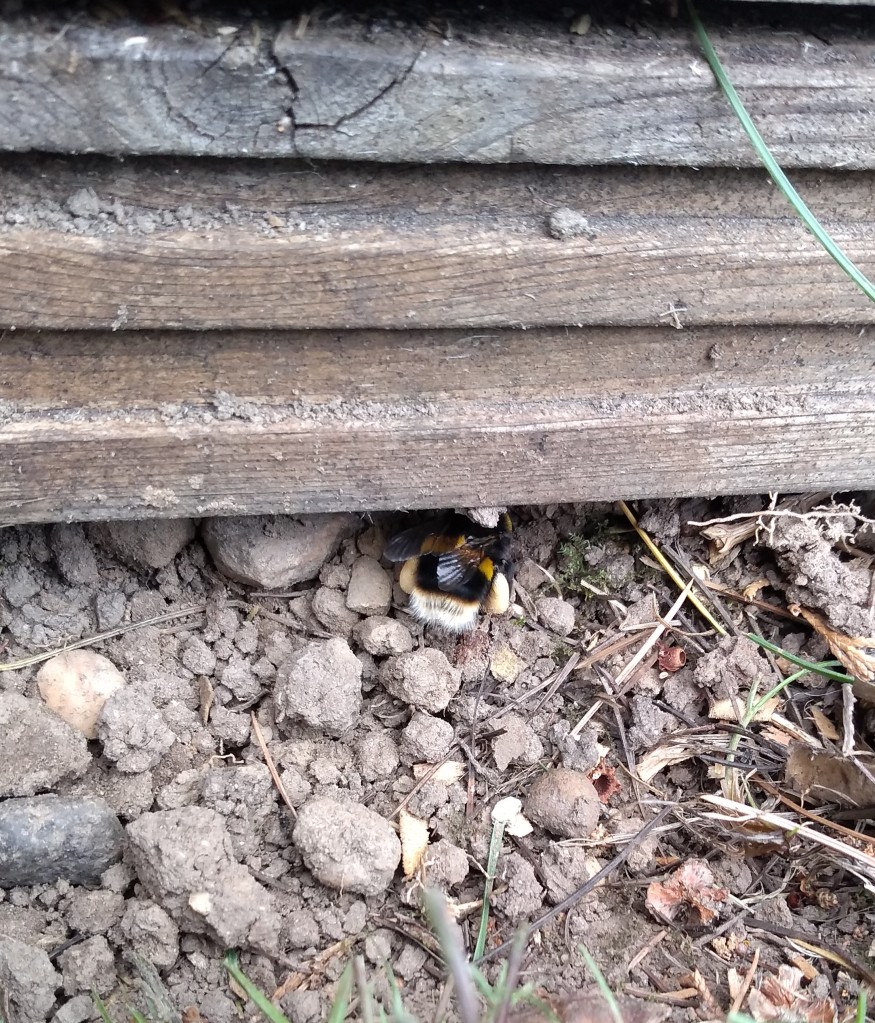
I noticed five Buff-tailed bumblebees coming and going from a nest under some decking in one garden.