Posted in nature

Tuesday was a School Day

The lovely sunshine we’ve had on and off recently has encouraged lots of wildflowers to start blooming over the past week. Amongst the Daffodils were Daisies (Bellis perennis), Snake’s head Fritillary (Fritillaria meleagris),

Snake’s-head fritillary has become naturalised in the lawn of this woodland area of the garden.

Dandelions (Taraxacum),

Perfect for pollinators, especially bees but also butterflies.

Cowslip (Primula veris),

Primroses on my allotment adds a little colour at this time.

Green alkanet (Pentaglottis sempervirens) and Forgot-me-nots (Myosotis). Even brave Tulips were beginning to open up.

Last Tuesday I learnt another plant, the Marsh marigold (Caltha palustris).

This particular plant was in a raised water feature made from an old rectangular metal container which replicated it’s natural growing conditions. In the wild, Marsh marigold grows in damp conditions such as ponds, marshes and wet woodland and flowers from March to July. It’s common name ‘Kingcup’ is a reference to the large buttercup like flowers resemblance to large golden cups (therefore cup of the kings); Even the latin Caltha means goblet.

A wonderful addition to ponds in gardens, this perennial provides shelter for amphibians as well as nectar for pollinators (Bees, beetles and flies).

However, one word of warning, the sap can be an irritant as it contains glycoside protoanemonin, especially in the older growth.

Magnolias and Ornamental cherry trees, including my Prunus incisa ‘Kojo-no-mai’ on the allotment, joined the wonderful display of Blackthorn (Prunus spinosa) blossom.

Sunny blue skies are the perfect backdrop to this huge Magnolia and Ornamental cherry (see below).
Along with the Cowslips, this ‘Kojo-no-mai’ cherry provides some pollen and nectar on my allotment.

I also noticed that Horse chestnut (Aesculus hippocastanum) trees were showing evidence of flower development alongside recently unfurled leaves; although they won’t bloom until May.

Will it be a good year for playing Conkers?

With all these flowers appearing, it was wonderful to see more bees take advantage of all the pollen and nectar available. On the sunniest days I even caught glimpses of the first Brimstone (Gonepteryx rhamni) and Peacock (Aglais io) butterflies of the year; venturing out of hibernation when it is warm enough too.

Posted in nature

No Rain but Rainbows Everywhere

I continue to get my daily exercise outdoors and enjoy seeing rainbows drawn by children in windows or on driveways. Although we had sun last week there was no rain so these cheerful rainbows of unity were the only ones that have appeared.

The lovely weather encouraged many insects out. Last week I managed to count eight Peacock (Aglais io) butterflies. I also saw one Brimstone (Gonepteryx rhamni) butterfly visiting some Dog violets (Viola riviniana). I have never noticed insects pollinate these pretty flowers before so it was lovely to observe that. These dainty plants are very useful additions to wildlife gardens for another reason too; several fritillery butterflies lay eggs on them. During that same walk I also saw lots of seven-spot (Coccinella septempunctata) ladybirds as well as a few Dark-edged bee-flies (Bombylius major).

A Dark-edged bee-fly pollinating some Forget-me-not (Myosotis sylvatica) flowers.

I have never seen these parasitic flies before whose host is the Tawny mining bee (Andrena fulva). The Tawny mining bee is commonly found in urban areas especially in lawns, although I have yet to see one (to find out more see the Bumblebee Conservation Trust). There is a recording scheme for Bee-flies so I shall pass this information on to the (BRC).

On Friday mornings exercise I saw a Song thrush (Turdus philomelos). The last time I saw one was a couple of years ago but this probably isn’t surprising because they are on the red UK conservation status list (see RSPB). It was great to see this one, although I wonder if I accidentally disturbed it looking for food; I came across it on a path before it flew into some trees.

As I walked further, I noticed more plants beginning to bloom. These were;

-Bulbous buttercups (Ranunculus bulbosus),

Identified by the reflexed sepals (turned downward), leaf shape, furrowed stems and the fact it is flowering before May.

-Danish scurveygrass (Cochlearia danica),

Once only found in coastal areas this plant now thrives here because of the salted roads during winter.

-Garlic mustard (Alliaria petiolata),

-Yellow corydalis (Pseudofumaria lutea) and

This often grows in the gaps in old walls.

-Dove’s-foot Crane’s-bill (Geranium molle).

Even without natural rainbows nature was still full of colour last week.

Posted in nature

A Magical Week

I have begun to notice a chill in the mornings as the nights grow colder. I love the promise of Autumn. It doesn’t quite feel autumnal yet (especially as the weather has warmed up again this weekend) but some changes are occurring. Conkers and beech masts have started dropping and fungi are appearing in some lawns. A couple of times I have come across fairy rings; in both instances the Marasmius oreades fungi was the cause (sadly no magical elvish, fairy or pixie dancing).

The week continued with more observations of Painted lady (Vanessa cardui) butterflies. On Monday there were two visiting a Buddleja bush along with a Small tortoiseshell (Aglais urticae) and a Large white (Pieris brassicae).
Then on Friday, in different gardens, more were flitting about. On one occasion, during the morning, I saw a Painted lady on a Ceratostigma willmottianum.

In the second half of the week I noticed more butterflies including a Green-veined white (Pieris napi) on Verbena bonariensis

and a Small tortoiseshell visiting an Erysimum ‘Bowles’s Mauve’.

Throughout last week I saw lots of pollinators busily collecting nectar and pollen.
On Monday I noticed lots of small flies and Buff-tailed bumblebees (Bombus terrestris) pollinating Marigold (Tagetes) flowers. Perhaps they are enticed by their overwhelming aroma which even I found hard to ignore.

Then on Wednesday there was a Common carder (Bombus pascuorum) bee flying between Nandina domesticas and several Agapanthus africanus.

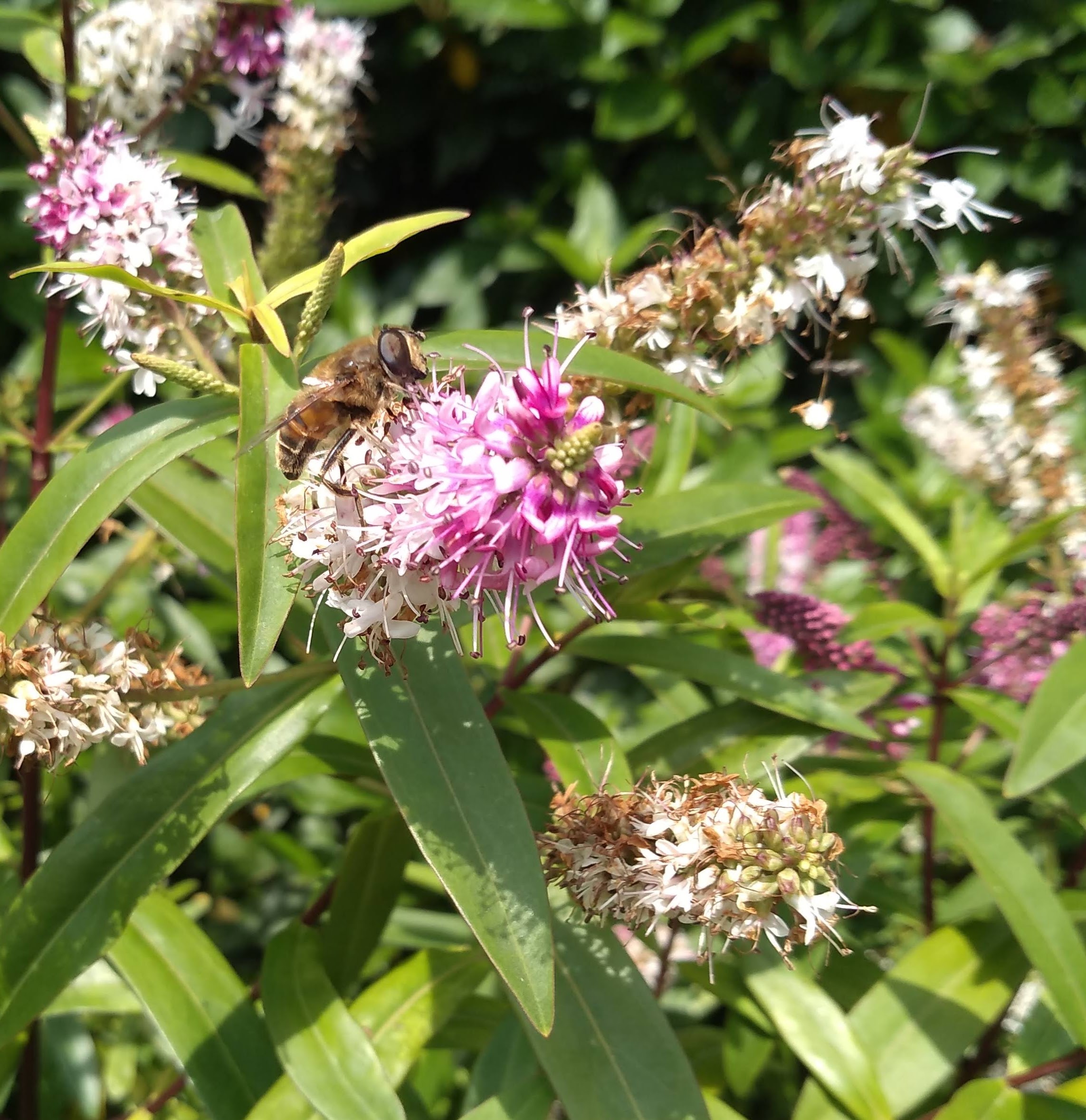
On Friday while working near some Hebe ‘Great Orme’ there were lots of honey bees (Apis mellifera) as well as a Hornet mimic hoverfly (Volucella zonaria).

Another interesting thing I noticed last week was a Red campion (Silene dioica) plant growing on an old moss covered log.

With no soil surrounding its roots clearly it was receiving sufficient moisture and nutrients from this unusual source. It has been flowering healthily all summer but I hadn’t realised it had been relying on the log for its growth until then. I found this plants ability for survival amazing and will closely watch its development.

Lastly I have been aware of how wonderful hardy Fuchsias (Fuchsia magellanica) are currently looking. Although I don’t see pollinators visiting the flowers, there have been a couple of times, in the past, when I have seen Elephant Hawk-moth (Deilephila elpenor) caterpillars feeding on Fushia plants. (See Elephant Hawk-moth).

These caterpillars also eat Himalayan balsam (Impatiens glandulifera) and Willowherbs including Enchanter’s nightshade (Circaea lutetiana) and Rosebay willowherb (Epilobium angustifolium). This beautiful pink and olive green moth flies at night and therefore feeds on Honeysuckle (Lonicera).

Across the way from this hardy Fushia there was a Honeysuckle growing along the wall so it would have been a fantastic place for these moths to inhabit. Unfortunately I didn’t come across any Elephant Hawk-moths this year but hopefully I will in years to come (and I am sure it will feel magical).

Posted in nature

The Heat Is On. 🔆🌡️⛈️☔

The weather last week was a mixed bag. Sunshine with the temperature rising into the thirties, fantastic storms and then dull days of rain. Thankfully it is a little cooler now; while I enjoy the sun, I wilt in muggy heat.

Given the weather there were still lots of butterflies around, mostly Peacock (Aglais io), Red admiral (Vanessa atalanta) and Small white (Pieris rapae). Unfortunately I haven’t managed to capture photos of any of these as they didn’t remain in situ for long. I see many white butterflies flit past me. It can be difficult to say if they are Large white (Pieris brassicae), Small white or female Orange tip (Anthocharis cardamines) butterflies because they disappear before I can identify them.

Happily I was able to photograph one butterfly on a Buddleia on Wednesday. The combination of the pattern in the underside, orange colouring I saw on the upper wings, together with the wing outline means the butterfly in the photo below is a Comma (Polygonia c-album).

Their Caterpillars usually feed on the Common nettles (Urtica dioica) but also Elms (Ulmus), Hops (Humulus lupulus) as well as Willows (Salix). Peacocks often visit Buddleia too. The Common Nettle is also the favoured food of Peacock Caterpillars; although they have been recorded feeding on hops and small nettle (Urtica urens) as well. As the common nettle is the favourite food of both Comma and Peacock caterpillars, what better reason is there for allowing some nettles to grow in a garden?

There were other observations last week too;
– a Harlequin ladybird (Harmonia axyridis) on some Lesser Burdock (Arctium minus),

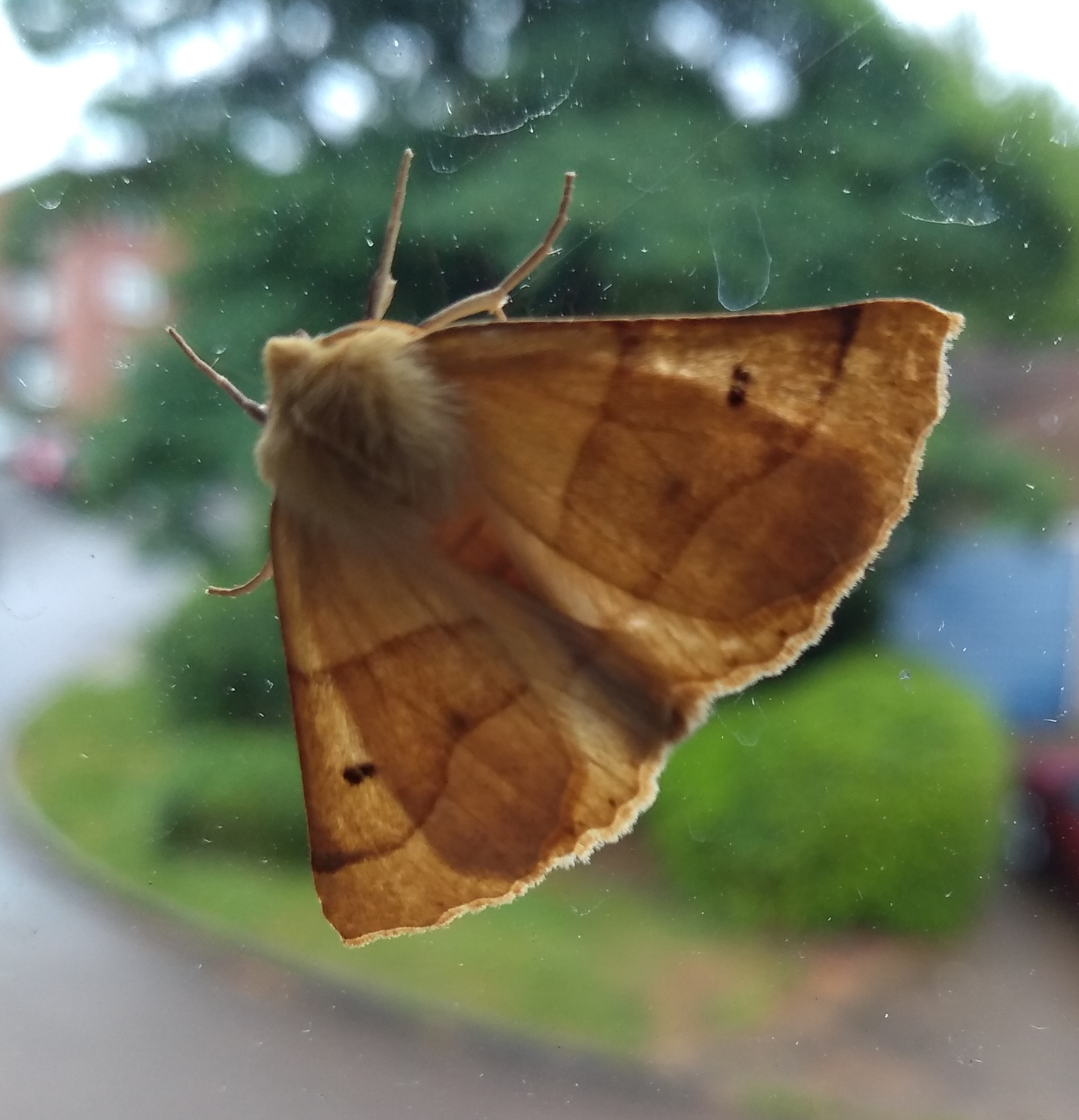
– a Scalloped oak (Crocallis elinguaria) moth,

The caterpillars of these moths feed on honeysuckle (Lonicera), heather (Calluna vulgaris) and broadleaf trees like Oak (Quercus) and Birch (Betula).

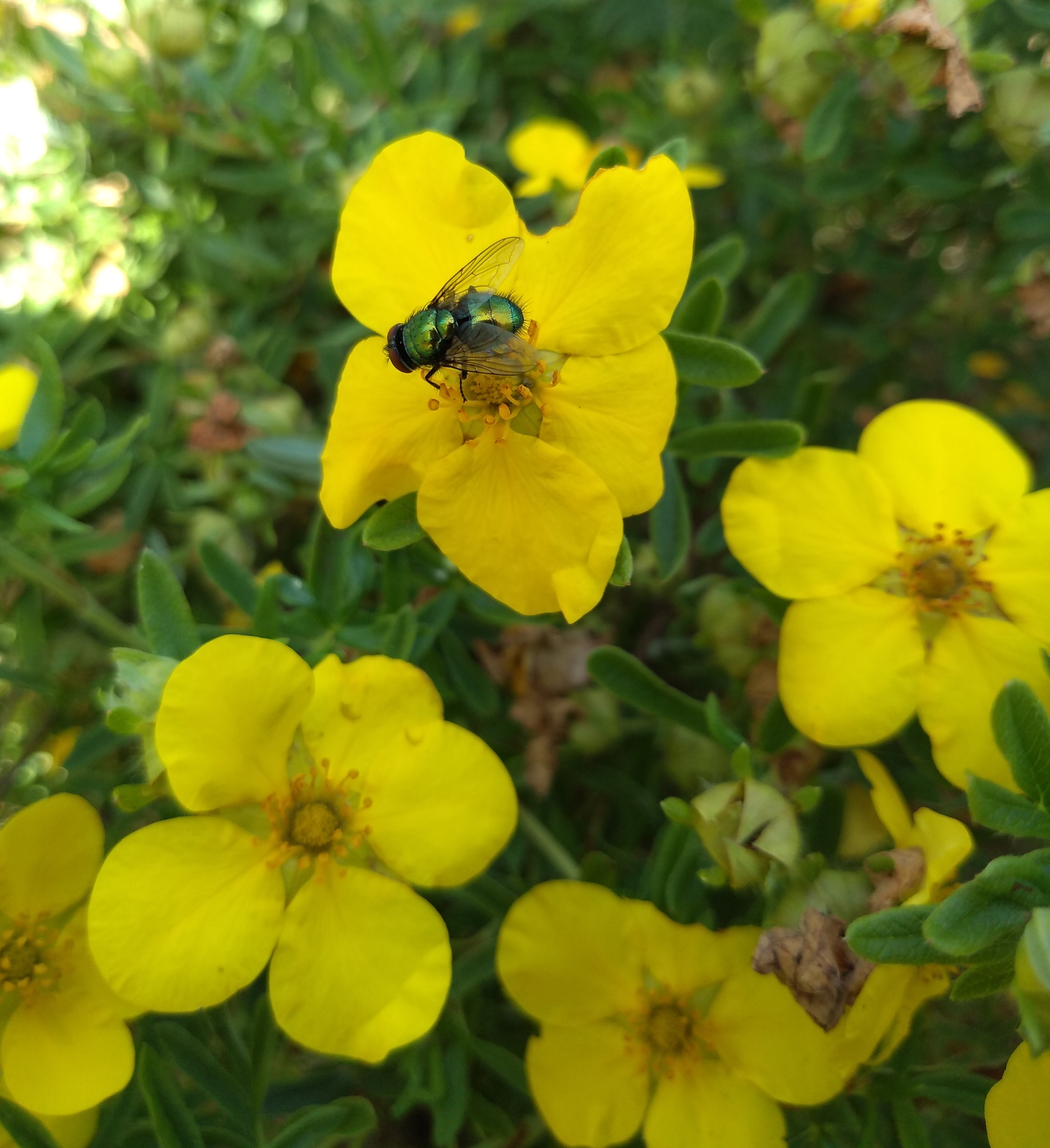
– plus a Long hoverfly (Sphaerophoria scripta), whose larvae feed on aphids, and a Common green bottle fly (Lucilia sericata) on a Potentilla plant.

Capturing the Common green bottle fly was accidental but it worked out really well. In the sun its glistening metallic colouring is highlighted against the yellow Potentilla flowers. Their maggots feed on dead tissue so their appearance is used to accurately determine time of death. Adult Common green bottle flies on the other hand are useful pollinators, as the last photo proves. Fascinating how different stages of this fly species exists alongside both death and life.