Posted in nature

Bees in Winter

Honey bees (Apis mellifera) overwinter in hives, huddling round the queen to keep warm, occasionally venturing out on warmer days. Bumblebees (Bombus) on the other hand have an annual lifespan with new queens, having mated during the summer and autumn months, hibernating underground until spring when they can begin a new colony; also sometimes waking up too early on warm days and foraging.

However over the past 10 years, in urban areas of Southern England, a trend has been seen with certain bumblebee species.
Initially Buff-tailed bumblebees (Bombus terrestris), but since then Early bumblebees (Bombus pratorum) and Tree bumblebees (Bombus hypnorum) have begun to nest in winter rather than hibernate. Consequently winter flowering plants such as Mahonia and Winter Heathers (Erica), Winter honeysuckle (Lonicera fragrantissima), Winter aconite (Eranthis hyemalis), Hellebores (Helleborus) and Snowdrops (Galanthus) are garden essentials; enabling these bees to access pollen and nectar during the colder months.

Solitary bees on the other hand will survive throughout winter in burrows or cavities as eggs, with their own supply of nectar and pollen close to hand (as the adults don’t survive winter). These include Mining and Mason bees which emerge early in spring taking advantage of Willow (Salix), Blackthorn (Prunus spinosa) and Hawthorn (Crataegus monogyna) in bloom. Leafcutter and Carder bees emerge later still. The one exception are Furrow bees; like Bumblebees, the female will hibernate during winter and lay eggs in spring.

I have noticed lots of Mahonias blooming over the last few weeks, their bright yellow flowers and perfume is wonderful to experience during dull days. Somehow the colour shines more vividly against grey skies.

Mahonia x media

Another shrub that has been blooming recently is Viburnum farreri, it’s lovely scent wafting through the air too.

Posted in nature

Amazing Auburn Beauty Spotted

Annual honesty (Lunaria annua), Shepherd’s purse (Capsella bursa-pastoris) and Hedge garlic (Alliara petiolata) were all blooming last week, which is great for the increasing numbers of pollinators I saw flying around.

Some flowers began to open up on a Crab apple (Malus spectabilis) I saw in in one garden too.

As alluded to above, more insects were prominent throughout last week compared to earlier in the month. I saw my first male Orange-tip butterfly (Anthocharis cardamines) and undisturbed Seven-spot ladybirds (Coccinella septempunctata) of the year.
Yet more species of bee were buzzing about too; I observed female Early bumblebees (Bombus pratorum) one Hairy-footed flower (Anthophora plumipes) bee queen, along with several female Red-tailed (Bombus lapidarius) bumblebees.
A great Bumblebee ID guide can be viewed at Blooms for Bees; this website also includes ways to encourage bees into your garden.

Then on Thursday, as I was clearing wildflower seedlings from a path, I noticed a beautiful redhead resting next to me.

This photo doesn’t do the vibrant colouration of this bee justice.

I recognized it was a bee but was initially unsure of the species. Upon further investigation, via Google lens, I discovered it was a female Tawny mining bee (Andrena fulva).

Given the place I saw the bee, I was unable to locate it’s nest, in fact it may have flown in from another garden anyway. Their burrow is usually located in lawns (sometimes flower beds); identifiable from a mound of earth with a hole at the top for the entrance. Often described as having a volcano like appearance it can be differentiated from ants nests which are flatter and have no distinguishable hole at the summit. After several weeks these mounds are no where to be found, so they can be left undisturbed without any worry of damage to lawns.

These solitary bees (which do not sting) can be seen between April and June in gardens and parkland as well as along the edges of fields and orchards.

The appearance of these beautiful bees coincides with the flowing of Cherry (Prunus), Pear (Pyrus), Hawthorn (Crataegus), Blackthorn (Prunus spinosa), Maple (Acer), Willow (Sallows) and Apple (Malus) trees, along with other plants such as Buttercups (Ranunculus) and Dandelions (Taraxacum). Nectar and Pollen from these blooms is collected for the bee larvae that develop in the nest beneath the ground. Once the young become pupa, they continue to hibernate through winter to eventually emerge the following spring.

Males are smaller than the female Tawny bees and are a dull brown colour. They do not take any part in creating nests or rearing the young, the females will undertake these jobs alone.

Posted in nature

Things Come in Threes

At least in several gardens last week, things with three leaves appeared as several Trefoils began to flower.

In some lawns the yellow flowering Slender hop clover (Trifolium micranthum) has shown itself along with Red clover (Trifolium pratense).

Slender hop clover
Red clover

Red clover is also called Bee-bread (along with White clover- Trifolium repens) due to its popularity with bees. It’s nectar is especially loved by Common carder bees (Bombus pascuorum), Honeybees (Apis mellifera) and Red-tailed bumblebees (Bombus lapidarius). Red clover, which is less commonly found in nature than White clover, is used for livestock feed and crop rotation (due to its nitrogen fixation abilities). It is also used in herbal medicine to treat respiratory and skin ailments,along with menopausal and PMS symptoms because the flower contains isoflavones. When taken internally, isoflavones become phytoestrogens which has similar affects in the body as estrogen (see Plantlife)

I will have to wait a little longer to see White clover flowering as it blooms from June. However White clover is commonly found in verges and grassland so I’m sure to see some eventually.

Unfortunately I have never spotted a four leaf clover (or five leaved). I am ever hopeful, just for the challenge because they are so hard to spot in the wild.

Several trees are blooming at the moment. Along with Hawthorn (Crataegus monogyna- the May tree flowers referred to in the rhyme ‘Cast ne’er a clout ere May is out’) the Horse chestnut (Aesculus hippocastanum) is also in flower; they have white flowers with a pink tinge.

I also see the Red horse chestnut tree (Aesculus x carnea Briotii) on my travels, both trees have very showy flowers.

It was great to see lots of bees about last week and various species too.

The first type of bee I saw was a Hairy-footed flower bee (Anthophora plumipes) around some forget me nots (Myosotis).

I also noticed lots of Buff-tailed bumblebees (Bombus terrestris),
Honey bees and Early bumblebees (Bombus pratorum) throughout the week too.

This Cotoneaster hedge was alive with Honey bees. Make sure the sound is on to listen to their relaxing buzzing.
The Early bumblebees were also visiting the Cotoneaster flowers.
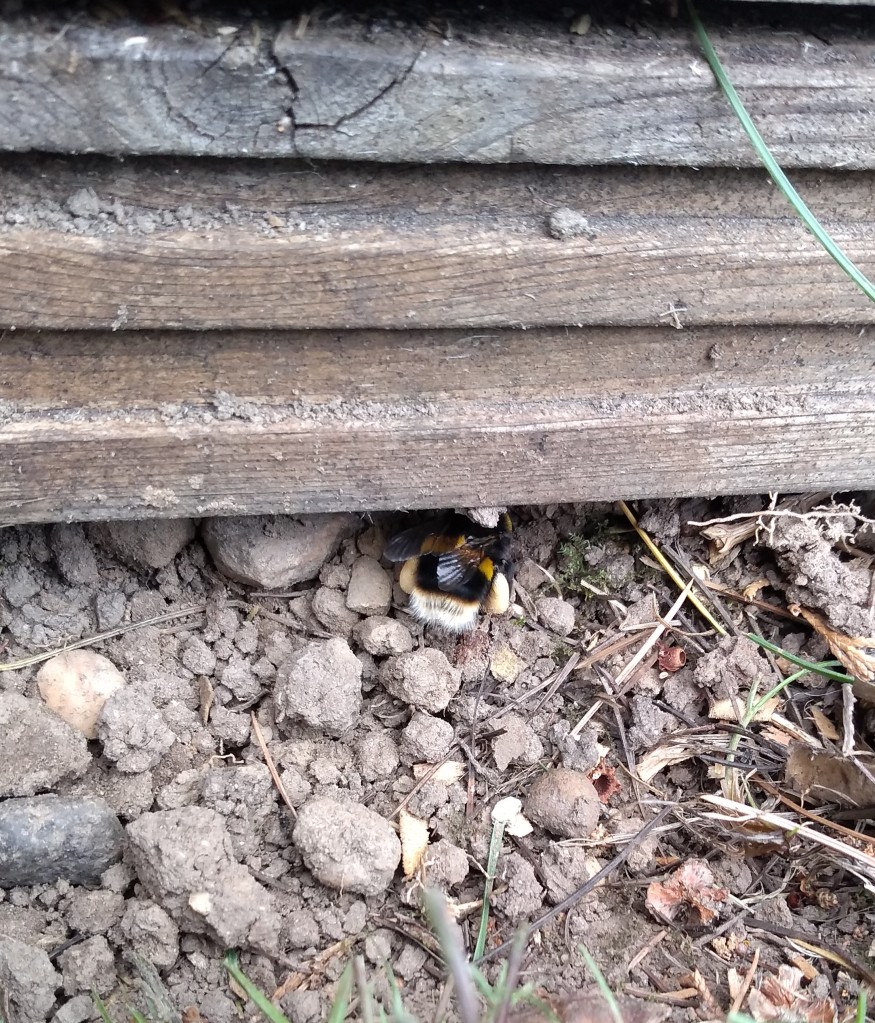
I noticed five Buff-tailed bumblebees coming and going from a nest under some decking in one garden.