Posted in Allotment, nature

Here today, gone tomorrow

How is it nearly July? The passage of time has certainly flown by, for me, but then the growing season is in full swing and has kept me busy.

In April, a few weeks of unusually warm weather for the time of year  ended with April showers. Since then there have been occasional periods of heavy rain, however it remained largely dry here in southern England. A couple of weeks ago (as well as this coming Monday) we had another very hot period of high temperatures. The weather remains warm, so colder mornings are refreshing. It was the sunniest spring on record and continues to be incredibly dry here in the south.

Early warm spring weather has meant that fruit picking this year has been very good. So far the strawberry, currants, gooseberry and raspberry harvests  have been great. There are plenty of apples and plums developing too.

The allotment is coming along, we had to hold out planting for a while due to the drought we had early spring. I took advantage of that to add  another wildlife area. The shed casts a shadow so I have been unsure what to do with it; now there is a dead hedge, stumpery, log pile and hedgehog house along with nettles and a few other plants to encourage insects, beetles and other invertebrates.

I have noticed a variety of insects this year. Lots of Brimstones (Gonepteryx rhamni) in spring have now been replaced by Commas (Polygonia c-album), Speckled woods (Pararge aegeria), Large whites (Pieris brassicae) and Peacock (Aglais io) butterflies.

Bees have been evident too; Ashy mining bees (Andrena cineraria) in particular. I saw a group of about 20 in one garden.

A buff tailed bee (Bombus terrestris) snoozing in a foxglove.

Juvenile ladybirds have also been evident, arriving soon after aphids show up, now becoming adults.


Mullein Moth (Cucullia verbasci) caterpillars were around one week in April and then disappeared in early June, presumably eaten by birds.

These vibrant caterpillars turn into a brown coloured moth.

Although the caterpillars had eaten a lot of the leaves, the plant survived and has begun to bloom now. It never ceases to fascinate me how the moths found the plant in the first place and how the birds found the caterpillars with no need for chemicals to control so-called pests. The adult Mullien moths are nocturnal, flying in April and May.

I have also learnt about another spider, the Cucumber spider (Araniella cucurbitina); named because of their vibrant green abdomens they are commonly found in the UK, especially in woodlands and hedgerows.

Larger than actual size. Males are about 3.5- 4mm while the larger females are between 4- 6mm.


In May, we met friends at Black park in Slough. It was wonderful to see the emergence of adult dragonflies from their nymph form, species unknown.

Posted in nature

Relaxing Holiday Adventures

Over the last few weeks Buddleja have been in flower, encouraging butterflies to visit and making them more visible. I have begun to notice Red admirals (Vanessa atalanta) and Peacocks (Aglais io) alongside Large (Pieris brassicae) and Small white (Pieris rapae) butterflies.

Having some time off work enabled me to take more walks. In my local woodland park I started to see a lot more Commas (Polygonia c-album) and Small heath (Coenonympha pamphilus) butterflies too. On a few occasions they flitted around me as I stopped to watch them; an absolutely joyful experience, almost like they were interacting with me in their own way.

Thankfully in the two weeks, I managed to venture further afield. On one occasion, I saw a Ringlet (Aphantopus hyperantus) butterfly while visiting an Arboretum in Herefordshire.

Woodlands are their habitat and they can be seen during July and August. The Caterpillars of this butterfly feed on various grasses, such as Tufted Hair-grass (Deschampsia cespitosa), Common Couch (Elytrigia repens), and other meadow grasses (Poa spp.).

Spending some time away on holiday gave me the chance to explore other environments, including those next to water, thus enabling me to notice different wildflowers.

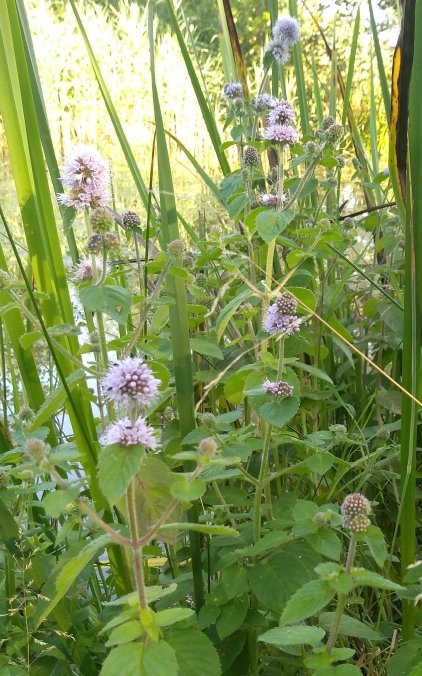
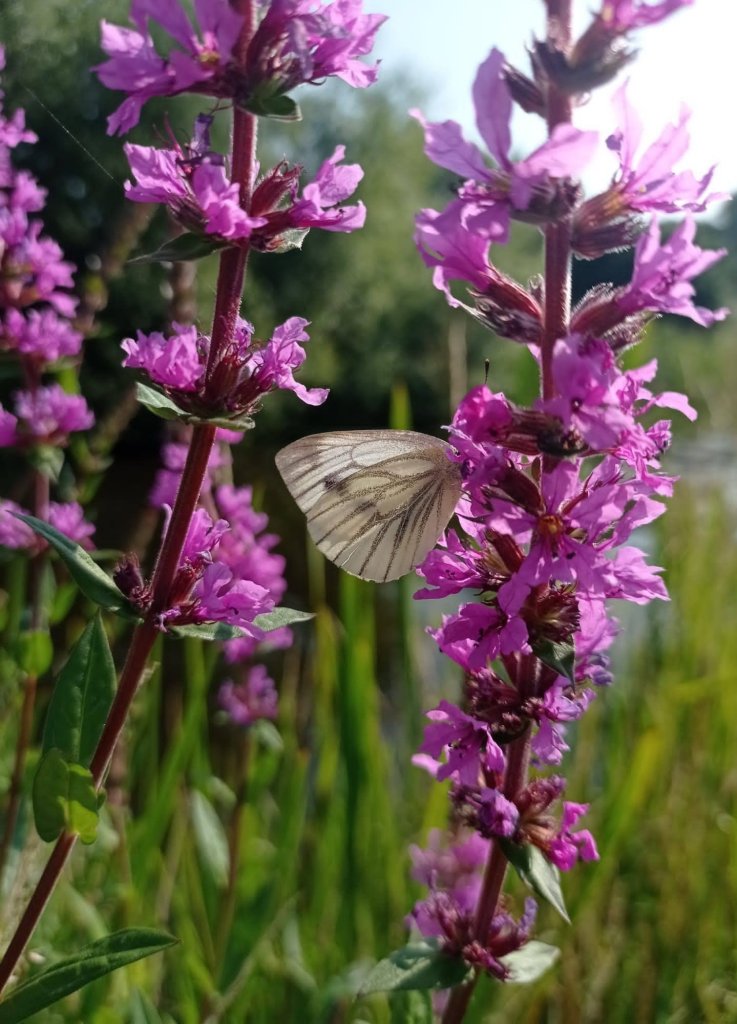
One walk took me past a canal. Water mint (Mentha aquatica) and Purple Loosestrife (Lythrum salicaria) were growing all down the canal edge.

Water mint

Both plants grow in shallow water and boggy conditions so are often found in fens and marshes as well as along the margins of ponds, streams, rivers and of course canals, as I discovered. They require habitats with full sun or dapled shade to bloom and are great for pollinators. Water mint flowers from the beginning of July up to November while Purple loosestrife only blooms between June and August. Purple Loosestrife can be visited by insects with long tongues and particularly enjoyed by butterflies and Red-tailed Bumblebees (Bombus lapidarius). It is also eaten by caterpillars of the Small Elephant Hawk-moths (Deilephila porcellus).

A Large white butterfly visiting some Purple Loosestrife.

As well as butterflies there were several dragonflies and damselflies, including this Blue-tailed damselfly (Ischnura elegans) dancing over the water.

This Blue-tailed damselfly was seen resting on a nettle leaf.

However, most of the bees I saw on that walk were interested in the plant I encountered at the first lock, Himalayan balsam (Impatiens glandulifera).

While the lock was completely swamped by this plant, it was only section I saw it in. It’s the first time I had come across Himalayan balsam, although I know of its reputation.

The pretty flower of the Himalayan balsam is popular with pollinators, especially bees. Here a bee is seen climbing into the flower to obtain nectar and pollen.

First introduced into the UK in 1839, from the Himalayas, this plant soon escaped formal gardens and naturalized in the wild becoming a nuisance in waterways. It grows fast and can become invasive very quickly as, up to 800 seeds from each pod, explode as far as 7 meters from the parent plant and even travel downstream. It isn’t long before a thicket is created where the plant out-competes other species to reduce biodiversity, cause erotion of riverbanks and affect water quality. All this means it is considered a weed in waterways and often removed by work-parties whenever possible. In fact it had been previously cleared from a lot of this canal. Control methods include pulling and cutting before they get a chance to set seed. It can take a few growing seasons before control over this plant is established. Management of this plant is mentioned under schedule 9 of the Wildlife and Countryside Act 1981. Interestingly, in Hertfordshire, control of this plant involves collection of the flowers to produce pink Gin (further information can be found at Herts Wildlife Trust).

The following week I visited a beach in Kent, it was so relaxing to hear the sounds of the seaside. One plant I noticed growing amongst the rocky area near the shingle was Alfalfa (Medicago sativa).

I know this plant as a green manure on allotments and gardens, adding nitrogen to soil for crops the following season. It’s also used as silage for livestock in agriculture plus alfalfa sprouts are used in some cuisines. I have never seen it in the wild or even flowering. There wasn’t a great swathe of it so clearly the plants were due to the odd escapee into the wild; perhaps a few seeds having blown there or been disposed by a bird. It was certainly good for local pollinators.

A Small white butterfly visiting the Alfalfa.
Posted in Allotment, nature

Time to Make Daisy Chains?

It was encouraging to witness dragonflies zipping about and mating over the past week; another sure sign of summers arrival for me.

Down at the allotment, it’s been wonderful to see the addition of a pond on a neighbouring plot. I’m excited to see what inhabits it; hopefully some beneficial wildlife will find it soon, perhaps some dragonflies of our own.

The predominant flowers on on recently mown grass are still daisies (Bellis perennis) although White clover (Trifolium repens) and Bird’s-foot trefoil (Lotus corniculatus) have begun to bloom alongside them.

My White clover and Bird’s-foot trefoil seedlings, down at the allotment, are coming along fantastically; I look forward to eventually transplanting them to my wild flower patch. Unfortunately, the Yellow rattle (Rhinanthus minor) seeds didn’t take.  Perhaps the weather earlier on in the year wasn’t conducive to their germination so I’ll try to obtain plants in autumn instead. Ideally I need them to control the grass so the other wild flowers have a chance to thrive.

I love seeing daisies everywhere. I love their simplicity, abundance, cheerful yellow center along with the fact they open during the day and close at night. Seeing them always brings back memories of making daisy chains as a child, which makes me smile. When I doodle flowers, it’s the daisy shape I always begin with before venturing onto others such as dandelions and foxgloves.

Therefore, I also enjoy seeing Oxeye daisies (Leucanthemum vulgare) join in the grassland mix as well which they did last week. When the grass on the verges is left to grow long for pollinators, it is these taller daisy flowers that can be seen looking upwards towards the sun.

Other tall wildflowers that began to bloom in the unmown grass last week were Yarrow (Achillea millefolium), Common  mallow (Malva sylvestris) and White campion (Silene latifolia). These plants are also great for pollinators, especially the latter whose might time scent is a temptation for moths. In fact this flower was added into Elizabethan pot pourri due to its clove aroma.

Posted in nature

All You Need is Love and Nature

Last week love was definitely in the air as I saw numerous Dragonflies and a couple of Buff-tailed bumblebees (Bombus terrestris) mating. New generations were also evident as several young species of insects and an amphibian were noticeable during the week.

Firstly a European gypsy moth (Lymantria dispar) caterpillar was discovered beneath some rhubarb that was being harvested.

Wind disperses these caterpillars when very young. So this one could have travelled several miles.

These caterpillars feed on Creeping Willow (Salix repens) and Bog-myrtle (Myrica gale) along with a few broadleaf trees and bushes. I guess this one could have been feeding on the Rhubarb; however as it was the only caterpillar and the rhubarb patch is very healthy, it was left. This moth was believed to be instinct in the UK during the early 20th century. However in recent years a few have established themselves in Jersey but also in areas of southern England.

I was happy to see the Seven-spot ladybirds on the allotment were happily munching their way through the white fly (Aleyrodidae) on the Calendula flowers. They have definitely grown in size.

Last Wednesday was the first time this year that I saw lots of Harlequin ladybirds (Harmonia axyridis), or more precisely their pupae as I cutback a Clematis in one garden. These ladybirds established themselves in the same garden last year so it wasn’t too surprising to rediscover them there.

Photo of this Harlequin ladybird pupae has been enlarged.

On the same day I also noticed a baby frog (Rana temporaria) hopping from a rejuvenated pond.

This photo is enlarged; It was smaller than my thumbnail so it was lucky I saw a small movement in the lawn.

I helped it escape the mower blades as my colleague cut the grass.

With the topsy turvy weather at the moment some days go by when I don’t see any pollinators; while other times they fill the air between visiting flowers. Along with bees and butterflies, lots of Hoverflies and day flying moths were about too.

I also saw Field Scabious
(Knautia arvensis) blooming along the verge as I walked towards my allotment.

This beautiful plant, loved by pollinators, flowers between July and October, so it isn’t that early.

Last week was uplifting, seeing nature continue to prosper. It fills me with hope for a wonderfully diverse world, something humans to reflect upon during these times.