Posted in nature

Daffodils in Snow

Daffodils (Narcissus) began to bloom at the beginning of March, in time for St David’s day, together with Hellebores.  Since then wildflowers including Red dead nettle (Lamium purpureum), Speedwell (Veronica), Celandine (Ficaria verna), Dandelions (Taraxacum), Primroses, Cowslips (Primula veris), Daisies (Bellis perennis), Dog violets (Viola riviniana) and Winter aconites (Eranthis hyemalis) have joined them. It’s lovely to see all the colour developing, taking over from the Snowdrops (Galanthus nivalis) and early flowering Crocuses that have started to whither. I have even noticed Bluebell (Hyacinthoides non-scripta) leaves showing now too, it wont be long before they flower.

Blackthorn (Prunus spinosa), the first trees of the year to bloom are putting on a show, their blossom resembling white clouds lining the roads. Willow (Salix) aren’t far behind, their buds ready to burst open. Even Magnolias, Camelias and Forsythia (in gardens) are beginning to flower as well. The male catkins on Poplar trees are noticeable now too.

Red male Poplar catkins on a twig fallen in the strong winds.

I have also witnessed the first queen Buff-tailed (Bombus terrestris) bumblebees venturing out on the few warmer sunnier days that we have had. Seeking energy sources as the venture out from hibernation. I also noticed a Brimstone (Gonepteryx rhamni) butterfly flutter passed me last week while the previous Friday a Peacock (Aglais io) butterfly flew passed as I worked. It was also lovely to see lots of Smooth newt (Lissotriton vulgaris) in a garden pond last Wednesday. The newts were almost full sized and looked fully developed already.

Although 20th of March was the Spring equinox we experienced a cold northerly blast of weather a few weeks ago. The wintery showers that arrived brought snow. During this transitional time, March weather can be very mixed. Although spring has sprung, winters grasp still holds on; It was strange to see Daffodils poking above snow for a day.

During a few of the snowy days, I witnessed a wonderful sight of a female Sparrowhawk (Accipiter nisus) perched on top of a tree and later in flight as it swooped towards a smaller bird in a more wooded area of town. Presumably the weather had forced it out into the open to search for food. It’s size, together with its dark brown head back, tail and wings together with a pale breast made it clear to identify. Males are a bluey grey colouring with pale breasts and orange highlights. Males are about 25% smaller than the females, the size of a Collared dove (Streptopelia decaocto).

These birds are protected under the Wildlife and Countryside Act 1981 because they are Amber Under the Red List, Birds of Conservation Concern 5: (2021).

Often found in woodlands or open ground nearby, as well as gardens in urban settings, Sparrowhawks are the most commonly seen bird of prey in the UK. They can be seen throughout the year eating smaller birds, rodents and also rabbits when their regular food is scarce. In fact many years ago I witnessed a male Sparrowhawk take down a city pigeon (Columba livia). Although similar in size, and although the feral pigeon was doing its best to escape the Sparrowhawks clutches it didn’t win the fight.

Sparrowhawk breeding will occur between May and the end of July, laying 4-5 eggs.

Although mostly silent, these birds do have a call which can be heard on the RSPB website here.

Posted in Allotment, nature

What’s up Buttercup?

With May finally here, spring is now in full swing. Lots of things are growing on the allotment from seedlings to fruit, even the Rhubarb is almost ready to pick.

During a woodland walk, on the Easter weekend, I observed the first Speckled wood (Pararge aegeria) butterfly of the year. Plus local ornamental Cherry trees (Prunus) began their spectacular show at the same time; later joined by the flowers of the Hawthorn (Crataegus) , Rowan (Sorbus) and Horse chestnut (Aesculus hippocastanum).

Over the last few weeks, more wildflowers have started to bloom, including Buttercups (Ranunculus), Stitchwort (Stellaria), Ground-ivy (Glechoma hederacea) Honesty (Lunaria annua) and Hedge garlic (Alliaria petiolata) along with Cuckoo flower (Cardamine pratensis).

Ground-ivy
Cuckoo flower

Another butterfly that began to emerge recently is the Orange-tip (Anthocharis cardamines). Hedge garlic and Cuckoo flower are important food sources for Orange-tip caterpillars, so it is lovely to think these butterflies will be laying eggs on the plants I’ve noticed to ensure future generations; the verge not being mown, allowing both plants to develop, enabling this.

The ‘No mow May’ campaign is back this year. Encouraging us to avoid mowing lawns in order to encourage a wide variety of wildflowers to bloom (including rare ones), thus increasing the availability of pollen and nectar for pollinators as they start to emerge (along with helping butterfly populations, as discussed above). After several years of this campaign together with the every flower counts survey, improvements in wildflower growth have been recorded, as people report their sightings taken at this time.
An article from the Plantlife charity discusses their findings in more detail here.

Even leaving the humblest of flowers to flower on lawns, like Dandelions (Taraxacum), Daisies (Bellis perennis) and Buttercups helps.

Posted in nature

Patience is a Virtue

February has a duality to it; on one hand plants have begun to bloom (bringing the excitement of Spring around the corner) while on the other, the weather reminds us that it’s still Winter and we must be patient for a little longer. Last week three storms arrived, including Eunice with high strength winds leading to rare red weather warnings for wind and floods in the Bristol channel area and South East (with the after effects still being experienced in other areas of the UK). Bad weather usually arrives in February, in fact last year we had snow.

However, while nature continues at its own pace, Spring activities still occur earlier as decades pass. I read an article by Miranda Bryant in the Guardian recently regarding indicators of Spring, flowering and bird activities, occuring earlier since 1987. Pre 1987 plants flowered a month later than they did between that year and 2019 (In fact this was particularly evident in 2019 and yet again in 2020). The Woodland Trust’s Natures calender also shows this trend. The article can be accessed in the following link- The Guardian .

It is too early to notice any indication of patterns in this blog yet, although one thing I have witnessed this year, not seen before are daisies appearing in lawns already.

Other cultivated plants that have begun to bloom in gardens, as usual at this time of year are:

Helleborus
Anemone blanda
Pulmonaria
Cyclamen and
Iris reticulata
Posted in Allotment, nature

Time to Make Daisy Chains?

It was encouraging to witness dragonflies zipping about and mating over the past week; another sure sign of summers arrival for me.

Down at the allotment, it’s been wonderful to see the addition of a pond on a neighbouring plot. I’m excited to see what inhabits it; hopefully some beneficial wildlife will find it soon, perhaps some dragonflies of our own.

The predominant flowers on on recently mown grass are still daisies (Bellis perennis) although White clover (Trifolium repens) and Bird’s-foot trefoil (Lotus corniculatus) have begun to bloom alongside them.

My White clover and Bird’s-foot trefoil seedlings, down at the allotment, are coming along fantastically; I look forward to eventually transplanting them to my wild flower patch. Unfortunately, the Yellow rattle (Rhinanthus minor) seeds didn’t take.  Perhaps the weather earlier on in the year wasn’t conducive to their germination so I’ll try to obtain plants in autumn instead. Ideally I need them to control the grass so the other wild flowers have a chance to thrive.

I love seeing daisies everywhere. I love their simplicity, abundance, cheerful yellow center along with the fact they open during the day and close at night. Seeing them always brings back memories of making daisy chains as a child, which makes me smile. When I doodle flowers, it’s the daisy shape I always begin with before venturing onto others such as dandelions and foxgloves.

Therefore, I also enjoy seeing Oxeye daisies (Leucanthemum vulgare) join in the grassland mix as well which they did last week. When the grass on the verges is left to grow long for pollinators, it is these taller daisy flowers that can be seen looking upwards towards the sun.

Other tall wildflowers that began to bloom in the unmown grass last week were Yarrow (Achillea millefolium), Common  mallow (Malva sylvestris) and White campion (Silene latifolia). These plants are also great for pollinators, especially the latter whose might time scent is a temptation for moths. In fact this flower was added into Elizabethan pot pourri due to its clove aroma.

Posted in nature

Tuesday was a School Day

The lovely sunshine we’ve had on and off recently has encouraged lots of wildflowers to start blooming over the past week. Amongst the Daffodils were Daisies (Bellis perennis), Snake’s head Fritillary (Fritillaria meleagris),

Snake’s-head fritillary has become naturalised in the lawn of this woodland area of the garden.

Dandelions (Taraxacum),

Perfect for pollinators, especially bees but also butterflies.

Cowslip (Primula veris),

Primroses on my allotment adds a little colour at this time.

Green alkanet (Pentaglottis sempervirens) and Forgot-me-nots (Myosotis). Even brave Tulips were beginning to open up.

Last Tuesday I learnt another plant, the Marsh marigold (Caltha palustris).

This particular plant was in a raised water feature made from an old rectangular metal container which replicated it’s natural growing conditions. In the wild, Marsh marigold grows in damp conditions such as ponds, marshes and wet woodland and flowers from March to July. It’s common name ‘Kingcup’ is a reference to the large buttercup like flowers resemblance to large golden cups (therefore cup of the kings); Even the latin Caltha means goblet.

A wonderful addition to ponds in gardens, this perennial provides shelter for amphibians as well as nectar for pollinators (Bees, beetles and flies).

However, one word of warning, the sap can be an irritant as it contains glycoside protoanemonin, especially in the older growth.

Magnolias and Ornamental cherry trees, including my Prunus incisa ‘Kojo-no-mai’ on the allotment, joined the wonderful display of Blackthorn (Prunus spinosa) blossom.

Sunny blue skies are the perfect backdrop to this huge Magnolia and Ornamental cherry (see below).
Along with the Cowslips, this ‘Kojo-no-mai’ cherry provides some pollen and nectar on my allotment.

I also noticed that Horse chestnut (Aesculus hippocastanum) trees were showing evidence of flower development alongside recently unfurled leaves; although they won’t bloom until May.

Will it be a good year for playing Conkers?

With all these flowers appearing, it was wonderful to see more bees take advantage of all the pollen and nectar available. On the sunniest days I even caught glimpses of the first Brimstone (Gonepteryx rhamni) and Peacock (Aglais io) butterflies of the year; venturing out of hibernation when it is warm enough too.

Posted in nature

Early blooms

It was lovely to see some flowers beginning to show themselves last Tuesday.

Wildflowers I noticed as I walked were,

Cow parsley (Anthriscus sylvestris),
Daisies (Bellis perennis),
Red deadnettle (Lamium purpureum),
and White deadnettle (Lamium album).

However I also saw flowers in gardens too. The cultivated plants that were also blooming were

Small white periwinkle (Vinca minor f. alba)
as well as Snowdrops (Galanthus).
Posted in nature

I Spy… Something Beginning With B

The mild temperature continued last week. When the sun came out on Wednesday and Friday mornings it almost felt like spring. Bees foraged on both days. Wednesday was the busiest as a [1] Buff-tailed Bumblebee (Bombus terrestris) and about five [2] Honeybees (Apis mellifera) were visiting a Winter honeysuckle (Lonicera fragrantissima).

[1]

[2]

While on Friday another Buff-tailed Bumblebee was collecting nectar from a Mahonia. I found the perfume from these shrubs hard to ignore so I am not surprised that the bees were intoxicated by them too. However I have never seen Honey bees active in January before.

Other things I noticed last week, usually associated with Spring, were lawns full of daisies (Bellis perennis) along with a Great tit (Parus major) loudly singing it’s repetitive two syllable song ‘tea-cher, tea-cher’.

[3]

Should I be concerned that I am noticing lots of spring activity in January? It is lovely to be reminded that Spring isn’t far away but hopefully it won’t be a continuing annual trend.

Posted in nature

Amphibians and Insects

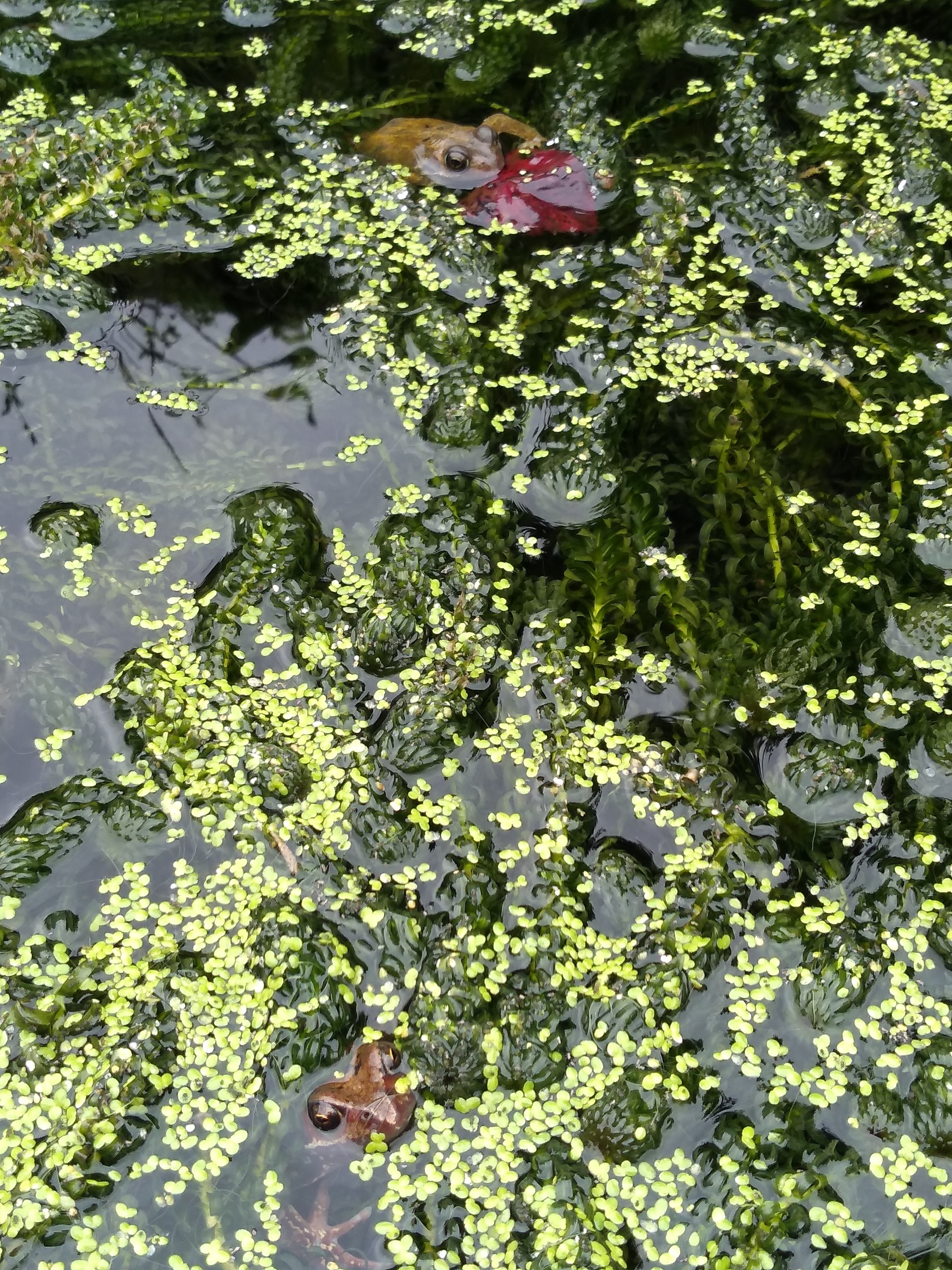
My week started and ended working next to ponds. The first was a small natural pond with a couple of frogs (Rana temporaria) sitting in it.

The other was a large disused outdoor swimming pool. In its neglected state rainwater collects within the concrete walls and nature is taking over. Given the murkiness of the water I was unable to obtain decent photos of my findings; however I saw another frog, (surrounded by lots and lots of tadpoles) along with a dragonfly nymph and a newt. It should be interesting to discover how many tadpoles survive to adulthood.

For the rest of the week insects were centre stage, especially on Wednesday when flying ants took to the sky. Flying ant season really tests my resolve to work through my dislike of ants (which originated in childhood). Thankfully I now find them more fascinating than loathsome, mostly.

The other insects I saw that day were;
– A (Chrysotoxum cautum) hoverfly on some Pyracantha.

– Honey bees (Apis mellifera) and a Red-tailed bumblebee (Bombus lapidarius) visiting a Geranium ‘Rozanne’ plant.

– Lavender (Lavandula) full of bees and butterflies, including more Honey bees as well as Buff-tailed bumblebees (Bombus terrestris), Meadow browns (Maniola jurtina) and a Ringlet (Aphantopus hyperantus) butterfly.

The Meadow brown butterflies also enjoyed visiting the Echinops bannaticus flowers too.

Even as I returned home I noticed a Willow Beauty (Peribatodes rhomboidaria) moth on the hall window.

The adults feed on Creeping thistle (Cirsium arvense) and Ragwort (Senecio jacobaea) both of these plants are common around this area. The caterpillars feed on various trees, shrubs as well as climbers ranging from Yew (Taxus baccata), Birch (Betula), ivy (Hedera helix), honeysuckle (Lonicera) and the wild Clematis, Traveller’s joy (Clematis vitalba).

The previous day I came across more insects that I was previously unaware of.

The first one was the Common red soldier beetle (Rhagonycha fulva).

It is a beneficial insect as adults eat aphids and are pollinators (feeding on nectar and pollen from open flat flowers such daisies and hogweed) while the larvae feed on slugs and snails along with other ground dwelling invertebrates.

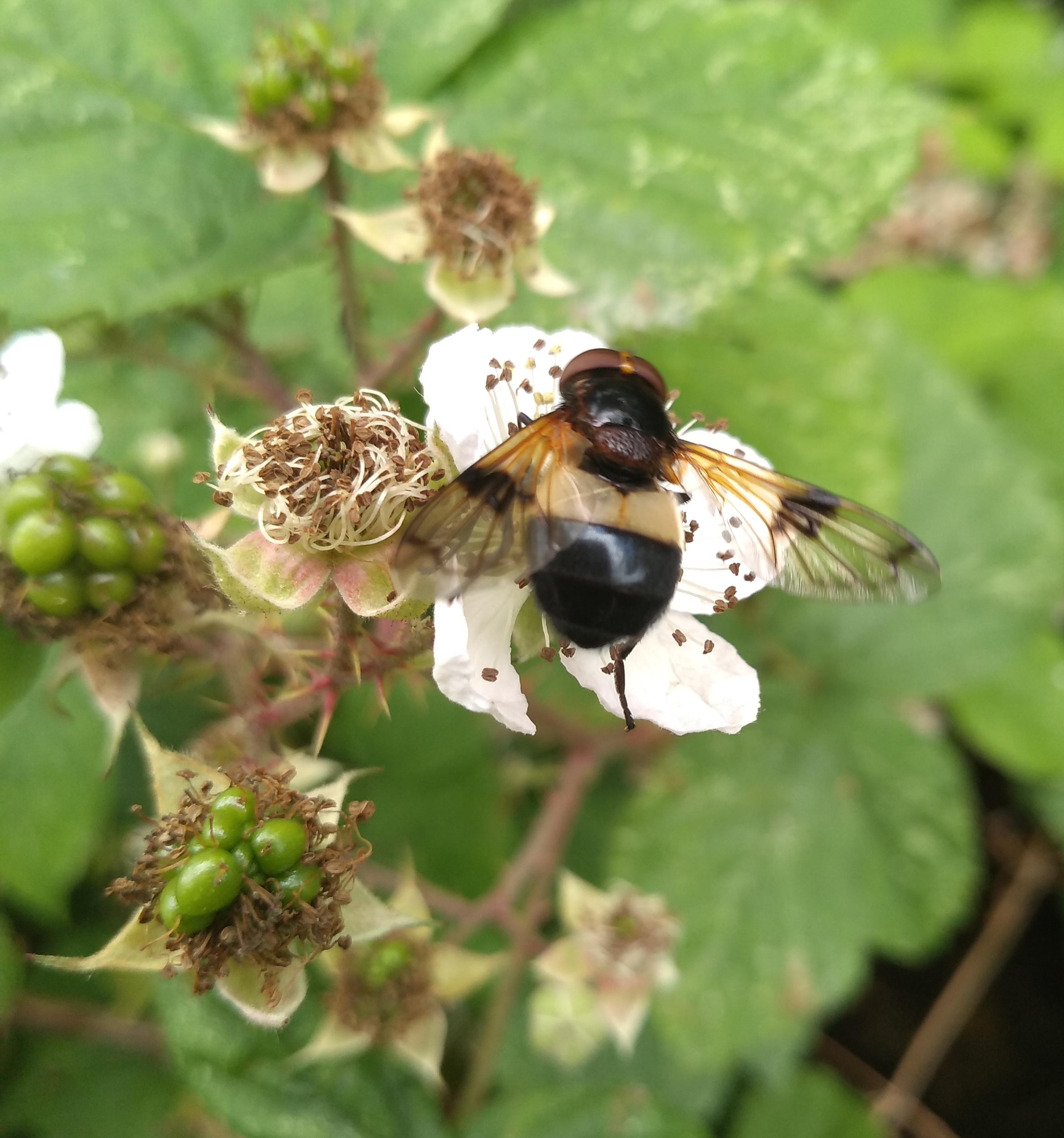
The other insect I saw on Tuesday was a female Volucella pellucens hoverfly feeding on nectar and pollen from Bramble (Rubus fruticosus).

These hoverflies also pollinate umbellifers; However as larvae they inhabit Bumblebee and wasp nests eating any waste produced along with their hosts larvae.
Posted in nature

Childhood Memories and Hedgehogs

In a week of much needed rain, I remained dry while waiting for the bus on Thursday. I arrived at the bus stop with plenty of time to spare and began to notice the flowers around my feet.

The most prolific were Daisies (Bellis perennis), Dandelions (Taraxacum officinale) and Buttercups (Ranunculus bulbosus). Childhood memories using these in flower based activities came back to me. Buttercups to discover if someone liked butter, Dandelions to tell the time (presumably when we weren’t wearing watches) and Daisies for making daisy chains or discovering if someone loved you (or loved you not).

Daisies remain a favourite flower of mine because seeing them lifts my spirits. Yet the thing I love most about Daisies is that the name means day’s eye (from the Old English dæges-eage) because the petals open up during daylight hours and close as night falls. Even in Welsh they are called llygad y dydd meaning the eye of day. The following photo, taken early in the morning, shows their progress as they open.

Other plants I noticed flowering were;

-Red dead-nettle (Lamium purpureum). This pretty non-stinging plant is good for Garden Tiger (Arctia caja), White Ermine (Spilosoma lubricipeda) and Angle Shades (Phlogophora meticulosa) moth caterpillars which feed on it’s leaves, while the flowers are great for Bumblebees (Bombus) and the Red Mason bee (Osmia bicornis).

-Shepherd’s purse (Capsella bursa-pastoris). The seed pods of this resemble heart shaped purses which contain copper coloured seeds that look like coins.

-Germander speedwell (Veronica chamaedrys). Speedwells at one time were considered a good luck charm for travellers for ‘speedy’ travel as they are often found along verges.

Initially the last plant I saw was unknown to me. It took some time but I eventually discovered that it is Wild Turnip (Brassica rapa).

Hedgehog Awareness Week took place last week (British Hedgehog Preservation Society). It publicises the continued decline in Hedgehog numbers along with information on how to help reverse this. I decided to learn more about hedgehogs at this time by reading ‘The Hedgehog Handbook’ by Sally Coulthard as I travelled by bus. Each chapter gives a monthly account on what hedgehogs are doing and how to help them.
This is a wonderfully informative book contains lots of useful advice that I can put into practice and I loved reading it.