Posted in nature

False Autumn

It might be the start of meteorological autumn but it’s still too early for leaves to start falling from trees; yet over the past few weeks this has been occurring. Referred to as false autumn, this leaf (and acorn) drop is occurring as a result of the extreme temperatures and drought we’ve experienced this year. It is a sign of stress as trees attempt to conserve water and energy. Current lower morning temperatures have also lead to an autumnal feeling. Thankfully we are now experiencing rainfall so perhaps this will prevent trees from showing further signs of stress even though it doesn’t stop us being in drought. Hopefully autumnal colour won’t be affected too much and we will still witness the spectacular seasonal colours this year.

A couple of weeks ago my partner and I went for a walk to spot Saturn ascending in the sky at dusk; we visited the local woodland park. At nine o’clock, on one of the hottest days of the year, the temperature was quite pleasant. As we walked through the woodland to an open area, where we could view the planet, we got to experience bats flying close by (the following videos is of some footage I managed to obtain).

Without a Bat detector, I have no way of correctly identifying the species out of the 18 that roost in the UK. According to the information I found on the Hertfordshire and Middlesex Bat Group website, the ones we most likely encountered in the area are either the Common Pipistrelle (Pipistrellus pipistrellus) or Soprano Pipistrelle (Pipistrellus pygmaeus). Regardless of the species, just experiencing the creatures flying nearby to capture insects was amazing. I haven’t witnessed bats in fight since I was a child.

It’s still possible to see some butterflies and bees at this time of year so late year flowering plants are essential.

A Common carder bee visiting a group of Aster flowers.

White tailed bumblebees (Bombus lucorum), Buff tailed bumblebees (Bombus terrestris), Red tailed bumblebees (Bombus lapidarius), Common carder bees (Bombus pascuorum) and even some Honey bees (Apis mellifera) still forage in September. The Butterfly Conservation charity produced a photo (see below) of common butterflies and moths to see at this time of year.

During the previous week I was still noticing several Hummingbird hawk moths (Macroglossum stellatarum) too. These moths have been quite prevalent this year.

On one occasion I managed to get a video of a Hummingbird hawk moth visiting a Buddleia.
Posted in nature

Bees in Autumn

The Autumn equinox finally arrived last Wednesday. It was lovely to notice bees still flying around when the sun shone. While these insects are synonymous with spring and summer, some are still active in September.
Common carder bees (Bombus pascuorum) were the most noticeable last week but I also saw a new Buff-tailed (Bombus terrestris) bumblebee queen visiting some Hylotelephium as well.

Common carder bee
Buff-tailed bumblebee queen

I also observed a couple of active bee nests in some lawns too. It was difficult to identify the specific species although given the time of year and colouration they were possibly Common furrow-bees (Lasioglossum calceatum) also called Slender mining bees. These bees are active from Spring until mid Autumn and nest in short grass. 

Posted in nature

Early Transition into Summer.

Last week began with Spring bank holiday monday. I went for a socially distant walk around the village with my partner. Thankfully he was very patient as I constantly stopped to take photos with my phone.

There were lots of sights and sounds to observe and it really felt like a summers day (which aren’t far off). Some I have noticed for a while like Orange-tip Butterflies (Anthocharis cardamines), Red-tailed bumblebees (Bombus lapidarius), Skylarks (Alauda arvensis), Red kites (Milvus milvus) and House sparrows (Passer domesticus).

Yet amongst the Elderflowers (Sambucus nigra) and Brambles (Rubus fruticosus), which are blooming at this time of year,

These flowers are great for making Elderflower cordial.
Looks like there will be lots of Blackberries this year.

were many more plants flowering too. The explosion of colour within our countryside is fantastic for pollinators. One insect I saw on Mondays walk, in a field busily pollinating Buttercups (Ranunculus), was the False oil beetle (Oedemera nobilis). This very small beetle is a vibrant metallic green colour. When it’s wings glistened in the sun, they changed from mid to light green.

Unfortunately this is the best photo I managed to get of this tiny beetle.

Upon my return to work, I noticed other insects flying about. Several small tortoiseshell Butterflies (Aglais urticae) were too quick for me to photograph, however I did capture Common carder bees (Bombus pascuorum) on Common comfrey (Symphytum officinale) and

a Cream Spot Ladybird (Calvia quattuordecimguttata)

Once again, another ladybird determined to get my attention by falling on my sunglasses while I wore them.

The Cream Spot ladybird has fourteen spots and survives winter in tree bark and Beech masts. Although it is usually found amongst hedgerows rather than gardens.

Wildflowers that were in full bloom last week were;

-Purple toadflax (Linaria purpurea),

-Field scabious (Knautia arvensis),

– Common stork’s-bill (Erodium cicutarium),

This plant is a good food source for Brown argus Butterfly (Aricia agestis) caterpillars, along with Meadow and Dove’s-foot Crane’s-bills (mentioned below). This butterfly is often found in southern chalk and limestone grassland but it can also inhabit places with disturbed soil like verges and coastal areas. In fact this plant was found on disturbed soil edging a field.

-Meadow crane’s-bill (Geranium pratense),

-Creeping cinquefoil (Potentilla reptans),

-Common poppy (Papaver rhoeas),

-Dove’s-foot Crane’s-bill (Geranium molle),

-Field bindweed (Convolvulus arvensis),

-Common mallow (Malva sylvestris),

-Creeping woodsorrel (Oxalis corniculata),

-Birds-foot trefoil (Lotus corniculatus) and

-White clover (Trifolium repens).

Found amongst lawns, this is a wonderful food source for the Common blue butterfly (Polyommatus icarus) and some bumblebees

Recent weather conditions have caused dryness within nature that normally exists during summertime. Water is already required and talk of conserving water has already begun to help prevent restrictions later in the year. I shall be interested to see how nature deals with this early warm dry weather, especially with less human disturbance due to lockdown. Will it be another great year for butterflies? I look forward to discovering more as we spring into summer.

Posted in nature

Things Come in Threes

At least in several gardens last week, things with three leaves appeared as several Trefoils began to flower.

In some lawns the yellow flowering Slender hop clover (Trifolium micranthum) has shown itself along with Red clover (Trifolium pratense).

Slender hop clover
Red clover

Red clover is also called Bee-bread (along with White clover- Trifolium repens) due to its popularity with bees. It’s nectar is especially loved by Common carder bees (Bombus pascuorum), Honeybees (Apis mellifera) and Red-tailed bumblebees (Bombus lapidarius). Red clover, which is less commonly found in nature than White clover, is used for livestock feed and crop rotation (due to its nitrogen fixation abilities). It is also used in herbal medicine to treat respiratory and skin ailments,along with menopausal and PMS symptoms because the flower contains isoflavones. When taken internally, isoflavones become phytoestrogens which has similar affects in the body as estrogen (see Plantlife)

I will have to wait a little longer to see White clover flowering as it blooms from June. However White clover is commonly found in verges and grassland so I’m sure to see some eventually.

Unfortunately I have never spotted a four leaf clover (or five leaved). I am ever hopeful, just for the challenge because they are so hard to spot in the wild.

Several trees are blooming at the moment. Along with Hawthorn (Crataegus monogyna- the May tree flowers referred to in the rhyme ‘Cast ne’er a clout ere May is out’) the Horse chestnut (Aesculus hippocastanum) is also in flower; they have white flowers with a pink tinge.

I also see the Red horse chestnut tree (Aesculus x carnea Briotii) on my travels, both trees have very showy flowers.

It was great to see lots of bees about last week and various species too.

The first type of bee I saw was a Hairy-footed flower bee (Anthophora plumipes) around some forget me nots (Myosotis).

I also noticed lots of Buff-tailed bumblebees (Bombus terrestris),
Honey bees and Early bumblebees (Bombus pratorum) throughout the week too.

This Cotoneaster hedge was alive with Honey bees. Make sure the sound is on to listen to their relaxing buzzing.
The Early bumblebees were also visiting the Cotoneaster flowers.
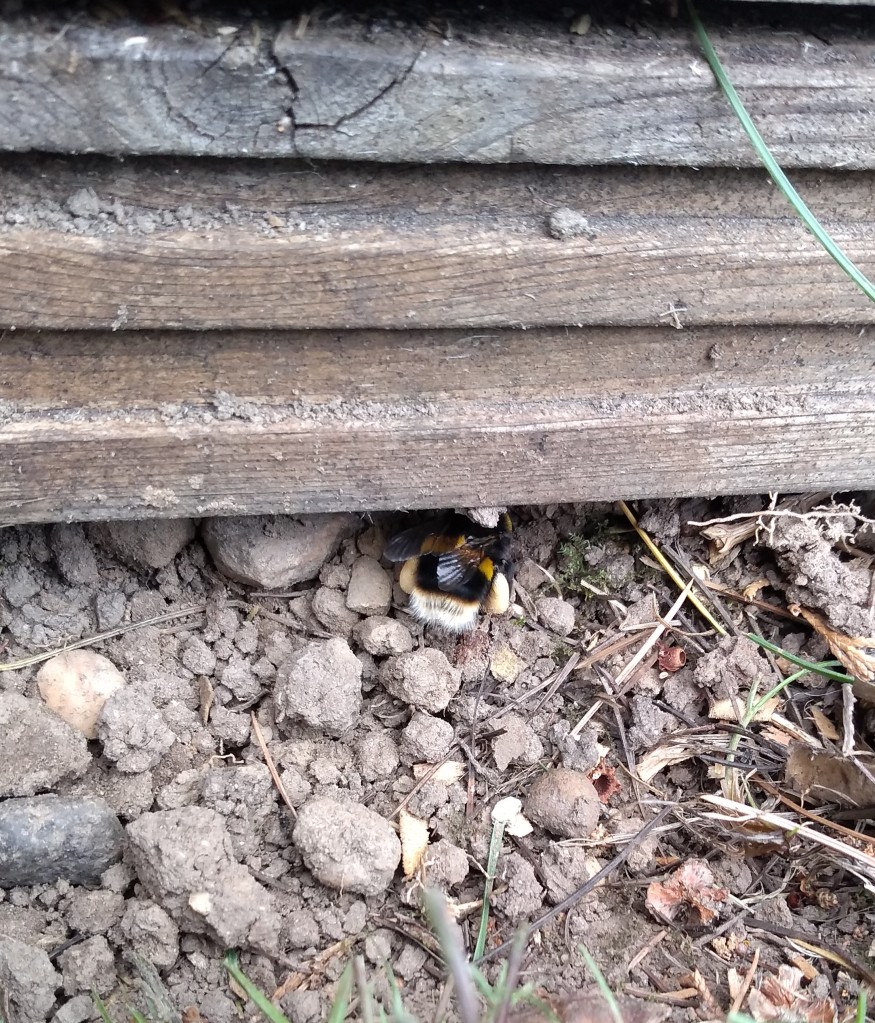
I noticed five Buff-tailed bumblebees coming and going from a nest under some decking in one garden.
Posted in nature

April Showers Finally Arrive.

The proverb ‘March winds and April showers brings forth May flowers’ came to mind several times in the past week. Now that May has arrived, I look forward to seeing what will bloom this month.

Due to the amount of rain within the week, observations were few and far between; although I occasionally noticed bees flying around during dry periods when the sun shone.

I saw several Common carder bees (Bombus pascuorum) visiting an expanse area of White dead-nettle (Lamium album).

Bees also visited Welsh poppies (Papaver cambricum) which were blooming early.

They tend to start flowering between June to August. I love the golden shades of yellow and orange produced by this plant. Their chearful appearance, is perhaps why clients often like having these in their gardens. 

I learnt some more wildflowers last week. It’s always lovely to expand my knowledge of wildflowers.

I found two in some borders, Hedgerow crane’s-bill (Geranium pyrenaicum) and

Lamb’s lettuce (Valerianella locusta).

The last one I saw was in a lawn, under the canopy of a tree, it was Meadow Saxifrage (Saxifraga granulata).

Posted in nature

What a Hoot.🦉🎵🦉🎶

On Saturday night I woke up to a beautiful duet. A pair of Tawny owls (Strix aluco) were calling to one another, reinforcing their territory. The male call sounds like ‘hooo, hu, huhuhuhooo’ while the female gives a ‘keewik’ sound (see BTO).

Tawny owls pair for life and remain in their territory (initially established in winter) throughout the year. Deciduous broadleaf woodland is their traditional habitat but sometimes they live in large gardens and parkland. They nest within tree cavities or nest boxes. Occasionally eggs are laid in February but more often between March and April. While the female is slightly larger than the male, these owls are the same size as a wood pigeon. They feed on small mammals, birds, rodents, fish, frogs, insects and worms. Their UK Conservation Status is Amber as their numbers are declining. 

Another bird which caught my eye last week was a male House sparrow (Passer Domesticus). I was leaving the allotment when I observed him collecting nest material before flying off. As with the Tawny owl, House sparrows pair for life and their numbers have also been declining for a while; House sparrows are Red in the UK Conservation Status list. I grew up seeing lots of them but since moving down south, I haven’t seen one for years so this was a wonderful sight. I love these little birds, especially hearing their chattering and chirping in their colonies. Hopefully I will see him and more Sparrows soon.

As the week went on I noticed more flowers blooming in the hedgerows. Wild strawberry, also called Alpine strawberry (Fragaria vesca), was the first one I saw.

The fruit of this strawberry can be eaten.

Others I saw were; Bugle (Ajuga reptans),

These flowers are visited by White-tailed bumblebees (Bombus lucorum), Common carder bees (Bombus pascuorum), Silver Y moths (Autographa gamma) along with Green-veined white butterflies (Pieris napi).

– Herb bennet/Wood avens (Geum urbanum) and

Grizzled skipper butterfly (Pyrgus malvae) caterpillars feed on this plant.

– Bush vetch (Vicia sepium).

Bees and other pollinators enjoy these flowers.

I got to see a female Orange- tip (Anthocharis cardamines) butterfly, having seen a male one the other week. Males have the orange tips while the tips on the female’s forewings are black (both have the black spots). The female can be identified apart from other white butterflies by the mottled green and white underwings (also exhibited by the males). Caterpillars of this butterfly feed on Garlic mustard (Alliaria petiolata) and Cuckoo flower (Cardamine pratensis).