Posted in nature

Nature’s fireworks 🍁🍂

The temperature has fluctuated during the previous two weeks, with a few light frosts and hotter than average November days. Leaf fall is well under way now too keeping us busy at work. I never cease to be in awe of the beautiful leaf colours as the sun shines; They make fireworks look monochrome in comparison.

Fungi observations were still numerous. Here are some that I have seen over the past few weeks;

The Prince (Agaricus augustus)
Golden waxcap (Hygrocybe chlorophana)
Russula queletii
False saffron milkcap/ Orange milkcap (Lactarius deterrimus)

Amazingly I have still seen the occasional Buff-tailed bumblebee (Bombus terrestris) queen; plus the previous Friday I also noticed a Common carder bee (Bombus pascuorum) near a compost bin in one garden.

Common carder bee

The Rowan (Sorbus) berries on the tree outside my flat are almost gone, mostly due to a local flock of starlings (Sturnus vulgaris); however other visitors enjoying the bounty have been two Song thrushes (Turdus philomelos) and two blackbird (Turdus merula) couples.

I enjoy watching Starlings, seeing their shiny purple and green plumage and listening to their social interactions and mimicry. Starlings have a wide repertoire of calls because they imitate sounds, especially other bird calls (usually 15-20 distinctive sounds); even their murmurations are beautiful to watch.

Other birds visiting the tree, not interested in the berries, were a male and female Chaffinch (Fringilla coelebs), my family of Blue tits (Cyanistes caeruleus) along with a newcomer, a rather vocal Coal tit (Periparus ater). It was lovely to be able to hear a new call coming from the Rowan, it can be heard here (RSPB).
Posted in nature

Delayed April Showers in May

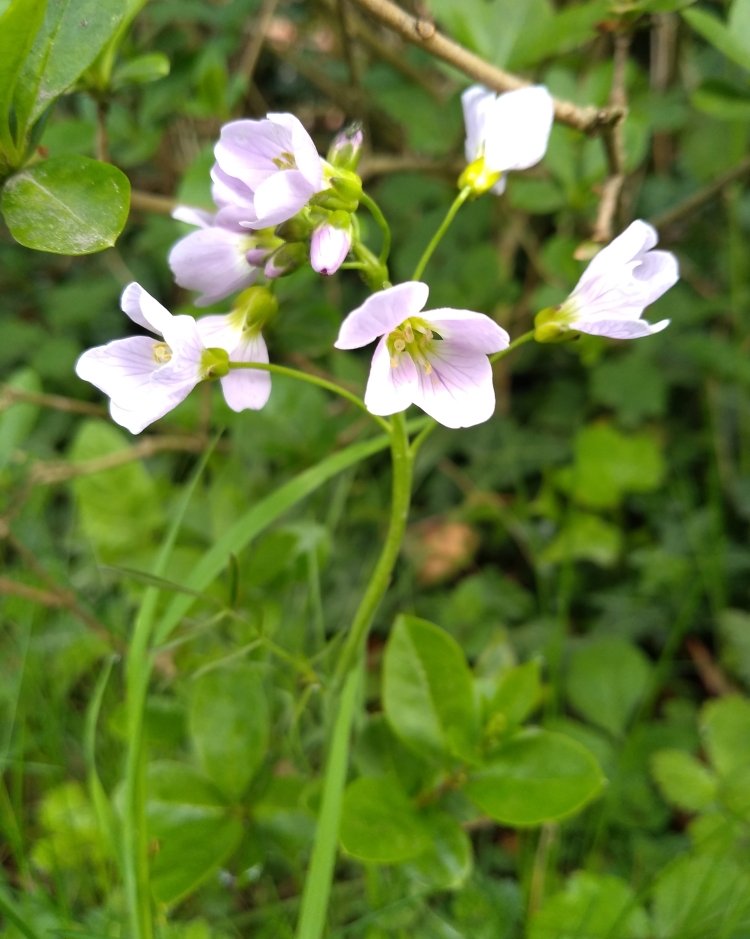
Rain showers continued to fall, reviving the ground at last. Between the downpours I noticed Cuckooflowers (Cardamine pratensis) begin to bloom last week.

So named because it flowers from late April, around the time male Cuckoos (Cuculus canorus) are heard in the UK once the birds return from Africa; signs that spring is well underway.

The last time I heard Cuckoos was in Shropshire many years ago. At the time, I only heard the males call of “cuck-oo’ in the distance. I have never witnessed the females call which can be heard here (Garden birds). I have never seen these birds either; perhaps one day, although their conservation status in the UK remains red (reasons for this is explained by the BTO website).

I love witnessing wildflowers being pollinated; yet more proof that patches of wildflowers are essential for pollinators. Last Sundays walk resulted in such a sighting. As I walked past an area where White dead-nettles (Lamium album) were blooming I became aware of a gentle buzz. A solitary Common Carder Bee (Bombus pascuorum) was visiting the patch of flowers.

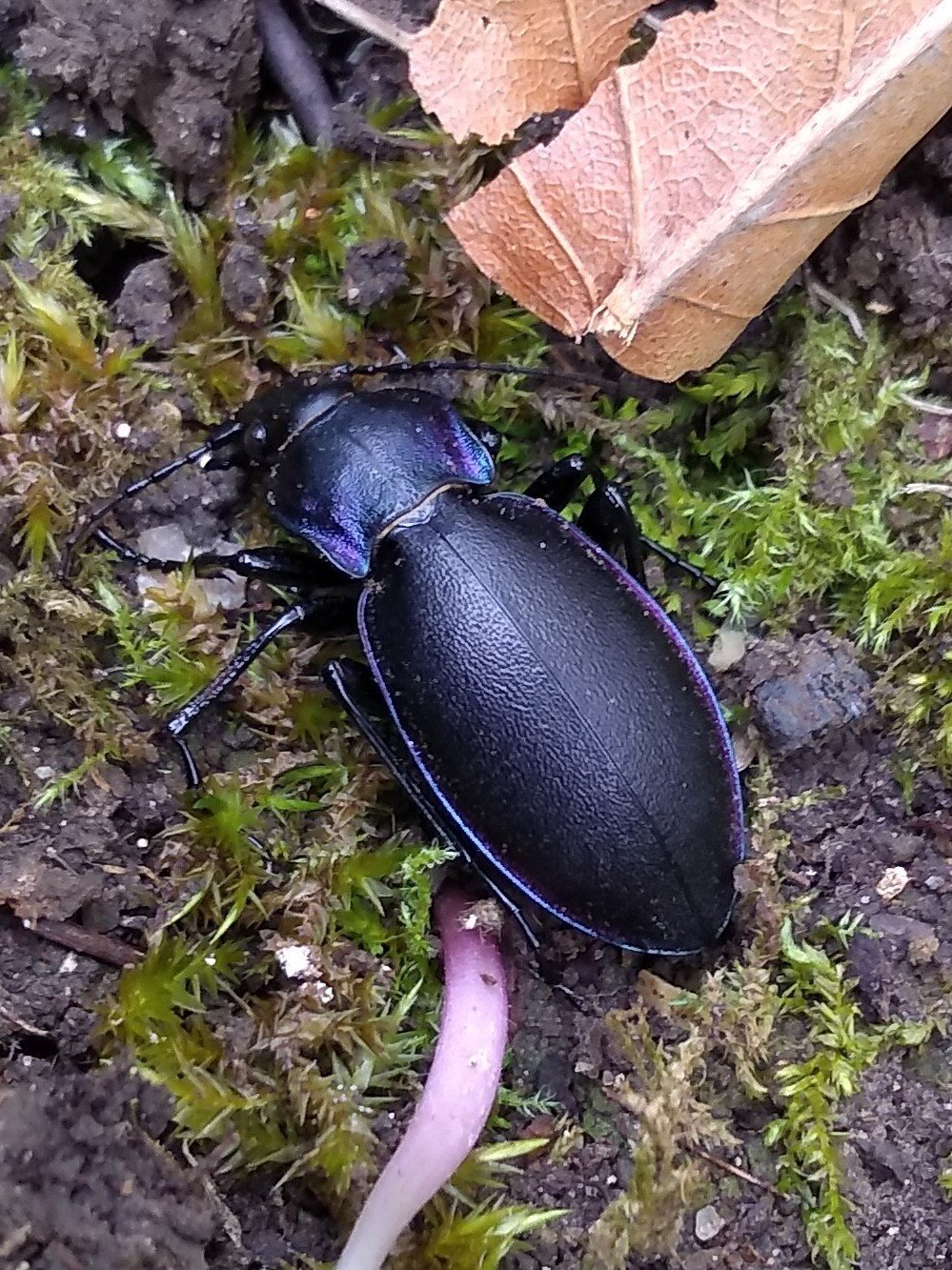
An insect that I became aware of later in the week was a Violet ground beetle. I have never seen one of these beetles before; it was so mesmerising as it glistened in the daylight.

It could have been one of two species of Violet ground beetle, either Carabus violaceus or Carabus problematicus, as they are difficult to tell apart (it’s all down to the amount of dimples and ridges apparently). As both can be found in gardens, if I had to make an educated guess, I would say it was a Carabus violaceus ground beetle (the more common of the two, especially in gardens). The Carabus violaceus can also inhabit farmland and meadows where as Carabus problematicus is predominantly found in woods and heathland.

Active at night, it doesn’t fly but will rely on running fast to capture pray and find shelter if disturbed. During the day, it predominantly hides under logs or stones; however I noticed this one when I moved a clump of soil. I was very conscious of taking its photo as quickly as possible before I covered it up once again. This adult beetle, along with their larvae, feeds on other insects alongside slugs, snail and worms.

Posted in nature

Flowers to Lift the Spirit


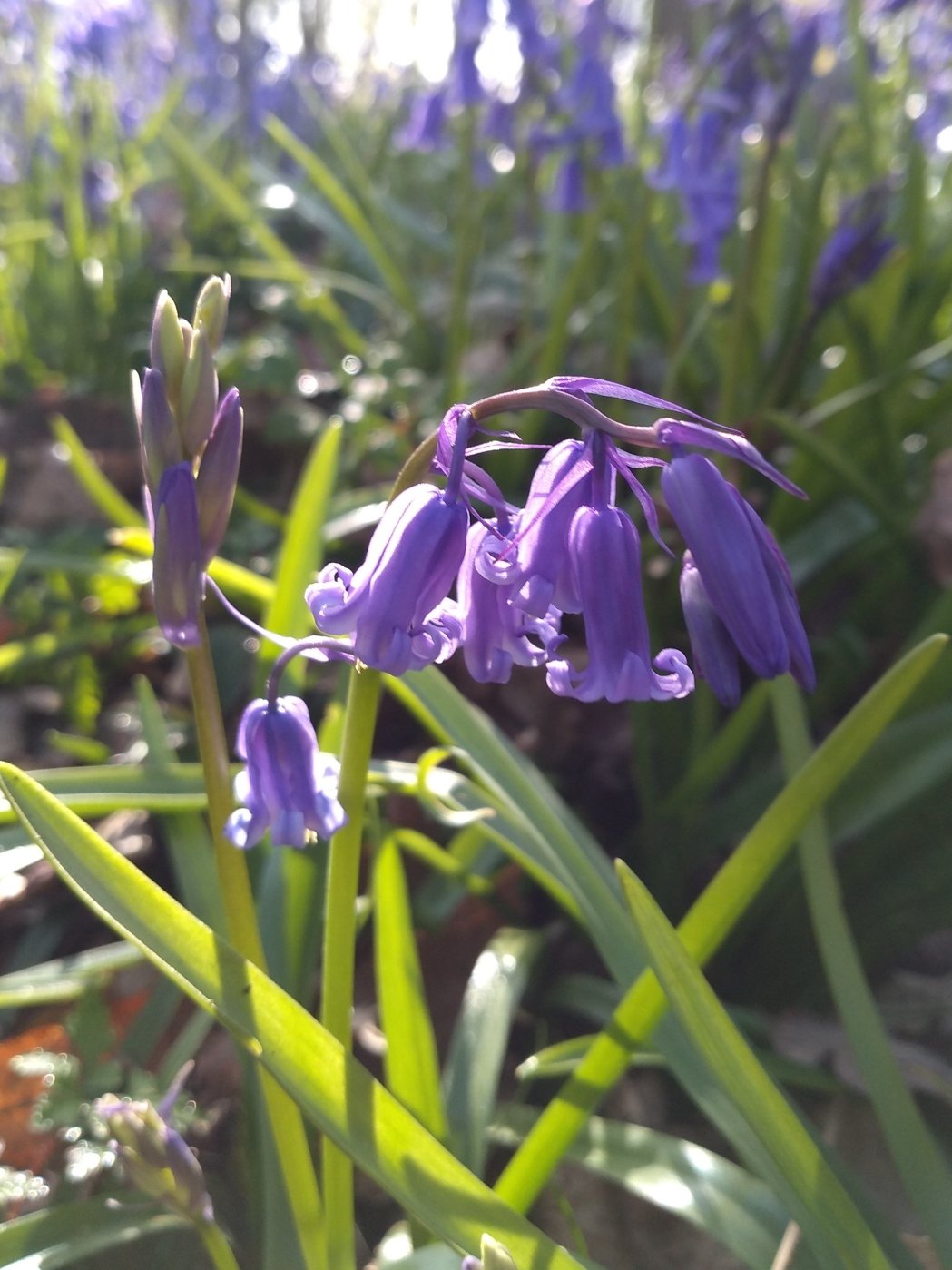
Last week the Bluebells (Hyacinthoides non-scripta) were just beginning to open. I always look forward to seeing these delicate flowers appear; it brings such joy to see their destinctive shade of blue on mass. Although not yet in full bloom, as I knelt down to take photographs I caught their delicate aroma.

Then later the same day, I got my first sighting of a Common carder (Bombus pascuorum) bee of the year, as it took advantage of the apple tree blosom.

I will never tire of hearing birdsong, it’s a wonderful soundtrack to have as I work. Not only is birdsong relaxing to me but it gives me the opportunity to keep learning too. The bird I became most aware of last Tuesday was the Nuthatch (Sitta europaea). Amongst all the birds I could here on that day, this was the clearest (it can be heard here on the RSPB website).

Unfortunately I didn’t get to see it. Having never seen one before I would have loved to see it’s mostly bluish grey and chestnut plumage (with hints white along with a black stripe across the eyes).

Similar in size to a Great tit (Parus major) these birds resemble a small Woodpecker as they climb trees. Nuthatches can be seen clinging to trunks or branches, as they climb up or down headfirst (the only British bird to descend trees in this way). They forage for insects and invertebrates, as well as feast on seeds and nuts (including beechmasts, hazel nuts and acorns) using tree crevices to store food for later. They also bury food and hide it beneath stones.

Nuthatches are found in mixed  broadleaf woodlands, parkland or urban gardens which have sufficient tree cover; occasionally eating from bird feeders. They particularly like areas with mature Oak (Quercus) trees. There was an established Oak nearby where I worked, so perhaps that’s where it was singing from.

They remain close to the nesting site where they fledged and are mostly seen in England and Wales; although their range is expanding into Scotland. Nests are holes in trees such as old Woodpecker nests.


Posted in nature

Tolkien’s Words of Wisdom are Still Appropriate.

Last week ended with a wonderful announcement in the news, the Great fox-spider (Alopecosa fabrilis), presumed extinct since 1993, has been refound alive (see the BBC News report). This highlights, both the amazing work undertaken by naturalists, as well as the importance of protecting wildlife and their habitats.

As an amateur naturalist and gardener, I haven’t undertaken such groundbreaking work but I try to do my bit whenever and wherever I can. I think of J.R.R. Tolkien’s quote ‘Even the smallest person can change the course of the future.’ from The Fellowship of the Ring (The Lord of the Rings trilogy) in these moments. We can all play a small part in saving nature’s wonderful diversity so that it has a future.

With this at the forefront of my mind I think back to one small act I hope made a difference last week. I noticed a female Common carder bee (Bombus pascuorum), identified by the white hairs on the sides of its thorax. It isn’t unusual to see these females fly this late in the season, (possibly a new queen getting ready for hibernation before starting a new nest in spring). However the one I saw was very still; I was concerned it was worn out and required help so I gathered some Verbena bonariensis and Salvia flowers to revive it. Thankfully my instinct was probably correct because it fed from the nectar contained within the posy I laid next to it.

Along with some cultivated plants, a few wild flowers were still blooming, Red clover (Trifolium pratense) and Yarrow (Achillea millefolium). Even though the latter flowers through to November, Red clover usually only blooms until October. The Common carder bee feeds from the Red clover flowers along with Honeybees (Apis mellifera) and Red-tailed bumblebees (Bombus lapidarius).

I also learnt some new fungi last week. The Golden waxcap (Hygrocybe chlorophana) which grows on grassland.

This fungi is on red list for threatened fungi in some European countries such as poland and Switzerland but not in the UK

Plus the other fungi I noticed, the Shaggy scalycap (Pholiota squarrosa) at the base of a tree stump.

This is often found next to broadleaf trees stumps, particularly beech (Fagus), and occasionally spruces (Picea) between August and November. 
Posted in nature

Song Finally Identified.

For several weeks I have heard lots of male Grasshoppers in the long grass next to my allotment plot. I have been hoping to see one so I can identify them. Finally last Saturday the opportunity arrived. Sitting on some carpet used as a weed suppressor, a Field Grasshopper (Chorthippus brunneus) was seen basking in the sun.

A Common Field Grasshopper (unsuccessfully) attempting to hide behind a stone.

At last I knew which grasshoppers were repeating that soft short chirruping ‘song’. The sound made as the hind legs are rubbed against their wings attracts females. With successful mating approximately 15 eggs are laid and remain in the soil until next year. The nymphs hatch from March onwards and after shedding their skins three or four times become adults in the subsequent summer. This common UK grasshopper feeds on grasses so they won’t go hungry living amongst the overgrown plot.

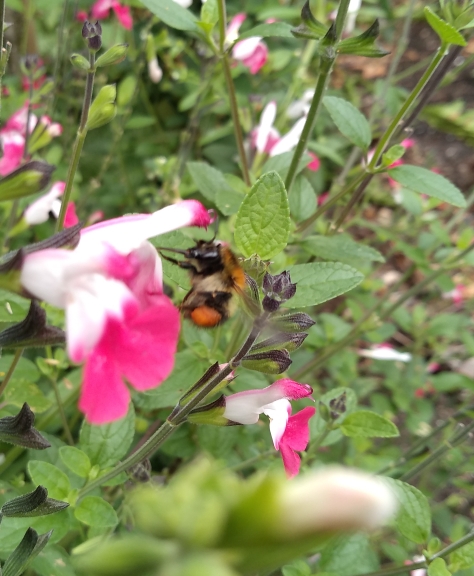
The other amazing thing I saw last week was another bee with spectacular coloured pollen baskets. A Common carder bee (Bombus pascuorum) with orange pollen baskets was visiting a Salvia flower.

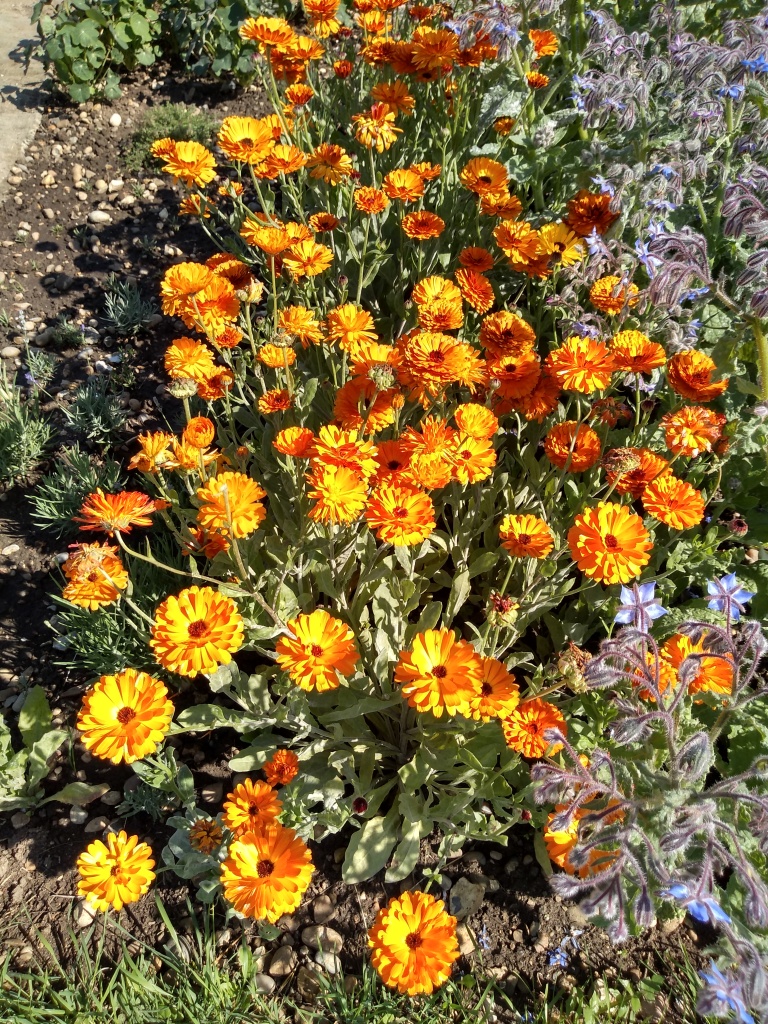
After checking a pollen colour chart, the source of the pollen it had collected was most likely from Calendula officinalis which are in full bloom at the moment (especially on my allotment).

Given the vibrant petals of Calendula I am not surprised that it’s pollen is deep orange. My Calendula is growing next to Borage which has been blooming for a while too. Loved by bees, Borage nectaries refresh every few minutes and the pollen is greyish blue in colour. I look forward to seeing bees with their pollen baskets full of Borage pollen.
Posted in nature

A Chill in the Air with Beautiful Sunrises.

Occasionally I am still surprised by nature. One instance of this occured on my way home last Monday when I saw a Heron (Ardea cinerea) standing on a rooftop. I had to double take to confirm it was real; thankfully it moved it’s head slightly. The house was near a river but I guess it was looking for an easy dinner from someone’s pond. Infact this wasn’t the only time I saw Herons during the week. On Wednesday I also noticed a couple flying above where I worked. One of them was calling but I think it was warning the other off because they eventually went their separate ways.

Jay’s (Garrulus glandarius) also became more visible last week as they harvested acorns before the squirrels (Sciurus carolinensis). I love the Jay’s colouring and the meaning behind their Latin name. Garrulous is a word that refers to their noisy chattering while glandarius translates as ‘of the acorn’, very appropriate.

Garden spiders (Araneus diadematus) seemed to be very busy creating their orb webs amongst perennials and shrubs; especially as I often managed to get my face tangled amongst them by accident (meaning their well deserved rest was cut short).

There was a chilly start to Thursday and I woke to a beautiful sunrise. Even though the temperature has dropped slightly, my Asters and Penstemon continue to flower well. Hopefully pollinators are still visiting them. I noticed some bees and a Red admiral (Vanessa atalanta) flying about in other gardens.

A Honey bee (Apis mellifera) visiting Helenium ‘Lemon Queen’.

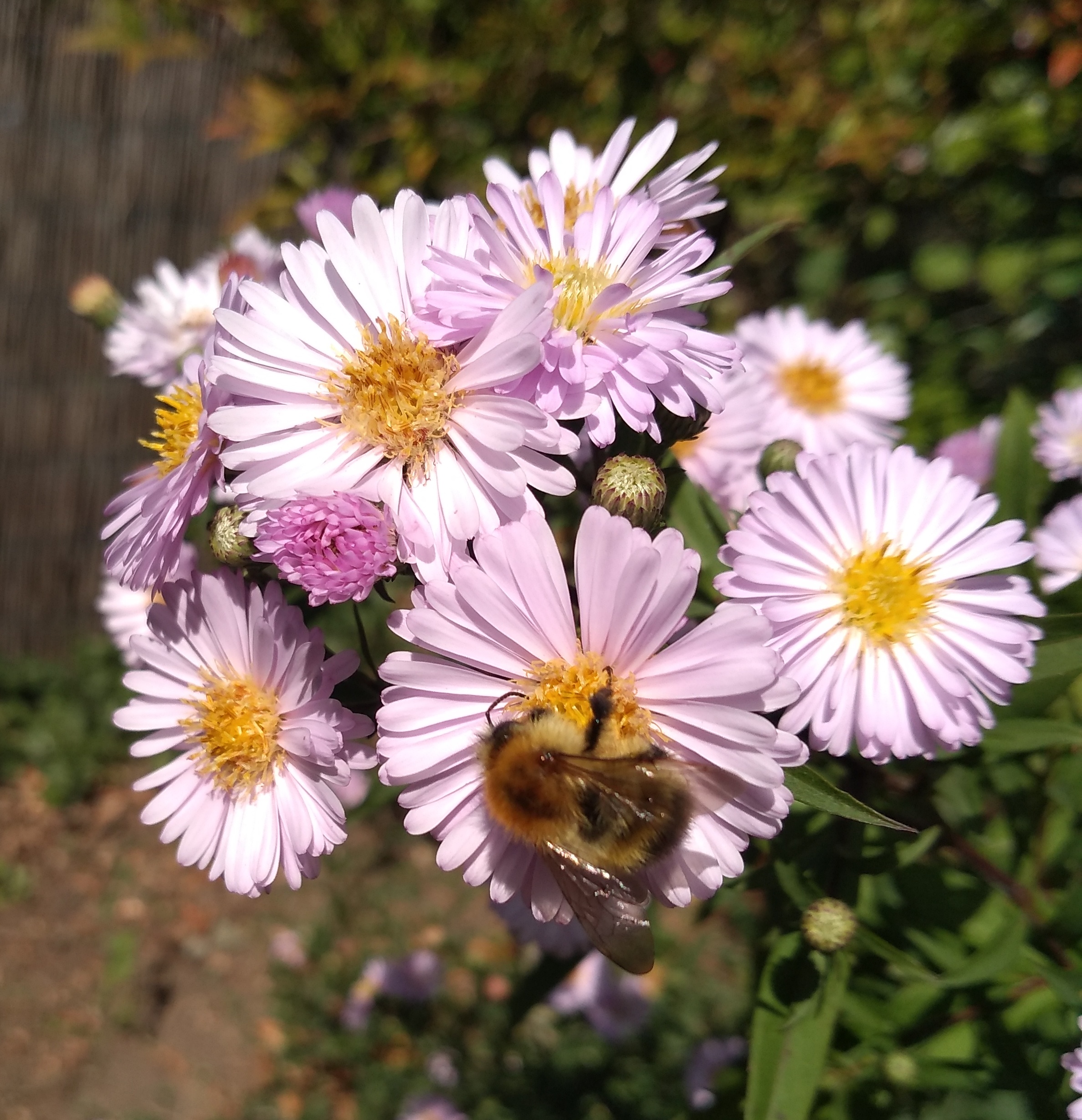
A Common Carder Bumblebee (Bombus pascuorum) visiting some Aster flowers.

On Friday however, I saw
2 Box tree moths (Cydalima perspectalis). These pretty moths with a purply-brown pattern set against white wings were not such a welcome sight. This is the first year I have noticed these moths. I first saw their caterpillars in another garden during the summer too. It is the caterpillars that cause the damage as they defoliate Box (Buxus) plants. They are considered a pest and are spreading further across the country (for further information see Butterfly Conservation).

Posted in nature

🎵…I’m Laughing at Clouds, so Dark up Above… 🎶🎵🎶

What a much needed wet week. I don’t mind working in the rain too much but on Monday I struggled to keep upbeat. While waiting at a bus stop (without a shelter) during very heavy rain it started finding a way through my waterproofs. Singing helped keep me positive, although rain seeped into my singing too. Eventually the Morecambe and Wise ‘I’m Singing in the Rain’ sketch came to mind and I started giggling to myself. I didn’t go as far as splashing in puddles and dancing on the bench though.

Thankfully there were moments of respite during the day and a few insects braved the weather, mainly;

– a Common carder (Bombus pascuorum) bee on Caryopteris clandonensis ‘Dark Knight,

– a Heath bumblebee (Bombus jonellus) visiting some Asters,

– and two Cinnamon bugs (Corizus hyoscyami) on some dried Purple toadflax (Linaria purpurea) seedhead.

I’m not sure they would have managed to get much sap from the plant. At least the photo is better than the last one I took of a cinnamon bug (see Blooms, Bees and Bugs).

Last week I also noticed more Grey Squirrels (Sciurus carolinensis) around. The softened ground has enabled them to cache nuts that are falling from the trees at the moment; hiding acorns keeping them busy.

Lots of Craneflies (Tipula paludosa) were noticeable too. Presumably I kept disturbing them as I worked because they were flying during the day. Their larvae, known as Leatherjackets, eat grass roots at night which causes patches of dead grass (therefore they are regarded pests of pristine lawns). Insect feeding birds gorge themselves on these, often leaving bits of loose grass where they have been. Unlike Leatherjackets, Craneflies don’t feed but try to find mates. It is possible to sex them, if the abdomen is pointed rather than squared it is a female (as the ovipositor can be seen). I still like to call them Daddy long legs as I did in childhood.

On Wednesday, as I worked near a pond, I witnessed a female Southern hawker (Aeshna cyanea) dragonfly laying eggs. She flew and stopped at various points around the pond edge, wherever there were gaps.

Then later in the week I discovered a Chicken of the Woods (Laetiporus sulphureus) fungi on a tree trunk,

as well as a Lunar Underwing (Omphaloscelis lunosa) moth. The Larvae of this moth feed on grasses.

The pattern on the forewings reminded me of stain glass windows and was very pretty.

Posted in nature

Quieter Days Ahead

We finally have some rain today, the start of some wetter weather this week. It looks very autumnal and very different from the weather of late. Although last week was still sunny and dry the amount of butterflies have reduced. However I do still see some Small white butterflies (Pieris rapae) flitting about. Wednesday was the best day for seeing these butterflies along with bees.

In a few gardens many late flowering plants are blooming nicely; this is especially important for pollinators that are still around in Autumn. Extending the season at the beginning of the year is just as helpful too. Early flowering bulbs, shrubs, wildflowers (including dandelions) Hellebores and Pulmonaria are great for the bees that forage in early spring. The first bees of spring are various solitary bees and the queens of some bumblebees (see Wildlife Trusts).

On Wednesday I saw;

– a Buff-tailed bumblebee (Nimbus terrestris) and Tree bumblebee (Bombus hypnorum) on Helianthus ‘Lemon queen’ flowers,

Buff-tailed bumblebee

Tree bumblebee

-Common carder bees (Bombus pascuorum) visiting Aster, Verbena bonariensis and Rudbeckia,

Aster

Verbena bonariensis

Rudbeckia

– and a Small white butterfly on Aster flowers.

On Friday I noticed more Common carder bees as they visited a hardy Fushia. This was the first time I noticed bees visit a Fushia so it was lovely to see it happen. These bees have long tongues and because they are small can collect nectar easily from Fushia flowers. However the two bumblebees I saw this week are larger and have short tongues which explains why I saw them visiting the Helianthus. Interestingly though Buff-tailed bumblebees are able to ‘rob’ nectar from bell shaped flowers by cutting a hole in the side of the flower to access the nectar. White-tailed bumblebees (Bombus lucorum) can also undertake nectar robbing. Even so single flowers, together with a variety of flower shapes are important for bees and other pollinators. Plus night scented flowers are beneficial for moths.

Another sighting from Wednesday was watching a Red Kite (Milvus milvus) soaring in circles above where I worked. I love hearing Red kites repeatedly call as they fly; it is a beautiful sound.

As well as insects and birds, occasionally I get to see wild mammals as I work too. There was an instance of this last Monday. I noticed a Fox (Vulpes vulpes) exiting a hedge and run into the neighbouring garden while I ate my lunch.

Posted in nature

Cozy Evening Reflections

I am feeling cozy, sitting on the sofa, as I reflect on last weeks observations on a dark evening.

Along with the earlier sunsets, fresh mornings have begun to take hold too. I have been noticing a lot of changes occurring with trees throughout the week. Their leaves are turning autumnal and I have been able to pick fresh apples as I work. Lots of conkers are falling around the bus stop too.

One of the apple trees with lovely sweet apples is pictured below. There were other trees with Russet and Cox apples.

The Rowan tree outside my home continues to have Blue tits (Cyanistes caeruleus) feeding on insects. Plus I have also seen a Robin (Erithacus rubecula) and two Long tailed tits (Aegithalos caudatus) eating insects on it’s branches, along with a Blackbird (Turdus merula) feasting in the berries.

Mr Blackbird wasn’t camera shy.

I still saw Small white (Pieris rapae), Red admiral (Vanessa atalanta) and Painted lady (Vanessa cardui) butterflies as they took advantage of the late flowering perennials.

On Wednesday I noticed a Painted lady butterfly as well as a Common carder bee (Bombus pascuorum) visiting some Ceratostigma willmottianum which is still blooming while the leaves are turning red.

Some plants have been flowering all summer, such as Geraniums and Verbena bonariensis, and now bloom alongside Sedums, Asters and Autumn crocus (Colchicum autumnale) painting gardens in muted colours.

Sedums and Verbena bonariensis looking lovely amongst ornamental grasses.

Geranium still flowering.

A Painted lady butterfly collecting nectar from an Aster flower.

Autumn crocuses blooming in the lawn.

Cutting back faded perennials was one of last weeks jobs which meant I disturbed a lot of Seven-spot ladybirds (Coccinella septempunctata). So I spent quite a bit of time rescuing them from garden waste bins too.

Lastly, as I walked home late on Wednesday, I ended up seeing a beetle walking across the path in the moonlight and enjoyed the view of the Waxing gibbous moon amongst the clouds.

Posted in nature

A Magical Week

I have begun to notice a chill in the mornings as the nights grow colder. I love the promise of Autumn. It doesn’t quite feel autumnal yet (especially as the weather has warmed up again this weekend) but some changes are occurring. Conkers and beech masts have started dropping and fungi are appearing in some lawns. A couple of times I have come across fairy rings; in both instances the Marasmius oreades fungi was the cause (sadly no magical elvish, fairy or pixie dancing).

The week continued with more observations of Painted lady (Vanessa cardui) butterflies. On Monday there were two visiting a Buddleja bush along with a Small tortoiseshell (Aglais urticae) and a Large white (Pieris brassicae).
Then on Friday, in different gardens, more were flitting about. On one occasion, during the morning, I saw a Painted lady on a Ceratostigma willmottianum.

In the second half of the week I noticed more butterflies including a Green-veined white (Pieris napi) on Verbena bonariensis

and a Small tortoiseshell visiting an Erysimum ‘Bowles’s Mauve’.

Throughout last week I saw lots of pollinators busily collecting nectar and pollen.
On Monday I noticed lots of small flies and Buff-tailed bumblebees (Bombus terrestris) pollinating Marigold (Tagetes) flowers. Perhaps they are enticed by their overwhelming aroma which even I found hard to ignore.

Then on Wednesday there was a Common carder (Bombus pascuorum) bee flying between Nandina domesticas and several Agapanthus africanus.

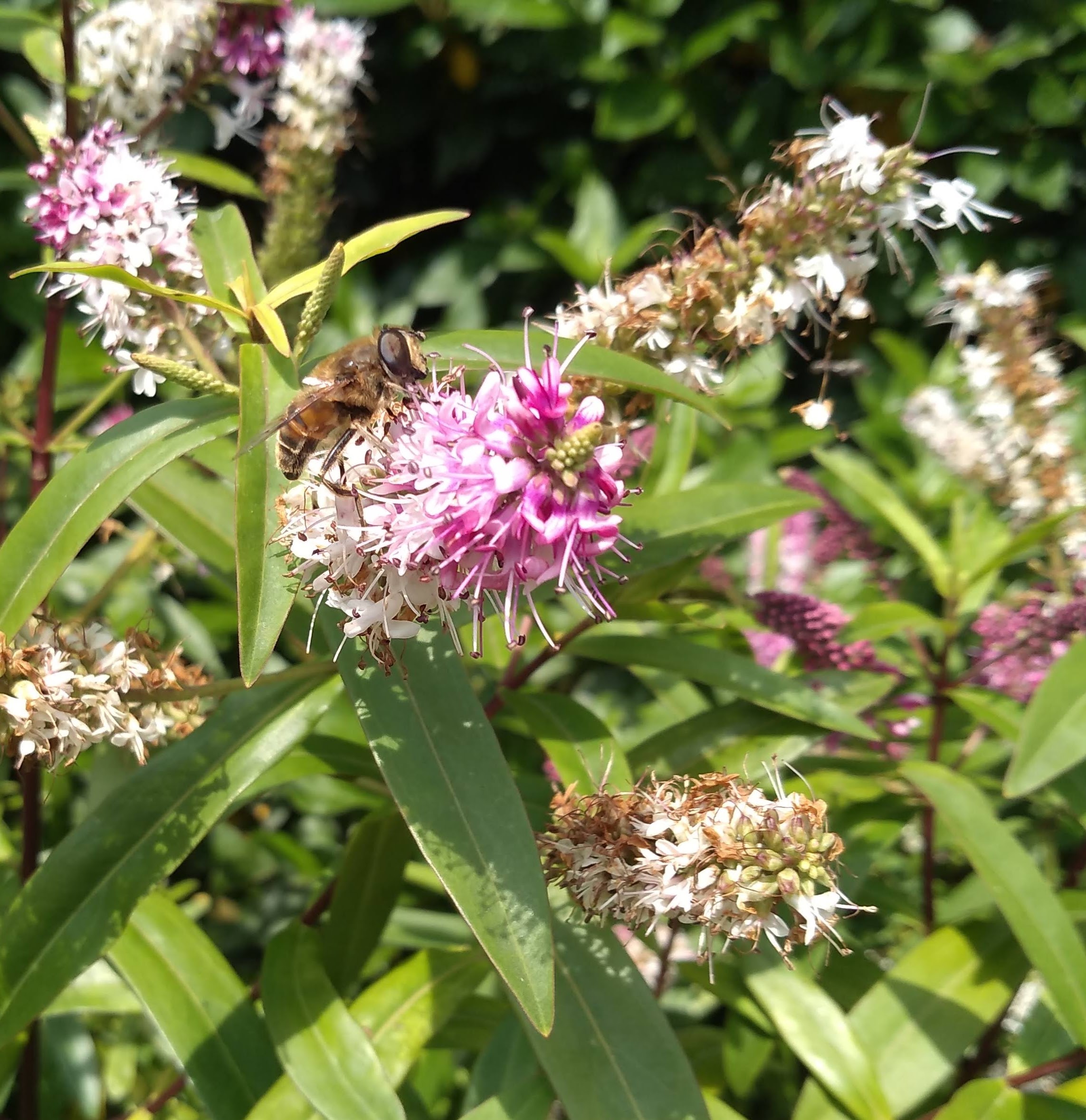
On Friday while working near some Hebe ‘Great Orme’ there were lots of honey bees (Apis mellifera) as well as a Hornet mimic hoverfly (Volucella zonaria).

Another interesting thing I noticed last week was a Red campion (Silene dioica) plant growing on an old moss covered log.

With no soil surrounding its roots clearly it was receiving sufficient moisture and nutrients from this unusual source. It has been flowering healthily all summer but I hadn’t realised it had been relying on the log for its growth until then. I found this plants ability for survival amazing and will closely watch its development.

Lastly I have been aware of how wonderful hardy Fuchsias (Fuchsia magellanica) are currently looking. Although I don’t see pollinators visiting the flowers, there have been a couple of times, in the past, when I have seen Elephant Hawk-moth (Deilephila elpenor) caterpillars feeding on Fushia plants. (See Elephant Hawk-moth).

These caterpillars also eat Himalayan balsam (Impatiens glandulifera) and Willowherbs including Enchanter’s nightshade (Circaea lutetiana) and Rosebay willowherb (Epilobium angustifolium). This beautiful pink and olive green moth flies at night and therefore feeds on Honeysuckle (Lonicera).

Across the way from this hardy Fushia there was a Honeysuckle growing along the wall so it would have been a fantastic place for these moths to inhabit. Unfortunately I didn’t come across any Elephant Hawk-moths this year but hopefully I will in years to come (and I am sure it will feel magical).