Posted in nature

A Snowy Adventure

The previous Sunday brought a little light relief as snow covered most of the UK. My childhood excitement of seeing the snow returned, so the days exercise was a walk through the local woodland park.

As I wondered past trees I began to notice odd glimpses of colour amongst the white and greys. Upon closer inspection I could see catkins already dangling along with female flowers ready to bloom on the Hazel (Corylus avellana) trees.

The male catkins are more showy than the tiny female flowers (which appear at the end of buds and harder to spot).
A very enlarged photo showing the red styles of the female flowers.

I also saw female flowers and cones on several Scots pine (Pinus sylvestris).

A closer view of the female flowers at the end of new shoots.

Surprisingly, given it was still snowing at the time, lots of birds were about too. I saw Redwing (Turdus iliacus), Blue tits (Cyanistes caeruleus), a small group of noisy Long tailed tits (Aegithalos caudatus) as well as a male Chaffinch (Fringilla coelebs) amongst the trees.

Redwings are migratory birds, from Iceland, Scandinavia and even Russia. Named after the red area under the wings, they can be seen in the UK between October and spring.

Throughout the week, as the snow slowly disappeared, I saw different birds visiting my Rowan (Sorbus) tree. I had never seen a Mistle thrush (Turdus viscivorus)
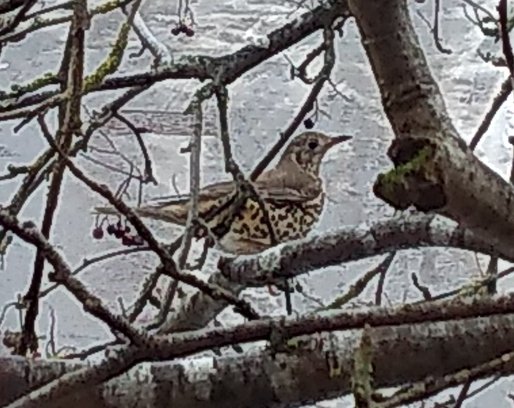
or male Chaffinch (Fringilla coelebs) visit the tree before.

Perhaps the reduced availability of food, during the snowy weather, made them search further afield than usual. Thankfully they found the remaining, mostly dried, berries on the Rowan tree outside my window.

Mistle thrush, so named because of their love of eating mistletoe (and guarding trees where it grows) also visit Rowan and Holly (Ilex) trees for their berries as well as eat worms, slugs and insects. They are larger and duller in colour than Song thrush (Turdus philomelos). Their spots are darker and rounder plus they have white tips to their tails. In fact they are larger than Blackbirds (unlike Song thrushes).

Wonderfully, there were even more flowers blooming in the garden too. I saw

Lungwort (Pulmonaria officinalis),
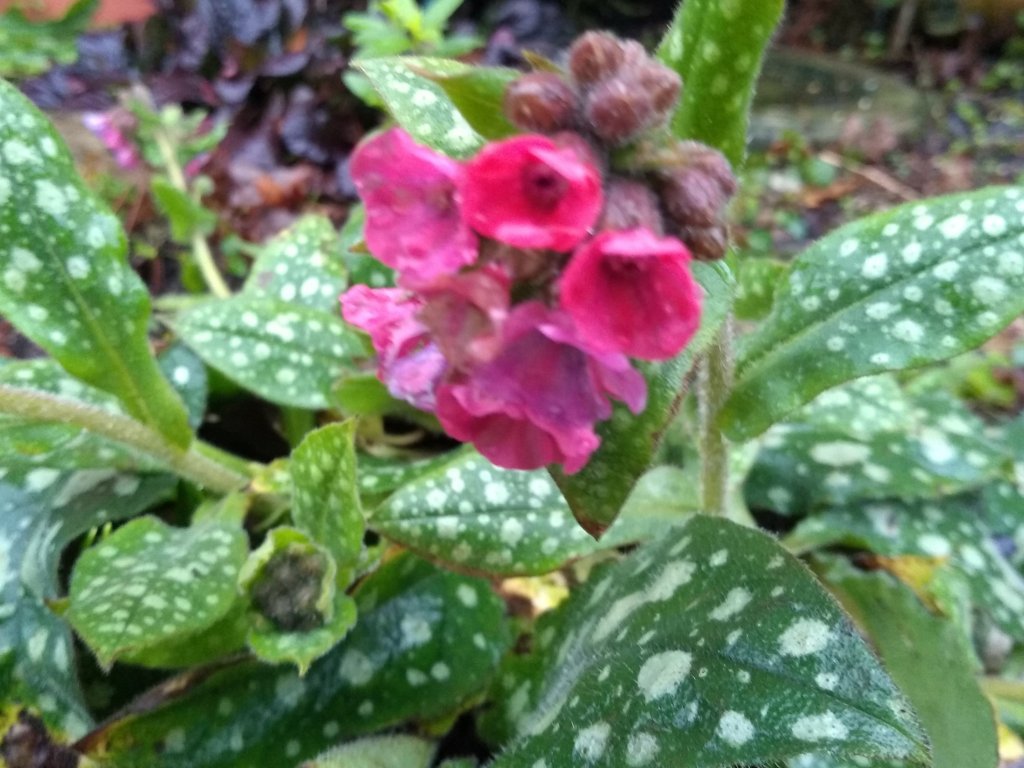
Crocus and

lots of Cyclamen.

Posted in nature

Small Body, Big Voice

Once again, watching birds on my local Rowan tree has become my therapy as I remain inside more.

Last week, along with the usual suspects of Blue tits (Cyanistes caeruleus), Starlings (Sturnus vulgaris), a Robin (Erithacus rubecula) and Blackbird (Turdus merula) was a Song thrush (Turdus philomelos) feasting on some berries as well as a female Chaffinch (Fringilla coelebs) making a pit stop.

Another bird I noticed last week, while working in one garden, was a Wren (Troglodytes troglodytes). I followed a loud bird call towards a hedgerow where I managed to discover this distinctive small bird. It was wonderful being able to connect the call to a Wren; partly because I didn’t recognise the call but mainly because I got to see a Wren (highly unusual in itself, as they often hide themselves away). I wasn’t sure why it was emitting an alarm call, possibly a cat was on the other side of the hedge, hopefully I wasn’t the reason. Almost as soon I saw the Wren it disappeared further into the hedge; my fleeting glimpse ended. The Wren alarm call can be heard on the following link British birdsong.

Posted in nature

National Tree Week (23/11/19-01/12/19)

Meteorological winter has begun. Rather appropriately Autumn turned wintery yesterday as we had a very cold and frosty start to the morning. Apparently it was the coldest night since February.

National tree week ends today too. Started by the Tree Council in 1975 it’s a time to focus on the importance of tree planting along with celebrate these amazing plants. The week coincides with the best time of year to plant trees. This time round there has been a specific emphasis on promoting the usefulness of trees in combating climate change (by pollution and carbon dioxide absorption).

I have planted many trees in the past, however last week the main job continued to be leaf collection.

A little momento of some beautiful leaves.

While most trees shed leaves consistently over a period of time, in my experience, leaf drop of English/ Pedunculate Oak (Quercus robur) and European Beech (Fagus sylvatica) tends to occur in one go at the end of Autumn. This has certainly been true this year, as we collected huge amounts of leaves from large Oak and Beech trees in many gardens; their beautiful rich autumnal colours like carpets on the ground.

Both these deciduous trees are from the Fagaceae family which explains their similarities. Both grow to great heights, have dense canopies and can exhibit marcescence (where some dead leaves are retained on the trees throughout winter).

Both trees are great for wildlife too. Beech nuts are eaten by Deer, Badgers (Meles meles), Grey squirrels (Sciurus carolinensis), Mice, Chaffinches (Fringilla coelebs) and Brambling (Fringilla montifringilla). Even the foliage is food for caterpillars of several species of moth like the Barred hook-tip (Drepana cultraria) and Olive crescent (Trisateles emortualis). Beech trees create a vital habitat for butterflies along woodland edges as well; including Orange-tip (Anthocharis cardamines) and Gatekeepers (Pyronia tithonus). Plus ectomycorrhizal truffle fungi grow beneath them. Turned into hedges, Beech can also create a habitat for birds.

As with the European Beech, the Pedunculate Oak supports a variety of fungi, animals, birds- particularly Jays (Garrulus glandarius) and insects such as Stag beetles (Lucanus cervus)
and the Purple hairstreak (Neozephyrus quercus) and Purple emperor (Apatura iris) butterflies. In fact of all the native British trees the Pedunculate Oak supports more wildlife than any other tree. Even its leaf litter and dead wood is full of life. I love these wonderful trees, especially ancient oaks. I enjoy thinking of all the hidden life existing alongside me as I work in the gardens. Also they are wonderful trees to hug. 🌳🤗