It was nice to notice a moth last week after a long absence, especially as Moth Night was held between 8-10th July in 2021. Each year Atropos, the Butterfly Conservation and the Centre for Ecology & Hydrology organise a citizen science moth recording event while celebrating these wonderful beautiful creatures. More information on Moth night can be found at Moth night.
With a wingspan of 18-25 mm, the moth I saw on Tuesday was a Garden carpet moth (Xanthorhoe fluctuata).
This common moth can be found from April to September, in many areas of the UK but particularly in gardens and allotments. Although this moth flies during the night, as with my sighting last week, they can be discovered at rest on buildings during the day.
The caterpillars of the Garden carpet will eat through Garlic Mustard (Alliaria petiolata), Shepherd’s-purse (Capsella bursa-pastoris), wild Horse-radish (Armoracia rusticana), Hairy Bitter-cress (Cardamine hirsuta) along with cultivated cabbages amongst other plants.
A useful moth ID app that I use a lot is ‘What’s Flying tonight’ produced by the Butterfly Conservation, UK moths and the Centre for Ecology & Hydrology.
While I mostly witness nature in amphibian, insect or plant form, just occasionally I get to see mammals too.
Last week I briefly observed two adult Hares (Lepus europaeus) as I traveled from a job; a garden at a house surrounded by farmland.
They were out in an open field some distance away from the driveway, yet close enough to be able to appreciate their size as well as distinguish the black tips on their long ears along with their distinctive hind legs.
As Hares are usually seen alone, I’m guessing these two were a pair. Perhaps aware of the movement of the electric vehicle, one suddenly crouched down as the other sat bolt upright alongside it. It was lovely to witness these two together in this way. Previously, I’ve only ever seen one Hare far in the distance running across an open field, presumably after being disturbed.
Hares are the UK’s fastest mammal, when disturbed they have a top speed of 45 mph and move in a zig zag formation.
While mostly solitary, these mammals occasionally live apart from one another in loosely connected groups. This explains why, in early spring, when two Hares are seen ‘boxing’ they’re not two males fighting for dominance but actually a female fighting off a male.
Their preferred habitat is a combination of farmland or undisturbed grassland surrounded by woods; enabling easy access to grass and crops for food while giving some protection.
Rather than burrows, Hares live in a form (an exposed depression on the ground). They remain close to their form during the daytime, becoming more active and feeding at night. The two I saw must have been in their form. I wonder if they had a litter? Hares can have three to four litters within a year (between March and July) giving birth to two- four leverets each time. Hares can live for up to four years.
There was one other prominent sighting from last week, that of a Angle shades Moth (Phlogophora meticulosa). I noticed it on Thursday, resting on the milk bottle carrier as I collected my milk delivery.
This is the moths I see more than any other, perhaps because I am surrounded by the perfect habitat for them; a mixture of gardens, parks, woodland and hedgerows containing an abundant food source for their caterpillars. Angle shades caterpillars will feed upon Common Nettle (Urtica dioica), Red Valerian (Centranthus ruber), Broad-leaved Dock (Rumex obtusifolius), Bramble (Rubus fruiticosus) and Hazel (Corylus avellana). As this is a night flying moth, I carefully transferred it to the nearby wall where it could gain shelter from the daylight.
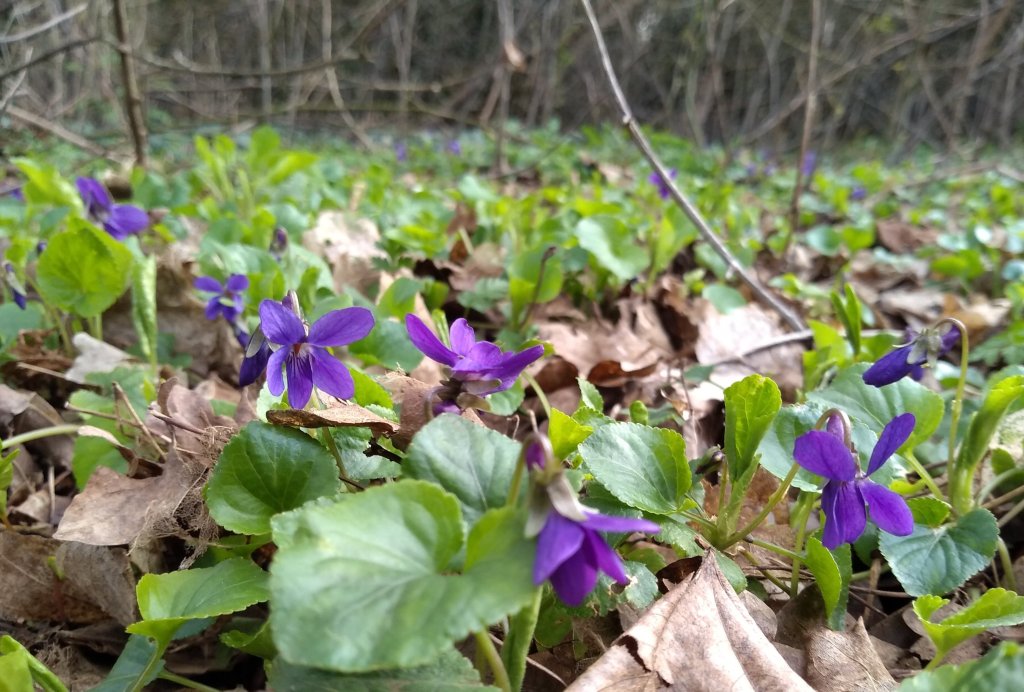
The Common Dog Violet (Viola riviniana) has begun to bloom, both in the wild (in woodlands, heaths and amongst hedgerows) as well as gardens.
This splash of purple usually arrives in April and lasts until June. If you are lucky, you may notice certain Fritillary butterflies feed from and lay their eggs on this plant (a spectacle I’ve yet to witness).
Willows were blooming last week too. There is one mature Goat Willow (Salix caprea) that I see regularly as I work. Another common name for the Salix caprea is Pussy willow, due to the male catkins resemblance to cats paws before they bloom.
Only males catkins turn yellow once they open.
Willow trees are dioecious; therefore females catkins, grow on separate trees to the male ones. Unlike the male catkins shown above, female ones are green and longer in length. Catkins appear on the trees before the leaves do.
So many catkins were open that the tree seemed alive with the sound of bees.I love the reddish tinge in the bark.
I am not sure how old this specific tree is but the species can live for about 300 years and grow up to 10 meters tall. The specimen in the garden I work at has definitely reached it full height.
The Kilmarnock willow (Salix caprea ‘Kilmarnock’) is a much smaller version of the Goat willow tree (grafted onto a dwarfing rootstock). I often see this tree in gardens and they were blooming last week too.
Unlike its larger counterpart, the Kilmarnock willow is a great addition to the average sized garden as it too is loved by bees.
The pollen covered Buff-tailed bumblebee pictured here clearly enjoyed visiting the male catkins on this Kilmarnock willow.
Goat willow trees are usually found in woodland, hedgerows and scrub, especially near waterways such as lakes, streams and canals.
Willows are a fantastic source of pollen and nectar for bees and other pollinators. They’re also a good food source for Sallow kitten (Furcula furcula), Sallow clearwing (Synanthedon flaviventris), Dusky clearwing (Paranthrene tabaniformis) and Lunar hornet clearwing (Sesia bembeciformis) moth caterpillars too. Even birds forage for insects amongst their branches.
As the wood burns well it is used to make charcoal. Plus it’s also used for wattle in timber frame houses.
My favourite fact is that the words witch, wicked and Wiccan are derived from Willow.
Traditionally, it was used to help treat toothache by chewing the bark and used to relieve diarrhoea, arthritis, sore throats, stop bleeding and clean wounds. In fact Aspirin, derived from salicin, was sourced from Willows.
The bacteria Brenneria salicis can cause Watermark disease in Willows which causes dieback and eventual death to the trees if left untreated.
If you are looking to add a small tree to your garden, the Kilmarnock willow is definitely worth looking into; unless you have a large garden then choose a mature male Goat willow instead (the bees will thank you for it).
The Silver birch (Betula pendula) is from the Betulaceae family, just like Hazel (Corylus) and Alder (Alnus), which also have flowers in the form of catkins (see my previous two posts A Snowy Adventure and The Birds and the Trees).
At the moment only the immature male catkins are visible (as they have been since autumn) dangling at the end of tree shoots.
Silhouette of male catkins on the ends of high branches.
Female Catkins develop after the leaves unfurl in spring. They face upwards, are bright green and smaller than the male ones; flowering between April and May. Unlike the fertilized Alder catkins these do not become woody and remain on the tree for seeds to disperse from there. Instead seed dispersal occurs as the female catkins disintegrate and are carried away by the wind as they fall from the tree.
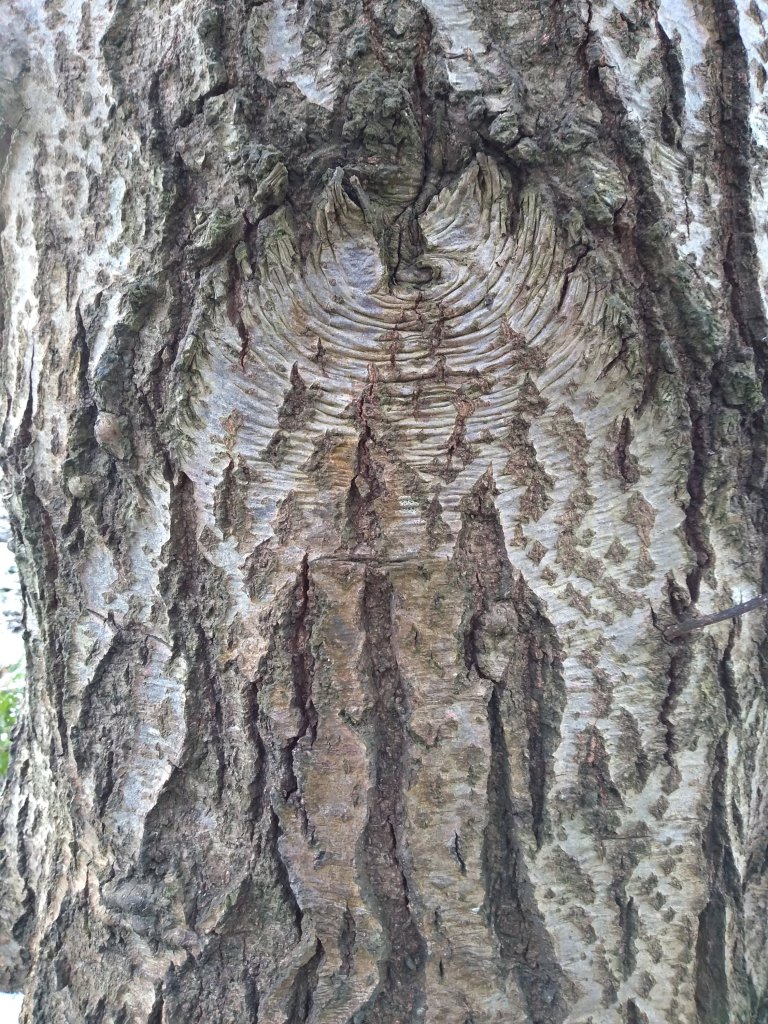
The paper like white bark of the Birch sheds to uncover newer, cleaner bark underneath; plus dark diamond shaped fissures develop as the tree ages.
Fissures developing on the trunk of a Silver birch from my local woodland park.
Two birch trees are native to the UK, the other is the Downy birch (Betula pubescens). It is possible for these to hybridize with one another however individually they can be differentiated. The Downy birch has hairy, single-toothed leaves and hairy shoots (which is how it gets its name); plus the leaf base is rounder. The leaves of the Silver birch are more angular, double toothed around the edges and hairless (the shoots are also hairless). The Downy birch also prefers damper soil than the Silver birch but both are naturally found in woodlands.
The Silver and Downy Birches have open canopies allowing flowers such as violets (Viola), Primrose (Primula vulgaris), Bluebells (Hyacinthoides non-scripta) and Wood anemone (Anemone nemorosa) to florish beneath them. Several fungi are linked with Birch trees too, such as Fly agaric (Amanita muscaria), Woolly milk cap (Lactarius torminosus), Birch milk cap (Lactarius tabidus), Birch brittlegill (Russula betularum), Birch knight (Tricholoma fulvum) and the Birch polypore (Fomitopsis betulina).
These trees can support over 300 insect species. They are a good food source for the caterpillars of Angle-shades (Phlogophora meticulosa), Buff tip (Phalera bucephala), Pebble hook-tip (Drepana falcataria), and Kentish glory (Endromis versicolora) moths. Several Bird species make use of these trees including woodpeckers (Picidae), which nest in the trunks, along with Siskins (Spinus spinus), Greenfinch (Chloris chloris) and Redpolls (Acanthis) that feed on the seeds.
Uses for Birch trees include the manufacture of furniture, handles and toys as well as the process of tanning leather.
In times gone by it was used to make bobbins, spools and reels for the Lancashire cotton industry as well. To the Celts Birches symbolised purity, renewal and love. Later on brooms were made using birch twigs in order to clean rooms. In Finland they are the national tree.
There are several threats to Birch trees, two fungal pathogens (Marssonina betulae and Anisogramma virgultorum) whichcan cause Birch dieback and eventual death. Bronze birch borer (Agrilus anxius) can also attack native trees. More information on both can be found on the Forest research website, see the links Birch dieback and Bronze birch borer.
On the 31st January, I undertook the RSPBs Big Garden bird watch. Most birds, I’d normally see, were clearly hiding but I did notice some within the hour. Those birds I saw were; 1 Carrion crow (Corvuscorone), 2 Robins (Erithacusrubecula), 1 Coal tit (Periparusater), 1 Blackbird (Turdusmerula) and 2 Mistle thrush (Turdus viscivorus). I enjoy taking part in this citizen science project each year; it’s interesting to see how the results differ each time.
Due to the frozen ground last week, I was still able to go for my regular exercise in the local woodland park. Various tree species were waking up from their winter sleep. Beech (Fagus) and Oak (Quercus) had started budding while others were developing catkins.
Last years leaves and new buds on a Beech tree.Old Oak leaves alongside new buds.
As well as the Hazel (Corylus avellana) other trees had catkins hanging from them too. Hazel catkins are the earliest to flower in the year, from January to March (see my previous post A Snowy Adventure).
Then the Alder (Alnus glutinosa) is the next tree to bloom with both male and female catkins. The male catkins are longer than the female ones which flower from February to March. Also hanging from the Alder trees were some small dark brown shapes. These woody cone-like fruit develop from the previous seasons fertilised female catkins; these can remain on the tree (even when the seeds have been shed) well into the following year alongside the newly formed catkins. I also noticed leaf buds growing on the trees last week too. When the buds burst, I shall update the Woodland trust Nature’s calendar with my findings.
Unfortunately I was unable to capture decent photos on location so I collected part of a fallen branch to take home.
One small female catkin above a group of larger male catkins. On the tree (before fertilisation when they develop into the rounder, woody fruit) the female catkins point upwards while the male ones hang down. A magnified view of two unfertilised female catkins.A leaf bud with one of last years fertilised female catkins.A magnified view of the Alder tree seeds that had remained in last seasons female catkin.
I find Alder trees fascinating and the rough, fissured bark beautiful.
Alder are native to Britain and found on wet land, next to water or in marshes and woodlands. They naturally thrive in moist conditions although can also grow in drier areas such as the edges of mixed woodland. Alder wood is durable when wet and actually becomes stronger rather than rot when submerged in water; a characteristic that makes them useful in flood mitigation, boat building, sluice gates, and even the construction of Venice which is mostly built on Alder piles. Alder wood is also used in the creation of charcoal, gunpowder and making clogs.
The pale wood turns a deep orange colour at the point at which it’s cut (while the rest of the wood remains pale); leading to a superstition, in Ireland, that it was bad luck to walk past an Alder tree on your travels. However, traditionally alder branches were also taken into houses to prevent Woodworm. Alder wood is particularly liked by various species of beetle larvae (collectively referred to as Woodworm). It is hoped that the beetles will lay eggs in the Alder rather than the furniture or fixtures; the branches once infested can then be removed.
There is also a traditional use for Alder flowers as a green dye; believed to be used as camouflage by outlaws like Robin hood and fairies.
For fun, I looked up Alder wands used in the Harry potter series. Only one is mentioned, that owned by Quirinus Quirrell. The wands qualities are described on the Wizarding world website.
The roots of Alder are nitrogen fixers. Nitrogen from the air is fixed into the soil, replenishing the levels and aiding soil fertility, through the bacterium Frankia alni.
As well as improving soil, Alder are great for wildlife too. The seeds are eaten by Redpoll (Acanthis flammea), Siskin (Spinus spinus) and Goldfinch (Carduelis carduelis). The leaves are food for the caterpillars of the Alder kitten (Furcula bicuspis), Pebble hook-tip (Drepana falcataria), Autumn green carpet (Chloroclysta miata) and Blue-bordered carpet (Plemyria rubiginata) moths. Bees visit the catkins for an early source of nectar plus Alders provide habitats for the Checkered skipper (Carterocephalus palaemon) butterfly, Small pearl-bordered fritillary (Boloria selene) butterfly, some species of Crane fly, Otters (which create nests amongst the roots) along with mosses, lichens and fungi that like damp conditions.
However, these trees are also threatened through infection by the Phytophthora fungus (together with some other broadleaf tree species). In Alder this disease is referred to as Alder dieback and eventually causes the death of any infected tree. For more information see the Forest research website. There aren’t many Alders in my local woodland park compared to other tree species so it would be sad to see them disappear. Given my newly acquired knowledge I will keep a special lookout for any ill health in these trees; thankfully no infection is being exhibited at the moment.
Last week I began hearing the male Tawny owls (Strix aluco) territorial call as I fell asleep and again when I awoke. Usually this starts from late autumn and continues throughout winter (see BTO). Whatever the reason for him asserting his territory early, it was lovely to hear that sound return from last winter. Yet this wasn’t the only spectacle I noticed last week.
Last Wednesday, as I cut back spent Lavender, I became aware of something flying past me. I continued to watch until the insect stopped to gain nectar from some Red Valerian (Centranthus ruber); It was a Humming-bird Hawk-moth (Macroglossum stellatarum). As this was my first sighting of this superb moth, I found it impossible to maintain my composure as I hurriedly fumbled for my phone. Unfortunately it was too quick for me to photograph as it flitted between flowers, not resting as it fed. It did return momentarily but I was still unable to gain photographic evidence before it flew away once again. A visual guide can be seen on the Butterfly Conservation website. For further information on Red Valerian see the RHS website.
Apparently it is possible to hear it buzz as it flies, due to the quick movement of it’s wings; sadly all I could hear were builders working nearby.
Occasionally this daytime flying moth can be observed at other times of the year but traditionally it is seen between June and September. It usually migrates to the UK from the continent but in milder winters can overwinter in this country; in sheltered areas such as crevices, holes within trees and outbuildings.
It obtains nectar from a variety of plants in gardens, woodland edges as well as heathland on very warm sunny days. Along with the Red Valerian I noticed this one visit these moths can be seen amongst Honeysuckle (Lonicera), Jasmine (Jasminum), Buddleja, lilac (Syringa), Escallonia, Petunia and Phlox. While the caterpillars only feed on Wild Madder (Rubia peregrina) and Red Valerian along with Lady’s (Galium verum) and Hedge Bedstraw (Galium album).
Last week began with me spotting a Grey heron (Ardeacinerea), presumably trying to catch fish while standing in the local river, as I walked passed to the first job of the day.
Yet the rest of the week remained fairly quiet until Friday morning arrived.
This is when I saw a Swallow tail (Ourapteryx sambucaria) moth.
As the moth ages it’s cream coloured wings lighten.
This one had been disturbed because they are night flying moths. The caterpillars overwinter in tree bark, and feed on Broadleaf trees such as Hawthorn (Crataegus monogyna) and Horse Chestnut (Aesculus hippocastanum) along with Ivy (Hedera helix).
Afterwards, at my allotment on Saturday I noticed a Parasitic wasp (Hymenoptera) on my Echinacea purpura PowWow wild berry, although I’m not sure which one.
There are 40 families of parasitic wasp in the UK and Ireland, from which 6,500 species have been recorded. I am pretty convinced that the one I saw wasn’t the Braconid Dinocampus coccinellae which causes the host, a dead Seven-spot ladybird (Coccinella septempunctata), to remain in situ over the wasp’s pupa cocoon as protection until it hatches. Nor does it appear to be Cotesia glomerata. This parasitic wasp lays it’s young in Large white (Pieris brassicae) caterpillars which dies as the young develops. Once they emerge they cocoon themselves beneath the caterpillar until they finally transform into adult wasps. I have Seven-spot ladybirds as well as Large white caterpillars at my plot but neither appear to be affected. Interestingly parasitic wasps can become hosts themselves. The parasitic wasps of parasitic wasps are called hyperparasoids.
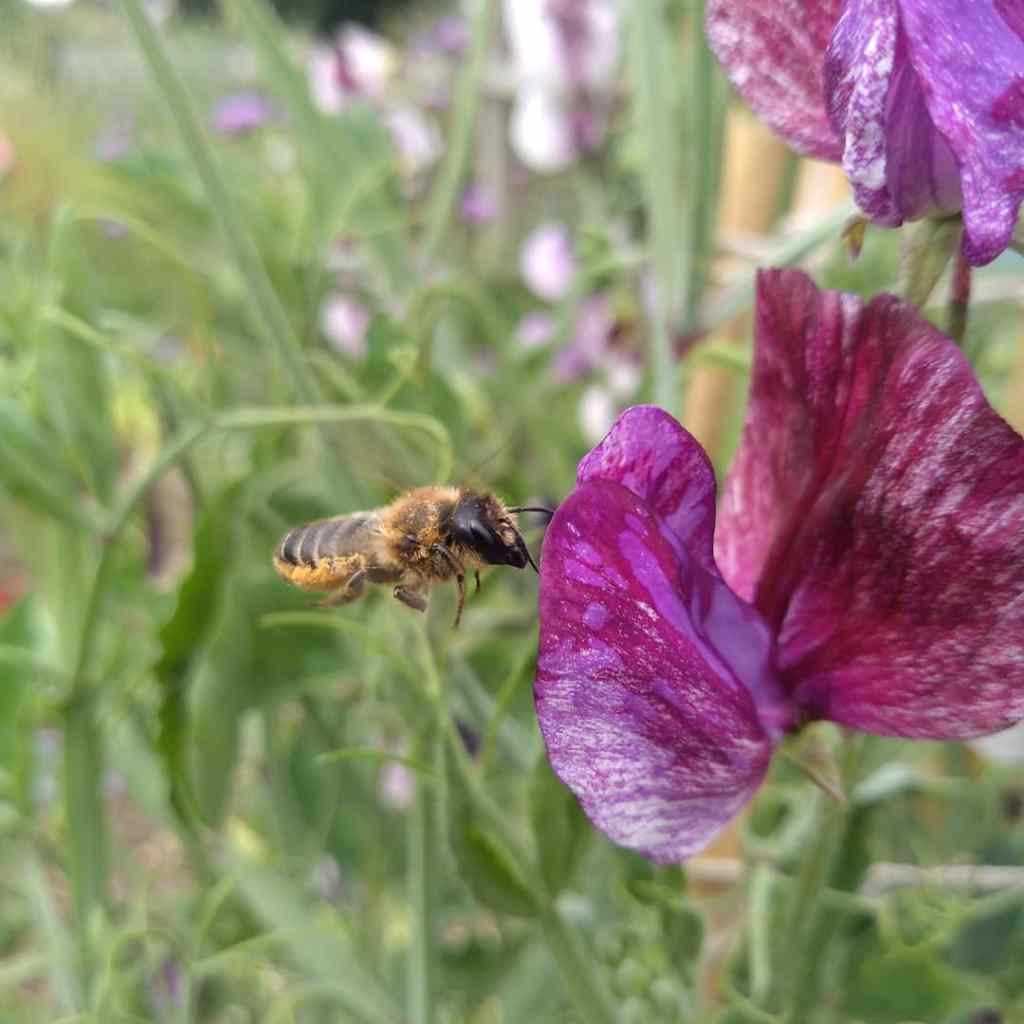
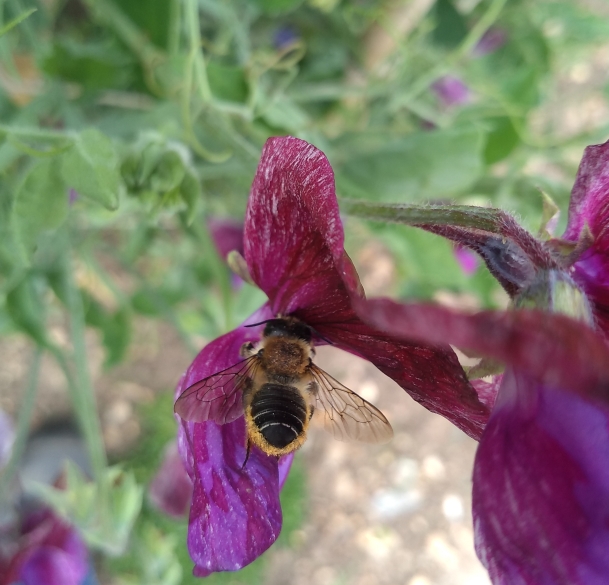
However this wasn’t the highlight of my week. Also at the allotment on Saturday I finally got to see a Leaf-cutter bee. I was so excited to see this spectacular sighting but had to stay quiet and still while I attempted to capture a photo of it.
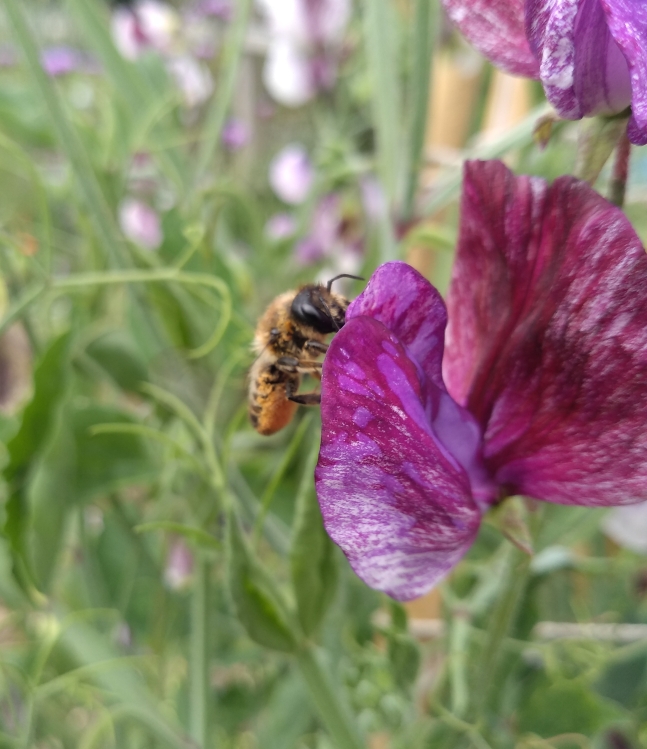
There are different Leaf-cutter bees in the UK but the one I saw was a Patchwork Leaf-cutter (Megachile centuncularis) bee. It was visiting my sweetpeas, collecting pollen and nectar for her young. The orange pollen brush underneath the abdomen clearly identifying it as a female of this species. The only thing left on my must see list, when it comes to Leaf-cutter bees, is to see one carrying a piece of leaf and also a nest. I do have a bee hotel on the allotment so here’s hoping.
Last week began with Spring bank holiday monday. I went for a socially distant walk around the village with my partner. Thankfully he was very patient as I constantly stopped to take photos with my phone.
There were lots of sights and sounds to observe and it really felt like a summers day (which aren’t far off). Some I have noticed for a while like Orange-tip Butterflies (Anthochariscardamines), Red-tailed bumblebees (Bombuslapidarius), Skylarks (Alaudaarvensis), Red kites (Milvusmilvus) and House sparrows (Passerdomesticus).
Yet amongst the Elderflowers (Sambucus nigra) and Brambles (Rubus fruticosus), which are blooming at this time of year,
These flowers are great for making Elderflower cordial.Looks like there will be lots of Blackberries this year.
were many more plants flowering too. The explosion of colour within our countryside is fantastic for pollinators. One insect I saw on Mondays walk, in a field busily pollinating Buttercups (Ranunculus), was the False oil beetle (Oedemeranobilis). This very small beetle is a vibrant metallic green colour. When it’s wings glistened in the sun, they changed from mid to light green.
Unfortunately this is the best photo I managed to get of this tiny beetle.
Upon my return to work, I noticed other insects flying about. Several small tortoiseshell Butterflies (Aglaisurticae) were too quick for me to photograph, however I did capture Common carder bees (Bombuspascuorum) on Common comfrey (Symphytumofficinale) and
a Cream Spot Ladybird (Calviaquattuordecimguttata)
Once again, another ladybird determined to get my attention by falling on my sunglasses while I wore them.
The Cream Spot ladybird has fourteen spots and survives winter in tree bark and Beech masts. Although it is usually found amongst hedgerows rather than gardens.
Wildflowers that were in full bloom last week were;
-Purple toadflax (Linariapurpurea),
-Field scabious (Knautiaarvensis),
– Common stork’s-bill (Erodiumcicutarium),
This plant is a good food source for Brown argus Butterfly (Aricia agestis) caterpillars, along with Meadow and Dove’s-foot Crane’s-bills (mentioned below). This butterfly is often found in southern chalk and limestone grassland but it can also inhabit places with disturbed soil like verges and coastal areas. In fact this plant was found on disturbed soil edging a field.
-Meadow crane’s-bill (Geraniumpratense),
-Creeping cinquefoil (Potentillareptans),
-Common poppy (Papaverrhoeas),
-Dove’s-foot Crane’s-bill (Geraniummolle),
-Field bindweed (Convolvulusarvensis),
-Common mallow (Malvasylvestris),
-Creeping woodsorrel (Oxaliscorniculata),
-Birds-foot trefoil (Lotuscorniculatus) and
-White clover (Trifoliumrepens).
Found amongst lawns, this is a wonderful food source for the Common blue butterfly (Polyommatusicarus) and some bumblebees
Recent weather conditions have caused dryness within nature that normally exists during summertime. Water is already required and talk of conserving water has already begun to help prevent restrictions later in the year. I shall be interested to see how nature deals with this early warm dry weather, especially with less human disturbance due to lockdown. Will it be another great year for butterflies? I look forward to discovering more as we spring into summer.
“Tell me can you feel it, tell me can you feel it, tell me can you feel it, the heat is on…”
The 80’s song from the Beverly Hills Cop soundtrack with Glenn Frey’s voice, synthesizer and saxophone was my earworm as the temperature soared last week. The temperature increased to around 27°C mid week, which meant lots more insects ventured out as it felt like summer.
I was happy to see my first Red admiral (Vanessaatalanta) butterfly of the year, however my main observations were bees including the Red-tailed bumblebee (Bombuslapidarius) and Honey bees (Apismellifera).
A Red-tailed bumblebee pollinating some geranium.Honey bees visited Nepeta.
Another bee I started seeing last week was the Tree bumblebee (Bombushypnorum). I noticed a nest inside a compost bin as I emptied grass clippings from the mower bag.
I have seen Tree bumblebees nest in bird houses before but not under compost. I made sure I avoided tipping grass onto their home and used the next bin along. I couldn’t help watching them for a little while as I stopped for a breather on the very hot Wednesday.
Moths were prominent throughout the week too. Unfortunately Box tree moth (Cydalima perspectalis) caterpillars and the signs of heavy infestation (foliage that had been eaten and covered with webbing) was noticeably present in several gardens. Therefore, I spent lots of time picking them off buxus topiary and informing clients to keep an eye out for them as well. For more information on this pest see the RHS website.
I discovered this years first sighting of a Silver Y (Autographa gamma) moth.
A Silver Y moth resting on a Heuchera leaf.
This immigrant is one of the few brown moths I can identify easily, mostly due to the clear y markings on it’s forewings but also because of their size and shape. This is a day and night flying moth which can be observed visiting flowers to obtain nectar.
However my most exciting moth sighting was the Lime hawk-moth (Mimas tiliae).
This spectacular large moth is night flying. It’s wingspan is 4.6-7.8cms and it can be found in broadleaf woodland, parks and gardens between May and July. I accidentally disturbed it as I pruned some shrubs under a Lime (Tilia sp.) tree. Thankfully it didn’t seem bothered by the disruption and it was carefully placed back near the lime tree. While adult moths of this species don’t feed, the caterpillars do. Once they have emerged from overwintering pupa, the caterpillars will eat Lime, elms (Ulmus sp.), Alder (Alnus glutinosa), Downy Birch (Betula pubescens) and Silver Birch (Betula pendula), Plane (Platanus x hispanica) along with some Cherry cultivars. This was the first Hawk-moth I have ever seen. There are a few that exist in the UK. The nearest I came to seeing one before was observing caterpillars of the Elephant hawk-moth (Deilephilaelpenor) eating away at some Fuchsia. For more information on these Hawk-moths see the Butterfly Conservation website (Lime hawk-moth and Elephant hawk-moth)
I also saw hoverflies. I am still learning about these insects and learnt another one last week.
The photo above shows a Narcissus bulb fly (Merodon equestris). The maggots eat away at the centre of bulbs from the Amaryllidaceae family. However even though the maggots are a pest, the adult hoverflies are pollinators.
On Saturday night I woke up to a beautiful duet. A pair of Tawny owls (Strix aluco) were calling to one another, reinforcing their territory. The male call sounds like ‘hooo, hu, huhuhuhooo’ while the female gives a ‘keewik’ sound (see BTO).
Tawny owls pair for life and remain in their territory (initially established in winter) throughout the year. Deciduous broadleaf woodland is their traditional habitat but sometimes they live in large gardens and parkland. They nest within tree cavities or nest boxes. Occasionally eggs are laid in February but more often between March and April. While the female is slightly larger than the male, these owls are the same size as a wood pigeon. They feed on small mammals, birds, rodents, fish, frogs, insects and worms. Their UK Conservation Status is Amber as their numbers are declining.
Another bird which caught my eye last week was a male House sparrow (PasserDomesticus). I was leaving the allotment when I observed him collecting nest material before flying off. As with the Tawny owl, House sparrows pair for life and their numbers have also been declining for a while; House sparrows are Red in the UK Conservation Status list. I grew up seeing lots of them but since moving down south, I haven’t seen one for years so this was a wonderful sight. I love these little birds, especially hearing their chattering and chirping in their colonies. Hopefully I will see him and more Sparrows soon.
As the week went on I noticed more flowers blooming in the hedgerows. Wild strawberry, also called Alpine strawberry (Fragariavesca), was the first one I saw.
The fruit of this strawberry can be eaten.
Others I saw were; Bugle (Ajuga reptans),
These flowers are visited by White-tailed bumblebees (Bombus lucorum), Common carder bees (Bombuspascuorum), Silver Y moths (Autographa gamma) alongwith Green-veined white butterflies (Pieris napi).
– Herb bennet/Wood avens (Geum urbanum) and
Grizzled skipper butterfly (Pyrgusmalvae) caterpillars feed on this plant.
– Bush vetch (Vicia sepium).
Bees and other pollinators enjoy these flowers.
I got to see a female Orange- tip (Anthocharis cardamines) butterfly, having seen a male one the other week. Males have the orange tips while the tips on the female’s forewings are black (both have the black spots). The female can be identified apart from other white butterflies by the mottled green and white underwings (also exhibited by the males). Caterpillars of this butterfly feed on Garlic mustard (Alliaria petiolata) and Cuckoo flower (Cardamine pratensis).








 Bee in the Moment