Posted in nature

Things Come in Threes

At least in several gardens last week, things with three leaves appeared as several Trefoils began to flower.

In some lawns the yellow flowering Slender hop clover (Trifolium micranthum) has shown itself along with Red clover (Trifolium pratense).

Slender hop clover
Red clover

Red clover is also called Bee-bread (along with White clover- Trifolium repens) due to its popularity with bees. It’s nectar is especially loved by Common carder bees (Bombus pascuorum), Honeybees (Apis mellifera) and Red-tailed bumblebees (Bombus lapidarius). Red clover, which is less commonly found in nature than White clover, is used for livestock feed and crop rotation (due to its nitrogen fixation abilities). It is also used in herbal medicine to treat respiratory and skin ailments,along with menopausal and PMS symptoms because the flower contains isoflavones. When taken internally, isoflavones become phytoestrogens which has similar affects in the body as estrogen (see Plantlife)

I will have to wait a little longer to see White clover flowering as it blooms from June. However White clover is commonly found in verges and grassland so I’m sure to see some eventually.

Unfortunately I have never spotted a four leaf clover (or five leaved). I am ever hopeful, just for the challenge because they are so hard to spot in the wild.

Several trees are blooming at the moment. Along with Hawthorn (Crataegus monogyna- the May tree flowers referred to in the rhyme ‘Cast ne’er a clout ere May is out’) the Horse chestnut (Aesculus hippocastanum) is also in flower; they have white flowers with a pink tinge.

I also see the Red horse chestnut tree (Aesculus x carnea Briotii) on my travels, both trees have very showy flowers.

It was great to see lots of bees about last week and various species too.

The first type of bee I saw was a Hairy-footed flower bee (Anthophora plumipes) around some forget me nots (Myosotis).

I also noticed lots of Buff-tailed bumblebees (Bombus terrestris),
Honey bees and Early bumblebees (Bombus pratorum) throughout the week too.

This Cotoneaster hedge was alive with Honey bees. Make sure the sound is on to listen to their relaxing buzzing.
The Early bumblebees were also visiting the Cotoneaster flowers.
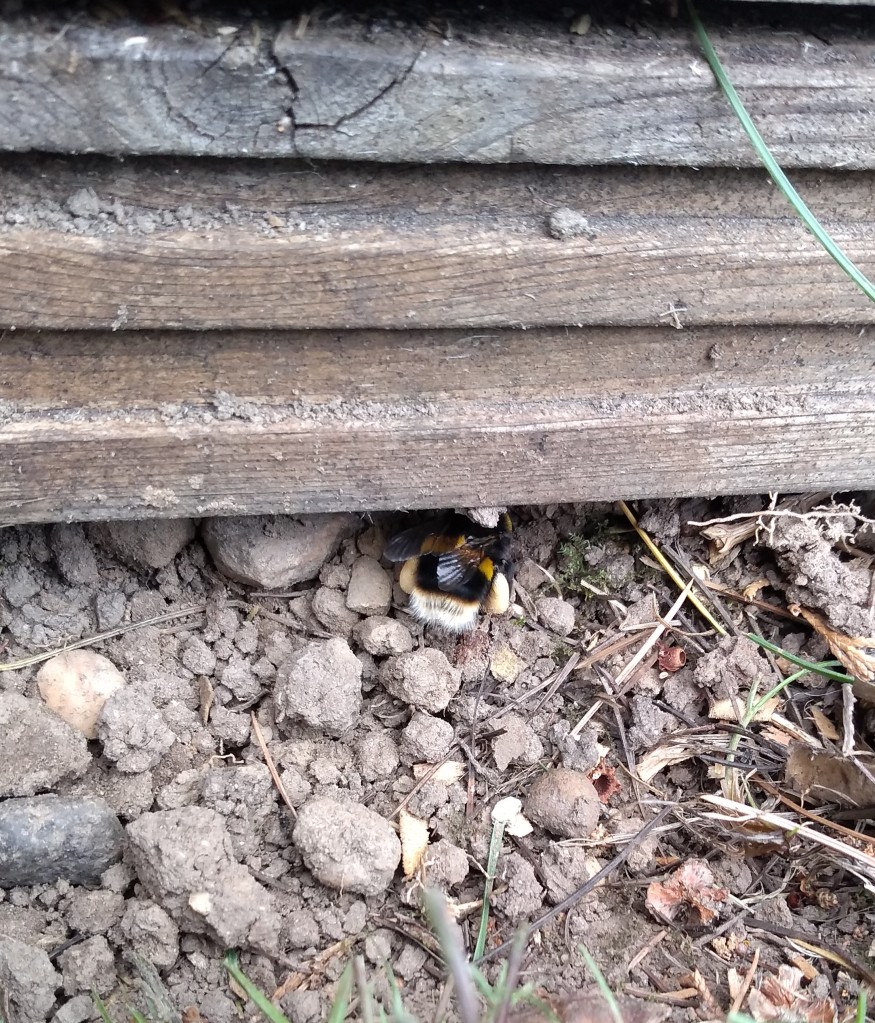
I noticed five Buff-tailed bumblebees coming and going from a nest under some decking in one garden.
Posted in nature

Every Day is a School Day

No doubt due to the recent weather, I have noticed more flowers blooming earlier than their traditional start time of June. One example is the Common nipplewort (Lapsana communis).

The Common nipplewort is part of the sunflower family.

Other plants flowering at the moment are Greater celandine (Chelidonium majus),

This isn’t a relative of the Lesser celandine (Ficaria verna) despite its name. It is part of the poppy rather than buttercup family.

– Three-cornered garlic (Allium triquetrum),

Ants spread the seeds of this wild flower.

– Red campion (Silene dioica),

A dioecious plant, male flowers bloom on separate plants to the female flowers.

– White campion (Silene latifolia),

White campion is pollinated by moths because it is night scented

– Cleavers (Galium aparine),

The flowers of Cleavers are tiny. This photograph has been enlarged so they can be seen more clearly.

– Common honeysuckle (Lonicera periclymenum),

I noticed the sweet scent first. This plant is beneficial for a variety of butterflies, like the White admiral (Limenitis camilla), bumblebees and moths. Birds such as Thrushes (Turdidae), Warblers (Sylvidae) and Bullfinches (Pyrrhula pyrrhula) also eat its berries. Plus Dormice (Muscardinus avellanarius) inhabit and feed on this plant.

– A sow thistle (Sonchus),

– A Hawkweed (Hieracium),

– Mouse-ear Hawkweed (Hieracium pilosella)

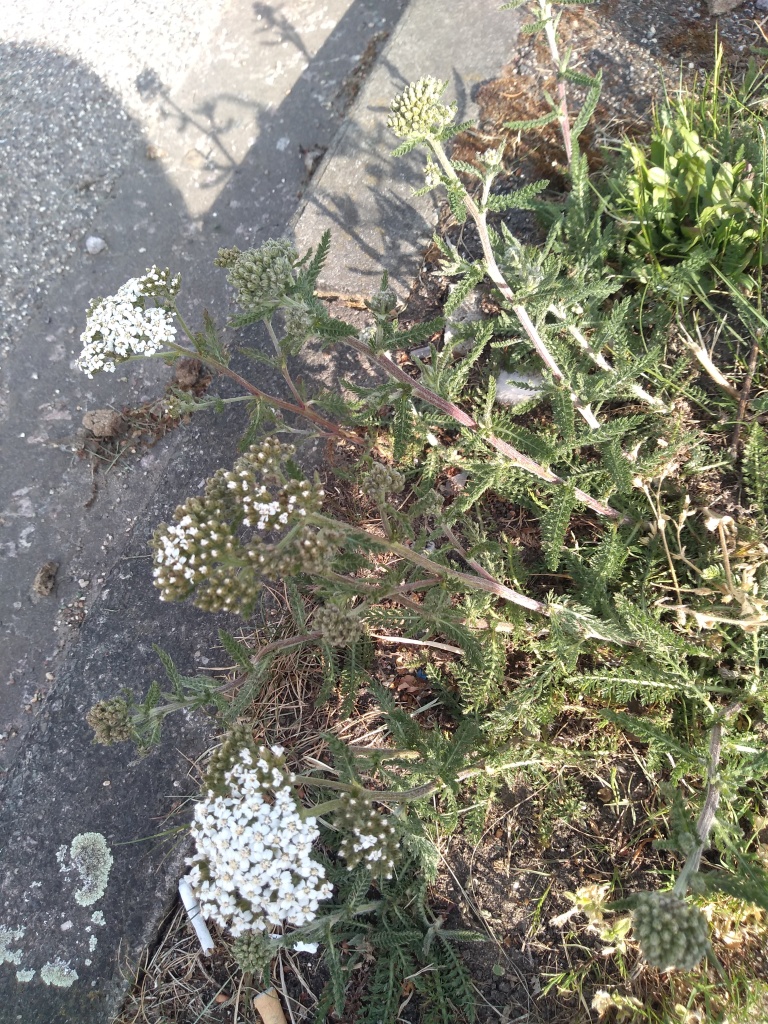
– and Yarrow (Achillea millefolium).

A plant that was new to me was Common knapweed (Centaurea nigra).

Along with all the wild flowers I noticed last week, the warm weather continued to encourage lots of insects out. There were more Holly blue (Celastrina argiolus) and Orange-tip (Anthocharis cardamines) butterflies along with bumblebees.

I also saw a Cinnabar moth (Tyria jacobaeae) at the allotment, amongst the long grass.

This moth flies flies during the day as well as at night time.

The most interesting insect I observed last week was a Pine ladybird (Exochomus qadripustulatus).

I have never seen this species of ladybird before. It dropped onto my sunglasses as I worked. Due to its small size (3mm in length), to begin with I thought it was a bit of dirt. As the name suggests, this beetle inhabits Pine (Pinus) trees. However they can also be found around other trees and shrubs especially Hawthorn (Crataegus monogyna).

Posted in nature

Increased Sunshine to Lift the Spirits.

With an increase in sunnier moments last week the more life is seemed to come out to enjoy the sun’s rays. Amidst these strange times I am especially glad I can enjoy nature therapy. In particular seeing Bumblebees flying around makes me smile. Along with several Buff-tailed Bumblebees (Bombus terrestris), I also saw a Hairy-footed flower bee (Anthophora plumipes) last Wednesday.

A Hairy-footed flower bee visiting Lungwort (Pulmonaria officinalis).
A Buff-tailed Bumblebee (Bombus terrestris) pollinating Winter heath (Erica Carnea).

In fact Wednesday was a very productive day for sightings. I saw my first lacewing (Neuroptera) of the season, which was hitching a ride in the van. I also saw a couple of 7-spot ladybirds (Coccinella septempunctata) amongst some Heuchera

Last week was great for counting frogs (Rana temporaria) too. On Wednesday there were seven attempting to remain shaded by a pile of scaffolding boards in a garden attached to a new build development. Consequently the frogs were moved to a quieter area so that access could be gained to the garden. Even on Thursday, as I worked next to a pond, I observed tadpoles emerge; It was fascinating to see the process unfold. I couldn’t count the total number of tadpoles but the pond was full of them as well as frogspawn; as it had been the previous year. Plus I even found a frog on the allotment.

As well as amphibians and insect sightings, further flowers blooming were,
Glory of the snow (Chionodoxa luciliae)

Anemone apennina and

Two-leaf squill, also called Alpine squill (Scilla bifolia)

Posted in Allotment, nature

‘March’ing into Spring

As with the first of March, this week ended with sunshine; although there have been moments of heavy rain as well. Meteorological Spring has begun and things are certainly waking up in the gardens. My Scilla have started to bloom and the Anemone blanda are looking magestic too.

Scilla
Anemone blanda

Wild flowers are starting to grow now as well; particularly Hairy bittercress (Cardamine hirsuta) and Common chickweed (Stellaria media).

When the sun was out, I noticed bees foraging. I have seen an Early bumblebee (Bombus pratorum) and a few Buff-tailed bumblebees (Bombus terrestris) visiting flowers. Early bumblebees are one of the smallest in the uk and emerge from hibernation in March, before many other species are seen.

A Bombus terrestris visiting a
Spring crocus (Crocus vernus)

I managed to spend Saturday at the allotment. It’s only the second week on a new plot. After an initial viewing the previous Saturday, my partner and I spent five productive hours this weekend; pruning the apple tree, removing grass from the weedsheet covered beds and sorting the compost bins. No Robins (Erithacus rubecula) visited as earth was disturbed but we did have some friendly Jackdaws (Corvus monedula).

Our allotment helpers

I also treated myself, and pollinators, to a Fuji cherry (Prunus incisa) ‘Kojo-no-mai’. It is the only thing flowering on the allotment at the moment (until we start growing cut flowers, fruit, herbs and vegetables) so it looked wonderful blooming in the sun.

Posted in nature

Out and About

I spent a lovely day catching up with friends at Windsor Great Park.

Before setting off I noticed a Common rustic (Mesapamea secalis) moth in the hallway. The caterpillars of his moth feed on grasses and cereal crops.

Upon arrival at the park there was a lovely sight of wildflowers on the banks leading to the entrance.

While walking around we spotted a swan (Cygnus olor), some Mallard ducks (Anas platyrhynchos), a crow (Corvus corone) as well as several wasps (Vespula vulgaris) obviously when we were eating our picnic. However before returning home I meandered round the plant shop. There were some Honey (Apis mellifera) and Bumble bees (Bombus) around the usual suspects like Lavender (Lavandula) and Catmint (Nepeta). However, eventually I saw a Mint (Pyrausta aurata) moth feeding on a Delosperma ‘Jewel of the Desert Grenade’ flower.

This is a day and night flying moth whose caterpillars eat plants such as Mints (Mentha) Catmint, Thyme (Thymus vulgaris).
and Lemon balm (Melissa officinalis).

Posted in nature

Childhood Memories and Hedgehogs

In a week of much needed rain, I remained dry while waiting for the bus on Thursday. I arrived at the bus stop with plenty of time to spare and began to notice the flowers around my feet.

The most prolific were Daisies (Bellis perennis), Dandelions (Taraxacum officinale) and Buttercups (Ranunculus bulbosus). Childhood memories using these in flower based activities came back to me. Buttercups to discover if someone liked butter, Dandelions to tell the time (presumably when we weren’t wearing watches) and Daisies for making daisy chains or discovering if someone loved you (or loved you not).

Daisies remain a favourite flower of mine because seeing them lifts my spirits. Yet the thing I love most about Daisies is that the name means day’s eye (from the Old English dæges-eage) because the petals open up during daylight hours and close as night falls. Even in Welsh they are called llygad y dydd meaning the eye of day. The following photo, taken early in the morning, shows their progress as they open.

Other plants I noticed flowering were;

-Red dead-nettle (Lamium purpureum). This pretty non-stinging plant is good for Garden Tiger (Arctia caja), White Ermine (Spilosoma lubricipeda) and Angle Shades (Phlogophora meticulosa) moth caterpillars which feed on it’s leaves, while the flowers are great for Bumblebees (Bombus) and the Red Mason bee (Osmia bicornis).

-Shepherd’s purse (Capsella bursa-pastoris). The seed pods of this resemble heart shaped purses which contain copper coloured seeds that look like coins.

-Germander speedwell (Veronica chamaedrys). Speedwells at one time were considered a good luck charm for travellers for ‘speedy’ travel as they are often found along verges.

Initially the last plant I saw was unknown to me. It took some time but I eventually discovered that it is Wild Turnip (Brassica rapa).

Hedgehog Awareness Week took place last week (British Hedgehog Preservation Society). It publicises the continued decline in Hedgehog numbers along with information on how to help reverse this. I decided to learn more about hedgehogs at this time by reading ‘The Hedgehog Handbook’ by Sally Coulthard as I travelled by bus. Each chapter gives a monthly account on what hedgehogs are doing and how to help them.
This is a wonderfully informative book contains lots of useful advice that I can put into practice and I loved reading it.